
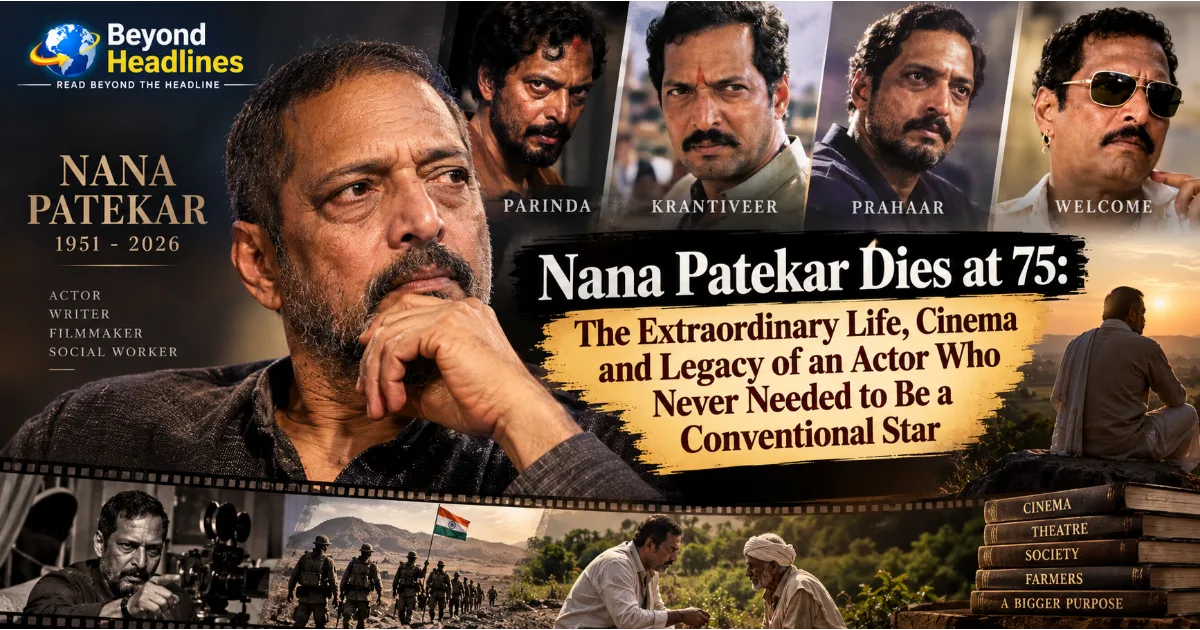
Nana Patekar, one of the most distinctive and respected actors in Indian cinema, died at the age of 75 on October 8, 2026, after suffering a cardiac arrest at his residence in Dona Paula, Goa. He was taken to Manipal Hospital, where doctors attempted to revive him for around 45 minutes, but he could not be saved. The hospital confirmed cardiac arrest as the cause of death, while a medico-legal case and post-mortem process were initiated to establish the medical details surrounding his death. Reuters
The news has sent shockwaves through Hindi and Marathi cinema because Patekar was not simply another successful actor. He represented a particular kind of Indian performer who could move between theatre, serious cinema, mainstream Bollywood, comedy and socially conscious work without losing his individuality.
His death also carries an unusual emotional weight because his last known public appearance came only days earlier. On October 4, Patekar attended an event in Dona Paula, Goa, where he addressed the gathering, interacted with performers and spoke about life, service and mortality. In remarks that have received renewed attention following his death, he reflected on the uncertainty of tomorrow. The Times of India
There was nothing about that appearance that suggested it would become his final public engagement. He appeared active, participated in the event and connected with people around him. Yet only four days later, the country was mourning his death.
That sudden ending has naturally led audiences to look back at his life. But the story of Nana Patekar deserves to be examined as more than a career retrospective. His journey tells us something important about Indian cinema itself, about how acting has changed, about the power of regional theatre and about the possibility of using celebrity influence for causes outside entertainment.
The Final Hours
According to reports from Manipal Hospital and other news organisations, Patekar was found unconscious at his residence in Dona Paula during the early hours of October 8. He was taken for emergency treatment, and medical teams attempted to revive him for approximately 45 minutes. He was declared dead at around 5:20 in the morning. The Indian Express
Reports have also said that Patekar had communicated that he was not feeling well before his condition deteriorated. The exact medical circumstances surrounding the cardiac arrest were still subject to the post-mortem process at the time of early reports.
That distinction is important because sudden death often produces speculation on social media. The responsible account is that the hospital identified cardiac arrest, while the detailed medical findings were to be established through the official procedure.
His final public appearance now carries an entirely different meaning. On October 4, he attended the installation ceremony of Samraat Club International in Goa. Video from the event showed him participating in the programme and interacting with performers. The Tribune
He also spoke about the uncertainty of life. His words were not necessarily unusual in the context of a speech about life and service, but after his death they have understandably become deeply emotional for audiences.
This is one of the strange realities of public memory. Ordinary words can acquire extraordinary meaning after a person's death because audiences hear them with knowledge that was unavailable at the time they were spoken.
A Career That Began With Theatre
Nana Patekar was born Vishwanath Patekar in Maharashtra in 1951. His career began in theatre before he moved into films, and that background became one of the most important foundations of his acting style.
Theatre demands a different kind of discipline from cinema. An actor cannot depend on editing, multiple takes or close-up shots to create an emotional response. The performer has to control voice, body language, timing and emotional intensity while communicating directly with an audience.
Those qualities remained visible throughout Patekar's film career.
He began working in cinema in the late 1970s, with Gaman in 1978 marking an early stage in his screen career. His later work gradually brought him recognition as an actor capable of handling complex and demanding characters. The Indian Express
What separated Patekar from many conventional leading actors was that he did not appear to be interested in fitting a predetermined image.
He did not have the polished appearance traditionally associated with the Hindi film hero. His screen personality could be rough, unpredictable, intimidating or vulnerable. That made him particularly effective in character-driven roles where personality mattered more than glamour.
The Rise of a Different Kind of Actor
Indian cinema has always had extraordinary character actors, but the mainstream industry has historically placed enormous importance on physical appearance and conventional heroism.
The leading man was generally expected to look like a romantic hero. He was expected to be young, attractive and physically impressive. Patekar challenged that formula through the sheer force of performance.
He showed that an actor could dominate a scene without fitting the traditional definition of a Bollywood star.
His voice became one of his most recognizable characteristics, but the voice worked because it was connected to emotional conviction. When Patekar delivered dialogue, audiences often felt that the words were coming directly from the character rather than from a performer reciting a script.
That quality became one of his trademarks.
He could make anger believable without turning it into theatrical shouting. He could make silence uncomfortable. He could make a character appear dangerous without needing elaborate action sequences.
His performances were often intense because he understood that human beings rarely experience emotions in isolation. Anger could contain fear. Confidence could hide insecurity. Cruelty could coexist with pain.
That complexity became central to his acting.
Salaam Bombay! and a Wider Audience
One of the important films in Patekar's early career was Mira Nair's Salaam Bombay!, released in 1988.
The film introduced audiences to a difficult and realistic world involving children living on the streets of Mumbai. It received international recognition and helped demonstrate that Indian cinema could tell socially challenging stories with global impact.
Patekar's involvement in serious cinema during this period helped establish him as a performer who could work effectively outside conventional commercial formulas.
His career was gradually moving toward a space where filmmakers could rely on him for complicated characters.
He was not simply cast because he looked like the hero.
He was cast because he could make the character believable.
That difference would become increasingly important as his career developed.
Parinda and the Making of an Iconic Character
Vidhu Vinod Chopra's Parinda, released in 1989, became one of the defining films of Patekar's career.
His portrayal of Anna was frightening, unpredictable and psychologically complicated. The performance demonstrated the actor's ability to create menace without depending solely on physical aggression.
Anna was not memorable because he was simply a violent criminal. He was memorable because Patekar gave him personality, instability and emotional depth.
The film also became an important milestone in the evolution of Hindi crime cinema.
Patekar's performance earned him the National Film Award for Best Supporting Actor, adding major institutional recognition to the reputation he had already begun building through his performances. The Indian Express
The success of Parinda established something that would remain true throughout his career.
Patekar could enter a film without being the conventional hero and still become one of the most unforgettable people on screen.
Krantiveer and the Power of Dialogue
If Parinda demonstrated Patekar's ability to play a deeply disturbing character, Krantiveer demonstrated how effectively he could carry a film around a forceful central performance.
Released in 1994, Krantiveer gave Patekar a character shaped by anger, social frustration and a desire for justice.
His dialogue delivery became one of the film's major attractions.
But his popularity in the film was not simply the result of loud speeches. Patekar understood how to give emotional history to dialogue. His characters often seemed to have reached a point where they were speaking because silence was no longer possible.
That quality made his monologues memorable.
It also helped establish him as one of the most recognisable dialogue performers in Indian cinema.
The Actor Who Could Move Between Seriousness and Comedy
One of the most impressive aspects of Nana Patekar's career was his ability to change genres.
An actor who becomes famous for intense drama can sometimes struggle to convince audiences in comedy. Patekar proved capable of doing both.
His performance in Welcome introduced him to audiences in a completely different way.
The character was comic, but Patekar's seriousness became part of the humour. He did not need to abandon his intense screen personality. Instead, he used it to create comedy.
This was a particularly clever aspect of his acting.
The audience knew what Patekar's screen presence normally suggested. When that same presence was placed in absurd situations, the contrast became funny.
His performance demonstrated that great comic acting does not always require an actor to become obviously playful. Sometimes the funniest performer in the room is the person who behaves as though the ridiculous situation is completely serious.
A Career That Crossed Generations
Patekar's career lasted for nearly five decades.
That alone is significant.
The Hindi film industry changed dramatically during those years. The parallel cinema movement evolved. The commercial Bollywood formula changed. Television became a major entertainment medium. Multiplexes transformed film distribution. Streaming platforms later created new opportunities for performers.
Through all these changes, Patekar remained recognisable.
Different generations discovered him through different films.
Some audiences remember Parinda.
Others remember Krantiveer, Agni Sakshi, Prahaar or Natsamrat.
A different generation may associate him first with Welcome.
More recent audiences saw him continue to work in films such as Housefull 5, O' Romeo and Subedaar. His continued presence demonstrated that his relevance did not depend entirely on playing young leading roles. Reuters
That is one of the strongest indicators of a lasting performer.
Recognition Beyond Popularity
Nana Patekar was not simply a commercially successful actor.
He was also recognised by India's major institutions.
He won three National Film Awards during his career and received the Padma Shri in 2013. His honours reflected the range and seriousness of his contribution to Indian cinema. AP News
His awards also tell an important story about the relationship between popular cinema and serious acting.
Patekar could work in commercially successful films while maintaining credibility as a performer.
He did not need to choose between popularity and artistic recognition.
His career demonstrated that audiences could embrace an actor whose strongest qualities were not conventional glamour but personality, intensity and character.
Why His Acting Style Was So Distinctive
There are many technically accomplished actors in Indian cinema, but only a smaller number develop a screen presence that can be recognised almost immediately.
Patekar belonged to that group.
His face, voice, physical movement and pauses were all part of his acting vocabulary.
He understood the importance of silence as much as speech.
He could hold a scene without constantly moving.
He could create tension simply by looking at another character.
He could change the atmosphere of a sequence through the rhythm of his dialogue.
These qualities are difficult to separate from personality because great screen presence is partly technical and partly instinctive.
Patekar appeared to possess that instinct.
A Personality That Did Not Follow the Bollywood Template
Patekar's relationship with the film industry was also different from the conventional celebrity model.
He was not known for building his public identity around constant appearances at glamorous events or maintaining the kind of celebrity visibility that has become increasingly common in the age of social media.
His public image was often associated with directness and simplicity.
That did not mean he was disconnected from the industry. He remained a major part of Indian cinema for decades.
But he did not appear to need the conventional machinery of celebrity to maintain relevance.
His films did much of that work for him.
This is particularly interesting today because actors operate in an environment where visibility is almost as important as performance. Social media, brand endorsements, interviews and public appearances can keep celebrities continuously present.
Patekar's career developed largely before that system became dominant.
His reputation was built primarily through performances.
The Importance of Marathi Theatre
To understand Nana Patekar fully, it is necessary to look beyond Bollywood.
His roots in Marathi theatre were central to his development as an actor.
Regional theatre has played an enormous role in shaping Indian performers, but national discussions about cinema often overlook those foundations.
Patekar carried that theatre discipline into Hindi cinema.
His ability to deliver dialogue with precision, maintain emotional intensity and command a scene can partly be understood through his theatrical background.
He also remained connected to Marathi cinema and theatre throughout his career.
His success therefore represented more than Bollywood achievement.
He became a bridge between regional artistic traditions and national popular culture.
The Natsamrat Chapter
Patekar's performance in Natsamrat became another important part of his legacy.
The Marathi film allowed him to return to the world of theatre through the story of an ageing stage actor whose life changes after leaving the theatre.
The role suited Patekar in a particularly powerful way because it connected directly with the themes of acting, ageing, identity and the emotional cost of leaving a profession that has defined one's life.
The film also demonstrated that Patekar's strongest work did not always require elaborate commercial production.
A powerful character and a deeply committed performance could be enough.
That philosophy was consistent with much of his career.
His Connection With the Indian Army
Another unusual part of Nana Patekar's life was his association with the Indian Army.
During the 1999 Kargil War, Patekar received permission to spend time with soldiers near the Line of Control. Reports about that period have become part of his public legacy, particularly because his involvement went beyond the usual expressions of support offered by celebrities during national crises. Reuters
His interest in the armed forces reflected another dimension of his personality.
He was often drawn toward institutions and communities where duty, discipline and sacrifice were central ideas.
That interest later appeared in his social work as well.
From Film Sets to Rural Maharashtra
Perhaps the most significant part of Patekar's life outside cinema was his work for farmers.
In 2015, he and fellow actor Makarand Anaspure spearheaded the formation of NAAM Foundation in response to drought conditions, farmer distress and water shortages in Maharashtra. The foundation describes its work as addressing drought, farmer suicides, water crises and the deterioration of rural communities. Naam Foundation
The organisation has worked on water conservation, agricultural education, restoration of water systems and village development.
That is important because farmer distress is not caused by a single problem.
Water shortages can affect crops. Poor agricultural conditions can affect income. Debt can increase pressure on families. Repeated drought can weaken entire villages.
Addressing such problems requires more than temporary assistance.
NAAM Foundation's work has therefore focused on longer-term interventions, including water management and agricultural development. Naam Foundation
Why NAAM Foundation Matters to His Legacy
The entertainment industry often measures celebrity impact through films, awards and box-office numbers.
Patekar's social work provides a different measure.
The foundation he helped establish created a mechanism through which his public influence could be directed toward rural communities.
That does not mean every social problem can be solved through charitable work. Large structural problems require government policy, institutional support and sustained investment.
But individual initiatives can still make meaningful contributions.
The continued work of NAAM Foundation is therefore an important part of Patekar's legacy because it demonstrates that his public life extended beyond cinema.
He was not simply using his fame to promote a cause.
He helped build an organisation around one.
The Farmer Connection
Patekar's concern for farmers also reflected his connection with Maharashtra.
The problems faced by rural communities were not abstract issues for him.
He repeatedly spoke about farmer distress and drought, and his association with NAAM Foundation made rural development one of the defining elements of his public work.
This created an interesting contrast.
The actor was one of the most recognisable faces of urban Indian entertainment, yet some of his most important social work focused on villages far removed from Mumbai's film industry.
That contrast helps explain why tributes following his death have come not only from actors but also from political and social circles.
The Final Public Appearance
The events of October 4 have received particular attention because they were Patekar's final known public appearance.
At the Samraat Club International event in Dona Paula, he spoke about life and the importance of doing something meaningful for others. He also remembered former Goa Chief Minister Manohar Parrikar, whom he had known personally. The Times of India
Reports and videos from the event show an energetic Patekar interacting with people and participating in the programme.
He was not giving what anyone present would have considered a farewell speech.
That is precisely why the footage has become so emotional after his death.
The audience was watching an actor enjoying an ordinary public engagement.
Only later did it become his final public appearance.
His Words About Tomorrow
Patekar's remarks about not knowing whether he would be there tomorrow have circulated widely following his death.
The statement should not be treated as a prediction.
People often speak about mortality, uncertainty and the temporary nature of life without knowing what is about to happen.
Yet the timing makes the words deeply poignant.
It also fits a recurring theme in Patekar's public personality. He often spoke about the importance of living meaningfully rather than assuming that tomorrow was guaranteed.
His final appearance therefore leaves audiences with a message that is emotional without needing to be turned into mythology.
Life is uncertain.
That was true when he said it.
It simply became painfully clear four days later.
Tributes From Across India
Following his death, tributes came from political leaders, actors and people across the entertainment industry.
Prime Minister Narendra Modi described Patekar as a versatile performer whose memorable roles would continue to be remembered. Other public figures also highlighted his contribution to cinema and his social work. AP News
Maharashtra Chief Minister Devendra Fadnavis also remembered Patekar's contribution to cinema and his work for farmers through NAAM Foundation. Loksatta
These tributes are significant because they reflect the multiple identities Patekar carried.
He was a film actor.
He was a theatre artist.
He was a filmmaker.
He was a public figure.
He was also associated with social work.
Each community remembers a different part of him.
Maharashtra's Decision to Honour Him
The Maharashtra government announced that Patekar would receive a state funeral in recognition of his contribution to Marathi theatre as well as Marathi and Hindi cinema. The Indian Express
The decision reflects the cultural importance of his career within the state.
Patekar's legacy was never limited to Hindi cinema.
His connection with Marathi theatre and cinema remained fundamental to his identity, even after he became a nationally recognised actor.
The state honour therefore acknowledges the full span of his contribution rather than only his Bollywood success.
What Made Nana Patekar Different?
The simplest answer is that he never depended entirely on conventional stardom.
He built his reputation through acting.
That distinction matters.
There are performers who become famous because of their public image and then reinforce that fame through films.
Patekar largely followed the opposite route.
His performances created the reputation.
The reputation then followed him from one generation to another.
His voice became recognisable because audiences heard it repeatedly in memorable characters.
His face became familiar because audiences associated it with powerful performances.
His name became important because his work gave it meaning.
That is a slower form of stardom, but it can be more durable.
The Actor Who Could Make Audiences Uncomfortable
Patekar did not always play characters audiences were supposed to admire.
Sometimes he played violent men.
Sometimes he played angry or broken individuals.
Sometimes his characters were morally uncertain.
This was important because cinema becomes more interesting when audiences are not given simple heroes and villains.
Patekar had the ability to make viewers understand a character without necessarily approving of that character.
That is a difficult acting achievement.
It requires the performer to give psychological depth to people who may behave badly.
Patekar's performances often did exactly that.
His Contribution to Indian Cinema Was Larger Than His Filmography
A filmography is useful for understanding an actor, but it cannot completely measure influence.
Patekar changed the expectations surrounding character actors.
He demonstrated that a performer did not need to look conventional to become commercially successful.
He showed that theatre-trained actors could become major figures in mainstream cinema.
He demonstrated that comedy could emerge from seriousness.
He also showed that a celebrity's public life could include substantial social engagement.
These contributions are difficult to quantify.
They are nevertheless part of his legacy.
The Generational Connection
One of the most remarkable things about Patekar was that his audience continued to renew itself.
People who watched his films in the 1980s introduced his work to younger family members.
Television reruns brought older films to new audiences.
Streaming platforms and digital clips made famous performances accessible to viewers who had never seen them in theatres.
As a result, Patekar's work did not disappear when individual films became old.
His performances continued to circulate.
That is how cinematic legacies survive.
What Happens to His Work Now?
The death of an actor often leads audiences back to their films.
Old movies receive renewed attention.
Dialogues begin circulating again.
Interviews are rediscovered.
Performances are discussed by people who may have forgotten how powerful they were.
Patekar's work is particularly suited to this kind of rediscovery because his career covers so many genres.
A viewer looking for serious drama can discover Parinda.
Someone interested in social cinema can explore Salaam Bombay!.
Another viewer may encounter Krantiveer.
A younger audience member may discover him through Welcome.
A Marathi cinema enthusiast may turn to Natsamrat.
Each route leads to a different part of the same actor.
The Meaning of Longevity
Nana Patekar's nearly five-decade career offers an important lesson about longevity.
The entertainment industry changes constantly.
Actors who dominate one decade can become less visible in the next.
Genres disappear.
Audience preferences change.
New stars emerge.
Technology changes how films are produced and consumed.
Yet certain performers remain relevant because their work contains qualities that do not depend on fashion.
Patekar's acting was one of those qualities.
Intensity does not become outdated.
Emotional truth does not become outdated.
A convincing performance does not become outdated.
That is why his work can continue to matter.
Beyond the Headline
The headline is that Nana Patekar died at 75.
The larger story is about a man who spent almost five decades proving that an actor does not need to fit a conventional mould to become unforgettable.
He began in Marathi theatre and gradually entered cinema.
He moved between serious films and mainstream entertainment.
He played criminals, soldiers, politicians, fathers, artists and comic characters.
He became known for a voice that could instantly change the mood of a scene.
He earned major national recognition and the Padma Shri.
But he also stepped outside cinema.
His association with the Indian Army became an unusual chapter of his life.
His work with NAAM Foundation connected him with farmers and drought-affected villages.
His final public appearance connected him once again with ordinary people in Goa.
These parts of his life cannot be separated if we want to understand his legacy properly.
The Bigger Meaning of His Passing
Nana Patekar's death is also a reminder of how quickly public life can change.
Only days before his death, he was standing on a stage, speaking to an audience and participating in a cultural event.
Today, that same appearance is being watched as his final public moment.
The footage has become part of his legacy.
But perhaps the more important lesson is not the emotional coincidence of his final words.
It is the life that preceded them.
Patekar spent decades working.
He continued acting when many performers of his generation had reduced their screen presence.
He remained connected to theatre.
He remained connected to Maharashtra.
He remained involved in social work.
He continued to engage with audiences.
His career did not end when his peak commercial years ended.
It evolved.
An Actor Who Refused to Become a Brand
Modern celebrity culture increasingly encourages performers to become brands.
An actor may have a carefully designed public identity, social media strategy, endorsement portfolio and lifestyle image.
Patekar's career developed differently.
His brand, if one can call it that, was simply his individuality.
People knew what a Nana Patekar performance felt like.
They knew the voice.
They knew the intensity.
They knew the directness.
They knew that he could surprise them.
That kind of identity is difficult to manufacture because it comes from years of consistent work rather than marketing.
What He Leaves Behind
Nana Patekar leaves behind films, performances, awards and memories.
He also leaves behind a body of social work that will continue through organisations such as NAAM Foundation.
He leaves behind an example for actors who may not fit the conventional image of a star.
He leaves behind a reminder that regional theatre can produce artists capable of influencing national cinema.
He leaves behind characters that audiences will continue to revisit.
Most importantly, he leaves behind evidence that a public figure can build a meaningful life beyond fame.
Conclusion
Nana Patekar's death at the age of 75 marks the end of one of the most distinctive careers in Indian cinema.
He was an actor who never needed to become a conventional Bollywood hero. His greatest strength was not glamour, but presence. It was the ability to make audiences believe that the character standing in front of them had a real history, real anger, real fear and real emotional consequences.
From Marathi theatre to Hindi cinema, from Gaman and Salaam Bombay! to Parinda, Krantiveer, Welcome and Natsamrat, his career crossed genres, languages and generations. He won three National Film Awards and received the Padma Shri, recognition that reflected both the depth and breadth of his work. AP News
But his legacy cannot be measured through awards alone.
His work with NAAM Foundation gave another dimension to his public life. The organisation he helped establish with Makarand Anaspure in 2015 continues to work on drought, water conservation, farming and village development in Maharashtra. Naam Foundation
His connection with the Indian Army during the Kargil period became another memorable chapter.
His attachment to theatre remained strong.
His relationship with Maharashtra remained central to his identity.
And even in his final public appearance, he was speaking about life, people and the importance of doing something meaningful.
His death has therefore created a loss that extends beyond Bollywood.
Indian cinema has lost a remarkable performer. Marathi theatre has lost one of its most recognisable voices. Maharashtra has lost a public figure closely associated with its cultural and social life. Millions of viewers have lost an actor whose performances became part of their memories.
Yet cinema has a strange ability to preserve people.
Nana Patekar will continue to appear on screens.
He will continue to speak through characters he played decades ago.
His voice will continue to echo through scenes that audiences have watched countless times.
New viewers who were not born when Parinda or Krantiveer were released will discover those performances and wonder how an actor could create such intensity without relying on conventional stardom.
That is the strongest form of legacy. A career survives when the work continues to speak after the performer is gone. Nana Patekar's work will do exactly that.
The headline today is about his death. Beyond the headline is the story of a theatre artist who became a national actor, a performer who challenged the definition of a Bollywood star, a man who remained connected to Maharashtra and rural India, and a public figure whose life extended far beyond the film screen.
That is why Nana Patekar's legacy will not be remembered through one character, one dialogue or one award. It will be remembered through the extraordinary range of a life spent acting, creating, questioning, serving and remaining unmistakably himself.
#BeyondHeadlines #NanaPatekar #NanaPatekarDeath #IndianCinema #Bollywood #MarathiCinema #HindiCinema #NanaPatekarLegacy #IndianActors #CinemaLegend #Parinda #Krantiveer #Welcome #Natsamrat #SalaamBombay #NationalFilmAwards #PadmaShri #NAAMFoundation #Maharashtra #IndianFilmIndustry #BollywoodLegend #IndianCinemaHistory #FilmLegacy #MarathiTheatre #KargilWar #IndianArmy #Farmers #RuralIndia #SocialWork #CinemaNews #EntertainmentNews #BeyondTheHeadline