
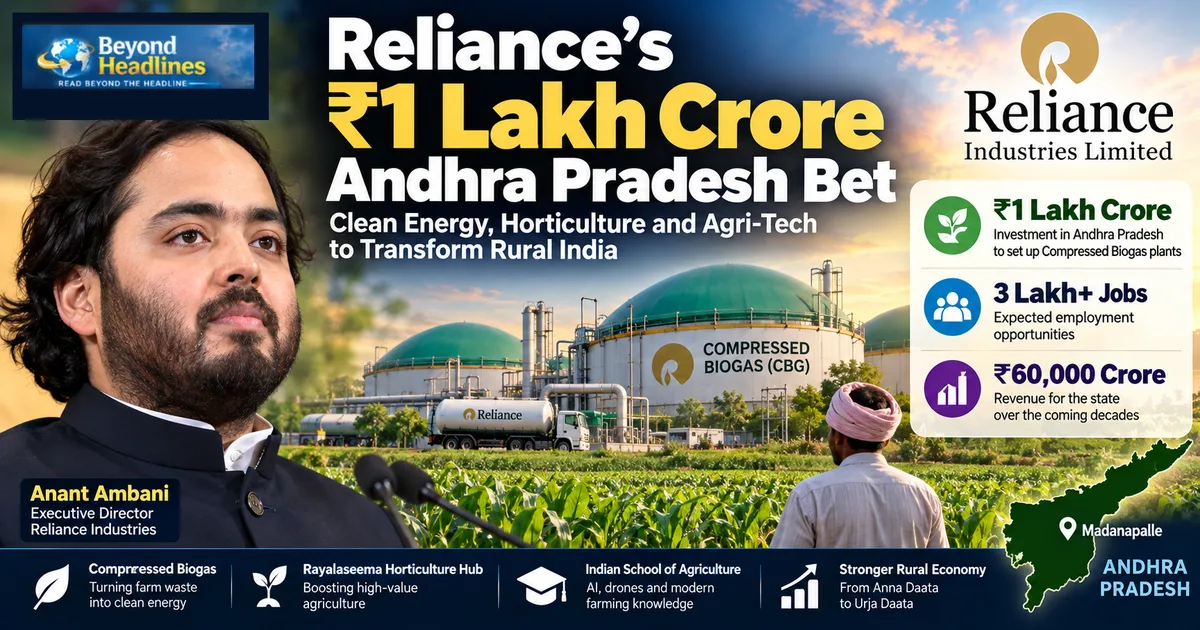
A major investment announcement from Reliance Industries has placed Andhra Pradesh at the centre of a much larger conversation about India's energy transition, rural employment and the future of agriculture.
At a foundation stone laying ceremony in Madanapalle on October 2, Reliance Industries Executive Director Anant Ambani announced that the company plans to invest ₹1 lakh crore in Andhra Pradesh to establish compressed biogas plants. According to Ambani, the proposed investment could create more than 3 lakh jobs and generate nearly ₹60,000 crore in revenue for the state over the coming decades. Business Standard
The announcement came alongside the foundation stone laying for the Rayalaseema Horticulture Hub and the Indian School of Agriculture, two initiatives aimed at changing how agriculture is practiced in one of Andhra Pradesh's historically challenging regions.
At first glance, these appear to be separate announcements. One concerns clean energy, another horticulture and another agricultural education. But there is a deeper connection between all three.
They represent an attempt to connect farmers with energy production, modern technology, processing, markets, education and new forms of rural enterprise.
That is what makes this story bigger than a ₹1 lakh crore investment headline.
The larger question is whether Andhra Pradesh can turn agricultural land, farm waste, technology and rural talent into an integrated economic ecosystem rather than treating agriculture and industry as separate parts of the economy.
The ₹1 Lakh Crore Announcement
Anant Ambani made the announcement while addressing the foundation stone laying ceremony for the Rayalaseema Horticulture Hub and Indian School of Agriculture in Madanapalle.
He said Reliance had received an opportunity from the Andhra Pradesh government to invest ₹1 lakh crore in the state to establish compressed biogas plants.
The proposed projects are expected to create more than 3 lakh jobs and generate nearly ₹60,000 crore in revenue for Andhra Pradesh over the coming decades. Business Standard
The scale is significant, but the announcement needs to be understood carefully.
The ₹1 lakh crore figure is an announced investment ambition. It should not automatically be treated as money already spent or as a completed project.
The number of plants, total production capacity and detailed implementation schedule associated with this latest ₹1 lakh crore announcement have not yet been publicly specified in the same level of detail as Reliance's earlier Andhra Pradesh CBG programme.
That distinction is important because Reliance already had a major CBG investment programme in Andhra Pradesh.
In April 2025, the company announced a ₹65,000 crore plan involving 500 CBG plants across the state. The first plant at Kanigiri in Prakasam district received its foundation stone in April 2025. Reliance Industries Limited
Reliance's latest annual report says the company had 55 CBG plants under development globally, with approximately 0.4 million tonnes of annual capacity, and a target to expand to more than 500 CBG plants by 2030. Reliance Industries Limited
Therefore, the latest announcement should be viewed as a significant new investment commitment or expanded ambition, while the precise relationship between the new ₹1 lakh crore figure and the earlier ₹65,000 crore Andhra programme still requires further clarification.
That is an important detail that can easily disappear behind a large headline.
Why Compressed Biogas Matters
Compressed biogas, commonly called CBG, is produced by processing organic material such as agricultural residue, animal dung, food waste and other biomass.
Through anaerobic digestion and related processing, organic matter can be converted into a methane-rich gas that can be purified and compressed for use as fuel.
The concept is particularly interesting for an agricultural state because it creates a possible economic value chain around materials that might otherwise be treated as waste.
A farmer may see crop residue as something that needs to be removed.
A CBG ecosystem can potentially see the same material as a feedstock.
That changes the economic equation.
Instead of asking only how much a farmer can earn by selling a crop, the system can potentially create additional value from what remains after the crop has been harvested.
This does not mean every piece of agricultural waste can automatically become commercially viable fuel.
Collection costs matter.
Transportation matters.
Feedstock availability matters.
Plant economics matter.
Storage matters.
Technology matters.
But where the conditions are suitable, the concept offers a way of linking agriculture with energy production.
From Anna Daata to Urja Daata
One of the central ideas in Anant Ambani's speech was that farmers who contribute to India's food security can also contribute to energy security.
That is the conceptual heart of the CBG proposal.
For decades, Indian agriculture has been discussed primarily in terms of food.
Farmers grow rice, wheat, fruits, vegetables, sugarcane, cotton and many other crops.
The clean energy transition creates another possibility.
Agricultural land, crop residue and organic resources can become part of an energy economy.
This does not mean food production should be displaced by energy crops.
That would create a completely different set of problems.
The more interesting model is one in which agricultural waste, barren land, livestock waste and other organic resources become inputs into a circular economy.
Reliance's earlier Andhra Pradesh CBG plan provides an example of this approach.
The 2025 announcement said around 500,000 acres of barren and waste land in Prakasam, Anantapur, Chittoor and Kadapa would be used, with Napier grass cultivated on the land to supply biomass for the plants. Reliance said the completed programme would produce CBG and organic fertiliser while creating rural employment. Reliance Industries Limited
That model attempts to connect land, agriculture, fuel and fertiliser into a single system.
The Circular Economy Opportunity
The most interesting part of CBG may not actually be the gas.
It is the possibility of creating a circular economic system.
Organic material enters the plant.
Energy is produced.
The process can also produce organic fertiliser.
That fertiliser can potentially return to agriculture.
Agricultural production generates more biomass.
The cycle continues.
This is very different from a traditional fossil fuel system where fuel is extracted from underground resources, processed, consumed and eventually becomes waste or emissions.
A well-designed bioenergy system attempts to keep biological resources moving through an economic cycle.
It can also create local economic activity.
Farmers can become suppliers.
Transporters can move feedstock.
Workers can operate plants.
Technicians can maintain equipment.
Businesses can provide services.
Farmers can potentially use the resulting fertiliser.
The success of such a system depends on economics and execution, but the underlying concept is powerful.
Why Andhra Pradesh Is Important
Andhra Pradesh has a large agricultural economy, extensive rural areas and significant land resources.
It also has an important geographical advantage.
The state contains multiple agricultural and climatic zones, giving it the potential to develop different types of horticultural and biomass-based economic activities.
But the opportunity is not evenly distributed.
Rayalaseema has historically faced water stress and difficult agricultural conditions.
That makes the region particularly important to the state's development strategy.
Instead of treating Rayalaseema simply as an area that requires government support, the new vision is to create an economic ecosystem capable of generating its own momentum.
The Rayalaseema Horticulture Hub is part of that effort.
The Rayalaseema Horticulture Hub
The foundation stone for the Global Horticulture Hub was laid in Madanapalle on October 2.
The project is designed to expand horticulture and strengthen production, processing, marketing and export capabilities across Rayalaseema.
Reports describe a larger ₹1 lakh crore Global Horticulture Hub plan involving central assistance and private investment, with the objective of increasing horticultural production across eight districts. The plan has been described as potentially expanding horticulture cultivation by around six lakh acres and benefiting thousands of villages through cluster-based development. The Times of India
The horticulture project is therefore not simply about encouraging farmers to grow more fruit.
The real objective is to build the infrastructure around agriculture.
That distinction is crucial.
A farmer can grow a high-value crop and still remain economically vulnerable if there is no cold storage, processing facility, reliable transport, market access or export channel.
Agriculture becomes significantly more valuable when the entire chain works.
Production is only the first stage.
From Seed to Shipment
One of the most important ideas emerging from the Rayalaseema plan is the attempt to connect the farmer to the entire value chain.
Seed selection affects productivity.
Irrigation affects quality.
Technology affects monitoring.
Processing affects shelf life.
Cold storage affects losses.
Packaging affects marketability.
Logistics affects delivery.
Market access affects price.
Exports affect the ultimate value captured by the agricultural ecosystem.
If these pieces are developed together, farmers have a better chance of participating in higher-value markets.
If they remain disconnected, production increases may not necessarily translate into proportionate increases in farmer income.
This is why infrastructure around agriculture can be as important as agricultural technology itself.
The Indian School of Agriculture
The second major announcement at Madanapalle is the Indian School of Agriculture.
The institution is being envisioned as a technology and knowledge centre for farmers and rural communities.
Anant Ambani described it as a place where artificial intelligence and modern technology would meet traditional agricultural knowledge.
The proposed applications include pest prediction, drone-based crop monitoring, precision irrigation, robotics and price intelligence. The Economic Times
That combination is particularly important.
Technology cannot simply be imposed on agriculture from outside.
Farmers already possess enormous amounts of practical knowledge.
They understand soil behaviour.
They know local weather patterns.
They understand crop cycles.
They know how pests behave in their fields.
They understand the practical limitations of irrigation and labour.
Artificial intelligence can process large quantities of data, but it does not automatically understand the reality of a particular village.
The most useful agricultural technology may therefore be technology that combines machine intelligence with farmer experience.
What AI Could Actually Do for Farmers
Artificial intelligence is often discussed at a very high level.
In agriculture, its value may come from much smaller decisions.
A farmer could receive an early warning about a potential pest outbreak.
A drone could identify areas of crop stress.
A system could recommend irrigation based on soil moisture, weather forecasts and crop requirements.
A pricing system could analyse market data and help farmers understand where demand is emerging.
A computer vision system could identify crop disease from photographs.
None of these technologies guarantees higher income.
But they can reduce information gaps.
And information gaps are a major problem in agriculture.
A farmer can lose money not because the crop failed, but because the crop reached the market at the wrong time.
A farmer can lose a crop because a pest problem was detected too late.
A farmer can waste water because irrigation decisions were based on habit rather than data.
Technology can potentially address these problems.
The Importance of Rural Access
There is another challenge.
Building a world-class agricultural technology centre in a city is relatively easy.
Getting that technology into a village is much harder.
This is why Anant Ambani's comments about Jio's involvement are important.
He said Jio would collaborate with the Indian School of Agriculture to deliver training programmes to farmers in Indian languages through virtual classrooms in villages.
The idea is to take knowledge to farmers rather than expecting every farmer to travel to a central institution. The Economic Times
That approach could become critical.
India has enormous linguistic diversity.
Agricultural knowledge is most useful when it is understandable and locally relevant.
A farmer should not need advanced English proficiency to benefit from precision agriculture.
Nor should technology require expensive equipment that only large farmers can afford.
If agricultural technology is going to transform rural India, accessibility will matter as much as innovation.
Jio Krishi and the Digital Agriculture Layer
Reliance has already developed Jio Krishi, a platform aimed at providing digital tools and services for farmers.
The company has also established a bioenergy research and development centre in Jamnagar, according to Anant Ambani's remarks. The Economic Times
This provides a clue about how Reliance may be thinking about the larger opportunity.
The company is not simply investing in one factory.
It is building capabilities across multiple parts of the agricultural and energy ecosystem.
Digital agriculture provides information.
CBG provides an energy pathway.
Organic fertiliser can return nutrients to agriculture.
Horticulture creates higher-value agricultural production.
Processing creates additional value.
Logistics connects farms to markets.
Telecommunications provide the digital infrastructure.
These pieces can potentially reinforce one another.
Why the ₹60,000 Crore Revenue Estimate Matters
The projected ₹60,000 crore in state revenue over the coming decades is another important part of the announcement.
This is not the same as Reliance generating ₹60,000 crore in profit.
It is a projection of revenue for the state associated with the investment programme over a long period.
That could include different forms of economic activity and government revenue generated through the ecosystem.
The time horizon also matters.
The figure is not an immediate fiscal windfall.
It is a long-term projection.
This is important because large investment announcements can create unrealistic expectations when people interpret long-term projections as near-term cash flows.
The actual economic impact will depend on how quickly projects are built, how efficiently they operate, how much employment they create, how much economic activity they stimulate and how much of the value remains within the state.
The headline number is impressive.
The implementation will determine its significance.
Three Lakh Jobs Is an Even Bigger Promise
The projected employment figure is perhaps more consequential than the investment number.
More than 3 lakh jobs could have a major impact on rural and semi-urban communities if the estimate materialises.
But the word "jobs" requires careful interpretation.
Large infrastructure programmes create different kinds of employment.
Some positions are permanent.
Some are temporary construction jobs.
Some are directly employed by the company.
Others are created indirectly through suppliers, logistics, maintenance, farming and services.
There can also be induced employment when workers spend their income in local economies.
The quality of those jobs matters.
A project can create thousands of jobs but still have limited impact on local prosperity if most high-skilled positions go to workers from outside the region.
That is why training must be part of the investment strategy.
The Indian School of Agriculture could potentially play an important role here.
The Missing Piece Is Skills
India has no shortage of young people.
The challenge is matching young people with productive economic opportunities.
This is especially important in rural regions.
If new CBG plants require technicians, operators, engineers and maintenance workers, local youth need pathways into those jobs.
If horticulture requires cold-chain specialists, agronomists, food-processing workers and digital agricultural advisors, training systems need to prepare people for those roles.
If farmers are expected to use drones and AI-based tools, they need practical education.
This is where the combination of infrastructure and education becomes more powerful than infrastructure alone.
A factory creates jobs.
A training ecosystem creates people capable of filling those jobs.
Together, they create a stronger regional economy.
The Risk of Big Numbers
There is always a temptation to celebrate large investment numbers without asking how the money will be deployed.
₹1 lakh crore is a huge figure.
But investment does not automatically create development.
The quality of investment matters.
The timing matters.
The location matters.
The technology matters.
The local workforce matters.
The supply chain matters.
Environmental safeguards matter.
The ability of farmers and small businesses to participate matters.
If most of the economic value remains concentrated in a small number of companies while local communities receive only limited employment, the development impact will be weaker than the headline suggests.
A genuinely transformative investment should create an ecosystem rather than simply a collection of large facilities.
That is the test Andhra Pradesh will eventually face.
The Earlier ₹65,000 Crore Programme Shows Why Execution Matters
Reliance's earlier CBG commitment provides a useful case study.
In 2024, the company and Andhra Pradesh signed an MoU for 500 CBG plants involving approximately ₹65,000 crore of investment and an expected 2.5 lakh jobs. The New Indian Express
In April 2025, the first plant received its foundation stone.
Reliance said the first project represented a ₹139 crore investment and would use Napier grass cultivated on barren and waste land. Reliance Industries Limited
The company has since continued developing its broader CBG platform.
Its FY2025-26 annual report states that 55 CBG plants were under development and that the company aims to expand to more than 500 plants by 2030. Reliance Industries Limited
This history is useful because it demonstrates the difference between an announcement and a functioning industrial system.
The first stage is commitment.
The second is land and approvals.
The third is construction.
The fourth is commissioning.
The fifth is stable operation.
The sixth is scaling.
The real economic impact begins to become visible only as the later stages occur.
Andhra's Waste Could Become an Economic Resource
One of the strongest arguments for CBG is that India produces enormous quantities of agricultural and organic waste.
Not all of it can be economically collected.
Not all of it is suitable for digestion.
But a significant portion has potential value.
Crop residues can become feedstock.
Animal waste can become feedstock.
Food processing waste can become feedstock.
Municipal organic waste can potentially become feedstock when properly segregated.
The opportunity is therefore not simply to produce fuel.
It is to build systems for collecting and monetising organic material.
That creates an entirely new rural supply chain.
A farmer who previously saw crop residue as a disposal problem could potentially become a supplier.
A transport operator could move biomass.
A village-level entrepreneur could aggregate feedstock.
A plant could process it.
The by-product could return to farms as organic fertiliser.
This is what makes circular economy models attractive.
The Environmental Question
CBG is often described as a clean fuel, but that does not mean every CBG project automatically has zero environmental impact.
The environmental benefits depend on how the feedstock is sourced, transported and processed.
If agricultural residue is collected efficiently and methane that might otherwise escape into the atmosphere is captured and used as fuel, the climate benefit can be meaningful.
If large quantities of biomass have to be transported long distances, the economics and environmental impact change.
Water use, land use and waste management also need to be considered.
The cultivation of energy crops on land must be managed carefully to avoid competing with food production or creating new ecological problems.
This is why integrated planning is essential.
A clean energy project should not be evaluated solely on the fuel it produces.
It should be evaluated across its entire lifecycle.
The Farmer Should Remain at the Centre
The strongest version of this model is one in which farmers are participants rather than simply suppliers of cheap raw material.
If farmers receive stable income from biomass, benefit from organic fertiliser and gain access to technology and markets, the system becomes more attractive.
If farmers are paid poorly while the majority of value is captured elsewhere, the model becomes much less transformative.
This is particularly important because agriculture is already a low-margin sector for many farmers.
Any new energy ecosystem must therefore be designed around predictable economic incentives.
Long-term contracts can help.
Transparent pricing can help.
Digital payments can help.
Access to information can help.
Local processing can help.
Training can help.
The objective should be to create additional income streams without making farmers excessively dependent on a single buyer.
Rayalaseema's Water Challenge Cannot Be Ignored
The horticulture vision is ambitious, but Rayalaseema's water constraints remain real.
Horticulture can create higher value per acre, but many horticultural crops can also require careful irrigation.
Technology can improve water efficiency through drip irrigation, soil moisture monitoring and precision irrigation.
The Indian School of Agriculture's proposed focus on precision irrigation therefore becomes especially relevant.
The region cannot simply copy agricultural models from wetter parts of India.
It needs crops and practices suited to local conditions.
Technology can help identify those combinations.
But technology must work within the limits of the local ecology.
Economic development that ignores water availability will eventually encounter physical constraints.
From Drought-Prone Region to High-Value Agriculture
The ambition behind the Rayalaseema Horticulture Hub is to change the economic identity of the region.
Instead of being defined primarily by drought and agricultural challenges, Rayalaseema could become known for high-value horticulture, processing, logistics, exports and agricultural technology.
Reports say the hub is expected to cover eight districts and potentially expand horticulture cultivation by six lakh acres, with the broader system covering production, processing, marketing and exports. The Times of India
If successfully implemented, this could create a new economic geography.
Farmers would not necessarily have to rely only on traditional crops.
They could potentially participate in value chains involving fruits, vegetables and other high-value crops.
Processing units could emerge near production clusters.
Cold storage could reduce wastage.
Packaging facilities could create local jobs.
Export infrastructure could connect the region to international markets.
That is how an agricultural project can become an industrial project.
The Importance of Cold Chains
One of the biggest challenges in horticulture is perishability.
A field can produce an excellent crop, but the value can disappear quickly if the product is not cooled, stored and transported properly.
This is why the phrase "from seed to shipment" matters.
Without cold chains, farmers may be forced to sell quickly.
When supply is high, prices can fall.
If storage exists, farmers may have more flexibility.
Processing can provide another outlet.
Export markets can create additional demand.
The infrastructure around agriculture therefore determines how much of the value reaches the farmer.
This is one reason the proposed horticulture hub could become more important than the simple number attached to its investment.
Agriculture Is Becoming a Technology Industry
The Indian agricultural economy is gradually moving toward a model where technology becomes part of almost every stage.
Satellites can monitor crops.
Drones can inspect fields.
Sensors can measure soil moisture.
Weather models can predict risks.
AI can analyse crop images.
Digital platforms can connect farmers with markets.
Machines can automate repetitive tasks.
Data can improve decisions.
The farmer does not disappear from this system.
The role of the farmer changes.
Instead of relying entirely on experience and intuition, farmers can increasingly combine experience with data.
That is the model implied by the Indian School of Agriculture.
It is not an argument that machines know more than farmers.
It is an argument that farmers can make better decisions when they have better information.
A Rural AI Revolution Will Look Different
Much of the global AI conversation focuses on chatbots, software development and office productivity.
Agricultural AI will look very different.
It may not involve a farmer sitting in front of a computer.
It could involve a drone flying over a field.
A mobile phone receiving a pest alert.
A sensor reporting soil moisture.
A platform identifying the best market for a crop.
An irrigation system changing water flow automatically.
A digital assistant speaking to a farmer in a local language.
That is the kind of AI that can become economically meaningful in rural India.
The technology disappears into the process.
The farmer experiences the outcome rather than the software itself.
The Opportunity for Rural Youth
The proposed ecosystem could also change the kinds of careers available in rural communities.
Agriculture does not have to mean only farming.
There can be agricultural data analysts.
Drone operators.
Equipment technicians.
Cold-chain managers.
Food-processing specialists.
Agronomists.
Digital extension workers.
Bioenergy technicians.
Logistics professionals.
Renewable energy operators.
Market intelligence specialists.
These jobs can allow rural young people to build careers without necessarily leaving their home regions.
That could have a significant social impact.
Migration from villages to large cities is often driven not only by income differences but by the lack of opportunity.
If technology and infrastructure create better local opportunities, some young people may choose to build careers closer to home.
That is one of the most important possible outcomes of the investment.
Why the Jio Connection Matters
Reliance's involvement introduces another unusual element.
The company is not entering Andhra Pradesh only through energy.
It already operates a massive telecommunications network through Jio.
That creates a potential advantage in building digital agriculture systems.
Connectivity is the foundation of digital services.
Without reliable internet access, AI tools, virtual classrooms and digital marketplaces remain theoretical.
Jio's involvement in the Indian School of Agriculture could therefore provide a technology layer around the physical agricultural infrastructure.
Virtual classrooms could reach villages.
Farmers could access training remotely.
Digital agricultural tools could be distributed through mobile platforms.
Information could move faster.
This is where the different Reliance businesses can potentially reinforce one another.
The Bigger Reliance Strategy
Reliance Industries has spent the past decade transforming itself from an energy and petrochemicals giant into a diversified conglomerate with major businesses in telecommunications, retail, digital services and new energy.
Its FY2025-26 annual report describes a broad strategy around new energy and new materials, including biofuels and clean energy. The company says it is developing an integrated CBG platform and targeting significant expansion in bioenergy. Reliance Industries Limited
The Andhra Pradesh announcement therefore fits into a much larger corporate strategy.
Reliance is looking for ways to build new businesses around the energy transition.
CBG is one piece.
Solar energy is another.
Green hydrogen is another.
Advanced materials are another.
The difference is that CBG has a direct connection to agriculture.
That makes Andhra Pradesh particularly interesting.
Why This Could Be Bigger Than Energy
If the CBG programme works as intended, its economic effect could extend far beyond fuel.
Farmers gain another potential income source.
Rural youth gain jobs.
Waste gains value.
Organic fertiliser becomes available.
Local logistics networks expand.
Small businesses emerge around the plants.
State revenues increase.
Energy imports can potentially be reduced.
Agricultural land may become more productive.
The result is an ecosystem rather than a single product.
That is why the ₹1 lakh crore announcement deserves attention.
Its significance will ultimately depend on whether the investment creates these connections.
The Difference Between Investment and Transformation
A company can invest ₹1 lakh crore without transforming a region.
Transformation occurs when investment changes the structure of the local economy.
That requires local supply chains.
It requires skills.
It requires infrastructure.
It requires markets.
It requires reliable institutions.
It requires participation from small businesses.
It requires benefits that reach communities beyond the gates of a major industrial facility.
The Rayalaseema initiatives are interesting precisely because they attempt to combine several of these elements.
CBG addresses energy.
Horticulture addresses agriculture.
The Indian School of Agriculture addresses skills and technology.
Jio addresses connectivity.
Together, they create the possibility of an integrated rural development model.
Whether that model works will depend on execution.
The Government's Role Is Equally Important
Reliance can provide capital, technology and business expertise.
But the government controls many of the conditions necessary for large-scale development.
Land approvals matter.
Roads matter.
Electricity matters.
Water management matters.
Regulation matters.
Farmer policies matter.
Skill development matters.
Export infrastructure matters.
Local administration matters.
The success of a large industrial ecosystem therefore depends on cooperation between private investment and public infrastructure.
The Andhra Pradesh government has been actively positioning the state as an investment destination.
Anant Ambani cited state government data indicating that hundreds of mega projects had been approved since June 2024, involving very large investment commitments and potential employment. He said around one-third of these investments were expected to be directed toward Rayalaseema. News Today | First with the news
If even a meaningful portion of those commitments moves into execution, the region could see a substantial change in its economic landscape.
The Risk of Announcements Without Delivery
Large investment announcements create excitement.
They also create expectations.
The public eventually judges them by what is actually built.
How many plants became operational?
How many people received jobs?
How much energy was produced?
How much waste was processed?
How much farmer income increased?
How many hectares became productive?
How many agricultural products reached new markets?
How much water was saved?
How much revenue reached the state?
Those are the metrics that will matter.
The most important number five years from now may not be the ₹1 lakh crore announced today.
It may be the number of functioning plants, trained farmers, profitable rural enterprises and sustainable jobs created on the ground.
The Importance of Transparency
Because the numbers are so large, transparency will be essential.
Investment announcements should eventually be followed by detailed project information.
Where will plants be located?
How much will each facility cost?
What will their capacity be?
What feedstock will they use?
How will farmers be paid?
What environmental standards will apply?
How much employment will each facility create?
What percentage of jobs will be local?
What is the construction timeline?
How will progress be measured?
The more information that becomes publicly available, the easier it will be for citizens, investors and policymakers to evaluate whether the project is delivering what was promised.
A Model for Other States
If Andhra Pradesh successfully combines agriculture and clean energy, other states could study the model.
India has large agricultural regions where crop residues and organic waste are abundant.
Punjab and Haryana have crop residue challenges.
Maharashtra has extensive agricultural and sugar industries.
Uttar Pradesh has enormous agricultural production.
Karnataka has significant livestock and agricultural resources.
Madhya Pradesh has large farming regions.
Different states would require different models.
But the principle would remain similar.
Turn waste into value.
Turn agricultural knowledge into technology.
Turn rural connectivity into economic opportunity.
Turn processing into local employment.
Turn farmers into participants in multiple value chains.
The Global Context
India is not the only country exploring bioenergy.
Countries across Europe, Asia and the Americas are experimenting with biogas and biomethane as part of their energy transition.
The global debate is increasingly focused on reducing fossil fuel dependence while finding practical alternatives that can operate alongside existing energy systems.
CBG has an advantage because it can potentially use existing gas infrastructure and vehicle technologies after appropriate purification and compression.
But its scalability depends on feedstock availability and economics.
India's enormous agricultural economy gives it a potentially large resource base.
The challenge is building the collection and processing infrastructure needed to use it efficiently.
From Waste to Wealth
The phrase "waste to wealth" can sound like a slogan.
In the CBG context, it can become a practical economic model.
Agricultural residue has value.
Animal waste has value.
Food waste has value.
Barren land can potentially be rehabilitated.
Organic fertiliser has value.
Clean fuel has value.
Data has value.
Agricultural knowledge has value.
The real opportunity is to connect these resources.
When they remain isolated, each has limited economic potential.
When connected into a system, their combined value can become much larger.
Beyond the Headline
The headline says Anant Ambani announced a ₹1 lakh crore investment in Andhra Pradesh.
That is significant.
But the real story is not simply the size of the cheque.
The real story is the attempt to connect India's rural economy with the country's clean energy transition.
It is about asking whether farmers can contribute not only to food security but also to energy security.
It is about whether agricultural waste can become a source of fuel and fertiliser.
It is about whether Rayalaseema can move from a region known for water stress to a region known for high-value horticulture.
It is about whether artificial intelligence can become useful to a farmer standing in a field rather than remaining a technology used primarily in offices.
It is about whether rural youth can find technology-enabled careers without leaving their villages.
It is about whether a telecommunications network can become part of an agricultural knowledge system.
It is about whether large private investment can create broad-based local economic opportunity.
And it is about whether ambitious announcements can be converted into functioning infrastructure.
The earlier ₹65,000 crore Reliance CBG programme provides a useful reminder of why execution matters. The company has already begun building the first of its planned 500 plants and has continued expanding its broader CBG platform. Reliance Industries Limited
The latest ₹1 lakh crore announcement takes the ambition to another level, but its ultimate importance will be determined by what happens next.
The plants need to be built.
The feedstock systems need to work.
Farmers need to benefit.
The jobs need to materialise.
The technology needs to reach villages.
The horticulture infrastructure needs to function.
Markets need to develop.
Exports need to become viable.
And the economic benefits need to reach beyond the balance sheets of large companies.
If that happens, Andhra Pradesh could become an important example of how agriculture, clean energy and technology can reinforce one another.
The most interesting part of the story is therefore not that Reliance is investing ₹1 lakh crore.
It is that the investment is being placed inside a much larger experiment.
Can a rural economy produce food, fuel, technology, jobs and entrepreneurship at the same time?
Can waste become an economic resource?
Can farmers become both food producers and energy suppliers?
Can AI make agriculture more precise without replacing the knowledge of farmers?
Can rural youth participate in the technology economy without having to move to Bengaluru, Hyderabad or Mumbai?
Can a drought-prone region become a high-value agricultural hub?
These questions will determine whether the Madanapalle announcements become another large investment story or the beginning of something much more consequential.
Andhra Pradesh now has an opportunity to build an economic model in which the farm is not isolated from the factory, the factory is not isolated from technology and technology is not isolated from the farmer.
That is the larger idea behind the numbers.
The ₹1 lakh crore is the headline.
The real story is what that money could build.
#BeyondHeadlines #AnantAmbani #MukeshAmbani #RelianceIndustries #AndhraPradesh #Rayalaseema #CompressedBiogas #CBG #CleanEnergy #BioEnergy #IndianAgriculture #Horticulture #IndianSchoolOfAgriculture #JioKrishi #ArtificialIntelligence #AgriTech #RuralIndia #Farmers #EnergyTransition #GreenEnergy #CircularEconomy #RuralEmployment #SustainableDevelopment #RenewableEnergy #AgricultureTechnology #FoodSecurity #EnergySecurity #IndiaGrowth #AndhraPradeshDevelopment #RayalaseemaDevelopment #RuralEntrepreneurship #BeyondTheHeadline