
Why Do We Give Jobs Decades but Businesses Only Months?
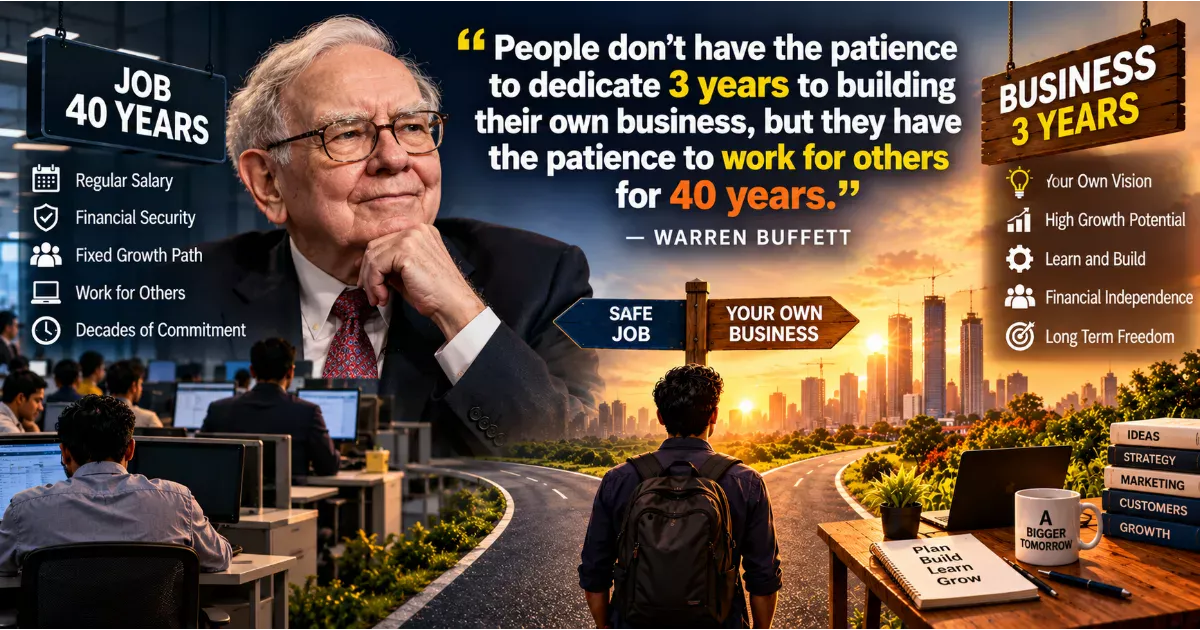
There is a popular business quote circulating across social media that captures a familiar contradiction in modern working life: people may be willing to spend 30 or 40 years working for an organisation, yet hesitate to give their own business three years to grow.
The quote is often attributed to Warren Buffett, but a reliable original source confirming that he said these exact words has not been established. It is therefore more accurate to treat it as a popular business saying rather than a verified quotation from the renowned investor.
Even without a confirmed author, the idea raises an important question. Why do people sometimes accept years of routine, deadlines, targets and uncertainty in employment, while expecting a business they own to produce meaningful results almost immediately?
The answer is not simply that people lack patience. Starting a business involves financial risk, emotional pressure, uncertain demand and the possibility of losing savings. Employment usually offers a more predictable income, even when the work is difficult or the opportunities for advancement are limited. A business owner, by contrast, may invest months of effort before earning a reliable profit.
Yet the contrast between long-term employment and short-term expectations for entrepreneurship reveals something important about how people approach success. Many businesses need time to find customers, refine their products, build trust, establish reliable processes and develop a sustainable source of revenue. Their early struggles do not always indicate that the idea is bad. Sometimes they reflect the ordinary process of building something that did not previously exist.
This does not mean every business deserves three years of unconditional commitment. Some ideas fail because the market does not need the product, the pricing is wrong, the business model is unsustainable or the founder cannot finance further losses. Persistence without learning can become an expensive mistake.
The real lesson is more practical: a business needs enough time to develop, but that time must be supported by evidence, disciplined decisions and a willingness to change direction.
Understanding this distinction can help aspiring entrepreneurs think more realistically about the journey from an idea to a functioning business.
Why Employment Often Feels Safer Than Entrepreneurship
Employment and entrepreneurship offer different relationships with risk, responsibility and reward. In a job, an employee generally exchanges time, expertise and effort for an agreed salary. The organisation is responsible for finding customers, developing products, managing operating costs and maintaining the business. Although employment is never completely secure, the employee usually does not personally carry the full financial burden of keeping the organisation alive.
A business owner has a different responsibility. The founder must identify a problem worth solving, create a product or service, find customers, determine prices, manage expenses and ensure that enough money comes in to cover obligations. Even when a product is excellent, the business can struggle if customers do not understand it, cannot afford it or prefer an established competitor.
This difference helps explain why people may remain in employment for decades. A regular salary can pay rent, support a family, fund education and cover everyday expenses. It creates a financial structure around which people can plan their lives. Leaving that structure to start a business can introduce uncertainty into nearly every financial decision.
There is also a difference in how progress is measured. In employment, people may receive a salary every month, periodic performance reviews and opportunities for promotion. Their progress is not always satisfying, but it is often visible through established systems. In entrepreneurship, progress can be difficult to measure during the early stages. A founder may spend months improving a product, meeting prospective customers and building relationships without seeing a corresponding increase in revenue.
Imagine someone who has worked in a company for ten years. They know their responsibilities, understand the organisation's procedures and have developed professional relationships. Their salary may increase gradually as they gain experience. Now imagine that the same person launches a small business. The first few months may involve designing a website, developing a product, contacting customers and learning how to sell. Despite considerable effort, revenue may remain inconsistent.
The contrast can be discouraging. The employee receives an identifiable financial reward for the month, while the entrepreneur may have worked just as hard without generating enough income to cover expenses. This can lead founders to conclude that their idea is failing before they have gathered enough information to understand what is happening.
However, the comparison is not entirely fair. Employment and business ownership serve different purposes and carry different responsibilities. A salary compensates an employee for their contribution, while business ownership offers the possibility of building an independent asset but also exposes the founder to greater uncertainty.
The goal should not be to dismiss employment as a poor choice. Employment can provide security, professional development and a meaningful career. It can also help people develop the skills, savings and industry knowledge needed to launch a business later.
The more useful question is whether people evaluate entrepreneurship using realistic expectations. A business is not necessarily failing because it does not become profitable in six months. Equally, it is not necessarily succeeding simply because its founder continues working on it for years. The quality of the evidence matters more than the passage of time alone.
The Myth of Overnight Success
One reason people become impatient with their businesses is that they see the visible results of other people's success without seeing the years of work that preceded them.
Social media is full of stories about founders who built successful companies, creators who turned a hobby into a full-time income and entrepreneurs who transformed a small idea into a large organisation. These stories can be inspiring, but they often focus on the breakthrough rather than the long period of uncertainty that came before it.
A successful business may appear to have grown rapidly because the public notices it only after it has gained attention. The founder's earlier attempts, unsuccessful products, difficult customer conversations, financial sacrifices and repeated changes of direction may receive far less attention.
This creates a distorted picture of what building a business looks like. People begin to expect a clear upward trajectory from the moment they launch. When the first product receives little attention or the first marketing campaign generates few sales, they assume that something has gone fundamentally wrong.
In reality, many businesses develop through repeated experimentation. A founder launches a product, learns which features customers value and discovers which marketing channels are effective. The original pricing may need to change. The intended audience may turn out to be different from the audience that actually buys. A service may need to become more specialised, or a product may require a simpler design.
These adjustments rarely make exciting success stories, but they are often central to the process of finding a workable business model.
Consider a small company that develops a digital platform for independent professionals. Its founders may initially believe that customers want a wide range of features. After launching, they discover that users mainly value two functions and find the rest confusing. The founders then simplify the product, improve the onboarding process and focus their marketing on the people most likely to benefit.
The company has not necessarily failed because the first version did not attract enough customers. It has received information that can help it develop a more useful product. The important question is whether the founders learn from that information and respond effectively.
There is a danger, however, in using the idea of delayed success to justify every poor result. Not every unsuccessful business is a hidden success waiting to emerge. Some products solve problems that customers do not care enough about to pay for. Some markets are too small, and some business models cannot generate sufficient margins.
The lesson is to stop expecting overnight success without romanticising prolonged struggle. Successful businesses often require time, but they also require evidence that the work is moving in a useful direction.
Why the First Three Years Can Be So Important
The idea of giving a business three years is best understood as a reminder that meaningful development takes time, not as a universal rule that every venture must follow.
During the first year, many founders are still discovering what their customers need. They may be testing their product, adjusting prices, building an initial customer base and learning how to manage basic operations. They may also be discovering that their original assumptions were incomplete or incorrect.
The second year can bring a different set of challenges. A business may have attracted its first customers but struggle to retain them. The founder may need to improve service quality, make the product more reliable, establish repeatable marketing processes or hire additional help. Revenue may increase, but expenses can rise at the same time.
By the third year, some businesses have accumulated enough experience to evaluate their position more clearly. They may understand which customers are most profitable, which products deserve further investment and which activities consume time without producing meaningful results. They may have developed repeat customers, a stronger reputation and more predictable operations.
This progression is not guaranteed. Some businesses find a profitable model much sooner, while others require longer to develop. Businesses in regulated industries, manufacturing, research-intensive sectors or infrastructure may have especially long development cycles. A small service business, on the other hand, may be able to test demand and generate its first revenue relatively quickly.
The value of a longer evaluation period is that it can prevent founders from confusing early difficulty with permanent failure. It gives them an opportunity to learn from customer behaviour and improve the business before making a final decision.
But the three-year idea should never become an excuse to ignore financial reality. A founder with limited savings cannot simply decide to absorb losses indefinitely. A business that is unable to attract paying customers despite repeated improvements may need a different strategy or a decision to stop.
A more useful approach is to set milestones for each stage. During the first few months, the founder might focus on validating demand and securing initial customers. Later milestones could measure repeat purchases, customer retention, gross margins and the ability to acquire customers at a sustainable cost.
These milestones should be appropriate to the business. A consultant, an online retailer and a technology start-up will not develop at the same pace. The point is to establish clear indicators of progress rather than relying on a vague promise that success will arrive if the founder waits long enough.
Three years can be a useful horizon for learning and evaluation, but the quality of the decisions made during those years matters far more than the calendar itself.
Patience Is Not the Same as Waiting Without a Plan
Patience is often described as one of the most important qualities an entrepreneur can develop. However, patience has little value when it becomes an excuse for avoiding difficult decisions.
A founder can spend three years working on a business without making meaningful progress. They might repeatedly invest in advertising without understanding why customers are not buying, continue developing features nobody requests or refuse to change a product because they are emotionally attached to the original idea. In such situations, the passage of time does not create success. It merely makes the mistake more expensive.
Productive patience is different. It means accepting that a worthwhile outcome may take time while continuing to learn, test assumptions and improve the business. It allows a founder to tolerate uncertainty without becoming passive.
Suppose a small business receives few orders during its first three months. An impatient owner might abandon the idea immediately. A patient but disciplined owner would investigate the reasons. Are enough potential customers seeing the offer? Is the product solving a problem people genuinely experience? Is the price appropriate? Do customers trust the seller? Is the purchasing process too complicated?
The answers would determine the next step. If potential customers like the product but find the price too high, the business might test a different package or payment structure. If people visit the website but do not complete purchases, the founder might examine the checkout process. If customers do not understand the product's benefits, the marketing message may need improvement.
Each experiment should have a clear purpose. The founder should identify what they want to learn, make a change and observe the results. Over time, these experiments can produce a more accurate understanding of the market.
This approach turns patience into an active business discipline. The founder is not merely waiting for success. They are working to understand what makes success possible.
It also creates a useful distinction between perseverance and stubbornness. Perseverance means continuing to pursue a meaningful goal despite obstacles. Stubbornness means refusing to reconsider a strategy even when evidence suggests it is not working.
Entrepreneurs need the first quality without becoming trapped by the second.
The Emotional Cost of Building Something of Your Own
Starting a business is not only a financial decision. It is also an emotional experience that can affect a founder's confidence, relationships and sense of identity.
When someone creates a business, the product often represents months or years of personal effort. The founder may have spent evenings learning new skills, invested savings in development and sacrificed leisure time to bring the idea to life. When customers ignore the product or revenue remains low, the disappointment can feel personal.
In employment, a difficult project can be separated from an employee's entire identity. The organisation, team and management structure provide some distance between the individual and the result. For a founder, the business may feel like a direct reflection of their abilities and decisions.
This can make criticism difficult to accept. A customer who rejects a product may seem to be rejecting the founder rather than simply choosing another option. Negative feedback can lead to defensiveness, while poor sales can create doubt about whether the entrepreneur is capable of succeeding.
Financial pressure adds to the challenge. A founder may worry about household expenses, family expectations, loan repayments or the possibility of having to return to employment. Friends and relatives may ask when the business will become profitable, particularly if they do not understand the uncertainty involved in starting a company.
The pressure can become even greater when the entrepreneur compares their progress with people who appear more successful. Someone else's business may seem to be growing rapidly, while the founder's own work remains largely invisible. This comparison can encourage rushed decisions, unnecessary spending or frequent changes of direction.
Managing these pressures requires more than motivation. Entrepreneurs need realistic financial boundaries, supportive relationships and ways to evaluate progress objectively. They should be able to discuss difficulties honestly without treating every setback as proof of personal failure.
It can also help to define success in stages. Early success might mean validating demand, securing the first paying customers or demonstrating that customers return. Later success might involve consistent profitability, a reliable team or the ability to operate without the founder handling every task.
These milestones make progress easier to recognise even when the business is not yet producing the income its founder ultimately wants.
Entrepreneurship inevitably involves uncertainty, but founders should not have to sacrifice their financial stability or well-being without limits. Building something meaningful requires persistence, and persistence is easier to sustain when the founder has a realistic plan for managing risk.
Why Customer Trust Takes Time to Build
One of the most overlooked challenges in business is earning trust. A founder may believe that a product is useful, affordable and well designed, but potential customers have no automatic reason to believe those claims.
Established businesses benefit from reputation, reviews, customer relationships and a track record of delivering what they promise. A new business begins with little or none of this evidence. Customers may hesitate because they have never heard of the brand, do not know whether the product will work or are concerned about what will happen if something goes wrong.
Building trust requires consistent behaviour. Businesses must communicate clearly, deliver products as promised, respond to complaints and make it easy for customers to understand what they are buying. Over time, positive experiences can lead to repeat purchases and recommendations.
This process can take longer than founders expect. A customer may discover a product today but purchase it weeks later after comparing alternatives. An enterprise customer may require several meetings, security reviews and internal approvals before signing a contract. A consumer may need to see a brand repeatedly before feeling confident enough to try it.
Different businesses also have different purchasing cycles. A person buying a low-cost household item may make a decision quickly. A company considering an expensive software platform may spend months evaluating alternatives and negotiating terms.
This is why impatience can damage a business's development. Founders who expect immediate results may abandon a marketing channel just before it begins producing useful leads, or change their product repeatedly before customers have had enough time to understand it.
At the same time, trust should not be used to excuse poor customer response. If customers repeatedly report the same problem, the business must address it. If people do not return after their first purchase, the founder should investigate whether the product delivers enough value.
A useful business does not simply wait for trust to develop. It earns trust through reliable service, clear communication and consistent results.
The Financial Reality: Not Everyone Can Afford to Wait Three Years
The motivational message behind the popular quote can be valuable, but it needs an important qualification. Not every person has the financial resources to spend three years building a business without dependable income.
For someone supporting a family, repaying a loan or managing essential expenses, prolonged losses can create serious hardship. Telling every aspiring entrepreneur to be patient without considering these constraints would be irresponsible.
Business owners need to understand their financial runway, meaning the amount of time they can continue operating before available cash is exhausted. They should estimate essential personal expenses, business costs, expected revenue and the consequences of slower-than-expected growth.
A founder may choose to retain a job while testing a business idea during evenings or weekends. This can reduce financial pressure and allow the founder to learn whether customers are willing to pay before making a larger commitment. Others may start with a service business requiring limited initial investment rather than immediately building an expensive product.
There is no single correct approach. The appropriate level of risk depends on the founder's circumstances, the nature of the business and the evidence of demand.
Entrepreneurs should also distinguish between revenue and profit. A business may generate sales while losing money on each transaction or spending more on customer acquisition than it earns from customers. Growing revenue does not necessarily mean that the business is becoming financially healthier.
Cash flow matters as well. A company can appear profitable on paper but struggle to pay its bills if customers delay payments or too much money is tied up in inventory. A business owner must understand not only how much money is being earned but also when money enters and leaves the business.
These realities do not undermine the value of patience. They make disciplined patience more important. A founder who understands their financial position can make better decisions about how long to continue, when to invest more and when to change direction.
Sometimes the most responsible choice is to keep the business small while demand develops. Sometimes it is to seek outside investment, change the business model or return to employment while preserving the lessons learned. Closing an unsustainable business can also be a rational decision rather than a personal defeat.
The objective is not to prove that the founder can endure hardship for three years. It is to build a business that has a credible path towards long-term viability.
How to Give Your Business Three Years of Serious Effort
If the idea behind the quote is to have greater patience with entrepreneurship, the practical question is how to use that time well. A founder should not simply promise to work hard for three years. They should establish a process that helps the business become more capable, more useful to customers and more financially sustainable.
First, validate the problem before investing heavily
Every business begins with an assumption about what customers need. That assumption should be tested before the founder commits substantial money or time. Speak to potential customers, examine competing products and identify whether people are already spending money to solve the problem. Interest and compliments are encouraging, but actual purchases provide stronger evidence of demand.
A founder should also understand who the intended customer is. Trying to serve everyone can make marketing vague and product development unfocused. A clearly defined audience makes it easier to understand customer needs, communicate benefits and determine whether the business is gaining traction.
Second, focus on delivering real value
Customers do not buy a product simply because its founder has worked hard on it. They buy because they believe it will solve a problem, save time, reduce costs, provide enjoyment or deliver some other meaningful benefit. The founder's effort matters, but the customer's experience ultimately determines whether the product deserves continued support.
This requires listening carefully to feedback. If customers struggle to use a product, the business should improve the experience. If a service consistently produces disappointing results, the delivery process may need to change. If customers do not understand the offer, the founder should reconsider how its value is communicated.
Third, measure progress instead of relying on motivation
Motivation changes from day to day, so it should not be the only force guiding a business. Founders need a small set of meaningful measures that reflect their business model. These might include paying customers, repeat purchases, customer retention, conversion rates, gross margins and cash flow.
The purpose is not to create complicated reports. It is to understand whether the business is moving towards a sustainable model. A growing audience may be useful, but if the business depends on sales, the founder must eventually establish whether that audience is willing to pay.
Reviewing these measures regularly can help identify problems early. It can also prevent a founder from abandoning a promising business simply because revenue has not yet reached the desired level.
Fourth, learn to sell
Many founders spend enormous amounts of time developing their products and very little time learning how to sell them. They may believe that a good product will naturally attract customers. In practice, customers need to discover the product, understand its benefits, trust the business and decide that the price is worthwhile.
Sales and marketing are therefore not activities that can always be postponed until the product is perfect. They are essential parts of discovering whether a business can survive. Customer conversations can also reveal information that product development alone cannot provide.
A founder who learns to communicate value, identify suitable customers and build relationships can improve the business's chances of finding a sustainable market.
Fifth, protect your financial runway
Patience becomes difficult when the business is running out of money. Founders should establish a realistic budget, separate personal and business finances where appropriate, monitor expenses and avoid making large commitments without a clear reason.
They should also decide in advance what evidence would justify additional investment. For example, a business might continue testing a product while customer interest improves, but reconsider the model if repeated experiments fail to generate paying customers. Such boundaries help ensure that persistence remains a deliberate decision rather than a reaction to the fear of admitting failure.
Sixth, change the strategy when the evidence demands it
A three-year commitment should be a commitment to learning and building, not a promise to preserve every original decision. Businesses often need to change their pricing, customer segment, distribution method or product features as they discover what works.
Founders should be willing to abandon assumptions that no longer fit the evidence. Sometimes the original idea is viable but the execution needs improvement. Sometimes a different customer group offers a better opportunity. In other cases, the evidence may indicate that the business cannot become sustainable under the current model.
Changing direction is not necessarily a sign of weakness. It can be an important part of responsible entrepreneurship.
Is Three Years Enough to Build a Successful Business?
There is no universal timeline for success. Some small businesses can establish a reliable customer base within months. Others require years of development, investment and market education. Businesses operating in highly regulated industries or developing complex technologies may need much longer before they can operate at scale.
The nature of the goal also matters. Establishing a self-employed service business is different from building a national retail brand or a technology company serving international customers. The resources required, the risks involved and the time needed to reach profitability can vary dramatically.
Three years should therefore be treated as a useful period for sustained effort and evaluation, not a guarantee that a business will succeed by a particular date. A founder can make significant progress within that time even if the business does not become large. They may discover a profitable niche, develop a valuable skill, build a loyal customer base or learn that a different business model offers a better opportunity.
The important question is what has changed during those years. Has the founder developed a better understanding of the market? Are customers receiving more value? Has the business improved its ability to attract and retain customers? Is there a credible path towards financial sustainability?
If the answers are encouraging, continued investment may make sense. If the evidence remains consistently negative despite serious efforts to improve the business, the founder should reconsider the approach.
Entrepreneurship rewards neither blind optimism nor constant doubt. It requires the ability to remain committed to a worthwhile goal while examining the evidence honestly.
Conclusion: Give Your Ambition Time, but Give Your Decisions Discipline
The popular quote about people working for others for 40 years while hesitating to spend three years building their own business highlights a real tension in how people think about success. It reminds us that building something independently often requires sustained effort, patience and a willingness to tolerate uncertainty.
However, the lesson is not that employment is inferior or that every business deserves years of unconditional commitment. Employment provides income, experience and stability that can be valuable throughout life. Entrepreneurship offers a different set of possibilities, accompanied by financial and personal risks that should never be ignored.
The deeper lesson is that meaningful results often require more time than people initially expect. A business must earn customer trust, improve its product, establish reliable processes and find a model that can support its costs. These achievements rarely happen automatically, and they cannot be measured solely by how hard the founder works.
Three years of disciplined effort can teach an entrepreneur a great deal, but only if those years include learning, customer feedback, financial planning and the courage to change direction when necessary.
Do not abandon a worthwhile idea merely because it has not produced immediate results. Equally, do not continue investing in a failing strategy simply because you have already spent years pursuing it. Learn to distinguish temporary difficulty from evidence that the business needs a fundamental change.
And remember that the quote itself has not been reliably verified as Warren Buffett's exact words. Its value lies in the question it raises, not in the fame of the person to whom it is attributed.
A job may reward you for the work you complete today. Building a business asks you to create something that can deliver value tomorrow, next year and beyond. Give that process enough time to develop, but make every year count through better decisions, stronger execution and a clearer understanding of what customers truly need.
#BeyondHeadlines #Entrepreneurship #BusinessMindset #StartupJourney #BusinessGrowth #PatienceAndPersistence #SmallBusiness #EntrepreneurLife #LongTermThinking #BusinessLessons #SelfEmployment #BuildYourBusiness #PersonalGrowth #BeyondTheHeadline

