
Jio is known for telecom, digital payments, entertainment, retail and increasingly artificial intelligence. But in September 2026, another interesting piece of the Jio ecosystem has come into focus: food delivery.
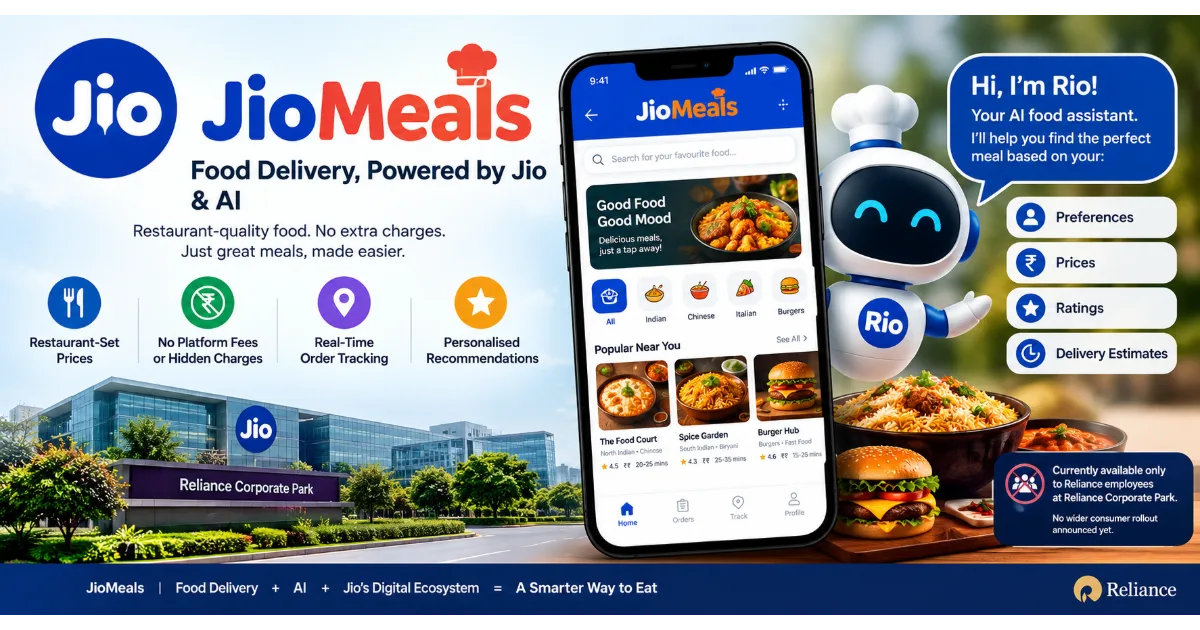
Reliance Jio has introduced JioMeals, a food-ordering platform currently designed for employees of Reliance Corporate Park (RCP). The service brings together restaurant discovery, food ordering, personalised recommendations, real-time delivery tracking and an AI assistant called Rio.
What makes JioMeals particularly interesting is not simply that Jio is facilitating food orders. The more significant part is the business model and technology experience being tested: restaurant-set pricing, no platform fees or hidden charges, personalised food discovery and an AI assistant that can recommend what a user should eat based on factors such as preferences, price, ratings and estimated delivery time.
The service is currently limited to RCP employees. There has been no announced general-public rollout, so it would be premature to describe JioMeals as a nationwide competitor to Swiggy or Zomato. Instead, the current product appears to be a controlled, employee-focused deployment that could also provide Jio with an opportunity to test food-commerce technology, logistics, AI recommendations and pricing models in a relatively contained environment. (TelecomTalk)
1. What Exactly Is JioMeals?
JioMeals is a food-ordering application developed by Jio Platforms Limited and currently intended for Reliance Corporate Park employees.
The application allows eligible users to:
Discover restaurants
Browse menus
Search for dishes
Filter food according to preferences
View restaurant and dish information
Customise orders
Add special instructions
Select quantities
Request cutlery
Place orders
Make digital payments
Track deliveries in real time
Contact delivery partners
Reorder previous favourites
Receive personalised recommendations
Get AI-powered food suggestions through Rio
The application has appeared on the Android ecosystem, but simply finding the application does not mean that it is open to every consumer. Available information indicates that access is restricted to RCP employees, with the application requiring a Reliance email ID for access. (AppAgg)
This distinction is important.
JioMeals is not currently an open-to-everyone food-delivery marketplace.
It is better understood as an employee-focused food-commerce platform currently being operated within the Reliance Corporate Park environment.
2. Why Is JioMeals Getting Attention?
At first glance, a company launching a food-ordering application may not sound particularly revolutionary.
India already has enormous online food-delivery platforms.
Consumers are accustomed to:
Opening an app
Searching for restaurants
Selecting food
Paying online
Tracking the delivery
So what is different about JioMeals?
There are several interesting elements.
First: Restaurant-rate pricing
JioMeals says restaurants set their own prices and that the platform does not mark them up.
Second: No platform fees
The application advertises no platform fees and no hidden charges.
Third: AI-powered food discovery
Instead of making users browse endlessly, JioMeals introduces Rio, an AI assistant designed to help users decide what to eat.
Fourth: Personalisation
The platform can recommend food based on user preferences and previous ordering behaviour.
Fifth: Controlled ecosystem
Rather than immediately opening the service to hundreds of millions of consumers, Jio appears to be operating it within the RCP employee environment.
That combination makes JioMeals interesting from a technology and business-model perspective. (TelecomTalk)
3. Who Can Actually Use JioMeals?
This is perhaps the most important detail.
JioMeals is currently for Reliance Corporate Park employees.
The available application information specifically describes JioMeals as a service for RCP employees. The reported application access requires a Reliance email ID. (AppAgg)
Therefore, at present:
| User | JioMeals access |
|---|---|
| Reliance Corporate Park employee | Available |
| General Jio customer | Not currently indicated |
| General Indian consumer | Not currently available |
| Non-Reliance employee | Not currently indicated |
| Anyone downloading the app | Does not automatically receive access |
This is a critical distinction because some headlines describing JioMeals as "Jio's new food delivery service" could give the impression that anybody in India can immediately order through it.
That is not the case based on the currently available information.
4. Why Start With Reliance Corporate Park?
An employee-focused launch can make considerable sense from a product-development perspective.
A nationwide food-delivery platform involves enormous complexity.
A public service would potentially have to deal with:
Millions of customers
Thousands of restaurants
Delivery partners
Different cities
Different traffic conditions
Different payment behaviours
Customer support
Refunds
Cancellations
Restaurant onboarding
Delivery optimisation
Fraud prevention
Address verification
Peak-hour demand
Customer acquisition
Promotional pricing
Competition
An employee-focused environment is much more controlled.
Reliance can potentially observe how people use the application without immediately exposing the platform to the complexity of a nationwide marketplace.
The RCP environment can therefore function as a real-world product-testing environment.
Employees can use the application, order food, interact with restaurants and delivery personnel, and generate operational feedback.
That can provide useful information about:
Ordering frequency
Popular cuisines
Peak ordering periods
Recommendation accuracy
Delivery times
Restaurant performance
Cancellation patterns
User preferences
AI interaction
Checkout behaviour
Importantly, this is an interpretation of why such a rollout could be useful; Reliance has not publicly stated that this is the specific strategic reason for limiting JioMeals to RCP.
5. The Most Interesting Feature: Restaurant-Set Prices
One of JioMeals' most notable claims is its approach to pricing.
According to the available application description, participating restaurants set their own prices and JioMeals does not mark those prices up. (AppAgg)
In simple terms:
Restaurant sets price → JioMeals displays that price → customer pays the restaurant-set price.
This is significant because food-delivery economics can become complicated when multiple fees and commissions are involved.
The consumer usually focuses on the menu price.
But the final checkout amount can potentially include other components such as:
Food price
Delivery charge
Platform fee
Taxes
Packaging charges
Other applicable fees
JioMeals is positioning itself around a simpler pricing proposition.
Its available material highlights:
Restaurant-set prices
No markups
No platform fees
No hidden charges
The exact economics between JioMeals, restaurants and delivery operations have not been publicly detailed in the information currently available.
Therefore, it would be incorrect to assume that every possible charge associated with food delivery has been eliminated in every circumstance.
What can be said is that JioMeals explicitly promotes restaurant-rate pricing and no platform fee/hidden charges in its current employee-focused product. (TelecomTalk)
6. Why "No Platform Fee" Is Significant
The phrase "no platform fee" may appear small, but it could be strategically important.
Imagine an employee ordering lunch several times a week.
Even a relatively small additional fee per order can accumulate over dozens or hundreds of orders.
JioMeals appears to be designed around the idea:
What you see as the restaurant's price is what you pay for the food.
This creates a simple consumer proposition.
Instead of asking:
"Why is my final bill higher than the menu price?"
the platform attempts to provide a more transparent checkout experience.
The available application information also mentions clear, itemised billing with no hidden charges. (AppAgg)
That transparency could be particularly relevant in an employee environment where people may order food frequently.
7. JioMeals Is Not Just About Food Ordering
If JioMeals were simply another restaurant-listing application, its launch would probably attract less attention.
The more interesting element is AI.
JioMeals integrates an AI assistant called Rio.
Rio is designed to help answer one of the most common questions associated with food delivery:
"What should I eat?"
That sounds simple.
But anyone who has spent several minutes scrolling through hundreds of restaurant listings knows that food discovery can create decision fatigue.
You may be hungry but have no idea what you want.
You might want:
Something spicy
Something under ₹300
Something vegetarian
Something quick
Something highly rated
Something from a favourite restaurant
Something different from yesterday
Something healthy
Something suitable for a group
This is where Rio becomes interesting.
8. What Is Rio AI?
Rio is the AI assistant integrated into JioMeals.
Available screenshots and reporting describe Rio as an AI companion that helps users decide what to order. Its recommendations can show information such as:
Restaurant
Dish
Price
Rating
Estimated delivery time
The idea is to move food discovery from a traditional search-and-scroll model toward a conversational or recommendation-based experience. (TelecomTalk)
For example, instead of manually searching:
"Pizza"
a user could potentially communicate a preference such as wanting something inexpensive, highly rated and quick to arrive.
Rio can then surface relevant options.
The available material does not disclose the underlying AI model powering Rio, so it would be inappropriate to claim that it uses a particular large language model or a particular proprietary architecture.
9. AI Could Change How Food Delivery Apps Work
Traditional food-delivery interfaces largely operate around search and discovery.
You open an application and see:
Restaurants
Categories
Offers
Cuisines
Recommendations
Search
The user does the work.
AI can reverse part of that relationship.
Instead of:
User searches → User compares → User decides
the model becomes:
User explains preference → AI understands → AI recommends → User chooses
That difference may become increasingly important across digital commerce.
Jio is already investing heavily in AI across its broader ecosystem. Reliance's 2026 materials describe Reliance Intelligence as a major growth engine focused on AI infrastructure, platforms and services, with ambitions spanning consumers, enterprises and governments. (Reliance Industries Limited)
Jio's public AI demonstrations also show a broader movement toward AI agents that can perform actions rather than merely answer questions. Its 2026 demonstrations include AI capabilities for areas such as calls, MyJio and other services. (Jio)
JioMeals therefore fits into a broader technology direction where AI becomes an interface for completing tasks.
10. Personalised Food Recommendations
Rio is not the only personalised feature in JioMeals.
The application also reportedly provides personalised recommendations based on user behaviour.
Features include:
Favourite dishes
Suggested items
Previously ordered dishes
Reordering
Personalised suggestions
The platform can therefore reduce the amount of browsing required for repeat users. (TelecomTalk)
For example, if someone regularly orders the same meal from the same restaurant, the app can make that item easier to discover again.
This is a simple but important UX principle:
The more the platform learns about a user's behaviour, the less effort the user needs to spend finding familiar choices.
11. Search and Food Filters
JioMeals also includes traditional food-discovery tools.
Users can search restaurants and dishes and apply food-type filters.
The available information specifically mentions:
Vegetarian
Egg
Non-vegetarian
filters. (TelecomTalk)
This may appear basic, but filtering is particularly important when a platform contains many restaurants and menu items.
Instead of scrolling through everything, users can narrow down the results.
The combination of:
Search + filters + recommendations + AI
is more significant than any one feature individually.
12. Customising Your Food Order
JioMeals also allows users to customise their orders.
Reported capabilities include:
Adjusting quantities
Customising dishes
Adding special instructions
Requesting cutlery
Requesting tissues
These are practical features rather than flashy technology.
But they matter because food ordering is rarely just:
"Give me item X."
People often want modifications.
For example:
Less spicy
Extra sauce
No onion
No particular ingredient
Extra quantity
Specific preparation instruction
The platform's checkout experience is therefore designed to accommodate a degree of personalisation. (TelecomTalk)
13. Reordering Previous Meals
Another practical feature is quick reordering.
The application description highlights the ability to instantly reorder previous favourites. (AppAgg)
This makes sense for an employee-focused food platform.
Consider a typical office employee.
They might repeatedly order:
Monday lunch from Restaurant A
Tuesday lunch from Restaurant B
Coffee from Restaurant C
Friday meal from Restaurant A
Having to search for the restaurant and menu every time is unnecessary.
A reorder button can reduce the process to a few taps.
This is particularly useful for habitual purchases.
14. Real-Time Order Tracking
JioMeals also provides real-time delivery tracking.
Once an order is placed, users can monitor its status and see delivery-related information.
Reported tracking features include:
Delivery partner information
Estimated arrival time
Map-based tracking
Ability to contact the delivery partner
This brings the experience closer to what consumers already expect from modern delivery applications. (TelecomTalk)
Real-time tracking is particularly useful in an office environment.
An employee does not necessarily want to continuously monitor a phone call or physically check the reception desk.
Instead, they can see the order's progress.
15. The Delivery Partner Experience
The available information indicates that users can contact the assigned delivery partner through the application when required. (TelecomTalk)
This can be important when the delivery reaches the campus and the rider needs assistance locating the appropriate delivery point.
However, details about JioMeals' complete delivery-partner network, compensation model, fleet structure or geographic expansion have not been publicly disclosed.
Therefore, it would be premature to assume that Jio has built a nationwide independent delivery fleet specifically for JioMeals.
16. JioMeals Beta: An Important Clue
The application has also appeared under the name Jio Meals Beta in third-party app-indexing information.
That listing identifies Jio Platforms Limited as the developer and describes the service as being for RCP employees. It also says users sign in with their Reliance email ID. (AppAgg)
The listing reports an initial release date of July 15, 2026, with an update recorded in early September 2026. (AppAgg)
Interestingly, the reported update included a feature intended to help users when a restaurant cancels an order: the application can surface a similar alternative instead of requiring the user to restart the entire search. (AppAgg)
That is a small feature, but it demonstrates an important product philosophy:
Don't make the user start over when something goes wrong.
17. Restaurant Cancellation and Alternative Recommendations
Restaurant cancellation is one of the frustrating parts of online food ordering.
Imagine:
You select a restaurant.
Browse the menu.
Choose your meal.
Pay.
Wait.
Restaurant cancels.
A poor application forces you to start again.
The reported JioMeals update instead introduces the ability to discover a similar alternative after a restaurant cancels. (AppAgg)
This is exactly the kind of workflow where AI and recommendation systems could become useful.
If the user ordered:
Paneer biryani from Restaurant A
the application could potentially identify:
Similar dish → nearby restaurant → comparable price → acceptable delivery time.
The currently available information confirms the alternative-ordering feature but does not establish the exact algorithm used to select those alternatives.
18. JioMeals and the Indian Food-Delivery Market
India's online food-delivery market is already highly developed.
Consumers are familiar with platforms such as Swiggy and Zomato.
These platforms have built extensive ecosystems around:
Restaurant discovery
Food ordering
Delivery
Digital payments
Restaurant advertising
Offers
Loyalty
Membership
Grocery and quick-commerce extensions
JioMeals therefore enters a market where users already have established habits.
But Jio has something that many new food-delivery startups do not have:
a huge existing digital ecosystem.
Jio's businesses span telecommunications, digital services, retail, entertainment and AI.
Reliance's current strategy also places considerable emphasis on building digital and AI capabilities across its ecosystem. (Reliance Industries Limited)
That creates an interesting question:
Could food eventually become another component of the Jio ecosystem?
At the moment, there is no announced public rollout establishing that direction.
But JioMeals demonstrates that the company is at least experimenting with food ordering in a controlled environment.
19. Why Jio Does Not Need to Immediately Challenge Zomato or Swiggy
It is easy to look at JioMeals and immediately ask:
"Is Jio going after Zomato and Swiggy?"
That conclusion would be premature.
The current product is restricted to RCP employees.
There is no publicly announced nationwide JioMeals consumer launch.
There is also no publicly disclosed information establishing:
Nationwide restaurant onboarding
A nationwide delivery fleet
Consumer acquisition plans
Public pricing strategy
Commission structure
Restaurant expansion targets
Consumer launch date
So the more accurate description today is:
JioMeals is an employee-focused food-ordering service with a sophisticated digital and AI feature set.
Whether it eventually becomes a public food-delivery marketplace is unknown.
20. The Bigger Experiment May Be AI Commerce
Perhaps the most interesting part of JioMeals is not food itself.
It may be the idea of AI-assisted commerce.
Today, most commerce applications require users to navigate menus.
AI changes that model.
Imagine saying:
"I'm hungry. I want something vegetarian, under ₹300, highly rated and delivered quickly."
Instead of manually applying four filters, an AI assistant could interpret all four requirements.
That concept can eventually apply beyond food.
For example:
Shopping
"Find me a laptop under ₹60,000 suitable for development."
Travel
"Find me a hotel near the airport under ₹4,000."
Entertainment
"Suggest a movie under two hours that I can watch tonight."
Food
"Find me something spicy, vegetarian and available within 30 minutes."
This is why Rio is potentially more significant than a simple chatbot.
The assistant sits between human intent and digital transactions.
21. From Search to Intent
Traditional apps are based on navigation.
You learn the interface.
You tap:
Food → Restaurant → Category → Dish → Cart → Checkout
AI-powered interfaces can instead begin with intent:
"I'm hungry and want something quick."
The system then interprets the intent.
That can reduce the number of decisions required from the user.
Jio's broader AI strategy appears to be moving toward similar agentic experiences. Reliance has publicly described AI systems intended not merely to answer questions but to take actions on users' behalf, subject to consent. (Jio)
JioMeals provides a practical example of how that philosophy could translate into commerce.
22. Why Restaurant Ratings and Delivery Estimates Matter to Rio
A food recommendation cannot simply be:
"This restaurant is popular."
The recommendation becomes more useful when multiple variables are considered.
For example:
| Factor | Why it matters |
|---|---|
| Price | Matches user's budget |
| Rating | Indicates customer feedback |
| Delivery time | Helps users who are in a hurry |
| Restaurant | Lets users choose a trusted source |
| Dish | Directly answers what to order |
| Preferences | Makes recommendation personal |
Rio reportedly presents recommendations with information including restaurant, price, rating and estimated delivery time. (TelecomTalk)
This is closer to decision assistance than simple search.
23. The Potential Economics Behind JioMeals
Jio has not publicly disclosed the full financial model of JioMeals.
That means several important questions remain unanswered.
For example:
How does Jio make money?
The available information says customers are not charged a platform fee and that restaurant prices are not marked up by JioMeals. (TelecomTalk)
But this does not reveal the complete business economics.
Possible revenue mechanisms in a future public model could theoretically include restaurant subscriptions, advertising, logistics charges, partnerships or other commercial arrangements.
However, these should not be treated as Jio's announced plans.
At present, the company's public information does not establish a nationwide JioMeals monetisation strategy.
24. Why Employee Food Delivery Can Be Different
A corporate campus creates a unique food-delivery environment.
Unlike a citywide service where a customer could be anywhere, a corporate campus provides a relatively concentrated user base.
That can potentially simplify:
Delivery routes
Delivery locations
Order density
Restaurant selection
Customer support
Delivery coordination
Peak-time analysis
It may also create predictable demand.
For example, lunch orders can cluster around specific periods.
This concentrated demand can provide a useful environment for testing logistics and recommendation systems.
Again, this is an analytical interpretation rather than a publicly stated explanation from Reliance for the RCP-only rollout.
25. The "Jio Ecosystem" Angle
Jio has spent years building beyond connectivity.
Its broader ecosystem now includes areas such as:
Telecom
Broadband
Digital applications
Entertainment
Retail
Payments
AI
Enterprise services
Digital commerce
Reliance's 2026 materials describe an ambition to build AI infrastructure and services serving consumers, enterprises and governments. (Reliance Industries Limited)
Within that context, JioMeals is interesting because food delivery touches several major digital categories simultaneously:
Commerce + AI + payments + logistics + recommendations + customer data + digital identity.
That makes food delivery a useful test case for agentic commerce.
26. Could JioMeals Eventually Become Public?
This is the biggest unanswered question.
As of September 2026, there is no confirmed public consumer rollout.
Available reporting specifically says Jio has not announced plans to make JioMeals available to the general public. (TelecomTalk)
Therefore, statements such as:
"Jio is launching a nationwide Zomato competitor"
would go beyond the currently verified information.
The more accurate statement is:
Jio has introduced an employee-focused food-ordering platform at Reliance Corporate Park, and its current feature set includes restaurant-rate pricing, no platform fees, personalisation, live tracking and Rio AI.
Anything beyond that remains speculation until Reliance officially announces it.
27. What Would Happen If JioMeals Goes Nationwide?
A nationwide rollout would be a very different proposition.
Jio would need to solve multiple problems.
Restaurant network
A national service requires a large restaurant ecosystem.
Delivery infrastructure
Food needs to move efficiently from restaurants to customers.
Customer acquisition
Jio would need to convince consumers to change established habits.
Restaurant economics
Restaurants would need a commercially sustainable relationship with the platform.
Customer support
Cancellations, refunds and complaints would increase dramatically.
Peak demand
Lunch and dinner peaks would create massive operational requirements.
Fraud and security
Payments and promotional abuse would need sophisticated controls.
Geographic expansion
Different cities have different restaurant densities and delivery patterns.
Competition
Existing food-delivery platforms have years of operational experience.
Therefore, scaling JioMeals from a corporate-campus service to a national marketplace would be a fundamentally different challenge.
28. JioMeals Could Also Influence Restaurant Economics
If the restaurant-rate model were ever expanded significantly, it could potentially create interesting changes in restaurant-platform relationships.
Restaurants could theoretically benefit from:
Greater price transparency
Direct control over menu prices
Reduced dependence on platform pricing mechanisms
Additional customer acquisition
AI-driven discovery
But again, the complete commercial relationship between restaurants and JioMeals has not been publicly disclosed.
So the current evidence supports describing the restaurant-set pricing model, not making broader claims about restaurant profitability.
29. What Makes JioMeals Different From a Typical Startup MVP?
Interestingly, JioMeals appears to be more than a basic ordering prototype.
The reported feature set already includes:
Restaurant discovery
Search
Food filters
Personalisation
AI assistant
Customisation
Digital payments
Reordering
Delivery tracking
Delivery-partner contact
Restaurant cancellation alternatives
Itemised billing
That is a relatively complete ordering experience even within an employee-only environment. (TelecomTalk)
The inclusion of AI from the beginning is particularly notable.
Rather than adding AI as a marketing layer after building a conventional food-delivery application, JioMeals appears to incorporate AI directly into food discovery.
30. What We Still Don't Know About JioMeals
There are many unanswered questions.
1. How many restaurants participate?
Not publicly disclosed in the sources reviewed.
2. How many RCP employees are using it?
Not publicly disclosed.
3. How many orders does JioMeals process?
Not publicly disclosed.
4. What AI model powers Rio?
Not publicly disclosed.
5. Does Rio use a proprietary Jio model?
No public confirmation found.
6. Who handles deliveries?
The complete delivery-partner structure has not been publicly explained.
7. What is the exact restaurant commission?
Not publicly disclosed.
8. Will JioMeals launch nationwide?
No confirmed public announcement.
9. Will it integrate with MyJio?
No confirmed public announcement regarding a public JioMeals integration.
10. Will JioMeals compete directly with existing food-delivery companies?
The current RCP-only service does not establish that.
These unknowns are important because they prevent us from turning an employee-focused product into a story about a nationwide food-delivery battle before the evidence supports it.
31. JioMeals Is a Small Product With a Potentially Bigger Story
The launch itself may be relatively small.
But the technology direction is interesting.
JioMeals combines:
Food + AI + Personalisation + Commerce + Logistics + Digital Payments
That combination reflects a larger transformation happening across technology.
Applications are increasingly moving from:
"Here are the options."
toward:
"Tell me what you want, and I'll help you get it."
Rio represents this shift within a food-ordering environment.
Instead of simply providing a restaurant catalogue, the platform attempts to help the customer make a decision.
32. Why Rio Could Become the Most Important Part of JioMeals
If Jio eventually expands JioMeals beyond RCP, Rio could potentially become the differentiating layer.
Food delivery itself is no longer technically unusual.
Almost every major platform can provide:
Restaurant search
Menus
Payments
Tracking
Ratings
AI-based decision assistance could become a different battlefield.
Imagine the future experience:
User: "I don't want rice today. Give me something spicy under ₹250."
Rio could theoretically respond with several options.
Then:
User: "Which one can reach me fastest?"
The assistant could narrow the selection.
Then:
User: "Order that."
The AI could potentially move from recommendation to transaction, subject to user confirmation.
That is where food delivery could evolve from an app-based ordering model into an agentic commerce model.
The current JioMeals implementation does not prove that the full sequence is already available, but its Rio assistant points toward this broader possibility.
33. The Bigger Reliance AI Strategy
JioMeals also makes more sense when viewed alongside Reliance's broader AI ambitions.
Reliance has described Reliance Intelligence as a new growth engine focused on AI infrastructure, platforms and services. Its stated objective includes building AI capabilities for consumers, enterprises and governments. (Reliance Industries Limited)
The company has also publicly demonstrated AI agents capable of performing actions in areas such as calls and services.
For example, Jio's 2026 demonstrations describe a Jio Call Agent that can, with user consent, perform actions including ordering food and booking a cab. (Jio)
That makes the emergence of an AI-powered food-ordering application particularly noteworthy.
It suggests that food is potentially being treated not merely as a delivery category, but as a use case for AI-assisted transactions.
34. JioMeals and the Future of Food Ordering
The next generation of food applications may not necessarily be about adding more restaurants.
They may be about reducing friction.
The user should not need to think about:
Which restaurant?
Which dish?
Which category?
Which offer?
Which delivery time?
Which price?
Which option?
The user should be able to explain the requirement.
AI then helps narrow down the possibilities.
JioMeals' Rio assistant is an early example of this concept.
35. Final Verdict: What JioMeals Actually Means Today
JioMeals is an intriguing new development in India's digital-commerce ecosystem, but its current scope needs to be understood correctly.
It is not currently a nationwide food-delivery service for all Jio users.
It is not currently confirmed as a direct nationwide competitor to Swiggy or Zomato.
It is an employee-focused food-ordering platform for Reliance Corporate Park, with a feature set that includes restaurant discovery, food filtering, customisation, personalisation, reordering, digital payments and real-time tracking. (TelecomTalk)
Its two most distinctive characteristics are arguably:
1. Restaurant-rate pricing and no platform fees
The application says participating restaurants set their own prices and that JioMeals does not mark them up. It also advertises no platform fees and no hidden charges. (TelecomTalk)
2. Rio AI
Rio is designed to help employees decide what to eat, presenting recommendations with useful information such as restaurant, price, rating and estimated delivery time. (TelecomTalk)
The application also appears to be actively evolving, with reported updates including an alternative-order flow when a restaurant cancels. (AppAgg)
The bigger question is what happens next.
Will JioMeals remain an internal employee service?
Will it expand to additional Reliance campuses?
Will it eventually become available to the general public?
Will Jio integrate it with MyJio?
Will Rio become a broader AI commerce agent capable of ordering food, booking services and completing transactions?
Those questions remain unanswered.
For now, the safest conclusion is that JioMeals is a real, limited-access Jio food-ordering product that gives us an interesting glimpse into how Reliance could combine AI, commerce and its wider digital ecosystem.
And perhaps the most interesting thing about JioMeals isn't that Jio is delivering food.
It is that Jio appears to be experimenting with a future in which you don't simply search for what you want to buy — you tell an AI what you want, and the AI helps you find and purchase it.
That shift from search → recommendation → transaction could ultimately be far more significant than the food-delivery app itself.
JioMeals at a Glance
| Feature | Current JioMeals information |
|---|---|
| Product | JioMeals |
| Developer | Jio Platforms Limited |
| Category | Food ordering / shopping |
| Current audience | Reliance Corporate Park employees |
| General public | Not currently available |
| Restaurant pricing | Restaurant-set prices |
| Jio markup | Application says no markup |
| Platform fee | Application advertises no platform fee |
| Hidden charges | Application advertises no hidden charges |
| AI assistant | Rio |
| AI purpose | Food discovery and recommendations |
| Recommendations | Personalised |
| Food filters | Vegetarian, egg, non-vegetarian |
| Customisation | Available |
| Special instructions | Available |
| Cutlery/tissues | Supported |
| Reordering | Available |
| Tracking | Real-time tracking |
| Delivery partner contact | Available |
| Restaurant cancellation alternative | Reported feature |
| Nationwide launch | Not announced |
| Public launch date | Not announced |
The table above reflects information available as of September 17, 2026; several commercial and technical details have not been publicly disclosed. (TelecomTalk)
Sources
The latest reporting reviewed for this article was published in September 2026, including reporting based on the JioMeals app listing and screenshots. (TelecomTalk) Reliance's broader 2026 AI strategy and product demonstrations were also reviewed to provide context for the AI/agentic-commerce discussion. (Reliance Industries Limited)
#JioMeals #Jio #RelianceJio #RelianceIndustries #JioPlatforms #FoodDelivery #FoodTech #FoodDeliveryIndia #AI #ArtificialIntelligence #RioAI #AIAssistant #GenerativeAI #AIFoodDelivery #TechNews #IndiaTech #IndianStartups #DigitalIndia #Technology #TechInnovation #FoodTechIndia #OnlineFoodDelivery #RestaurantTech #DigitalCommerce #AIInnovation #FutureOfFood #FutureOfCommerce #JioEcosystem #BusinessNews #StartupIndia #Innovation #TechTrends #IndiaBusiness #Reliance #JioNews