Former IDF Chief Gets First Chance to Replace Benjamin Netanyahu After Election Deadlock, but Coalition Negotiations Could Prove More Difficult Than the Election Itself
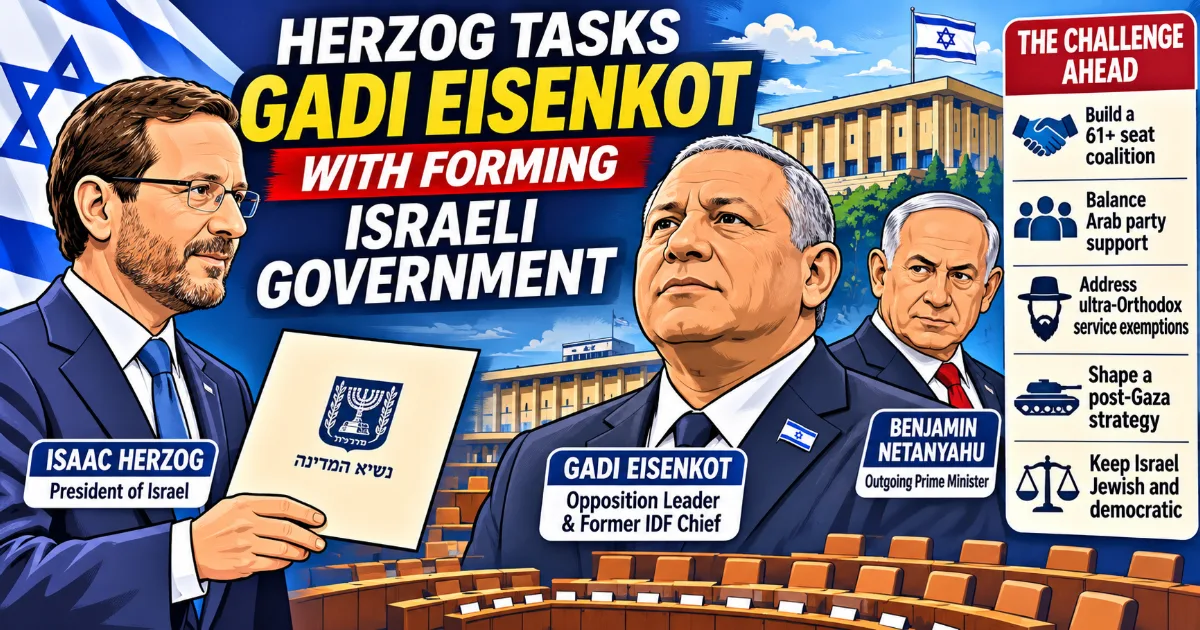
Israel has entered a potentially historic political transition after President Isaac Herzog formally tasked opposition leader Gadi Eisenkot with forming the country's next government. The decision, announced on November 8, 2026, gives the former chief of the Israel Defense Forces the first opportunity to assemble a parliamentary majority and potentially replace Benjamin Netanyahu, who has dominated Israeli politics for much of the past decade.
The development follows the October 27 general election, which produced a deeply divided Knesset without giving either political camp an easy route to government formation. During consultations with representatives of the elected parliamentary factions, 67 members recommended Eisenkot for the task, while 46 recommended Netanyahu. A faction representing seven lawmakers declined to recommend either candidate.
The numbers gave Eisenkot a clear advantage in the presidential consultations, but they do not automatically guarantee that he can form a functioning government. Israel's parliament, the Knesset, has 120 seats, meaning a government generally needs the support of at least 61 lawmakers to secure a parliamentary majority.
Continue Reading
Eisenkot must now turn a collection of political endorsements into a workable coalition. That means negotiating with parties that may agree on the need for political change but disagree sharply on military service, relations with Arab lawmakers, the future of the Gaza conflict, judicial institutions and Israel's national security priorities.
His challenge is particularly complicated because Netanyahu's Likud remains a major political force. The outgoing prime minister has not disappeared from the political landscape, and his supporters continue to have significant representation in parliament.
Eisenkot has promised to pursue a national emergency government capable of addressing Israel's political divisions and security challenges. He has also said he is prepared to consider unconventional political initiatives to achieve that objective. Yet the principles he has placed at the centre of his proposed coalition could exclude some of the very parties whose support may be necessary to reach a majority.
The next few weeks could therefore determine not only who leads Israel but also what kind of political arrangement emerges after a period marked by war, public anger, institutional distrust and deep divisions over Netanyahu's leadership.
How President Isaac Herzog Made His Decision
President Isaac Herzog's decision followed a formal consultation process with representatives of the political factions elected to the 26th Knesset.
The Israeli president does not simply appoint the leader of the party that wins the most seats. After an election, the president consults parliamentary factions and considers which member of the Knesset is most likely to assemble a government capable of obtaining parliamentary support.
These consultations provide political guidance, but the president retains responsibility for deciding whom to nominate to form the government.
On November 5, Herzog announced that 67 lawmakers had recommended Gadi Eisenkot, while 46 had recommended Benjamin Netanyahu. He also explained that the figures did not make the final decision entirely straightforward because disagreements and mutual vetoes existed both between political blocs and within them.
Herzog said he would hold further discussions with political leaders before deciding whom to appoint. His stated objective was to identify the candidate with a realistic possibility of building a stable government.
On November 7, the president informed Eisenkot of his intention to assign him the responsibility. The formal appointment followed on November 8 at the President's Residence in Jerusalem.
Herzog urged Eisenkot to work towards establishing a government that would serve the entire population, including citizens who had not supported him politically. His message emphasised responsibility, national unity and the need to overcome the divisions exposed during the election.
The decision was a significant moment because it gave an opposition leader the first opportunity to form a government rather than automatically returning the mandate to the incumbent prime minister.
However, the president's appointment should not be confused with the transfer of executive power. Eisenkot has been given the opportunity to negotiate and form a government. He must still assemble sufficient parliamentary support, present his proposed administration and secure the required approval of the Knesset.
Until that process is completed, Netanyahu remains the incumbent prime minister.
Who Is Gadi Eisenkot?
Gadi Eisenkot is a former senior military commander who has moved into national politics after a long career in Israel's defence establishment.
Born in 1960, Eisenkot served in the Israel Defense Forces for several decades and eventually became its chief of staff. He held that position from 2015 to 2019, overseeing military planning, operational strategy and major security decisions during a period of continuing regional instability.
His military career shaped his political identity. Eisenkot has generally presented himself as a security-focused leader who values professional planning, institutional discipline and practical decision-making.
He has been associated with a tough military approach towards armed groups threatening Israel, while also criticising political decisions that he believes undermine national security or weaken state institutions.
His experience became particularly relevant after the October 7, 2023, Hamas-led attack on Israel and the subsequent war in Gaza. Eisenkot entered the political arena and served in the wartime political leadership, including the emergency war cabinet established after the attack.
His son, Gal Eisenkot, was killed while serving in the Gaza conflict in December 2023. The loss became a deeply personal part of Eisenkot's public story and brought further attention to his criticism of the government's handling of the war and its broader strategic objectives.
Eisenkot later left the emergency political arrangement, expressing serious disagreements with Netanyahu's approach to the conflict, the handling of hostages and the absence of a clear long-term strategy.
He eventually became a leading figure in the opposition and established the Yashar political platform, presenting himself as an alternative to Netanyahu's leadership.
His rise has attracted attention because he is neither a conventional political careerist nor a leader whose public identity is built primarily around ideological campaigning. His military background gives him credibility among voters concerned about security, while his criticism of Netanyahu appeals to those seeking political change.
Yet military experience alone cannot guarantee success in coalition politics. Forming a government requires compromise, party management and the ability to reconcile competing interests. Those may prove to be the most demanding tests of Eisenkot's political career.
The Election Result: Why Neither Camp Has an Easy Majority
The October 27 election created a fragmented political landscape.
Although Netanyahu's Likud remained a significant force, his political bloc did not emerge with the parliamentary strength required to form a government independently. The anti-Netanyahu camp also faced a difficult arithmetic problem because its constituent parties did not command enough seats without support from other factions.
Reports on the election described Netanyahu's bloc as holding 53 seats, while the core change-oriented opposition bloc held 48. Arab parties collectively accounted for 19 seats, creating a potentially decisive parliamentary group.
The presidential consultation figures reflected a broader alignment. Factions representing 67 lawmakers recommended Eisenkot, while factions representing 46 recommended Netanyahu. Seven lawmakers did not recommend either candidate.
These figures should not be mistaken for a signed coalition agreement. A party may recommend a candidate during presidential consultations without agreeing to join that candidate's government. It may also offer external support on confidence votes or legislation while remaining outside the cabinet.
This distinction is central to understanding Eisenkot's challenge.
He has received enough recommendations to justify the president's decision, but he still needs to negotiate the political arrangements required to govern. Some of the lawmakers who recommended him may be unwilling to join a coalition under all circumstances.
Others may demand policy concessions that conflict with the positions of his existing partners.
A government formed through a narrow majority could also be vulnerable to disagreements over security policy, religious affairs, military service and relations with the Palestinian population.
Israel's political system has repeatedly experienced unstable coalitions and early elections. Eisenkot therefore needs more than a mathematical majority. He needs a coalition that can survive the pressures of governing during a period of serious domestic and regional uncertainty.
Eisenkot's Four Principles: The Foundation of His Proposed Government
Eisenkot has made clear that he does not want to build a government simply by bringing together every politician who opposes Netanyahu. Instead, he has outlined four principles that potential coalition partners must be prepared to accept.
These conditions are intended to define the political identity of the government and distinguish it from the outgoing administration. They also create difficult choices for parties whose support could be essential to securing a majority.
According to the explanation published by the Jewish Telegraphic Agency, the four principles concern Israel's identity as a Jewish and democratic state, the values of the Declaration of Independence, mandatory national service and the dismantling of Hamas's military and governing power.
Israel as a Jewish and Democratic State
The first condition is recognition of Israel as both a Jewish and democratic state.
This principle reflects the constitutional and political foundations of Israel as the national home of the Jewish people, while also recognising democratic institutions and the rights of its citizens.
For Eisenkot, the condition is intended to establish a shared understanding among coalition partners about the character of the state.
It could, however, complicate negotiations with Arab political parties. Their representatives may support changes in government policy, but they may object to political formulations that they believe do not sufficiently recognise the equality and collective rights of Arab citizens.
The issue is therefore not merely symbolic. It concerns how a future government defines citizenship, national identity, minority rights and the relationship between Jewish and Arab communities.
Acceptance of the Values of Israel's Declaration of Independence
The second principle requires coalition partners to accept the values expressed in Israel's Declaration of Independence.
The declaration, proclaimed in May 1948, established the foundation of the modern state and articulated commitments to freedom, justice, peace, equality and religious and cultural rights.
Eisenkot's emphasis on the document is politically significant because it provides a framework for discussing the balance between Israel's Jewish national identity and its democratic obligations.
It also creates a point of contrast with political forces that have supported controversial changes to the judiciary and the distribution of power between government institutions.
For Eisenkot, a government must be built around shared democratic commitments rather than solely around opposition to one political leader.
The difficulty will be translating these broad principles into specific policy agreements. Coalition partners may agree with the language of the declaration while disagreeing over judicial reform, minority rights, religious authority and the powers of the executive.
Mandatory Service for All
The third principle concerns mandatory military, national or civilian service.
This is one of the most difficult conditions because it directly affects the long-standing exemptions enjoyed by many ultra-Orthodox Jewish men studying in religious institutions.
For decades, the question of whether yeshiva students should be required to serve in the military has been one of Israel's most divisive domestic political issues.
The ultra-Orthodox parties have traditionally defended arrangements allowing many full-time religious students to avoid compulsory military service. They argue that religious study is central to Jewish life and should receive protection within the state's political and legal framework.
Eisenkot's position is that national responsibilities should be distributed more equally. His proposal would require wider participation in military, national or civilian service.
The issue has become particularly sensitive after years of war and the growing demands placed on Israel's military personnel and reserve forces.
If the IDF requires a larger pool of recruits and reservists, the question of exemptions becomes more difficult to avoid. Families whose members have repeatedly been called for service may question why other groups are not required to contribute in comparable ways.
But the ultra-Orthodox parties may be unwilling to accept a coalition agreement that significantly changes existing arrangements.
Eisenkot could therefore find himself facing a difficult choice: preserve his principle and risk losing potential partners, or negotiate exceptions that weaken one of his central campaign commitments.
Recognition of Hamas as a Terrorist Organisation
The fourth principle concerns Hamas and the future of Gaza.
Eisenkot has stated that coalition partners must recognise Hamas as a terrorist organisation and support dismantling its military and governing power.
The condition is intended to establish a common security position among parties joining the government.
It is also particularly difficult for Arab political parties, whose leaders may condemn attacks on civilians while resisting political language they believe could be used to justify broader military operations or undermine Palestinian political aspirations.
Ra'am leader Mansour Abbas has faced questions about his position on Hamas. During the presidential consultations, he indicated that he had a clear position but wanted to preserve space for political communication and influence.
The Joint List has also been reluctant to adopt the precise language demanded by Eisenkot.
This creates a major coalition problem. Arab parties may be willing to support a change of government, but they may not accept every condition placed before them.
The four principles are therefore both a political statement and a negotiating framework. They show what Eisenkot wants his government to represent, but they also identify the issues that could prevent him from forming one.
The Arab Parties Could Hold the Key to Government Formation
One of the most consequential aspects of the election is the role of Arab political parties.
Together, Arab parties account for a significant number of Knesset seats. Their parliamentary support could help Eisenkot reach the 61-member threshold required for a government.
Their position is particularly important because the core opposition bloc does not have enough seats on its own.
During the presidential consultations, Arab factions recommended Eisenkot for the task of forming a government. The Joint List and the United Arab List, commonly known as Ra'am, were among the factions supporting his nomination.
However, recommending a candidate is not the same as joining a coalition.
Arab parties have different political identities, priorities and approaches to relations with the Israeli state. They also represent communities that have experienced discrimination, unequal public investment, concerns about policing and disputes over national identity and the Palestinian question.
For these parties, supporting a government could provide an opportunity to influence policies on housing, education, infrastructure, employment, public safety and municipal development.
But they would also face political pressure from voters who may oppose cooperation with a government that continues military operations in Gaza or maintains policies they regard as harmful to Palestinians.
Eisenkot must therefore decide whether Arab lawmakers can support his government without formally entering the cabinet, whether they can join through negotiated arrangements or whether their backing can be secured through a broader parliamentary understanding.
The difficulty is that his fourth principle on Hamas may make such an arrangement politically complicated.
The opposition leader needs Arab support to strengthen his parliamentary position, but he has also established conditions that some Arab parties may find difficult to accept.
This contradiction could become the central obstacle to his government-formation effort.
The Ultra-Orthodox Parties Face a Different Dilemma
The ultra-Orthodox parties are another potential source of parliamentary support, but their demands could conflict with Eisenkot's position on national service.
United Torah Judaism, which has traditionally been aligned with Netanyahu's political camp, did not recommend either candidate during the presidential consultations. Its seven lawmakers could become important in negotiations if Eisenkot seeks to broaden his coalition.
The Shas party is another significant force in ultra-Orthodox politics.
Both parties have strong reasons to defend religious education, religious institutions and the existing arrangements surrounding military exemptions.
Eisenkot's proposed universal-service principle creates a direct challenge to those priorities.
The dispute is not new. Israel has struggled for decades to reconcile the military-service obligations of most Jewish citizens with exemptions granted to many ultra-Orthodox students.
The issue has become more urgent because of the demands created by the war and the need to maintain sufficient military personnel.
A coalition agreement could potentially include phased implementation, alternative forms of service or transitional arrangements. However, any compromise would need to satisfy Eisenkot's partners without appearing to abandon his commitment to equal national responsibility.
The ultra-Orthodox parties may also face pressure from their own supporters if they agree to changes that could affect religious institutions and community life.
This makes their participation uncertain, even if they are not fully committed to Netanyahu's continued leadership.
The result is a complicated political equation. Eisenkot needs a broad coalition, but the policy positions that define his proposed government may limit the number of parties willing to join it.
Benjamin Netanyahu Is Still a Major Political Force
Although Herzog has given Eisenkot the first opportunity to form a government, Netanyahu remains an important figure in the negotiations.
His Likud party continues to hold substantial parliamentary representation, and his supporters have not accepted the election outcome as a political mandate for a straightforward transfer of power.
Netanyahu has argued for a national unity arrangement, presenting cooperation between political camps as necessary for Israel's security and stability. He has also urged Eisenkot to avoid relying on Arab parties for parliamentary support.
The proposal creates a dilemma for Eisenkot.
A unity government involving Netanyahu could potentially reduce the difficulties of assembling a majority. It might also bring together political figures with experience in security and national administration.
However, Eisenkot entered the election as an alternative to Netanyahu and has repeatedly criticised the outgoing government's leadership and handling of national security.
Joining Netanyahu could therefore undermine the central political promise of his campaign.
The two leaders also have significant disagreements over the October 7 attack, the subsequent war, the management of the hostage issue and the direction of Israeli institutions.
Eisenkot has argued that Netanyahu's leadership has contributed to a crisis of public trust and that Israel needs a different political direction.
Netanyahu, on the other hand, remains a skilled political negotiator with a strong party organisation and a loyal political base.
If Eisenkot fails to form a government, Netanyahu could receive another opportunity to assemble a coalition. The president's decision has given the opposition leader the first chance, not eliminated the incumbent's political options.
This makes the coming weeks especially important. Netanyahu will have an incentive to prevent Eisenkot from assembling a stable majority, while Eisenkot must demonstrate that the political support expressed during consultations can be converted into a government.
Israel's Security Challenges Will Shape the New Government
Whoever leads Israel will inherit a difficult security environment.
The country continues to face the consequences of the October 7, 2023, attack and the subsequent war in Gaza. Relations with Hezbollah and the security situation along the Lebanese border remain important concerns. Iran's regional influence and its relationship with armed groups across the Middle East also remain central to Israeli security planning.
Eisenkot's military background may strengthen his credibility in discussions about defence policy, but it will not automatically resolve disagreements over the country's strategic direction.
The new government would need to address military readiness, reserve-force mobilisation, intelligence failures, border security and the long-term future of Gaza.
It would also face difficult questions about hostages, ceasefire arrangements, humanitarian access and the future governance of Palestinian territories.
Eisenkot has been critical of aspects of Netanyahu's wartime leadership, particularly the absence of a clear long-term political strategy. Yet he has not presented himself as a leader who would simply abandon Israel's security objectives.
His military career reflects a strong security outlook. His approach to armed groups and regional threats has often been tough, and a change of prime minister should not automatically be interpreted as a fundamental change in Israel's military policy.
The composition of the coalition will matter greatly. Parties that join the government may have different positions on settlements, Palestinian statehood, military operations and negotiations with regional actors.
A narrow coalition could find it difficult to agree on these issues, especially if security developments require rapid political decisions.
The international community will therefore be watching not only whether Eisenkot forms a government but also which parties enter it and what policy commitments they demand.
The Gaza War and the Question of a Long-Term Political Strategy
One of the most difficult responsibilities facing a new Israeli government will be deciding what comes after the military campaigns in Gaza.
The October 7 attack fundamentally changed Israeli politics and public perceptions of national security. The attack exposed serious failures in intelligence, preparedness and border defence, creating demands for accountability across the political system.
Netanyahu's government has faced criticism over its handling of the war, the absence of a clearly defined post-war arrangement for Gaza and the continuing uncertainty surrounding hostages and security objectives.
Eisenkot has been particularly critical of the government's failure to establish a credible long-term strategy. His military experience gives him a detailed understanding of operational planning, but governing requires political decisions that go beyond military capabilities.
A future administration would need to consider who governs Gaza, how security arrangements are maintained, what role international partners could play and whether a political framework can prevent another cycle of violence.
These questions are likely to create disagreements within any coalition. Some parties may favour a more aggressive military approach, while others may support greater international involvement or a political settlement.
Eisenkot's ability to establish a common position will be an early test of whether his proposed national emergency government can function beyond the immediate objective of replacing Netanyahu.
Relations With the United States and Regional Powers
Israel's relationship with the United States will remain central to its foreign and security policy.
Washington is Israel's most important strategic partner, providing military assistance, diplomatic support and cooperation on intelligence and defence technologies. However, the relationship has also experienced tensions over the conduct of the Gaza war, humanitarian conditions and the future of the Palestinian territories.
A new government under Eisenkot could attempt to rebuild confidence with Washington by presenting a more predictable decision-making process and a clearer long-term strategy.
His military background and experience in national security could help establish credibility with American defence and intelligence officials. Nevertheless, US policy towards Israel will depend on the actual decisions of the new administration rather than the identity of its prime minister alone.
Relations with Arab states will also matter. The future of regional normalisation agreements, cooperation against Iranian influence and the security of trade routes will remain important considerations.
Any new government will need to balance Israel's security requirements with international pressure over Gaza and the wider Israeli-Palestinian conflict.
A political transition could create an opportunity to reconsider diplomatic priorities, but it would not automatically produce a breakthrough in regional relations.
The Economic Challenges Facing the Next Government
Israel's political uncertainty comes at a time when the economy must manage the financial consequences of prolonged military operations and heightened security spending.
War places pressure on government finances through defence expenditure, compensation, reconstruction, mobilisation of reserve personnel and disruptions to businesses. Tourism, construction, technology investment and local economic activity can also be affected by prolonged instability.
The technology sector is particularly important to Israel's economy. The country has a substantial technology and startup ecosystem, with international investors and global companies closely following developments in its political and security environment.
A stable government could help restore confidence by providing clearer economic priorities and reducing uncertainty over regulation, public spending and long-term national planning.
However, coalition negotiations could complicate budget decisions. Parties may demand additional spending for religious institutions, public services, infrastructure, defence or community programmes.
The next government will also have to balance the demands of military preparedness with investment in education, housing, healthcare and economic development.
Eisenkot's ability to build a stable coalition will therefore have consequences beyond the political leadership of the country. It could influence investor confidence, public spending and Israel's capacity to address the economic effects of prolonged conflict.
How Much Time Does Eisenkot Have to Form a Government?
Under Israel's Basic Law: The Government, a member of the Knesset who receives the mandate generally has 28 days to form a government. The president can grant an extension of up to 14 additional days if necessary.
Eisenkot therefore faces an initial period of four weeks, with the possibility of receiving another two weeks.
The first stage will involve identifying which parties are willing to negotiate and determining whether they can agree on the principles of a coalition.
The next stage will be negotiating the distribution of ministerial positions, policy commitments and parliamentary responsibilities. These discussions can become complicated because parties often seek control over ministries that directly affect their political priorities.
Eisenkot will also need to establish whether his potential partners are prepared to support the government consistently on important votes.
A coalition that reaches 61 seats on paper may still be unstable if individual lawmakers or factions are unwilling to support key decisions.
If Eisenkot fails, the president can give another member of the Knesset an opportunity to form a government. Netanyahu could become the next candidate considered for the task.
If the political process fails to produce a viable government, Israel could face another election.
This possibility creates pressure on all political parties. Another election would extend uncertainty, increase political fatigue and potentially reproduce the same parliamentary divisions.
What Happens If Eisenkot Succeeds?
If Eisenkot secures the required parliamentary support, Israel could experience a significant political transition.
His government would represent a change in leadership after Netanyahu's long period of political dominance. It could also bring together parties that have historically disagreed on major questions but share an interest in establishing a different national administration.
The immediate challenge would be to demonstrate that the coalition can govern effectively.
Eisenkot would need to appoint ministers, establish priorities, present a budget and address urgent security and economic questions. He would also have to manage disagreements among partners who may have very different expectations of the new administration.
The success of his government would ultimately depend on whether it can move beyond the common objective of replacing Netanyahu and establish a coherent programme for the country.
If the coalition remains united only by opposition to the former prime minister, it could struggle when confronted with difficult decisions.
A government built around clear principles, practical agreements and realistic expectations would have a stronger chance of lasting.
What Happens If Eisenkot Fails?
Failure to form a government would not necessarily end Netanyahu's political career or automatically trigger another election.
The president could give another Knesset member an opportunity to secure a parliamentary majority. Netanyahu would remain a possible candidate, particularly because Likud continues to have substantial representation.
Another possibility would be an alternative coalition arrangement involving parties currently negotiating with Eisenkot.
If no candidate can establish a government within the constitutional process, the country could move towards another election.
Such an outcome would be politically costly. Israel has already experienced years of polarisation, repeated political confrontations and the pressures of war. Another campaign could deepen divisions without necessarily resolving the underlying disagreements.
It would also delay decisions on the military-service dispute, economic priorities, judicial institutions and the future of Gaza.
For this reason, Eisenkot's appointment represents an opportunity for political change, but also a test of whether Israel's political system can produce a government capable of governing during a national crisis.
Conclusion: A New Opportunity for Political Change, but No Guaranteed End to the Crisis
President Isaac Herzog's decision to task Gadi Eisenkot with forming Israel's next government marks an important moment in the country's political history.
The former IDF chief has secured the support of parliamentary factions representing 67 lawmakers during the presidential consultations, giving him the first opportunity to assemble a majority and potentially replace Benjamin Netanyahu.
But the task ahead is considerably more complicated than the appointment itself.
Eisenkot must reconcile the positions of parties that disagree over Arab political participation, military-service exemptions, the future of Gaza, Israel's national identity and the balance between security and democratic institutions.
His four principles provide a framework for negotiations, but they could also prevent some potential partners from joining his coalition.
The Arab parties may be essential to securing a majority, yet their positions on Hamas and the Palestinian question could conflict with his conditions. The ultra-Orthodox parties could offer additional parliamentary support, but their opposition to compulsory military service for religious students presents another major obstacle.
Meanwhile, Netanyahu remains a powerful political figure with a substantial parliamentary base. If Eisenkot cannot form a government, the incumbent could receive another opportunity to return to power.
The next few weeks will therefore be decisive. They will determine whether the election has created a genuine opportunity for a change in government or simply another period of political negotiations without a clear outcome.
For Israel, the stakes extend far beyond the identity of its next prime minister. The country must address the consequences of the October 7 attack, the future of Gaza, regional security, the burden of military service, economic pressures and growing divisions within Israeli society.
Eisenkot's military experience may help him navigate national security challenges, but his political future will depend on his ability to negotiate, compromise and build trust among very different groups.
Herzog has given him the first opportunity. The harder task now belongs to Eisenkot: turning parliamentary support into a government that can actually govern.
Israel may be approaching a change in leadership, but whether that change produces stability, a new political direction or another election will depend on the coalition negotiations now beginning in Jerusalem.
#IsraelPolitics #GadiEisenkot #IsaacHerzog #BenjaminNetanyahu #IsraelGovernment