One Festival, Many Traditions
India is a land of extraordinary cultural diversity, where the same festival can be celebrated in remarkably different ways across regions, communities, and generations. Dussehra, also known as Vijayadashami, is a wonderful example of this diversity. Celebrated at the conclusion of Navratri, the festival carries a powerful message: the ultimate victory of good over evil, truth over falsehood, and righteousness over injustice.
For some communities, Dussehra is associated with Lord Rama's victory over Ravana, as described in the Ramayana. In other traditions, the day celebrates Goddess Durga's victory over the buffalo demon Mahishasura. Across India, the festival also marks the triumph of courage, devotion, wisdom, and the determination to stand against wrongdoing.
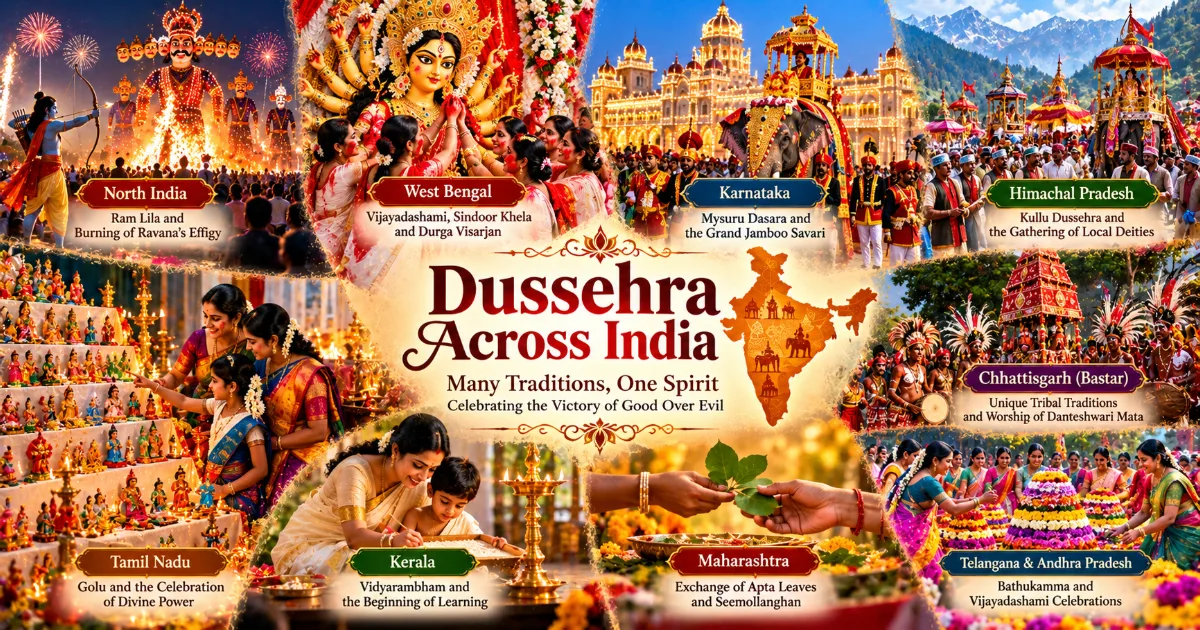
Although the central message remains connected to the victory of good, the ways in which people celebrate Dussehra differ considerably. From the burning of Ravana's effigy in North India to the grand royal celebrations of Mysuru in Karnataka, from the week-long festivities of Kullu in Himachal Pradesh to the distinctive tribal traditions of Bastar in Chhattisgarh, each region contributes its own history, beliefs, art, music, and customs.
Understanding these regional celebrations helps us appreciate that India's cultural identity is not built around a single tradition. Instead, it is a living collection of diverse practices that share common values while preserving their unique local character.
Continue Reading
1. North India: The Victory of Lord Rama Over Ravana
In many parts of North India, Dussehra is primarily associated with Lord Rama's victory over Ravana, the king of Lanka, as narrated in the Ramayana. The festival celebrates the triumph of righteousness and the restoration of justice.
Ram Lila: Bringing the Ramayana to Life
One of the most important traditions associated with Dussehra is Ram Lila, a theatrical presentation of episodes from the life of Lord Rama. These performances often begin during the days leading up to Dussehra and conclude with the battle between Rama and Ravana.
Local performers, actors, musicians, and volunteers work together to bring the epic story to the stage. Some performances take place in neighbourhood grounds, while others are organised on a much larger scale with elaborate costumes, dramatic scenes, and specially constructed stages.
Ram Lila serves more than an entertainment purpose. It helps communities pass stories from the Ramayana to younger generations and encourages reflection on duty, courage, loyalty, sacrifice, and moral responsibility.
Burning of Ravana's Effigy
On Vijayadashami, many communities organise the symbolic burning of large effigies of Ravana. In some places, effigies of Meghnad and Kumbhakarna are also displayed and burned.
Crowds gather to witness the event, which often includes cultural performances, festive markets, food stalls, and family activities. The burning symbolises the defeat of evil and reminds people that arrogance, injustice, and the misuse of power can ultimately lead to downfall.
However, the deeper message of Dussehra is not simply about condemning a character from an epic. It also encourages people to examine the negative qualities that may exist in their own lives, such as anger, greed, dishonesty, jealousy, and excessive pride.
Family Traditions and Community Gatherings
Families often wear new or traditional clothes, visit relatives, share festive meals, and participate in local celebrations. In many places, the day is considered auspicious for beginning new work, purchasing useful items, or making plans for the future.
These customs make Dussehra both a religious occasion and a community celebration that brings people together.
2. West Bengal: Vijayadashami and the Farewell to Maa Durga
In West Bengal, Vijayadashami is closely connected with the conclusion of Durga Puja, one of the most important cultural and religious festivals in the region.
For several days, beautifully decorated pandals, artistic idols, traditional music, cultural performances, and community gatherings transform towns and cities. Kolkata, in particular, is known for its elaborate pandals and creative interpretations of religious and social themes.
The Final Prayers to Goddess Durga
On Vijayadashami, devotees gather to offer their final prayers to Maa Durga before the ceremonial immersion of her idol. The atmosphere is often filled with a mixture of happiness, devotion, and sadness because the festival is coming to an end.
In many Bengali traditions, the Goddess's annual visit is understood through the imagery of a beloved daughter returning to her parental home. Her departure therefore carries a deeply personal meaning for devotees.
Sindoor Khela
A well-known Vijayadashami tradition in many Bengali communities is Sindoor Khela. Married women apply vermilion to the Goddess and, according to local custom, to one another as part of a ritual associated with auspiciousness, marital well-being, and blessings.
The ceremony is often accompanied by smiles, photographs, affectionate greetings, and emotional farewells. Participation and specific customs can vary across communities and families.
Durga Visarjan
After the farewell rituals, the idols are carried in processions to designated immersion sites. Devotional music, drums, chants, and the enthusiasm of the crowds create a memorable conclusion to the celebrations.
For many people, Durga Puja is not only an expression of religious faith but also a celebration of Bengali identity, creativity, craftsmanship, food, music, and community life.
The festival demonstrates how a religious occasion can become an important part of a region's cultural heritage while retaining its spiritual significance.
3. Karnataka: The Royal Grandeur of Mysuru Dasara
Mysuru Dasara is one of Karnataka's most celebrated cultural events. The festival is particularly famous for its royal associations, illuminated Mysore Palace, cultural programmes, and traditional procession.
Unlike celebrations centred mainly on the burning of Ravana's effigy, Mysuru Dasara places considerable emphasis on royal heritage, public festivities, artistic traditions, and the worship of Goddess Chamundeshwari.
The Significance of Goddess Chamundeshwari
Goddess Chamundeshwari is the presiding deity of Mysuru and is traditionally associated with the defeat of Mahishasura. The nearby Chamundi Hills are closely connected with the mythology and cultural identity of the city.
The worship of the Goddess forms an important part of Mysuru Dasara. The festival recalls the victory of divine power over destructive forces and reflects the region's long-standing traditions of devotion.
The Famous Jamboo Savari
One of the major attractions of Mysuru Dasara is the Jamboo Savari, a grand procession associated with the royal traditions of the former Mysore kingdom. The procession features a decorated elephant carrying the golden howdah, which traditionally houses the image of Goddess Chamundeshwari during the celebration.
The procession may include traditional musicians, folk performers, cultural groups, decorated tableaux, and other ceremonial participants. Its precise arrangements can vary from year to year.
The Illuminated Mysore Palace
During Dasara, Mysore Palace is illuminated with thousands of lights, creating one of the festival's most recognisable sights. Visitors gather to admire the palace, attend cultural performances, and experience the festive atmosphere throughout the city.
Mysuru Dasara brings together religious devotion, royal history, music, dance, and regional pride. It is an example of how historical traditions continue to shape modern public celebrations.
4. Himachal Pradesh: The Unique Kullu Dussehra
Kullu Dussehra is another distinctive celebration that demonstrates the diversity of India's festival traditions. Held in the Kullu Valley of Himachal Pradesh, the festival begins on Vijayadashami and continues for several days, unlike many other Dussehra celebrations that conclude on that day.
A Gathering of Local Deities
One of the most remarkable features of Kullu Dussehra is the participation of local deities from villages across the surrounding region. Their decorated palanquins are brought to Kullu as devotees, musicians, and community members gather for the festivities.
The festival reflects the strong relationship between religious traditions, village life, and the cultural identity of the Himalayan region.
Lord Raghunath and the Festival
Lord Raghunath, a form of Lord Rama, holds a central place in Kullu Dussehra. The festival's traditions are associated with the establishment of his worship in the valley and the historical patronage of local rulers.
The gathering of deities and the ceremonial activities surrounding Lord Raghunath give the festival a distinctive character. Rather than focusing exclusively on the burning of Ravana's effigy, Kullu Dussehra emphasises collective devotion, regional traditions, and the participation of village communities.
Folk Music, Dance, and Community Life
Traditional music, dancing, fairs, handicrafts, and local foods add to the festive atmosphere. The event also offers opportunities for artisans and local businesses to showcase their work.
Kullu Dussehra illustrates how India's festivals are shaped by local history and geography. The mountain landscape, village-based religious traditions, and community participation all contribute to the festival's distinctive identity.
5. Chhattisgarh: The Extraordinary Tribal Traditions of Bastar Dussehra
Bastar Dussehra, celebrated in the Bastar region of Chhattisgarh, is one of India's most distinctive Dussehra traditions. It is especially notable because its central customs differ from the widely known narrative of Lord Rama's victory over Ravana.
The festival is deeply connected with the worship of local deities, particularly Danteshwari Mata, and the cultural traditions of Bastar's Indigenous communities.
A Long-Running Cultural Celebration
Bastar Dussehra is known for its extended period of ceremonies, which may continue for several weeks. Its rituals involve community participation, processions, traditional structures, and ceremonies rooted in regional history.
The festival is traditionally associated with Jagdalpur and the surrounding areas. Different communities and groups contribute to the preparations and observances, making it a major expression of local cultural identity.
The Importance of Danteshwari Mata
Goddess Danteshwari Mata holds a central position in the religious traditions of Bastar. Devotees seek her blessings, and the festival's ceremonies reflect the relationship between the Goddess, the region's communities, and their inherited customs.
Although Bastar Dussehra takes place during the broader Dussehra season, its central focus is not the familiar burning of Ravana's effigy. This distinction highlights the importance of understanding regional festivals on their own terms rather than assuming that every celebration follows the same story.
Community Participation and Indigenous Heritage
Bastar Dussehra demonstrates the role of community cooperation in preserving cultural traditions. Ritual responsibilities, collective preparations, and the participation of local groups help sustain practices that have developed over generations.
The festival also provides an opportunity to recognise the diversity of Indigenous cultural heritage in India. Its customs deserve to be understood respectfully within their own historical and religious context.
6. Tamil Nadu: Golu and the Celebration of Divine Power
In Tamil Nadu, Navratri and Vijayadashami are associated with several distinctive customs. One of the best-known traditions is Golu, also called Kolu, in which dolls and figurines are arranged in stepped displays inside homes, temples, and community spaces.
The Tradition of Golu
Families create displays featuring dolls of deities, mythological characters, saints, animals, and scenes from everyday life. Some displays are carefully preserved and expanded across generations, with particular dolls holding sentimental or religious significance.
The arrangement often becomes a focal point for family worship and social gatherings. Friends, relatives, and neighbours may visit one another's homes to view the displays, exchange greetings, and share traditional foods.
Golu is not simply a decorative activity. It offers an opportunity to share stories, preserve artistic traditions, and bring family and community members together during Navratri.
Music, Devotion, and Cultural Learning
In many households, devotional songs and traditional music form part of the celebrations. Women may gather for religious singing, while children learn about deities and stories represented in the displays.
The festival also provides a setting for passing cultural knowledge from one generation to the next. The dolls, songs, rituals, and conversations help connect family traditions with the wider cultural history of the region.
Vijayadashami and New Beginnings
Vijayadashami is regarded by many families as an auspicious time to begin learning or start a new activity. It is associated with Vidyarambham, the ceremonial introduction of young children to learning, although practices and their timing vary across communities.
The emphasis on education and new beginnings gives the day a special meaning beyond the conclusion of Navratri.
7. Kerala: Vidyarambham and the Beginning of Learning
In Kerala, Vijayadashami is widely associated with Vidyarambham, a ceremony that marks the introduction of young children to formal learning. The name combines the ideas of knowledge and beginning.
For many families, this occasion represents a child's first symbolic step into education. Temples and other designated venues may organise ceremonies where children are guided through their first letters or writing exercises.
The First Step Towards Education
During Vidyarambham, a teacher, priest, parent, or another respected guide may help a child write their first letters. In some traditions, the child traces letters in rice or another writing medium while receiving blessings for a successful educational journey.
The ceremony reflects the belief that education is not merely the acquisition of information. It is also a path towards wisdom, understanding, discipline, and personal development.
The Connection Between Vijayadashami and Knowledge
The association between Vijayadashami and learning reflects the wider cultural idea that the day is suitable for beginning meaningful activities. Families may use the occasion to introduce children to music, dance, reading, writing, or other forms of learning.
Although the exact ceremony differs across communities, its central purpose is to encourage a positive beginning and to seek blessings for the child's future.
Vidyarambham highlights another dimension of Vijayadashami: the celebration of knowledge and the importance of learning throughout life.
8. Maharashtra: Apta Leaves and the Tradition of Gold
In Maharashtra, Dussehra is associated with several regional customs, including the exchange of apta leaves as symbolic gold. This practice gives the festival a distinctive social and cultural character.
The Meaning of Apta Leaves
During Dussehra, people may exchange leaves from the apta tree as a symbolic gesture of prosperity and goodwill. The leaves are traditionally treated as representations of gold, reflecting stories and customs associated with the festival.
Friends, relatives, neighbours, and acquaintances exchange the leaves while offering greetings and good wishes. The practice encourages people to visit one another and maintain social bonds.
Seemollanghan: Crossing Boundaries
Another tradition associated with Dussehra in parts of Maharashtra is Seemollanghan, which broadly refers to crossing a boundary. In some communities, people traditionally travel beyond the boundaries of their village or locality as part of the observance.
The practice is linked to older customs and ideas of auspicious journeys, courage, and the beginning of new undertakings. Its form and significance can differ by location.
Worship of Tools and New Ventures
In some communities, Dussehra is also associated with the worship of tools, vehicles, weapons, books, or equipment used in daily work. This reflects respect for the objects and skills that support a person's livelihood.
For farmers, artisans, students, and business owners, the day can provide an opportunity to express gratitude for their work and seek blessings for future success.
These traditions demonstrate how Dussehra connects religious belief with social relationships, professional life, and the hope for prosperity.
9. Telangana and Andhra Pradesh: The Spirit of Bathukamma and Vijayadashami
In Telangana, the festival season around Navratri includes Bathukamma, a distinctive floral celebration closely associated with the region's cultural identity. Vijayadashami is also widely observed in Telangana and Andhra Pradesh, with worship, family gatherings, and local religious customs.
Bathukamma: A Celebration of Flowers and Community
Bathukamma is a festival in which women and girls arrange seasonal flowers into colourful, layered floral formations. The celebrations often include traditional songs, dancing in groups, and gatherings in public spaces.
The festival expresses a strong connection with seasonal flowers, local traditions, community participation, and respect for nature. It has its own distinctive calendar and customs, although it takes place during the broader festive period associated with Navratri and Dussehra.
Vijayadashami Celebrations
Vijayadashami is celebrated through worship of the Goddess, visits to temples, family gatherings, and other regional traditions. Some people begin new activities or seek blessings for education, work, and prosperity.
The precise customs differ among families, communities, and locations. Together, Bathukamma and Vijayadashami reflect the richness of the festive calendar in Telangana and the surrounding region.
10. Why Do Dussehra Traditions Differ Across India?
The regional differences in Dussehra celebrations are not contradictions. They reflect India's long history of cultural exchange, local storytelling, religious devotion, and community traditions.
Local History Shapes Festivals
Many festivals have developed over centuries through the influence of local rulers, temples, religious teachers, storytellers, artists, and community leaders. As a result, a festival may acquire different meanings and practices in different regions.
Mysuru Dasara reflects royal heritage and the worship of Chamundeshwari, while Bastar Dussehra is deeply connected with local deities and Indigenous traditions. Kullu Dussehra highlights the gathering of village deities, and Bengal's Vijayadashami centres on the emotional farewell to Maa Durga.
Each tradition has its own historical and cultural context.
The Same Values Can Be Expressed in Different Ways
Although the ceremonies differ, many Dussehra traditions emphasise courage, devotion, justice, wisdom, gratitude, and the hope for a better future.
The burning of Ravana's effigy symbolises the defeat of evil in one tradition. In another, the worship of Goddess Durga celebrates divine strength and protection. Elsewhere, the festival may emphasise community solidarity, the beginning of education, or the preservation of regional heritage.
These different expressions show how a shared cultural value can be communicated through many forms.
Families and Communities Preserve Traditions
Festivals survive because people continue to practise and teach them. Parents introduce children to family customs, local performers present traditional stories, artisans create religious objects, and community members organise celebrations.
Every generation has a role in deciding how traditions are preserved, adapted, and shared with others. This process keeps India's cultural heritage alive rather than confining it to history books.
11. The Modern Significance of Dussehra
In contemporary India, Dussehra continues to provide opportunities for religious observance, cultural participation, and community engagement. At the same time, its values can be connected with challenges faced in modern life.
Standing Against Injustice
The victory of good over evil encourages people to think about honesty, fairness, and accountability. In everyday situations, this may mean refusing to support wrongdoing, treating others fairly, and taking responsibility for one's actions.
Overcoming Negative Qualities
The stories associated with Dussehra also invite personal reflection. Anger, greed, arrogance, jealousy, and dishonesty can damage relationships and communities. The festival provides an opportunity to reflect on these tendencies and make a conscious effort to improve.
Strengthening Community Relationships
Public celebrations create opportunities for neighbours and families to meet, collaborate, and share experiences. Volunteers, artists, organisers, and local businesses often work together to make the festivities possible.
Such cooperation can strengthen community relationships and encourage respect among people with different backgrounds.
Protecting Cultural and Environmental Heritage
Modern celebrations can also place pressure on public spaces and natural resources. Responsible waste management, careful use of materials, respect for local regulations, and consideration for the environment can help communities celebrate more sustainably.
Preserving cultural traditions and protecting nature should be treated as complementary responsibilities.
Conclusion: India's Diversity Makes Dussehra Special
Dussehra is more than a festival celebrated on a single day. It is a collection of regional traditions that reflect India's religious diversity, historical experiences, artistic creativity, and community life.
In North India, the burning of Ravana's effigy recalls Lord Rama's victory. In West Bengal, Vijayadashami marks the emotional farewell to Maa Durga. Mysuru Dasara showcases royal heritage and the worship of Chamundeshwari, while Kullu Dussehra brings together village deities and local communities. Bastar preserves distinctive Indigenous traditions, Tamil Nadu celebrates Golu, Kerala highlights the beginning of learning through Vidyarambham, and Maharashtra observes customs such as the exchange of apta leaves.
These celebrations differ in their stories, rituals, and expressions, yet each contributes to India's living cultural heritage.
Learning about regional Dussehra traditions helps us appreciate the communities that preserve them and understand why cultural diversity deserves respect. It also reminds us that festivals are not only occasions for celebration but opportunities to reflect on the values we wish to carry into everyday life.
As we celebrate Dussehra, let us remember the importance of truth, courage, compassion, knowledge, and responsibility. Let us respect the traditions of different communities, preserve our cultural heritage, and pass these meaningful customs to future generations.
Wishing everyone a joyful Vijayadashami and a Happy Dussehra! May goodness, wisdom, peace, and prosperity flourish in every home.
#HappyDurgaPuja2026 #vijaydashmi