The Dawn of Freedom
As midnight approached on 14 August 1947, the atmosphere inside the Constituent Assembly in New Delhi was filled with anticipation. India stood on the threshold of a new beginning. After generations of political resistance, mass movements, sacrifices and negotiations, British colonial rule was finally coming to an end.
Outside the Assembly, millions of people waited for the moment when India would become independent. Across the country, celebrations were being prepared. Yet the joy of freedom existed alongside uncertainty, fear and grief. The decision to divide British India had created two new dominions, India and Pakistan, and millions of people were preparing to leave the places they had called home for generations.
At the centre of this historic moment stood Jawaharlal Nehru, who would become independent India's first Prime Minister. His speech, delivered shortly before midnight, described the moment as a meeting with destiny. It expressed the hopes of a nation that had struggled for freedom and now faced the responsibility of building its own future.
But independence was not simply the end of British authority. It marked the beginning of an extraordinary political and social transformation. India had to establish a government, create democratic institutions, integrate hundreds of princely states, manage the consequences of partition and address the enormous challenges inherited from colonial rule.
The birth of independent India was therefore both a moment of celebration and the beginning of a difficult national journey.
The Final Days of British Rule
The British decision to transfer power had been announced through the Mountbatten Plan on 3 June 1947. The plan accepted the partition of British India into two dominions, India and Pakistan.
The Indian Independence Act received royal assent on 18 July 1947. It provided the legal framework for the creation of the two independent dominions.
Pakistan came into existence on 14 August 1947, with Muhammad Ali Jinnah becoming its first Governor-General. India became independent on 15 August 1947, with Lord Mountbatten serving as its first Governor-General.
The two countries emerged from the same colonial administration, but they inherited different territories, political arrangements and administrative challenges.
The division involved the provinces of Punjab and Bengal, both of which were partitioned. The new borders were determined by the Radcliffe Boundary Commission, led by British lawyer Sir Cyril Radcliffe.
Radcliffe had been given an extremely difficult assignment. He had to draw boundaries across regions where religious communities were geographically mixed and where economic, cultural and family connections crossed provincial borders.
The boundary awards were announced on 17 August 1947, after independence had already taken place.
This delay created considerable uncertainty. People celebrated the creation of new countries without knowing precisely which side of the new borders their homes would fall on.
For many families, the arrival of independence was accompanied by the sudden realisation that their villages, towns and ancestral lands might now belong to another country.
The Midnight Speech
On the night of 14 August 1947, the Constituent Assembly gathered in New Delhi for its historic session.
Jawaharlal Nehru addressed the Assembly shortly before midnight. His speech, remembered as the Tryst with Destiny address, became one of the defining moments in India's modern history.
He spoke about the long struggle for freedom and the responsibility that independence placed upon the people of India.
The speech did not present independence as the completion of every national aspiration. Instead, Nehru described it as the beginning of a larger responsibility to serve the people and build a society based on justice and opportunity.
He recognised that freedom would have little meaning unless it improved the lives of ordinary citizens. Poverty, ignorance, disease and inequality remained enormous challenges.
At midnight, India became independent.
On 15 August 1947, the national flag was raised over independent India. The celebrations marked the end of British colonial rule and the beginning of a new chapter in the history of the subcontinent.
For millions of Indians, the moment represented the achievement of a goal pursued by generations of nationalists, reformers, revolutionaries, workers, peasants, students and ordinary citizens.
The Birth of Pakistan
Pakistan had become an independent dominion on 14 August 1947.
Muhammad Ali Jinnah became its first Governor-General, while Liaquat Ali Khan became its first Prime Minister.
The new country consisted of two geographically separated regions. West Pakistan included the territories that now form Pakistan, while East Bengal became East Pakistan, separated from the western wing by more than a thousand kilometres of Indian territory.
The creation of Pakistan was the outcome of a political movement that had developed over several decades. The Muslim League had argued that Muslims required a separate political homeland to protect their political and cultural interests.
The Lahore Resolution of 1940 had provided an important foundation for this demand. Over the following years, the idea of Pakistan became increasingly central to the League's political programme.
However, the new state faced enormous challenges from the beginning.
Pakistan had to establish its central government, organise its administrative institutions, create military and financial structures and accommodate millions of refugees.
The division of assets and administrative resources between India and Pakistan also created difficulties. Government offices, military equipment, financial reserves and records had to be divided between the two dominions.
Karachi became Pakistan's first capital. The new government began functioning under extraordinary pressure, with many administrative decisions having to be made before permanent institutions could be established.
Jinnah's vision for Pakistan, expressed in his address to the Constituent Assembly on 11 August 1947, included equal citizenship and freedom of religion. The future political character of the new country, however, would continue to be debated.
Partition and the Great Migration
While political leaders celebrated independence, one of the largest migrations in modern history was taking place.
The partition of British India caused millions of people to cross the newly created borders. Muslims moved toward Pakistan, while many Hindus and Sikhs moved toward India. The movement was particularly intense in Punjab, where the division of the province separated communities that had lived alongside one another for generations.
Families left their homes, farms, businesses and places of worship. Some travelled in organised groups, while others fled in fear as violence spread through their districts.
Railway stations, roads and refugee camps became important parts of the migration. Trains carrying displaced families sometimes arrived at their destinations after experiencing attacks along the way.
The violence was devastating. Communities were targeted because of their religious identity, and ordinary people were caught in circumstances they had little power to control.
The exact number of people killed remains uncertain. Historical estimates vary, but the death toll is generally understood to have reached several hundred thousand and may have been considerably higher.
Around 14 to 18 million people are commonly estimated to have been displaced across the borders, although figures vary according to the methods used by historians.
The migration also created a long-term refugee crisis. Families arrived in unfamiliar towns without homes, property or stable employment. Governments had to organise shelter, food, medical assistance and opportunities for resettlement.
Partition was not simply the division of territory. It was the separation of families, the loss of homes and the destruction of many local relationships that had developed over generations.
Punjab: A Province Divided
Punjab experienced some of the worst consequences of partition.
Before 1947, Punjab had a diverse population consisting of Muslims, Hindus and Sikhs. The province was also an important agricultural and commercial region, with extensive irrigation systems and railway connections.
The Radcliffe boundary divided Punjab into eastern and western sections. Western Punjab became part of Pakistan, while eastern Punjab became part of India.
The division created enormous uncertainty because religious communities were spread across the province rather than separated into clearly defined territories.
Muslim families in areas that became part of India often felt compelled to move toward Pakistan. Hindu and Sikh families in areas that became part of Pakistan faced similar pressures to migrate toward India.
Violence, fear and retaliatory attacks transformed the region. Villages were abandoned, agricultural communities were disrupted and commercial networks collapsed.
The refugee crisis placed enormous pressure on both governments. India had to provide accommodation and employment to displaced Hindus and Sikhs arriving from western Punjab and other parts of Pakistan. Pakistan faced the challenge of receiving large numbers of Muslim refugees, many of whom had left valuable property behind.
The effects of partition remained visible in the political, economic and social development of both countries for decades.
Bengal: Another Divided Province
Bengal was also partitioned in August 1947.
Western Bengal became part of India, while eastern Bengal became part of Pakistan as East Bengal. It was later renamed East Pakistan.
The division affected communities that shared language, literature, food traditions, family connections and commercial networks.
Calcutta, which had been the capital of British India until 1911 and remained a major economic centre, became part of India.
Eastern Bengal, with its agricultural economy and important river systems, became geographically separated from Pakistan's western wing.
The partition of Bengal also created a long-lasting refugee movement. Many Hindus moved from East Bengal into India, particularly into West Bengal. Migration continued in different waves over subsequent decades.
Unlike Punjab, where the initial violence and displacement were particularly concentrated around the time of partition, migration from Bengal continued over a much longer period.
The division affected agriculture, trade, transport and family life. It also created political and cultural questions that would later become central to the history of Bangladesh.
Gandhi and the Struggle for Communal Peace
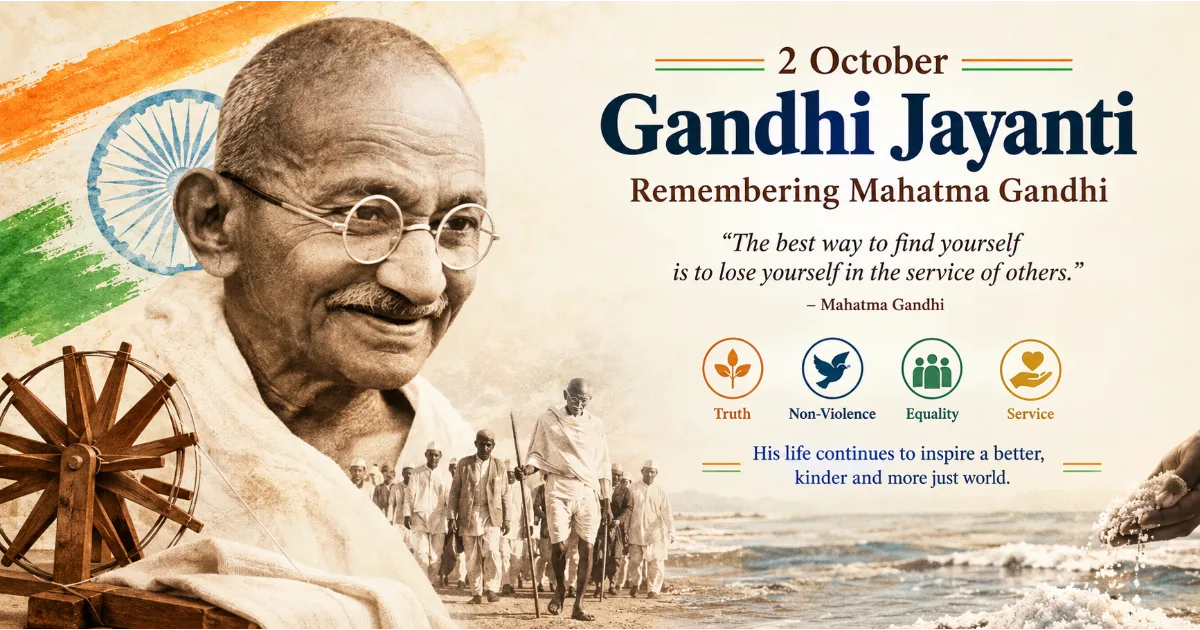
One of the most remarkable aspects of independence was Gandhi's absence from the celebrations in Delhi.
While political leaders gathered to mark the transfer of power, Gandhi was in Calcutta, attempting to prevent communal violence.
He believed that the freedom of India would be incomplete if people could not live together peacefully. For him, independence was not simply a matter of replacing British officials with Indian leaders. It also required moral responsibility, social harmony and respect for every community.
Gandhi had spent months travelling through areas affected by communal violence. He had visited Noakhali in eastern Bengal and later moved to Bihar, encouraging people to reject revenge and protect vulnerable communities.
In August 1947, his presence in Calcutta helped create an atmosphere of restraint during a period of extreme tension.
On 15 August, Gandhi did not participate in the official celebrations. He continued his work of encouraging peace and reconciliation.
His approach was not universally accepted, and many people disagreed with his political positions. Yet his efforts during partition demonstrated his belief that national freedom and communal harmony were inseparable.
The Integration of the Princely States
One of the greatest challenges facing independent India was the future of the princely states.
British India consisted of directly administered provinces and hundreds of princely states ruled by Indian princes under British paramountcy.
With the end of British rule, paramountcy would lapse. The rulers were expected to decide whether to join India or Pakistan, taking account of geographical, political and practical considerations.
There were more than 560 princely states, ranging from large territories with significant populations to small estates with limited administrative authority.
The Indian government understood that political fragmentation could threaten the stability of the new country.
Sardar Vallabhbhai Patel, India's Deputy Prime Minister and Home Minister, played a central role in the integration process. V. P. Menon, a senior civil servant, also made an important contribution to the negotiations.
Together, they worked to persuade the rulers to sign Instruments of Accession, through which they agreed to transfer authority over defence, external affairs and communications to the Indian Union.
Most princely states joined India through negotiation. However, several cases created serious difficulties.
Junagadh: A Difficult Accession
Junagadh was a princely state on the Kathiawar peninsula in present-day Gujarat.
Its ruler, Nawab Mahabat Khan III, was Muslim, while the majority of the population was Hindu.
In August 1947, the Nawab's government decided to accede to Pakistan, despite Junagadh's geographical location within the territory that would otherwise become India.
Pakistan accepted the accession in September 1947.
The Indian government objected, arguing that the decision created serious geographical and political difficulties. The situation became increasingly unstable as local opposition developed and administrative authority weakened.
A provisional government opposed to the Nawab's decision emerged, and Indian forces entered the region after the Nawab fled to Pakistan.
In February 1948, a plebiscite was held. An overwhelming majority of those who voted supported accession to India.
Junagadh therefore became part of the Indian Union.
The episode demonstrated how the integration of princely states could involve political negotiations, popular movements and questions of geographical practicality.
Hyderabad: The Largest Princely State
Hyderabad was one of the most important princely states in India.
It was ruled by the Nizam, Mir Osman Ali Khan, and had a large population, significant financial resources and its own administrative institutions.
The Nizam wanted Hyderabad to remain independent rather than immediately join India or Pakistan.
The Indian government was concerned because Hyderabad was located within the geographical centre of India. An independent Hyderabad could create serious difficulties for national unity and communications.
Negotiations continued, and a Standstill Agreement was signed in November 1947 to maintain existing arrangements temporarily.
However, tensions increased within the state. The Razakars, a militia associated with the Majlis-e-Ittehadul Muslimeen, became increasingly influential and were involved in violence and intimidation.
There was also opposition to the Nizam's rule from different political and social groups, including the Telangana peasant movement.
In September 1948, the Indian government launched a military operation known as Operation Polo. Hyderabad's forces surrendered after a short campaign, and the state was integrated into India.
The operation was followed by serious violence, and later investigations documented killings and abuses affecting civilians.
The integration of Hyderabad was a major turning point in the consolidation of the Indian Union, but it also revealed the human costs that could accompany the process.
Kashmir: The Unresolved Question
The princely state of Jammu and Kashmir presented one of the most complicated challenges of partition.
It was ruled by Maharaja Hari Singh, whose population included Muslims, Hindus, Buddhists and other communities.
The Maharaja initially sought to delay a decision about accession, hoping to preserve the state's independence.
However, the situation changed dramatically in October 1947 when armed tribal forces from Pakistan entered Kashmir.
The invasion created a military emergency. The Maharaja requested assistance from India, and the Indian government required accession as the legal basis for sending troops.
On 26 October 1947, the Maharaja signed the Instrument of Accession to India. Indian troops were subsequently airlifted to Srinagar.
The fighting developed into the First Indo-Pakistani War of 1947 to 1948.
The conflict continued until a United Nations-supported ceasefire came into effect on 1 January 1949. The ceasefire left the former princely state divided between areas administered by India and Pakistan.
Kashmir would remain one of the most enduring and sensitive disputes between the two countries.
Its history cannot be separated from the circumstances of partition, the decisions of the princely ruler, the political aspirations of the people and the military confrontation between the new states.
Building a Democratic Republic
Even as the new Indian government dealt with partition and princely states, it had to establish a permanent constitutional system.
The Constituent Assembly had begun meeting in December 1946, before independence. After 15 August 1947, it became the constitution-making body of sovereign India.
Dr. Rajendra Prasad served as its president, while Dr. B. R. Ambedkar became chairman of the Drafting Committee in August 1947.
The Assembly included representatives from different regions, communities and political traditions. Its members debated the structure of government, fundamental rights, citizenship, federalism, judicial independence and the responsibilities of the state.
The challenge was enormous. India was a country of extraordinary linguistic, religious, cultural and social diversity. Its constitution had to create a common political framework without erasing that diversity.
The framers also faced the legacy of colonial rule, including economic inequality, limited education, social discrimination and the concentration of administrative power.
The Constitution was intended to establish a democratic republic in which political authority would ultimately rest with the people.
It would take more than two years of debate and drafting before the Constitution was completed.
The First Challenges of Independent India
The new government inherited an economy shaped by colonial priorities.
India had important agricultural and industrial sectors, but poverty remained widespread. Literacy levels were low, public health systems were limited and infrastructure was unevenly developed.
Partition disrupted railway connections, commercial networks and agricultural systems. The division of Punjab affected irrigation arrangements, while the separation of Bengal disrupted trade and transport.
The refugee crisis placed enormous pressure on public finances and administrative institutions.
The government had to organise relief camps, provide housing, restore employment opportunities and help displaced families rebuild their lives.
There were also questions about the division of military personnel, financial resources and government assets between India and Pakistan.
The new government had to establish diplomatic relations, maintain internal security and create institutions capable of functioning independently of Britain.
These challenges required difficult decisions and long-term planning.
Independence had ended colonial sovereignty, but it had not immediately removed the economic and social problems inherited from the colonial period.
The Leaders of a New India
Jawaharlal Nehru became India's first Prime Minister and led the government through the early years of independence.
He supported parliamentary democracy, scientific development, industrialisation, secular citizenship and an active role for India in international affairs.
Sardar Vallabhbhai Patel, as Deputy Prime Minister and Home Minister, concentrated on national integration and the administrative consolidation of the country.
Dr. B. R. Ambedkar played a central role in constitution-making and argued for constitutional safeguards, social equality and the protection of individual rights.
Dr. Rajendra Prasad became the first President of the Republic of India when the Constitution came into force in 1950.
Maulana Abul Kalam Azad, India's first Education Minister, contributed to the development of the country's educational institutions and national cultural policy.
These leaders had different political philosophies and sometimes disagreed over important questions. Yet they shared the responsibility of transforming a newly independent country into a functioning democratic state.
The success of this process would depend not only on political leadership but also on the participation of millions of ordinary citizens.
The Meaning of Independence
The independence of 1947 represented the culmination of a long and complicated struggle.
The freedom movement had included constitutional reformers, mass protesters, revolutionaries, social reformers, workers, peasants, students, women and political organisations with different ideas about India's future.
There was no single path to independence. The final outcome emerged from decades of political mobilisation, international changes, economic pressures, administrative negotiations and the weakening of British power after the Second World War.
The creation of India and Pakistan also demonstrated that the end of colonial rule did not automatically resolve the political disagreements that had developed during the colonial period.
For India, independence began a difficult process of building democratic institutions, integrating princely states and addressing social and economic inequalities.
For Pakistan, independence created the responsibility of constructing a new state across two geographically separated regions.
For millions of ordinary people, the period brought both freedom and loss. Some celebrated the creation of a new country, while others mourned relatives, abandoned homes and communities destroyed by violence.
The history of 1947 must therefore be remembered in its entirety. It was a moment of extraordinary political achievement, but also a period of immense human suffering.
India had become independent, but the work of building the nation had only begun.
Next Episode: Episode 60, The Making of the Indian Constitution and the Birth of the Republic
In the next episode, we will explore how the Constituent Assembly transformed the hopes of independence into a constitutional framework. We will examine Dr. B. R. Ambedkar's role, the debates over fundamental rights, secularism, federalism and universal adult franchise, and the adoption of the Constitution on 26 November 1949. We will also follow India's transformation into a sovereign democratic republic on 26 January 1950.
#HistoryCorner #IndianIndependence #PartitionOfIndia #PrincelyStates #HistoryOfIndia