
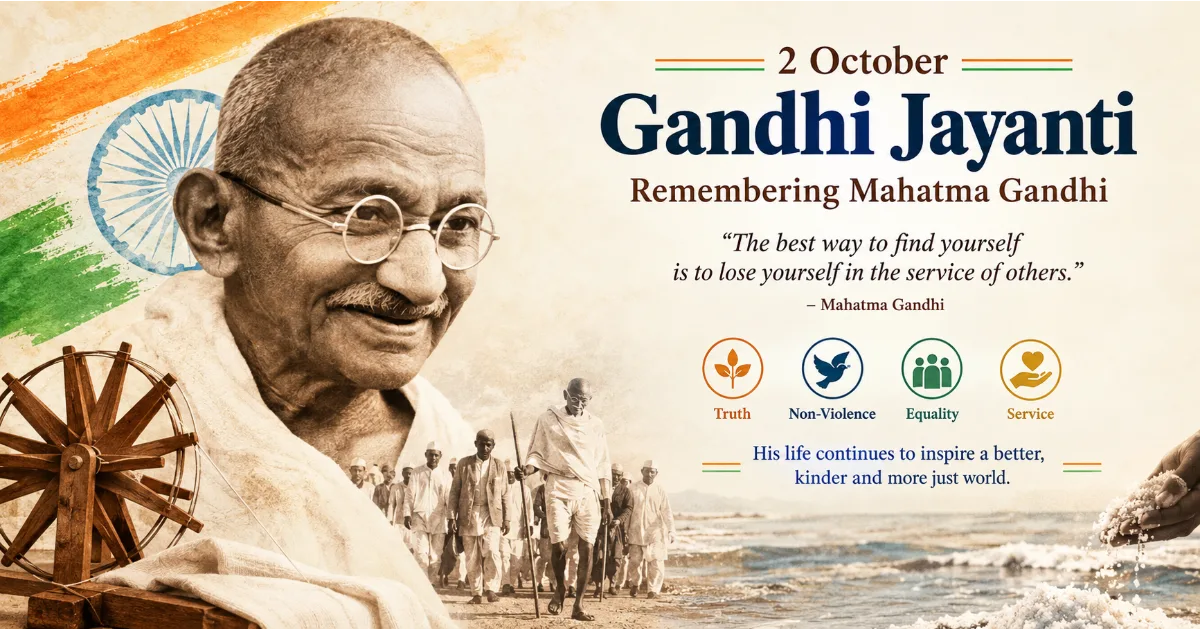
Introduction: Why 2 October Is Remembered Across India
2 October is observed across India as Gandhi Jayanti, the birth anniversary of Mohandas Karamchand Gandhi, popularly known as Mahatma Gandhi or Bapu. Born on 2 October 1869 in Porbandar, Gujarat, Gandhi went on to become one of the most influential figures of India's freedom movement and one of the most widely recognised advocates of non-violent resistance in modern history. His life was not limited to political struggle against British rule. It was also a long journey involving truth, self-discipline, social reform, economic self-reliance, communal harmony, dignity of labour and the belief that political freedom should be accompanied by responsibility towards society.
Gandhi's name has become deeply connected with India's struggle for independence. His image is associated with the spinning wheel, khadi, long marches, peaceful protests, Satyagraha, the Salt March and his efforts to bring ordinary people into the national movement. His approach to politics was different from conventional ideas of power because he believed that resistance could be strong without being violent. He argued that people could challenge injustice through civil disobedience, non-cooperation, boycotts, marches and collective action while refusing to respond to violence with further violence.
The importance of Gandhi Jayanti goes beyond remembering the birthday of a historical personality. It provides an opportunity to understand one of the most important periods in Indian history and to examine the ideas that shaped Gandhi's public life. It also provides an opportunity to look critically at his achievements, disagreements, controversies and limitations. Gandhi was not a person without contradictions. His views changed over time, his decisions were sometimes criticised and several aspects of his political and social thought continue to be debated. A meaningful understanding of his legacy therefore requires both historical appreciation and critical examination.
The significance of 2 October also extends beyond India. The United Nations observes the date as the International Day of Non-Violence, reflecting the global influence of the principles associated with Gandhi's philosophy. His methods of non-violent resistance influenced political and social movements in different parts of the world. While each movement adapted these ideas according to its own circumstances, Gandhi became internationally associated with the possibility of confronting injustice without relying primarily on physical violence.
The Early Life of Mohandas Karamchand Gandhi
Mohandas Karamchand Gandhi was born on 2 October 1869 in Porbandar, a coastal town in present-day Gujarat. He belonged to a family connected with public administration and grew up in the social and cultural environment of nineteenth-century western India. His early years were shaped by family values, religion, traditions and the social conditions of the time. Nothing in his childhood guaranteed that he would eventually become a major political leader or an international symbol of non-violence.
Gandhi's early education took place in Gujarat, and as a young man he eventually travelled to England to study law. His decision to go to London represented a major transition. He was entering a society that was culturally different from the environment in which he had grown up. His years in England exposed him to new ideas, social customs and intellectual influences. He eventually qualified as a barrister and returned to India with the intention of establishing a legal career.
His initial professional life in India was not particularly successful. Gandhi found it difficult to establish himself as a lawyer, and his early experiences did not immediately suggest the political future that awaited him. An opportunity to travel to South Africa for legal work eventually changed the direction of his life. The years he spent there became one of the most important stages in his personal and political development.
Gandhi's Transformation in South Africa
Gandhi travelled to South Africa in 1893 to work on a legal case. He expected to remain there for a relatively limited period, but his experiences in the country had a profound effect on him. He encountered racial discrimination directed towards Indians and experienced situations in which his dignity and legal rights were challenged because of his race.
One of the most famous incidents associated with his time in South Africa occurred when he was removed from a first-class railway compartment despite possessing a valid ticket. The incident exposed him to the reality that formal legal rights did not necessarily protect Indians from racial discrimination. Instead of simply accepting the experience and returning to India, Gandhi began to think about how individuals and communities could organise against discriminatory practices.
South Africa became the environment in which Gandhi's political philosophy began to take shape. He worked with the Indian community, organised campaigns and experimented with methods of protest. These experiences gradually changed his understanding of resistance. He began to develop the idea that injustice could be opposed through disciplined collective action without relying on physical violence.
His South African experience was therefore much more than an episode in his career. It was a period of political education. Gandhi learned how to organise people, communicate political demands, negotiate with authorities and develop strategies for resisting discriminatory laws. It was also during this period that his ideas about truth, non-violence and civil resistance became more clearly defined.
Understanding Satyagraha
One of the most important concepts associated with Gandhi is Satyagraha. The term is often translated as "truth force" or "holding firmly to truth." For Gandhi, Satyagraha was not simply a method of peaceful protest. It represented a philosophy of resistance based on truth, non-violence, courage and willingness to accept personal suffering.
Gandhi believed that resisting injustice did not require treating the opponent as a person who had to be destroyed. Instead, the purpose of resistance was to expose injustice and appeal to the conscience of the person or institution responsible for it. A Satyagrahi was expected to resist unjust actions while attempting to avoid hatred towards the individual opponent.
This did not mean that Gandhi believed people should remain passive in the face of injustice. His approach involved active resistance. People could refuse to obey unjust laws, withdraw cooperation, boycott institutions, participate in marches and engage in civil disobedience. What distinguished the approach was the attempt to maintain non-violence even when facing punishment or aggression.
Satyagraha therefore required courage. A person participating in civil disobedience had to understand that refusing to obey an unjust law could lead to arrest or imprisonment. Gandhi believed that accepting such consequences without retaliating through violence could demonstrate the seriousness of the moral position being taken.
The concept also reflected Gandhi's belief that the means used to achieve a goal were extremely important. He did not believe that a good objective automatically justified every method used to reach it. If a movement seeking freedom became dependent on hatred and violence, he worried that the resulting society might carry those habits into the future.
Gandhi Returns to India
After spending many years in South Africa, Gandhi returned to India in 1915. By this time, he had developed considerable experience in community organisation and non-violent resistance. His return occurred during an important period in India's political development, when opposition to British rule was growing and different forms of nationalism were emerging.
Gandhi spent considerable time travelling across India and attempting to understand the conditions faced by ordinary people. He met farmers, workers, political leaders and local communities. This period helped him understand that India's political struggle could not be limited to educated urban groups. If independence was to become a truly national movement, ordinary people would need to participate.
Gandhi gradually became one of the central figures of the Indian National Congress. His political approach emphasised mass participation and connected the demand for political freedom with social and economic questions. He believed that independence should not simply mean replacing British administrators with Indian administrators. It should also involve building a society in which ordinary people had dignity and a greater role in shaping their own lives.
Gandhi and the Champaran Movement
One of Gandhi's early major campaigns in India took place in Champaran in Bihar. Farmers there faced difficulties connected with the cultivation of indigo under arrangements imposed by European planters. Gandhi travelled to the region to investigate the grievances of the farmers and became involved in organising support for them.
The Champaran campaign became significant because it demonstrated Gandhi's method of combining investigation, public mobilisation, negotiation and civil resistance. Rather than immediately beginning a large-scale confrontation, he first attempted to understand the conditions of the farmers and collect information about their grievances.
The campaign helped establish Gandhi as a leader who was willing to engage directly with the problems faced by ordinary people. It also demonstrated his belief that national politics could not be separated from local economic and social conditions.
The Kheda and Ahmedabad Struggles
Gandhi also became involved in other local struggles, including the Kheda campaign in Gujarat and the Ahmedabad mill workers' dispute. These campaigns further developed his understanding of mass mobilisation and negotiation.
The Kheda struggle involved farmers facing difficulties in paying land revenue during a period of poor harvests. Gandhi and other leaders supported the demand that revenue collection should take account of the economic conditions faced by the farmers.
The Ahmedabad dispute involved textile workers seeking better working conditions and wages. Gandhi's involvement demonstrated that his political activities were not limited to the question of British rule. He was also interested in economic relationships between workers and employers and in the broader question of social justice.
These early campaigns helped establish the methods that would later become central to larger national movements. Gandhi connected local grievances with principles of justice, organised collective action and encouraged participants to maintain discipline.
The Non-Cooperation Movement
The Non-Cooperation Movement became one of Gandhi's major national campaigns. Gandhi believed that colonial rule depended partly upon the cooperation of Indians. If people withdrew their cooperation from colonial institutions, the system could be challenged.
The movement encouraged people to boycott certain institutions and products associated with British rule. It also encouraged the use of Indian-made goods and promoted the idea that people could participate in the freedom struggle through everyday choices.
The importance of the Non-Cooperation Movement was partly its ability to involve large numbers of ordinary citizens. Politics was no longer limited to meetings of political leaders. Students, workers, traders, farmers and other sections of society became involved in different ways.
However, the movement also demonstrated the difficulty of maintaining non-violent discipline on a mass scale. Gandhi believed that violence could fundamentally undermine the principles of the campaign.
Chauri Chaura and Gandhi's Decision to Withdraw
The Chauri Chaura incident in 1922 became a major turning point. During a protest in the town of Chauri Chaura, violence broke out and police personnel were killed. Gandhi regarded the incident as evidence that the movement had not developed sufficient discipline to remain non-violent.
He therefore decided to withdraw the Non-Cooperation Movement. The decision generated disappointment and criticism among many supporters who believed the movement was gaining momentum. However, Gandhi considered non-violence to be more than a political tactic. It was a fundamental principle of the movement.
The episode demonstrates one of the most complicated aspects of Gandhi's leadership. He was willing to sacrifice political momentum when he believed that the methods being used had moved away from the principles he considered essential.
The Philosophy of Non-Violence
Ahimsa, or non-violence, became one of the central ideas associated with Gandhi. However, Gandhi's understanding of non-violence was more demanding than simply avoiding physical aggression.
He believed that non-violence required people to control hatred and hostility. A person could strongly oppose an unjust system while refusing to dehumanise the people involved in that system. This distinction was central to his approach to political resistance.
Non-violence also required courage. Gandhi did not believe that avoiding confrontation was the same as non-violence. In his view, a person who refused to resist injustice because of fear was not necessarily practicing true non-violence. Non-violent resistance required the courage to confront injustice while refusing to respond through violence.
This principle became one of the most influential aspects of his legacy. It provided an alternative to the assumption that political change necessarily required armed conflict.
The Role of Swadeshi in Gandhi's Movement
Swadeshi became another important part of Gandhi's political and economic philosophy. The idea encouraged Indians to use goods produced within the country and reduce dependence on imported British products.
Gandhi connected Swadeshi with economic self-reliance. He believed that colonial economic policies had weakened local industries and contributed to economic dependence. Encouraging local production could therefore become both an economic and political form of resistance.
The spinning wheel became a major symbol of Swadeshi. Gandhi encouraged people to spin thread and wear khadi. The practice represented more than clothing. It was intended to promote self-reliance, local production and respect for manual labour.
Khadi and the Spinning Wheel
Khadi became one of the most recognisable symbols of Gandhi's philosophy. Gandhi deliberately adopted simple clothing and encouraged Indians to use hand-spun and hand-woven cloth.
The spinning wheel represented self-reliance and participation. A person did not need to be a political leader to contribute to the freedom movement. By spinning thread or choosing khadi, an ordinary person could connect personal behaviour with the larger national struggle.
Gandhi also saw the spinning wheel as a symbol of dignity of labour. He wanted people to recognise the value of productive work rather than treating manual labour as inferior.
The image of Gandhi sitting at the spinning wheel eventually became one of the most powerful visual representations of the freedom movement.
The Salt March and Civil Disobedience
The Salt March of 1930 was one of the defining moments of Gandhi's political career. The campaign challenged the British salt laws and became an example of how an everyday commodity could become a symbol of political resistance.
On 12 March 1930, Gandhi began a march from Sabarmati Ashram towards Dandi on the Gujarat coast. The journey covered roughly 240 miles and attracted increasing attention as it progressed.
When Gandhi reached Dandi, he symbolically broke the salt law by making salt from seawater. The act was simple, but its political significance was considerable. Salt was something used by people across economic and social classes, making it an effective symbol for a mass civil disobedience campaign.
The Salt March helped transform civil disobedience into a nationwide movement. People in different parts of India participated in protests, boycotts and other acts of resistance.
Why the Salt March Became So Powerful
The Salt March demonstrated Gandhi's ability to connect a complicated political issue with something ordinary people understood immediately. Salt was part of everyday life. The colonial salt regulations therefore provided a direct way for people to see how political authority affected ordinary households.
The march also demonstrated the importance of symbolism. Gandhi's long walk attracted attention because it was both a physical journey and a political statement. Photographs and reports of the march reached audiences far beyond the people who participated directly.
The campaign also showed that political resistance did not always need to involve weapons or violent confrontation. An ordinary act, when performed collectively and deliberately, could become a powerful form of civil disobedience.
Gandhi and the Indian National Congress
Gandhi became one of the most influential leaders of the Indian National Congress, but the Congress itself contained many different political opinions. Leaders disagreed about economic policy, industrialisation, constitutional reform, socialism, political strategy and the pace of independence.
Gandhi worked with many leaders, including Jawaharlal Nehru and Vallabhbhai Patel, but disagreements were an ordinary part of the movement. Other figures, such as Subhas Chandra Bose, developed different approaches to the struggle against British rule.
The freedom movement should therefore not be understood as a movement in which everyone agreed with Gandhi. His influence was considerable, but Indian nationalism contained multiple traditions and strategies.
Gandhi and Jawaharlal Nehru
Gandhi and Jawaharlal Nehru shared the goal of Indian independence, but they did not always share the same ideas about India's future. Nehru was more strongly attracted to industrialisation, scientific development and modern economic planning, while Gandhi placed greater emphasis on village economies, local production and simplicity.
Their relationship involved both cooperation and disagreement. Gandhi recognised Nehru's importance to the younger generation and supported his political role, while Nehru respected Gandhi's enormous influence despite differences in their political and economic ideas.
Their relationship demonstrates that political movements can contain different visions of the future while still sharing a broad common objective.
Gandhi and Subhas Chandra Bose
Gandhi's relationship with Subhas Chandra Bose was also complex. Bose was a prominent nationalist leader who eventually pursued a different strategy for India's independence, including the organisation of the Indian National Army.
The differences between Gandhi and Bose reflected larger debates within the independence movement about methods, timing and the use of force. Gandhi remained committed to non-violent resistance, while Bose believed that armed struggle could play a role in ending British rule.
Studying these differences is important because it shows that India's independence movement was not based on one political strategy.
Gandhi and Vallabhbhai Patel
Vallabhbhai Patel was another major leader associated with Gandhi and the Congress. Patel participated in several movements and became an important organiser.
Gandhi and Patel had a close political relationship, although they also had differences. Patel was known for his organisational abilities and practical approach, while Gandhi placed greater emphasis on moral principles and non-violence.
After independence, Patel played a major role in the integration of princely states into the Indian Union. His contribution demonstrates again that India's transition to independence involved many leaders performing different roles.
Gandhi and Dr. B. R. Ambedkar
Gandhi's relationship with Dr. B. R. Ambedkar remains one of the most important and debated relationships in modern Indian history. Both were deeply concerned with the condition of communities facing caste discrimination, but their approaches differed significantly.
Gandhi campaigned against untouchability and promoted social reform. Ambedkar, however, argued for structural changes, political representation and the destruction of caste itself. Their disagreements became especially significant during debates surrounding political representation for communities historically subjected to untouchability.
The Poona Pact of 1932 emerged from these disagreements. Understanding the relationship between Gandhi and Ambedkar is essential for understanding the complexity of debates surrounding caste, political representation and social justice during the freedom movement.
Gandhi and the Fight Against Untouchability
Gandhi regarded untouchability as a serious moral and social problem. He campaigned for the dignity and inclusion of communities that faced social exclusion.
He travelled to different parts of India, spoke against discriminatory practices and encouraged social reform. He also sought to promote greater access to public spaces and religious institutions.
However, Gandhi's approach to caste and untouchability has been widely debated. Ambedkar and later scholars and activists criticised several aspects of Gandhi's approach. Contemporary readers therefore need to understand both Gandhi's anti-untouchability campaigns and the limitations identified by his critics.
This is an important part of studying historical figures honestly. Recognising a person's contribution does not require ignoring disagreements about their methods or ideas.
Gandhi and Women's Participation
Women played a significant role in India's freedom movement, and Gandhi encouraged their participation in mass campaigns. Women took part in boycotts, marches, picketing and civil disobedience.
Gandhi believed that women could play an important role in non-violent resistance. His campaigns created opportunities for many women to participate publicly in political activity.
At the same time, Gandhi's views on gender and women's roles have also been examined critically. His expectations about women's behaviour and morality reflected aspects of the social context in which he lived. Contemporary discussions therefore consider both the opportunities his movements created for women and the limitations of his views.
Gandhi's Understanding of Religion
Religion played a significant role in Gandhi's personal and political thought. He drew inspiration from different religious and philosophical traditions and believed that different faiths could contribute to the search for truth.
Gandhi did not advocate a political system in which one religion dominated others. Instead, he emphasised religious tolerance and mutual respect.
His belief in interfaith harmony became particularly important during periods of communal tension. He repeatedly argued that India's diversity should be treated as a strength rather than a reason for conflict.
Gandhi and Communal Harmony
Gandhi devoted considerable attention to Hindu-Muslim relations and communal harmony. He believed that independence would have limited meaning if Indians fought one another because of religious identity.
During periods of communal violence, Gandhi travelled to affected areas and attempted to encourage reconciliation. His presence in these places reflected his belief that peace required more than political agreements. It required rebuilding trust between ordinary people.
His efforts became particularly important during the period surrounding Partition.
Partition and the Pain of 1947
India achieved independence on 15 August 1947, but independence came with the Partition of British India. Partition resulted in enormous violence, displacement and suffering.
Millions of people crossed newly created borders. Families were separated, communities were uprooted and many people lost their lives.
While political leaders in Delhi prepared for independence celebrations, Gandhi spent much of this period among communities affected by communal violence. His focus was on reducing hostility and helping people affected by the crisis.
The contrast between India's political independence and the human tragedy of Partition deeply affected Gandhi. He believed that freedom could not be considered complete if communities were destroying one another.
Gandhi's Final Days
Gandhi spent the final months of his life working for communal harmony. He travelled to areas affected by violence and used prayer meetings, dialogue and fasting as methods of appealing for peace.
His final days were therefore consistent with themes that had shaped his life for decades. Even after India became independent, he continued to believe that social harmony and human dignity were essential.
On 30 January 1948, Gandhi was assassinated in New Delhi by Nathuram Godse. His death shocked India and the wider world.
The assassination occurred only a few months after independence and at a time when the country was still dealing with the consequences of Partition.
Gandhi's Concept of Truth
Truth was one of the central ideas of Gandhi's philosophy. He described his life as an experiment with truth, suggesting that moral development was an ongoing process rather than a finished achievement.
For Gandhi, truth involved more than avoiding lies. It involved attempting to align one's beliefs, words and actions.
His autobiography, commonly known as "The Story of My Experiments with Truth," reflects this approach. Gandhi openly discussed mistakes, personal struggles and changes in his thinking.
The willingness to examine one's own mistakes was an important part of his philosophy. He believed that people should be willing to learn and change rather than assume that they were always correct.
Gandhi and Self-Discipline
Gandhi's political philosophy was closely connected to personal discipline. He believed that people who wanted to influence society also needed to examine their own behaviour.
His daily life included prayer, simple living, spinning and periods of fasting. These practices were part of his attempt to control his desires and remain consistent with his principles.
Whether one agrees with all of his personal practices or not, his emphasis on discipline demonstrates the importance he placed on connecting personal conduct with public ideals.
Gandhi and Simplicity
Gandhi's simple clothing became one of his most recognisable characteristics. He gradually adopted increasingly simple dress and eventually became strongly associated with khadi.
His clothing was a political and social statement. Gandhi wanted to identify himself with ordinary Indians, especially people living in poverty.
The decision to wear simple clothing was therefore not simply about appearance. It represented his broader emphasis on simplicity, self-reliance and solidarity.
Gandhi and the Dignity of Labour
Gandhi believed that manual labour deserved respect. He personally participated in activities such as spinning and sanitation work.
He opposed the idea that certain forms of work should automatically be treated as inferior because they involved physical labour.
His emphasis on dignity of labour was connected to his broader concern with social equality. He believed that productive work should be recognised as valuable and that society should not treat workers with disrespect.
Gandhi and Cleanliness
Cleanliness and sanitation were important parts of Gandhi's social reform programme. He believed that communities had responsibilities towards their surroundings and that sanitation was connected to public health and dignity.
His interest in cleanliness was therefore not merely aesthetic. It was connected to the quality of everyday life.
The idea that citizens should take responsibility for public spaces continues to be relevant in modern India, where sanitation, waste management and public health remain important social concerns.
Gandhi's Views on Education
Gandhi believed that education should contribute to the development of the whole person. He did not want education to be limited to memorisation and examinations.
He placed importance on practical skills, productive work, character development and social responsibility.
His educational philosophy was connected to his belief that learning should prepare people not only for employment but also for participation in society.
Gandhi and Village Development
Gandhi placed considerable importance on villages. He believed that India's development should not leave rural communities behind.
His economic ideas emphasised local industries, self-reliance and decentralised production. He worried that excessive centralisation of economic power could increase inequality.
Independent India eventually followed a different economic path in many areas, with major emphasis on industrialisation, scientific development and large-scale infrastructure.
Gandhi's village-centred economic ideas therefore remain part of an ongoing debate about development, industrialisation, rural economies and inequality.
Gandhi and Modern Industrialisation
Gandhi was critical of forms of industrialisation that he believed could concentrate wealth and weaken local communities. He questioned whether economic growth alone should be considered progress.
His concerns were connected to human dignity, employment and economic equality.
At the same time, India after independence pursued industrialisation and modern economic development. Gandhi's views therefore provide one perspective within a much larger debate about the relationship between technology, economic growth and social well-being.
The Quit India Movement
The Quit India Movement of 1942 was another major stage in India's struggle for independence. Gandhi and the Congress leadership called for an end to British rule.
The movement emerged during the Second World War, when India was being governed by Britain without the full political consent of Indian leaders.
Gandhi's call for the British to leave India became a powerful expression of nationalist sentiment. The British authorities responded with mass arrests, including the imprisonment of Gandhi and other major leaders.
Despite the imprisonment of its leadership, the movement became an important demonstration of the widespread demand for independence.
Gandhi and the Idea of Freedom
For Gandhi, freedom was not limited to political independence. He believed that people should also have dignity, economic opportunity and social respect.
A country could become politically independent while still suffering from poverty, discrimination and social inequality.
His broader understanding of freedom therefore included personal responsibility, social reform and economic self-reliance.
This approach helps explain why Gandhi devoted so much attention to issues beyond British rule.
Gandhi's Global Influence
Gandhi's ideas eventually influenced political and social movements outside India. Leaders and activists in different parts of the world studied his methods of civil resistance.
One of the most prominent examples was the American Civil Rights Movement, in which Martin Luther King Jr. and others studied and adapted principles associated with Gandhi's non-violent resistance.
Other movements also explored methods of civil disobedience, boycotts and non-violent protest.
These movements operated in very different historical circumstances, so their strategies were not identical to Gandhi's. However, his ideas became part of a broader international discussion about resistance and social change.
International Day of Non-Violence
The international recognition of 2 October as the International Day of Non-Violence reflects the global significance associated with Gandhi's philosophy.
The day provides an opportunity to discuss non-violence, peace and conflict resolution.
It also demonstrates how a historical figure from India's freedom movement became part of a wider global conversation about political and social change.
Gandhi's Legacy in Modern India
Gandhi remains a major presence in India's public memory. His portraits appear in government institutions, schools and public buildings. Memorials and museums associated with his life attract visitors.
Rajghat in New Delhi, Gandhi Smriti and the Sabarmati Ashram are among the places associated with his legacy.
His writings continue to be studied, and his ideas remain part of discussions about politics, economics, social reform, education and peace.
Why Gandhi's Legacy Is Debated
Gandhi's influence does not mean that every aspect of his life or thought is accepted without criticism. Scholars, activists and political thinkers have debated his positions on caste, race, gender, economics, religion and political strategy.
His relationship with Ambedkar remains a major subject of discussion in studies of caste and social justice. His economic philosophy has been debated in relation to industrialisation and modern development. His writings from different periods have also been examined for changes and contradictions.
These debates are important because historical understanding should not depend on unquestioning admiration.
Remembering Gandhi Without Turning Him Into a Myth
Gandhi is often represented through a small number of familiar images and quotations. These images are powerful, but they can sometimes simplify a complicated historical figure.
Remembering Gandhi responsibly means recognising that he was a human being who changed over time, made mistakes, faced criticism and sometimes changed his position.
It also means remembering that he was part of a much larger independence movement.
India's freedom was not achieved by one person. Countless farmers, workers, students, women, political activists, revolutionaries, writers, journalists and ordinary citizens participated in the struggle in different ways.
Gandhi's contribution was enormous, but it was part of a collective historical process.
The Importance of Studying Gandhi Critically
Historical figures should be studied through evidence and context. Gandhi's achievements deserve recognition, but his limitations and controversial views should also be examined.
Critical study does not mean rejecting history. It means understanding it more completely.
By examining both achievements and controversies, readers can understand why Gandhi became influential and why his legacy continues to generate debate.
This approach also allows younger generations to develop a more mature understanding of history rather than reducing historical figures to simple heroes or villains.
Gandhi's Relevance in Everyday Life
The values associated with Gandhi can also be considered at the level of everyday behaviour.
Truth can mean being honest when dishonesty would be easier. Non-violence can mean refusing to respond to disagreement with hatred or humiliation. Responsibility can mean accepting mistakes rather than immediately blaming someone else.
Dignity can mean treating people respectfully regardless of their occupation or economic position. Service can mean contributing time, knowledge or resources to others without expecting recognition.
These actions may appear small compared with the major events of India's freedom struggle, but social change is often built through countless ordinary decisions.
Gandhi and the Power of Individual Action
Gandhi understood the importance of individual participation. A person did not need to be a political leader to contribute to a movement.
The spinning wheel, khadi, boycotts and marches provided ordinary people with ways to participate.
This idea remains relevant because large social changes often begin with individuals making choices that become collective practices.
A single action may seem insignificant, but when thousands or millions of people participate, it can become a powerful social force.
Gandhi and the Meaning of Courage
Gandhi's understanding of courage was closely connected with non-violence. He believed that refusing to use violence did not mean refusing to confront injustice.
In many situations, non-violent resistance required people to accept punishment, imprisonment and hardship.
This approach challenges the idea that courage must always involve physical force. Gandhi argued that moral courage could also involve standing firmly against injustice while refusing to become consumed by hatred.
Gandhi and the Importance of Dialogue
Gandhi's political life involved disagreements with many people, including other leaders within the freedom movement.
His approach demonstrated that disagreement does not necessarily have to become personal hatred.
In a diverse democratic society, people will inevitably have different opinions. The challenge is to create space for disagreement while maintaining mutual respect.
This remains relevant in an age when political and social debates can quickly become hostile.
Gandhi and Responsibility After Freedom
One of Gandhi's important concerns was what would happen after independence.
Political freedom was essential, but he believed that Indians would also have to take responsibility for building their society.
This meant addressing poverty, discrimination, sanitation, education, economic inequality and communal tensions.
Independence therefore could not be understood as the final destination. It was the beginning of another responsibility.
The Human Side of Gandhi
Behind the public image of Mahatma Gandhi was a human being who experienced uncertainty, failure, disagreement and personal struggle.
His autobiography reveals his willingness to discuss his own weaknesses and mistakes.
This human dimension is important because historical figures are often transformed into symbols after their deaths.
Understanding Gandhi as a person makes his journey more meaningful because it shows that his transformation happened gradually.
He was not born as the leader that history eventually remembered.
He became that person through experiences, decisions, failures, learning and sustained effort.
Gandhi's Life as a Journey of Learning
Gandhi's journey can be understood as a continuous process of learning.
His experiences in South Africa changed his understanding of racial discrimination. His campaigns in India changed his understanding of mass politics. His encounters with farmers and workers influenced his social concerns. His experiences during communal violence deepened his commitment to harmony.
He continuously experimented with his ideas and adjusted his methods.
This willingness to learn is one of the most interesting aspects of his life.
The Symbolism of the Walking Stick, Charkha and Salt
Several ordinary objects became powerful symbols through Gandhi's public life.
The spinning wheel represented self-reliance and dignity of labour. Salt represented civil disobedience and resistance to unjust colonial authority. His walking stick became associated with the long marches through which he mobilised people.
These objects became powerful because they connected abstract political ideas with visible everyday actions.
Gandhi understood that people could connect more easily with political ideas when those ideas were represented through familiar objects and practices.
Gandhi and the Power of Simple Actions
The Salt March demonstrated that a simple action could become politically significant when performed collectively.
The same principle applied to khadi. Wearing locally produced cloth was an ordinary action, but when millions of people adopted it as part of a political movement, it became a symbol of national resistance.
Gandhi's approach therefore emphasised the political importance of everyday choices.
What Gandhi Jayanti Can Teach the Present Generation
Gandhi Jayanti can be more than a day of ceremonial remembrance. It can also become an opportunity for reflection.
Young people can use the day to learn about India's freedom movement, understand the historical context of colonial rule and explore the different leaders and movements that contributed to independence.
It can also be a time to reflect on values such as honesty, responsibility, respect and peaceful disagreement.
The purpose is not to reproduce the past exactly but to understand it and consider what lessons remain relevant.
Gandhi and the Responsibility of Citizens
Gandhi believed that citizens had responsibilities towards their communities.
Freedom does not mean that people can ignore the consequences of their actions. A healthy society depends on people taking responsibility for their behaviour and participating constructively.
This principle can be applied to many aspects of modern life, including public cleanliness, respect for workers, responsible communication and participation in community life.
Gandhi's Message of Human Dignity
Human dignity was an important theme throughout Gandhi's work.
His campaigns against untouchability, his emphasis on dignity of labour and his attempts to connect with ordinary people were all related to the belief that human beings should not be treated as inferior because of social status.
The idea of dignity remains important today because societies continue to face questions about inequality and discrimination.
Gandhi and the Idea of Service
Gandhi connected leadership with service. He believed that public life should not simply be a pursuit of personal power.
His lifestyle and political campaigns attempted to demonstrate that leaders should remain connected to the people they claim to represent.
This idea of service continues to be relevant in discussions about leadership and public responsibility.
Learning From Gandhi's Successes and Failures
Perhaps one of the most important ways to remember Gandhi is to learn from both his successes and failures.
His successful mobilisation of ordinary people demonstrates the power of organised non-violent resistance.
His decision to withdraw the Non-Cooperation Movement demonstrates the difficulties involved in maintaining discipline in a mass movement.
His campaigns against untouchability demonstrate his concern for social reform, while his disagreements with Ambedkar demonstrate the complexity of debates about caste and representation.
His economic ideas provide an alternative perspective on development, even though independent India followed a different path in many respects.
Studying both achievements and limitations provides a fuller understanding of his legacy.
Gandhi and the Meaning of Freedom Today
Freedom remains a powerful concept in modern society, but its meaning can extend beyond political independence.
People may have political rights while still experiencing economic hardship, discrimination or social exclusion.
Gandhi's broader understanding of freedom encourages us to consider whether political rights are accompanied by dignity and meaningful opportunities.
The challenges faced today are different from those faced during colonial rule, but the connection between freedom and responsibility remains an important subject of discussion.
Why Gandhi Continues to Matter
Gandhi continues to matter because his life raises questions that remain relevant.
How should injustice be resisted?
How can disagreement exist without hatred?
What responsibilities accompany freedom?
How should economic development be balanced with human dignity?
How can communities with different identities live together peacefully?
What role should individuals play in social change?
These questions cannot be answered by one historical figure. They require continuous reflection by every generation.
Remembering the Wider Freedom Movement
Gandhi's story should never be separated completely from the wider story of India's independence movement.
Millions of Indians participated in the struggle in different ways. Some joined mass movements. Some organised local campaigns. Some worked through political institutions. Some participated in revolutionary activities. Some wrote newspapers and books. Some provided resources. Some went to prison. Some lost their lives.
Women played important roles in protests and underground activities. Students participated in demonstrations. Farmers and workers became involved in mass movements. Local communities across India experienced the struggle in different ways.
Remembering Gandhi should therefore encourage people to explore the broader history of India's freedom movement.
Gandhi Jayanti as a Day of Reflection
2 October can be seen as a day to pause and reflect on the values associated with Gandhi's life.
It can be an opportunity to ask whether we are honest in our daily lives, whether we listen to people with different opinions and whether we take responsibility for our actions.
It can also be an opportunity to think about how we treat people who have less power or privilege than ourselves.
These questions make Gandhi Jayanti relevant beyond history classrooms and official ceremonies.
From Historical Memory to Everyday Practice
The most meaningful way to remember a historical figure may be to consider how the values associated with that person can influence everyday behaviour.
Truth becomes meaningful when people practice honesty.
Non-violence becomes meaningful when people control hatred and aggression.
Dignity becomes meaningful when people treat others respectfully.
Service becomes meaningful when people contribute without expecting recognition.
Responsibility becomes meaningful when people accept the consequences of their decisions.
In this sense, remembrance becomes more than symbolic.
Conclusion: The Continuing Meaning of 2 October
2 October is Gandhi Jayanti, the birth anniversary of Mohandas Karamchand Gandhi. It is a day to remember one of the central figures of India's freedom movement and a person whose ideas influenced political and social movements around the world.
Gandhi's journey from Porbandar to South Africa, and from South Africa back to India, demonstrates how experiences can transform an individual. His development of Satyagraha and his commitment to non-violence influenced the way political resistance was understood in the twentieth century.
His role in the Non-Cooperation Movement, Civil Disobedience Movement, Salt March and Quit India Movement made him one of the most recognisable leaders of India's struggle for independence. At the same time, his work extended beyond political freedom to issues such as untouchability, village development, khadi, education, sanitation, dignity of labour and communal harmony.
His legacy, however, cannot be understood through admiration alone. His disagreements with other leaders, particularly Dr. B. R. Ambedkar and Subhas Chandra Bose, reveal the diversity of political thought within the independence movement. His views on caste, gender, economics and modernity continue to be examined and debated.
This complexity does not make Gandhi's historical contribution less important. Instead, it makes the study of his life more meaningful.
Gandhi was not simply a figure who delivered speeches or led marches. He attempted to connect political action with personal conduct. He believed that truth should be practiced, that resistance should be disciplined and that freedom should involve responsibility.
His life also reminds us that India's independence was a collective achievement. Gandhi was one of its most influential leaders, but he was surrounded by millions of people who participated in the struggle in different ways. Farmers, workers, students, women, political activists, writers, revolutionaries and ordinary citizens all contributed to the movement.
Remembering Gandhi therefore means remembering the larger history of India's struggle for freedom.
It also means recognising that independence was not the end of the nation's responsibilities. The creation of a just and peaceful society requires continuous work. Political freedom must be accompanied by respect for human dignity, social responsibility and an effort to address inequality and discrimination.
The world in which Gandhi lived has changed dramatically. Technology, communication, economies and societies have transformed. Yet many of the questions associated with his life remain relevant.
How should we respond to injustice?
How can we disagree without hatred?
How should freedom be balanced with responsibility?
How can people from different communities live together peacefully?
What does dignity mean in everyday life?
What role can an individual play in creating social change?
These are questions that every generation must answer for itself.
Perhaps this is why Gandhi continues to be remembered.
His life does not provide a perfect answer to every modern problem. Instead, it provides a historical example through which we can examine questions of truth, resistance, responsibility, dignity and peace.
On this Gandhi Jayanti, we can remember his achievements, study his ideas, examine his limitations and understand the historical circumstances in which he lived.
We can remember the man without turning him into a myth.
We can appreciate his contribution without ignoring the contributions of others.
We can study his philosophy without treating every idea as beyond criticism.
We can remember India's freedom struggle while recognising that it was shaped by millions of people.
Most importantly, we can understand that the values associated with Gandhi become meaningful only when they move beyond words.
Truth requires honesty.
Non-violence requires discipline.
Freedom requires responsibility.
Dignity requires respect.
Peace requires effort.
Social change requires participation.
These principles are not limited to one historical period. They remain questions for every generation.
Gandhi Jayanti therefore gives us an opportunity not only to remember the past but also to reflect on the present.
It reminds us that history is not simply a collection of dates and names. It is a record of people making choices, societies experiencing change and movements attempting to shape the future.
Gandhi's life was one such journey.
It began in Porbandar in 1869 and eventually became part of the history of an independent India.
His legacy remains complex, contested and influential.
And perhaps that is precisely why it continues to deserve our attention.
On 2 October, we remember Mahatma Gandhi.
We remember his journey.
We remember his struggles.
We remember his experiments with truth.
We remember his commitment to non-violence.
We remember the freedom movement in which he played a central role.
We remember the millions who participated alongside him.
And we remember that the responsibility of building a better society does not belong to one leader or one generation.
It belongs to all of us.
#GandhiJayanti #MahatmaGandhi #Gandhi #October2 #2October #GandhiJayanti2026 #GandhianValues #Satyagraha #NonViolence #Ahimsa #Truth #Peace #IndianHistory #IndianFreedomMovement #FreedomStruggle #IndependenceMovement #India #Bapu #MohandasKaramchandGandhi #DandiMarch #SaltMarch #Swadeshi #Khadi #SabarmatiAshram #GandhiHeritage #HistoryOfIndia #IndianHeritage #NationalLeaders #InternationalDayOfNonViolence #PeaceAndNonViolence #TruthAndNonViolence #RememberingGandhi #GandhiLegacy #UnityInDiversity #SocialJustice #HumanDignity #Freedom #Service #DignityOfLabour #IndianIndependence