
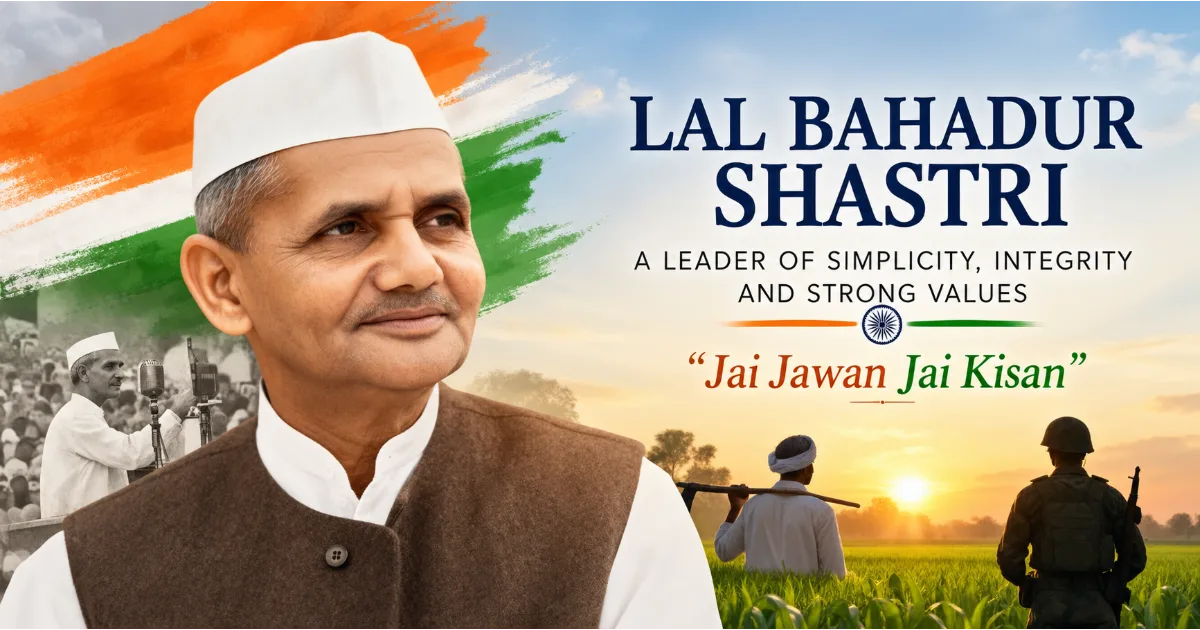
Introduction: Why 2 October Is Special in Indian History
Every year, 2 October occupies a special place in the history and public life of India. The date is widely remembered as the birth anniversary of Mahatma Gandhi, one of the most influential figures of India's freedom movement. At the same time, 2 October is also the birth anniversary of Lal Bahadur Shastri, India's second Prime Minister and one of the country's most respected political leaders. Although Gandhi and Shastri belonged to different generations and played very different roles in India's national journey, both are remembered in connection with values such as simplicity, discipline, public service, responsibility and dedication to the nation.
Lal Bahadur Shastri's life is remarkable not because he came from wealth or privilege, but because he rose from modest circumstances through education, discipline, political participation and a strong commitment to public service. His political journey began during the freedom struggle and continued through the difficult years of India's early independence. He served in several important positions before becoming Prime Minister at a particularly challenging moment in the country's history.
Shastri became Prime Minister in 1964 following the death of Jawaharlal Nehru. His tenure was relatively short, lasting less than two years, but it included some of the most difficult circumstances faced by independent India. The country was dealing with food shortages, economic pressures, political challenges and eventually a major war with Pakistan in 1965. During this period, Shastri became closely associated with the famous slogan "Jai Jawan, Jai Kisan," which expressed recognition of the importance of both India's soldiers and its farmers.
Remembering Lal Bahadur Shastri is therefore not simply about remembering a former Prime Minister. His life provides an opportunity to understand a period when India was still developing its democratic institutions, strengthening its economy, addressing food security and protecting its territorial integrity. His public career also provides an example of how personal simplicity and public responsibility can exist alongside difficult political decisions.
Early Life of Lal Bahadur Shastri
Lal Bahadur Shastri was born on 2 October 1904 in Mughalsarai, in present-day Uttar Pradesh. His family background was modest, and his early life was marked by financial difficulties. His father, Sharada Prasad Srivastava, worked as a school teacher and later served in the revenue department, while his mother was Ramdulari Devi.
Shastri's childhood was affected by the early death of his father. This placed additional responsibilities on his mother and family. Growing up without the advantages enjoyed by wealthy families gave him an early understanding of hardship and simplicity. The values that later became closely associated with his public image were rooted partly in the circumstances of his early life.
His original family surname was Srivastava. Later in life, he stopped using the caste-associated surname and became known simply as Lal Bahadur Shastri. The title "Shastri" was awarded to him after he completed his education at Kashi Vidyapeeth in Varanasi. The word traditionally refers to a learned person, particularly someone educated in classical learning or scriptures, and eventually became permanently associated with his name.
His early education was not easy because of financial limitations and family circumstances. Nevertheless, education remained important to him. His determination eventually took him to Kashi Vidyapeeth, where he completed his studies and received the title that would later become part of his identity.
Childhood and the Development of Character
The early years of Shastri's life help explain several characteristics that became visible in his later public career. He experienced economic limitations, but these circumstances did not prevent him from pursuing education or becoming involved in public life. His journey demonstrated that a modest beginning does not necessarily determine the extent of a person's contribution to society.
Shastri became known for restraint and simplicity. Even after reaching the highest political office in India, he maintained a relatively modest lifestyle. He was not known for excessive personal display or extravagant habits, and this became an important part of the way people remembered him.
His childhood also coincided with a period when India's national movement was becoming increasingly influential. India remained under British colonial rule, while political ideas concerning freedom, self-government and national identity were spreading among young Indians. These developments eventually became a major influence on Shastri's life and political thinking.
Influence of Mahatma Gandhi
Mahatma Gandhi had a significant influence on Lal Bahadur Shastri's political development. Gandhi's ideas concerning truth, non-violence, self-discipline, swadeshi and service to society influenced many young Indians of Shastri's generation.
For Shastri, the freedom struggle represented more than a political campaign. It was also a movement that demanded personal sacrifice and discipline. Young people who participated in the national movement faced the possibility of imprisonment, disruption of education and uncertainty about their future.
Shastri became involved in the freedom movement while he was still young. He participated in activities associated with the Indian National Congress and accepted the possibility of imprisonment as part of the struggle against colonial rule.
His association with the national movement shaped his understanding of public service. His later political career reflected the belief that political office should be connected with responsibility rather than personal privilege.
Participation in the Non-Cooperation Movement
The Non-Cooperation Movement launched by Mahatma Gandhi in 1920 became an important turning point for many young Indians. The movement encouraged people to withdraw cooperation from colonial institutions and participate in peaceful resistance against British rule.
Shastri was deeply influenced by the movement and became involved in the national struggle. His participation resulted in his arrest while he was still very young. The experience became part of his early political life and demonstrated the personal sacrifices associated with the independence movement.
For someone from a modest family, participating in the freedom struggle meant accepting uncertainty and giving up conventional educational and career opportunities. Shastri's decision demonstrated his commitment to the national cause.
The movement also gave him valuable political experience. He came into contact with Congress workers, activists and senior leaders and gradually developed an understanding of organisation, public communication and grassroots mobilisation.
Education at Kashi Vidyapeeth
After becoming involved in the national movement, Shastri continued his education at Kashi Vidyapeeth. The institution had been established as part of the effort to provide national education outside the colonial educational framework.
He completed his studies there and received the title "Shastri," which eventually became permanently associated with his name.
Education remained an important part of his development. His later career reflected an understanding that national progress required educated citizens, responsible institutions and social awareness. Education, in his life, was not merely a means of personal advancement but was closely connected with character, responsibility and service.
Marriage and Family Life
Lal Bahadur Shastri married Lalita Devi, and they had a family life that remained relatively private compared with the highly public lives of many political leaders.
Even after entering national politics and holding important government positions, Shastri's family circumstances remained modest. His lifestyle did not change dramatically simply because he had entered positions of political authority.
This aspect of his life contributed to the public image that developed around him. At a time when political office could easily become associated with privilege, Shastri's personal restraint was frequently noted and later became an important part of his legacy.
Life in the Freedom Struggle
Shastri's participation in India's freedom movement continued over many years. He was imprisoned several times by the British authorities because of his involvement in nationalist activities.
Prison was a significant part of the lives of many Indian freedom fighters. Political imprisonment interrupted careers, separated families and created personal hardship. For Shastri, these experiences became part of his political education.
During the freedom struggle, he developed an understanding of organisation, discipline and patience. These qualities later became visible in his administrative career and helped shape the way he approached public responsibilities.
His contribution to the freedom movement was not primarily based on dramatic speeches or personal charisma. Instead, he became known within the movement for organisational ability, discipline and commitment.
Shastri and the Indian National Congress
The Indian National Congress was the principal political organisation associated with India's independence movement and later became the dominant governing party during the early years of independent India. Shastri gradually developed a reputation within the organisation for reliability, discipline and organisational ability.
He worked with senior Congress leaders and accepted responsibilities within the party's organisational structure. His career demonstrated that political leadership can develop gradually through years of organisational and administrative work.
Rather than rising through a single dramatic political event, Shastri accumulated experience through different responsibilities. This gradual development prepared him for important positions after independence.
From Freedom Fighter to Administrator
India achieved independence in 1947, but independence did not immediately solve the country's problems. The new nation faced enormous challenges, including Partition, communal violence, refugee movements, economic difficulties, food shortages and the task of establishing and strengthening democratic institutions.
Shastri became involved in the administration of Uttar Pradesh before moving into national politics. His experience in the freedom movement was combined with practical administrative responsibility.
He served as a minister in the government of Uttar Pradesh and later moved to the national level. His administrative career contributed to his reputation as a disciplined and capable political leader.
Shastri's Role in Independent India
After independence, Shastri held several important government positions. His responsibilities included areas related to transport, railways, communications and other national affairs.
His approach was generally associated with careful administration and personal accountability. One of the most remembered episodes of his career occurred during his tenure as Minister for Railways, when a major railway accident led him to accept political and moral responsibility.
The episode became an important part of discussions about ministerial accountability in India. It demonstrated the principle that holding public office involves responsibility for the functioning of the department under one's charge.
The Railway Minister and the Principle of Responsibility
During Shastri's tenure as Railway Minister, a major railway accident occurred. Although railway accidents can involve multiple administrative, technical and operational factors, Shastri accepted political responsibility and resigned from his position.
His resignation became an important example in discussions about ministerial accountability in India's parliamentary system.
The significance of the episode lies in the principle that public office carries responsibility. A minister may not personally cause an administrative failure, but the office involves accountability for the functioning of the department.
Shastri's decision therefore became associated with the idea that political authority should be accompanied by responsibility. His resignation demonstrated that he viewed public office as a position of accountability rather than simply a position of power.
Simplicity as a Way of Life
Simplicity was one of the qualities most commonly associated with Lal Bahadur Shastri. Even after becoming a senior political leader, he did not cultivate an extravagant public persona.
His lifestyle remained relatively modest, and he was not known for excessive personal display. His family also continued to live in a manner that reflected restraint.
For Shastri, simplicity was closely connected with his understanding of public service. Political leaders, in his view, were expected to remain connected with ordinary citizens and to understand the realities faced by people with limited resources.
His life therefore became a reminder that public authority does not necessarily require personal luxury.
Becoming Prime Minister of India
Jawaharlal Nehru died on 27 May 1964 after serving as India's first Prime Minister for nearly seventeen years. His death created a major political transition because Nehru had played a central role in shaping India's early years as an independent republic.
Lal Bahadur Shastri succeeded Nehru and became India's second Prime Minister.
The transition was significant because Shastri had a different personality and leadership style from Nehru. Nehru was internationally prominent and associated with long-term institution building, industrialisation and non-alignment, while Shastri was generally more understated and administrative in his public approach.
His challenge was to lead a young republic facing serious economic, agricultural and security pressures.
India in the Mid-1960s
When Shastri became Prime Minister, India was experiencing significant difficulties. Food production was a major concern, and the country depended substantially on food imports to meet domestic requirements.
Agricultural productivity was not sufficient to guarantee food security for India's growing population. Drought and other agricultural difficulties increased the pressure on the government.
At the same time, India faced security concerns following the 1962 war with China. The country was also dealing with economic pressures and the need to strengthen national defence.
Shastri therefore inherited a government that had to address development, food security and national security simultaneously.
The Food Crisis and Agricultural Challenges
One of the most important issues during Shastri's tenure was food security. India needed to increase agricultural production and reduce its dependence on imported food.
The challenge was not simply to produce more food in a single year. The country required a long-term transformation of agricultural productivity.
Farmers needed better access to irrigation, improved seeds, fertilisers, agricultural research and institutional support. These areas eventually became important components of India's agricultural transformation.
Shastri recognised that national development could not be separated from the condition of rural India.
The Meaning of "Jai Jawan, Jai Kisan"
Lal Bahadur Shastri became closely associated with the slogan "Jai Jawan, Jai Kisan," meaning "Hail the Soldier, Hail the Farmer."
The slogan expressed two fundamental national priorities. Soldiers contributed to the country's security, while farmers contributed to its food supply.
The phrase became particularly meaningful during a period when India was dealing with both food shortages and military tensions.
The slogan also reflected the idea that national strength depends on different sections of society. A country requires security to protect its sovereignty, while adequate food production is essential for social and economic stability.
The Importance of the Indian Soldier
During Shastri's tenure, national security became a major concern. The experience of the 1962 conflict with China had created a strong awareness of India's defence requirements.
When conflict with Pakistan escalated in 1965, India's armed forces played a central role in defending the country.
Shastri publicly expressed confidence in the armed forces while emphasising national unity. His leadership during the war became an important part of his historical legacy and public image.
The Importance of the Indian Farmer
The second part of Shastri's famous slogan recognised India's farmers. Agriculture employed a large proportion of India's population and remained central to the country's economy and social structure.
Shastri's emphasis on farmers reflected the reality that national development depended heavily on rural productivity.
The agricultural transformation that followed over subsequent decades involved contributions from scientists, farmers, policymakers and institutions. The Green Revolution later became a major part of India's agricultural history. Shastri's period in office preceded the full-scale transformation associated with the Green Revolution, but his emphasis on agricultural production helped make food security a major national priority.
Encouraging Voluntary Sacrifice
During the food crisis, Shastri encouraged citizens to reduce consumption and accept personal sacrifices for the national interest. He appealed to people to practise restraint in food consumption at a time when the country faced shortages.
His approach relied not only on government regulations but also on a sense of shared responsibility.
This reflected his belief that national challenges could not be solved by government action alone. Citizens also had responsibilities, particularly when national resources were under pressure.
The Idea of Collective Responsibility
Shastri's approach during the food crisis reflected the principle that governments and citizens share responsibility for addressing national challenges.
When resources are limited, national leadership must communicate difficult realities and encourage collective participation. Shastri's personal lifestyle also strengthened the consistency between his public appeals for restraint and his own conduct.
The idea of collective responsibility remains relevant whenever societies face economic, environmental, security or social challenges.
The 1965 India-Pakistan War
One of the defining events of Shastri's prime ministerial tenure was the India-Pakistan War of 1965.
The conflict developed after tensions along the India-Pakistan border and in Jammu and Kashmir, and fighting eventually expanded into a broader war.
The Indian armed forces fought on multiple fronts, while the conflict resulted in casualties on both sides.
For India, the war became a major test of national defence following the difficulties experienced during the 1962 conflict with China.
Shastri's leadership during the conflict became an important part of his historical legacy.
Shastri's Leadership During the War
During the 1965 conflict, Shastri demonstrated a leadership style that was firm but relatively understated. He addressed the nation and expressed confidence in India's armed forces, while his famous slogan "Jai Jawan, Jai Kisan" gained additional significance during the crisis.
The Prime Minister's responsibilities during wartime include political decision-making, communication with the public, diplomatic engagement and coordination with national institutions. Shastri had to manage these responsibilities while the country faced considerable military and political pressure.
The conflict eventually ended through a ceasefire in September 1965, followed by diplomatic efforts aimed at restoring relations between India and Pakistan.
Tashkent and the Search for Peace
After the 1965 war, India and Pakistan participated in negotiations in Tashkent, then part of the Soviet Union. Soviet Premier Alexei Kosygin played an important role in facilitating the talks.
The negotiations resulted in the Tashkent Declaration, which was signed on 10 January 1966 by Lal Bahadur Shastri and Pakistani President Ayub Khan.
The declaration sought to restore peace and normal relations following the conflict. The agreement represented the diplomatic phase that followed the military confrontation and demonstrated the importance of negotiation after armed conflict.
The Final Night in Tashkent
Tragically, Lal Bahadur Shastri died in Tashkent on 11 January 1966, only hours after the signing of the Tashkent Declaration.
His sudden death shocked India. Shastri had served as Prime Minister for less than two years, and his death therefore occurred at a relatively early stage of his national leadership.
The circumstances of his death have generated public discussion and various claims over the decades. The official account attributed his death to a heart attack, while later questions and theories have circulated regarding the circumstances. Such claims need to be distinguished from established documentary evidence.
What is historically established is that Shastri died in Tashkent shortly after participating in the negotiations and signing the declaration.
A Prime Minister Who Served for a Short Time
Shastri's tenure as Prime Minister lasted from June 1964 until January 1966. Compared with several other Indian Prime Ministers, this was a short period.
However, his tenure included food insecurity, agricultural difficulties, economic pressures, national defence concerns, war and subsequent diplomatic negotiations.
His historical legacy therefore developed around the manner in which he responded to major challenges rather than the length of time he spent in office.
Shastri and the Idea of Leadership
Leadership is often associated with power, visibility and public recognition. Shastri represented a different style of leadership that was quieter and more understated.
His political strength was associated less with dramatic personal presentation and more with his reputation for reliability, discipline and responsibility.
His career demonstrates that leadership can be expressed through consistency, accountability and institutional work. A leader does not necessarily need to dominate every public conversation to exercise significant influence.
Accountability in Public Life
The railway resignation remains one of the strongest historical examples associated with Shastri's understanding of accountability.
In a democratic system, public office is connected with responsibility. Ministers oversee departments and are answerable to Parliament and the public for their administration.
Shastri's resignation demonstrated that he considered accountability to be more than a theoretical principle. His action became part of the historical discussion surrounding ministerial responsibility in India.
Shastri's Relationship With Ordinary Citizens
Shastri's modest background contributed to his public image as a leader connected with ordinary Indians.
He had experienced financial limitations himself and understood that large sections of the population lived with limited resources.
His public appeals during the food crisis therefore emphasised restraint, sacrifice and collective responsibility rather than simply asking the government to solve every problem.
His image as a leader who understood ordinary life became an important part of his historical legacy.
The Role of Discipline in His Life
Discipline was another important characteristic associated with Shastri. His life involved political struggle, imprisonment, organisational work and administrative responsibility.
He developed a reputation for restraint and careful conduct. For Shastri, discipline was not simply about following rules. It was also connected with self-control and responsibility.
A society facing difficult circumstances requires citizens and institutions capable of thinking beyond immediate personal convenience. His public life reflected this principle.
Shastri and the Freedom Movement
It is important to remember that Shastri was not a leader who suddenly entered public life after independence. His political identity had been formed during the freedom struggle.
He experienced imprisonment and political sacrifice before India became independent. These experiences influenced his approach to public office after 1947.
For him, independence was not the final objective. It created a responsibility to build institutions, strengthen the economy and improve the lives of citizens.
Freedom and Responsibility
The freedom struggle focused on achieving freedom from colonial rule. After independence, the challenge became the responsible use of that freedom.
India needed democratic institutions, economic development, social stability and national security. Citizens also had responsibilities within the new democratic system.
Shastri's life illustrates the transition from freedom fighter to administrator. He moved from opposing colonial authority to exercising constitutional authority within an independent parliamentary democracy.
The Importance of Agriculture in Nation Building
Agriculture remained central to India's development during Shastri's time. The country's food problem demonstrated the vulnerability created by insufficient agricultural production.
The long-term response required technological innovation, improved irrigation, better agricultural practices, scientific research and stronger rural institutions.
Shastri's recognition of farmers as an important part of national strength helped elevate agricultural production as a national priority. "Jai Kisan" therefore represented more than a slogan. It reflected the understanding that farmers were essential to national food security and economic development.
The Defence of the Nation
The other half of Shastri's famous slogan recognised India's soldiers. National security requires trained armed forces, appropriate equipment, strategic planning, logistics and political leadership.
The 1965 war demonstrated the importance of these elements. Shastri's recognition of the armed forces reflected their role in protecting India's sovereignty and territorial integrity.
The slogan "Jai Jawan, Jai Kisan" therefore brought together two fundamental concerns of the period: national security and food security.
Shastri and National Unity
India is a country of enormous linguistic, religious, cultural and regional diversity. National unity after independence required democratic institutions capable of bringing different communities together.
During periods of crisis, unity becomes especially important. War and food shortages can create uncertainty and social tensions, making public communication and cooperation essential.
Shastri's leadership during the 1965 war was therefore also connected with the challenge of maintaining national solidarity during a period of pressure.
A Leader Without Excessive Personal Cult
Political history often creates strong personalities around national leaders. Shastri's public image developed differently.
He was remembered for humility rather than grandeur. His relatively quiet personality contrasted with the enormous responsibilities he carried as Prime Minister.
The absence of an elaborate personal style did not prevent him from becoming a significant national leader. His career demonstrates that political influence can develop through credibility, conduct and responsibility as much as through personal charisma.
The Meaning of Humility
Humility does not necessarily mean an absence of firmness. Shastri's public career demonstrated that a modest personality could coexist with difficult decisions.
His conduct during the 1965 war demonstrated that quiet leadership could still involve decisive action. His personal style also reinforced the idea that public office is temporary and that public service is larger than the individual who occupies a particular position.
Personal Sacrifice and Public Service
Shastri's life was marked by sacrifice from his youth. He accepted imprisonment during the freedom movement and later accepted political responsibility for an administrative failure.
As Prime Minister, he encouraged citizens to accept sacrifices during food shortages.
His public career therefore contained a consistent theme of placing public responsibility above personal comfort. This became one of the reasons his name remained associated with integrity, service and accountability.
The Importance of Ethical Leadership
Ethical leadership involves more than simply avoiding corruption. It can include accountability, honesty, responsibility and consistency between personal conduct and public statements.
Shastri's career is often discussed in these terms. His resignation as Railway Minister, modest lifestyle and appeals for national sacrifice contributed to this historical image.
Studying his life provides an opportunity to understand why ethical conduct matters in democratic government and public institutions.
Shastri and Democratic Institutions
Shastri served within India's parliamentary democratic system and worked through political and constitutional institutions.
Parliament, political parties, the civil service, the armed forces and other institutions all played important roles in governance.
His career illustrates the importance of institutional leadership. A democratic country cannot depend solely on individual personalities. Strong institutions are necessary for continuity, accountability and effective governance.
The Political Transition After Nehru
The transition from Nehru to Shastri was historically important. Nehru had been Prime Minister since independence and had become internationally recognised as the face of the new republic.
The question of succession therefore carried considerable significance. Shastri's appointment demonstrated that India's political system could manage a leadership transition through established political and constitutional processes.
His tenure contributed to continuity within India's parliamentary system during a sensitive period.
Shastri's Economic Challenges
The Indian economy during the mid-1960s faced multiple difficulties. India was still a developing country with limited industrial and agricultural capacity, while population growth placed additional pressure on food supplies.
At the same time, defence expenditure had increased because of security concerns. The government therefore had to balance development needs with national security requirements.
Shastri's leadership was exercised in an environment where resources were limited and expectations were high.
The Importance of Self-Reliance
Food shortages encouraged India to think more seriously about self-reliance in agriculture. Self-reliance did not necessarily mean complete isolation from the international economy. It meant developing domestic capacity so that essential national needs could be met more securely.
Agricultural research, irrigation, improved seeds, fertilisers and modern farming techniques eventually became important parts of India's food security strategy.
The transformation involved many scientists, farmers, policymakers and institutions, but the recognition of food security as a major national priority was particularly important during the period in which Shastri served as Prime Minister.
The Green Revolution and Shastri's Legacy
The Green Revolution in India is generally associated with the later development and adoption of high-yielding crop varieties, irrigation, fertilisers, agricultural research and institutional support.
Scientists such as M. S. Swaminathan played a major role in India's agricultural transformation. Shastri's tenure came before the full results of the Green Revolution became visible, but his emphasis on increasing food production helped establish agriculture and food security as major national priorities.
The later achievements of India's agricultural sector therefore belong to a much broader historical process involving multiple governments, scientists, farmers and institutions.
Shastri and the Common Citizen
One of the enduring aspects of Shastri's public image is his emphasis on the role of ordinary citizens.
He did not present national development as something that could be achieved entirely through government institutions. His appeals for food conservation and national sacrifice reflected the idea that citizens also had responsibilities.
This approach remains significant in a democracy because citizens are not merely recipients of government policy. They are participants in national life.
The Power of a Simple Message
"Jai Jawan, Jai Kisan" remains one of the most memorable phrases associated with Shastri because it expressed a complex national idea in simple language.
The soldier represented national security, while the farmer represented food production and rural economic life. Together, the two parts of the slogan expressed the importance of both defence and food security.
The phrase also demonstrated Shastri's ability to communicate national priorities in language that ordinary citizens could easily understand.
Why Shastri's Words Remained Powerful
Political speeches and slogans can become disconnected from everyday life when they are overly complicated. Shastri's public communication often focused on practical concerns such as food, agriculture, defence, sacrifice and responsibility.
These subjects directly affected ordinary citizens. His communication therefore connected national policy with the daily realities of people across the country.
The Personal and the Political
Shastri's public life demonstrates how personal values can influence political leadership.
His simple lifestyle was consistent with his public appeals for restraint. His experience of imprisonment shaped his understanding of sacrifice. His modest background contributed to his sensitivity toward ordinary citizens, while his administrative experience prepared him for increasingly significant government responsibilities.
His political career was therefore closely connected with his personal development.
The Human Side of Lal Bahadur Shastri
Historical leaders are often remembered through slogans, official photographs and major political events, which can make them appear distant from ordinary human experience.
Shastri's life had a much more personal journey. He was a child who grew up in modest circumstances, a student who pursued education, a husband and father, a freedom fighter, a prisoner, an administrator, a minister and eventually the Prime Minister of India.
His journey was shaped by circumstances, choices, opportunities and responsibilities. Understanding this human dimension makes his historical story more complete.
Shastri's Relationship With Simplicity
Simplicity was visible not only in Shastri's personal possessions but also in his communication style and public personality.
He did not depend heavily on elaborate political presentation. His public presence was relatively quiet, which allowed his actions and decisions to receive greater attention.
In an age when political communication often depends heavily on visibility, Shastri's career provides a historical example of a leadership style based more strongly on conduct and responsibility.
A Leader During Crisis
Leadership becomes especially visible during difficult circumstances, and Shastri faced several major challenges within a short period.
Food shortages required appeals for sacrifice and conservation. Agricultural production needed attention. National defence required strengthening. The 1965 war required military and political leadership, while the period afterward required diplomatic engagement.
His ability to remain composed and focused during these circumstances became an important part of his historical image.
The 1965 War and National Confidence
The 1965 war had significance beyond military operations. India was still a relatively young republic, and memories of the 1962 conflict were still fresh.
The country's military response in 1965 affected public perceptions of national defence and military preparedness. Shastri's leadership during the conflict became associated with public confidence in India's ability to defend itself.
The armed forces were publicly recognised as an essential institution of national security.
Peace After Conflict
Shastri's legacy is sometimes remembered primarily through the 1965 war, but the diplomatic process that followed is equally important.
The Tashkent negotiations demonstrated that military conflict eventually has to be followed by political and diplomatic engagement. War does not eliminate the need for negotiation, and national security can involve both military preparedness and efforts to establish peace.
Shastri participated in that diplomatic process until the end of his life.
The Tashkent Declaration
The Tashkent Declaration was signed on 10 January 1966. The agreement sought to restore relations between India and Pakistan after the 1965 conflict and included commitments concerning the withdrawal of armed forces and the restoration of diplomatic relations.
Shastri's participation demonstrated that national security and diplomacy could operate alongside one another. A government can defend national interests while also pursuing peaceful resolution after conflict.
Shastri's Death
The death of Lal Bahadur Shastri on 11 January 1966 was unexpected. He died in Tashkent shortly after the signing of the peace declaration.
His death created uncertainty at a sensitive moment for India. The country had lost a Prime Minister who had served for only a short period but had already faced major national challenges.
His passing was widely mourned, and his sudden death became an important part of his historical story.
Historical Questions About His Death
Over the years, questions and theories concerning the circumstances of Shastri's death have appeared in public discussions.
A responsible historical account must distinguish established records from later speculation. The official account attributed his death to a heart attack. Various questions have subsequently been raised regarding the circumstances and documentation surrounding his death, but such claims should be assessed against available evidence rather than presented as established facts.
Historical inquiry is valuable when it remains evidence-based and distinguishes documented information from speculation.
The Legacy of Lal Bahadur Shastri
Shastri's legacy is associated with several interconnected themes, including simplicity, accountability, national service, agricultural development, support for the armed forces and leadership during periods of crisis.
His short tenure does not make these aspects of his career insignificant. Instead, the intensity of the challenges he faced during a relatively short period became a central part of the way his leadership was remembered.
Shastri as an Example of Public Service
Public service requires accepting responsibility for issues that affect large numbers of people. Ministers must deal with problems that cannot always be solved quickly, while Prime Ministers must make decisions under uncertainty and pressure.
Shastri's career demonstrates the importance of accepting these responsibilities without treating public office as a source of personal privilege.
His life therefore has relevance not only to political leaders but also to anyone working in public institutions or positions of responsibility.
Responsibility Beyond Political Office
The values associated with Shastri's life can also be applied to ordinary life. Responsibility means accepting the consequences of one's actions. Discipline means continuing to perform necessary duties even when circumstances are difficult. Simplicity can involve distinguishing genuine needs from unnecessary consumption, while service can mean using one's abilities to contribute to others.
These principles are not limited to government or politics. They can be applied in families, workplaces, educational institutions and communities.
What Students Can Learn From Shastri
Students can find several lessons in Shastri's life. His educational journey demonstrates the importance of perseverance when circumstances are difficult, while his political development demonstrates that leadership can begin with responsibility long before a person receives formal authority.
His life also provides examples of accepting failure, remaining disciplined and maintaining consistency between personal conduct and public responsibility.
His journey demonstrates that meaningful achievement often develops gradually through education, experience and sustained commitment.
What Young Professionals Can Learn
Young professionals often associate leadership with senior positions, titles and recognition. Shastri's career provides a historical example of a different path in which leadership develops through reliability, accountability and disciplined work.
A person who accepts responsibility for mistakes can build trust, while someone who respects colleagues and fulfils commitments can gradually develop credibility.
His career illustrates that leadership can emerge through everyday conduct long before a person receives a formal leadership title.
What Citizens Can Learn
Citizens also have responsibilities within a democracy. Voting is one form of democratic participation, but civic responsibility extends beyond elections.
Citizens contribute by following laws, respecting others, paying taxes, protecting public property, participating in communities and helping people who require support.
Shastri's emphasis on collective sacrifice during difficult times reflected the idea that national development requires participation from society as a whole.
The Meaning of "Jai Jawan, Jai Kisan" Today
The slogan remains historically significant because the underlying ideas continue to matter.
National security remains an important responsibility of the state, while agriculture continues to play an important role in India's economy and society. The armed forces continue to contribute to national defence, while farmers remain essential to food production.
The economy and society of India have changed significantly since the 1960s, but the historical meaning of the slogan remains connected with recognition of these two foundational contributions.
Shastri and the Idea of National Development
National development cannot be measured only by economic growth. A strong country also requires food security, public institutions, education, healthcare, infrastructure, defence and social stability.
Shastri's period in office focused attention on several of these fundamental requirements. His leadership demonstrated that national development can sometimes require citizens and institutions to respond collectively to immediate challenges while working toward longer-term stability.
Integrity and Public Trust
Public trust is difficult to build and can be damaged when institutions or leaders fail to accept responsibility.
Leaders gain credibility when their actions are consistent with their stated values. Shastri's personal simplicity and willingness to accept responsibility contributed to the trust associated with his public image.
The principle extends beyond politics. In families, workplaces, institutions and communities, trust develops when people demonstrate consistency between what they say and what they do.
The Importance of Accepting Mistakes
The willingness to accept responsibility for failure is an important aspect of leadership.
Shastri's resignation as Railway Minister remains an important historical example of this principle. Rather than treating resignation solely as a personal setback, he treated it as an expression of responsibility for the department under his charge.
The broader lesson is applicable to many organisations because mistakes are inevitable, while the way people respond to mistakes can influence institutional trust.
Shastri's Contribution to India's Political Culture
India's democratic culture was still developing during Shastri's lifetime. The country had inherited institutions from the colonial period but needed to adapt them to democratic governance.
Leaders such as Shastri contributed to a political culture in which ministers were expected to be accountable for the functioning of their departments.
His career therefore forms part of the broader history of India's parliamentary traditions and the development of political responsibility in the early republic.
Remembering Shastri Alongside Gandhi
The fact that Gandhi and Shastri share the same birth date creates a meaningful historical connection.
Gandhi represents India's struggle against colonial rule and the philosophy of non-violent resistance. Shastri represents the generation that inherited the responsibility of governing an independent India during its formative years.
Their lives therefore belong to different stages of India's national journey. Gandhi played a major role in mobilising people during the freedom movement, while Shastri became part of the generation responsible for strengthening the institutions and security of the independent republic.
Remembering both on 2 October provides an opportunity to reflect on the relationship between freedom and responsibility.
From Freedom Struggle to Nation Building
The freedom movement focused on achieving independence. After 1947, the challenge changed significantly.
India needed to establish institutions, improve living standards, increase agricultural production, expand education, strengthen infrastructure and protect national security.
Shastri belonged to the generation that had to make this transition from the struggle for freedom to the practical responsibilities of nation building.
His political career demonstrates that achieving independence was the beginning of another long historical process rather than the end of India's challenges.
The Difference Between Power and Service
Political office provides authority, but public office is intended to serve society.
Shastri's life is remembered partly because of the distinction between personal power and public service that was reflected in his conduct. He did not make personal extravagance the centre of his public identity.
His career provides an example of how political office can be understood as a responsibility toward citizens and institutions rather than merely as a source of personal privilege.
The Importance of Personal Example
People often respond more strongly when leaders practise the values they ask others to follow.
Shastri's appeals for restraint during food shortages were consistent with his own reputation for modest living. His conduct therefore strengthened the connection between his public message and his personal example.
This demonstrates a broader principle of leadership: credibility can depend not only on what a leader says but also on whether personal conduct supports those words.
National Crises and Social Solidarity
Crises test the strength of societies. Food shortages can create fear and competition, while war can create uncertainty and economic pressure.
During such periods, national leadership must communicate clearly and encourage cooperation and responsibility.
Shastri's public messaging during the mid-1960s emphasised these qualities. His appeals for restraint and unity reflected an understanding that national crises require participation from citizens as well as government institutions.
The Role of Farmers in Indian History
Indian society has historically had a deep connection with agriculture, and for much of the population farming has been a major livelihood.
The food crisis of the 1960s demonstrated the importance of agricultural productivity for national stability and independence.
Shastri's recognition of farmers as important contributors to national life helped give agriculture greater visibility in the national conversation.
The Role of Soldiers in Indian History
The armed forces are another essential institution of the modern Indian state. India's geography, borders and regional security environment require military preparedness and national defence capabilities.
The 1965 war demonstrated the importance of these responsibilities. Shastri's recognition of soldiers reflected their role in protecting national sovereignty and territorial integrity.
Shastri's Communication Style
Shastri's communication style was generally straightforward and closely connected with practical national concerns.
He did not depend on elaborate rhetoric to communicate ideas about food, agriculture, defence, sacrifice and responsibility.
His famous slogan was short and memorable because it connected two major national priorities with people whom ordinary citizens could immediately recognise.
Effective communication does not always require complexity. Sometimes a simple message can express a much larger national idea.
A Symbol of Simplicity
Over time, Shastri became a symbol of simple living and responsible leadership.
His image is associated with modest personal habits, restrained public presentation and an understated manner. These characteristics became part of public memory.
However, remembering him only as a symbol of simplicity would provide an incomplete understanding of his historical importance. His significance also lies in his political decisions, administrative responsibilities, leadership during war and participation in peace negotiations.
A Symbol of Courage
Courage can take different forms. It can involve military action, but it can also involve accepting responsibility, making difficult decisions and standing firm during uncertain circumstances.
Shastri experienced different forms of courage throughout his life. He participated in the freedom movement despite the possibility of imprisonment, accepted ministerial responsibility after a railway accident, led the country during a war and subsequently participated in diplomatic negotiations.
His life therefore demonstrates that courage can be expressed through both action and responsibility.
A Symbol of Responsibility
Responsibility is perhaps the strongest theme connecting different phases of Shastri's life.
As a student, he pursued education despite difficult circumstances. As a freedom fighter, he accepted imprisonment. As a minister, he accepted accountability. As Prime Minister, he faced national crises. As a leader, he asked citizens to contribute to national efforts.
His life therefore provides a consistent historical example of responsibility across different stages of public life.
Why His Legacy Continues
Historical relevance does not depend entirely on the number of years a person spends in power.
Shastri's legacy continues because the values associated with his life remain understandable across generations. Integrity, responsibility, discipline, simplicity, national service and respect for ordinary citizens continue to be relevant in political life, professional life and personal life.
His story therefore remains part of India's collective historical memory.
Remembering Shastri on 2 October
Every 2 October provides an opportunity to remember Shastri alongside Gandhi and to reflect on different stages of India's national journey.
Gandhi's birth anniversary recalls the freedom movement and the philosophy of non-violent resistance. Shastri's birth anniversary recalls the responsibilities that followed independence and the challenges faced by the early republic.
The date can therefore become an opportunity to consider questions about public service, citizenship, leadership, accountability, agriculture, national security and the responsibilities associated with freedom.
The Importance of Historical Memory
Historical memory shapes how societies understand themselves. Remembering national leaders helps younger generations understand the circumstances under which modern India was built.
However, remembrance should not mean turning historical figures into perfect or unquestionable personalities. A serious understanding of history requires examining achievements, decisions, limitations, controversies and historical context.
Shastri's life can be remembered with respect while still being studied critically and through available evidence.
Studying Shastri Beyond the Slogan
"Jai Jawan, Jai Kisan" is one of the most famous phrases associated with Shastri, but his contribution was much broader.
His life included participation in the freedom movement, education at Kashi Vidyapeeth, organisational work within the Congress, administrative responsibilities in Uttar Pradesh, service as a national minister, acceptance of ministerial accountability, leadership as Prime Minister during the 1965 war and participation in the Tashkent negotiations.
Understanding this wider journey provides a more complete picture of his contribution to India's history.
The Importance of Context
Historical figures should always be understood within the circumstances of their time.
India in the 1960s was very different from India today. The economy was smaller, agricultural productivity was lower, infrastructure was less developed and technology was limited.
The country was also dealing with the consequences of independence and Partition, while defence capabilities were still developing.
Understanding this context helps explain the complexity of the challenges Shastri faced as Prime Minister.
Shastri's Place in Indian History
Lal Bahadur Shastri occupies a distinctive position in Indian history because he belonged to the generation that participated in the freedom struggle and then became responsible for governing the independent nation.
He was neither India's founding Prime Minister nor a long-serving leader. Instead, he served during a transition between important phases of India's political history.
His contribution lies in the responsibilities he assumed during that transition and the manner in which he responded to the challenges of his time.
Leadership Without Grandeur
Modern political leadership is often associated with large public events, dramatic speeches, extensive media coverage and strong personal branding.
Shastri's career represented a different style. His leadership was comparatively quiet, and his public personality was modest, yet the decisions made during his tenure carried national consequences.
His life therefore provides an example of leadership in which conduct, responsibility and decision-making are more important than public grandeur.
The Lesson of Humble Leadership
Humility can allow leaders to listen to colleagues, experts and institutions.
Shastri worked within governmental structures and relied on political colleagues, civil servants, military leadership and other institutions in carrying out the responsibilities of government.
His approach demonstrates that leadership does not require a person to claim complete knowledge or authority over every issue. Effective governance often depends on collaboration and institutional decision-making.
The Lesson of Courageous Decision-Making
At the same time, leadership requires decisions to be made under pressure.
During the 1965 war, Shastri had to respond to rapidly changing circumstances. During the food crisis, he had to communicate difficult realities to the public. During the Tashkent negotiations, he had to participate in diplomatic discussions concerning the aftermath of the conflict.
These responsibilities required judgment under pressure and an understanding of both immediate circumstances and longer-term national interests.
The Lesson of Service
The idea of service connects different stages of Shastri's life.
He entered public life during the freedom struggle, served in government after independence, accepted responsibility when difficulties arose and led the country during a challenging period.
His career can therefore be understood as a journey from participation in the struggle for independence to responsibility for the governance of an independent nation.
What 2 October Can Mean for the Present Generation
For the present generation, 2 October can be more than a holiday or commemorative occasion.
It can be a day to reflect on the responsibilities associated with citizenship. Young people can consider how they contribute to their communities, students can reflect on education and discipline, professionals can think about integrity and accountability, and citizens can consider their role in democratic life.
Remembering Shastri becomes more meaningful when historical lessons are connected with contemporary responsibilities.
The Relevance of Discipline in Modern Life
Modern life contains constant distractions and competing responsibilities. Technology provides continuous access to information and entertainment, while professional and personal demands can compete for attention.
In such an environment, discipline remains important.
Shastri's life demonstrates the value of consistency and sustained effort. Large achievements are often built through many smaller responsibilities performed carefully over a long period.
The Relevance of Simplicity
Simplicity does not necessarily mean rejecting progress or modern technology. It can mean understanding what is genuinely necessary and avoiding unnecessary excess.
A simple approach to life can allow individuals to focus more clearly on meaningful goals.
Shastri's lifestyle provides a historical example of modest living even while occupying the highest political office in the country.
The Relevance of Accountability
Accountability remains essential in modern organisations.
Whether in government, business, education or civil society, people must take responsibility for decisions made within their areas of authority.
Avoiding responsibility may provide temporary protection, but it can damage institutional trust. Shastri's resignation as Railway Minister remains an important historical example of accepting accountability.
The Relevance of National Service
National service does not require every person to enter politics or the armed forces.
Teachers contribute by educating students. Farmers contribute by producing food. Scientists contribute through research. Doctors contribute through healthcare. Engineers contribute through infrastructure and technology. Workers contribute through their professions, while citizens contribute through everyday civic responsibilities.
Shastri's life reminds us that national development is a collective effort involving many different professions and communities.
The Meaning of "Jai Kisan" in a Changing India
India's agricultural economy has changed significantly since Shastri's time. Farmers today operate in an environment shaped by technology, changing markets, mechanisation, climate pressures and evolving agricultural practices.
Despite these changes, agriculture remains essential to the country's food system and rural economy.
The phrase "Jai Kisan" continues to represent historical recognition of the contribution made by farmers to Indian society.
The Meaning of "Jai Jawan" in a Changing India
India's security environment has also changed considerably since 1965. Modern defence involves advanced technology, intelligence, cybersecurity, air power, naval capabilities, space systems and sophisticated logistics.
Despite these developments, the fundamental responsibility of protecting national sovereignty remains.
"Jai Jawan" therefore continues to represent respect for those serving in India's armed forces while retaining its historical connection to the period in which Shastri used the phrase.
Shastri's Place in the Story of Modern India
The story of modern India is not the story of a single leader. It includes freedom fighters, farmers, workers, scientists, soldiers, teachers, administrators, entrepreneurs and millions of ordinary citizens.
Shastri's contribution forms one part of this larger national journey. His leadership connected the experiences of the freedom movement with the practical responsibilities of governing an independent country.
Remembering the Person Behind the Title
The title "Prime Minister" can sometimes overshadow the person who held it.
Lal Bahadur Shastri was a human being who experienced childhood hardship, education, family responsibilities, political imprisonment, administrative challenges and national crises.
He did not begin his life knowing that he would become Prime Minister. His journey developed through circumstances, choices and responsibilities accumulated over many years.
This makes his story particularly useful for understanding how public leadership can develop gradually.
A Journey Built Step by Step
Shastri's career was not an overnight success. He moved from student activism to participation in the freedom movement, from political organisation to state administration, and from ministerial responsibilities to national leadership.
Each stage contributed experience that prepared him for later responsibilities.
His life demonstrates the importance of gradual development and sustained work. Historical biographies often focus on the final achievement, but Shastri's journey shows the importance of the years of preparation that preceded it.
The Importance of Character
Skills can help a person obtain a position, but character can influence how that position is used.
Shastri's career is remembered partly because of the personal qualities associated with him, including discipline, modesty, accountability and responsibility.
His life therefore provides an example of how leadership requires more than technical competence. It also involves the values through which authority is exercised.
The Importance of Public Trust
Governments depend on public trust, particularly during periods of crisis.
When food shortages, war or economic pressures create uncertainty, citizens need confidence that public institutions are responding responsibly.
Shastri's simple public image and emphasis on collective responsibility contributed to the trust associated with his leadership.
Trust does not eliminate disagreement, but it can help societies respond collectively when difficult circumstances arise.
Learning From Historical Leaders
Studying historical leaders does not mean copying every decision they made.
History can instead be used to understand how individuals responded to the circumstances of their time.
Shastri's life can be studied for lessons concerning accountability, administration, communication, crisis leadership and public service. At the same time, his decisions should be understood through historical context and available evidence.
The Importance of Evidence in History
Historical memory can simplify complex events. Slogans can become more famous than policies, stories can become more influential than documents, and legends can develop around national figures.
A responsible understanding of history therefore requires evidence.
Shastri's life is best studied through official records, historical research, biographies, parliamentary material and contemporary accounts.
Respecting a historical figure does not require abandoning critical examination. In fact, evidence-based study provides a more complete understanding of historical personalities.
The Enduring Symbol of the Simple Leader
Among India's Prime Ministers, Shastri remains particularly associated with personal simplicity.
His short tenure, sudden death and modest personality contributed to a distinctive place in public memory.
He became associated with a form of political leadership in which personal conduct and responsibility were important parts of public credibility.
For many Indians, his name continues to evoke ideas of simplicity, sacrifice, accountability and service.
Shastri and the Next Generation
Young Indians encounter history through textbooks, speeches, documentaries, commemorative events and public discussions.
History becomes more meaningful when it is connected with questions that young people face today, including how to respond to failure, how to accept responsibility, how to balance personal ambition with social responsibility and how individuals can contribute to society.
Shastri's life provides historical material for exploring these questions without reducing his entire legacy to a single slogan.
A Message for Students
Students can remember Shastri not merely as the leader associated with "Jai Jawan, Jai Kisan," but as someone who continued his education, participated in the freedom movement, experienced imprisonment, accepted public responsibility and eventually became Prime Minister during a difficult period.
His educational journey and political development demonstrate how perseverance, learning and character can contribute to leadership.
A Message for Professionals
Professionals can draw lessons from Shastri's approach to responsibility.
Titles alone do not create leadership. A manager develops leadership through accountability, a public official builds trust through responsible conduct and a colleague becomes dependable by keeping commitments.
Leadership develops through everyday actions long before it becomes visible through formal positions.
A Message for Citizens
Citizens should remember that a country is not built by governments alone.
National development depends on millions of individual decisions and contributions. Saving resources, respecting public spaces, following laws, supporting communities, helping others and participating responsibly in democratic life all contribute to society.
Shastri's appeals for collective sacrifice reflected this broader understanding of citizenship.
The Meaning of Service in Democracy
Democracy provides citizens with rights, but it also involves responsibilities.
Public officials are expected to serve citizens, citizens are expected to participate responsibly, institutions must function according to law, and public accountability must remain part of democratic life.
Shastri's career belongs to this broader democratic framework and provides an example of the responsibilities associated with public office.
Why His Story Should Be Remembered
Lal Bahadur Shastri's story deserves remembrance because it captures a critical phase of Indian history.
He was born under colonial rule, participated in the struggle for independence, experienced imprisonment, entered government after independence, served as a minister, became Prime Minister, faced food shortages and war, pursued peace after conflict and died while serving the country.
His life therefore spans the transition from colonial India to independent India and illustrates the responsibilities faced by the generation that inherited the new republic.
2 October as a Day of Reflection
2 October can be remembered as a day of reflection on leadership, freedom and responsibility.
Gandhi's birth anniversary recalls the freedom movement and the philosophy of non-violent resistance, while Shastri's birth anniversary recalls the responsibilities that followed independence.
Together, their stories represent different but connected chapters in India's national journey.
Beyond Ceremonies
Historical remembrance can sometimes become limited to ceremonies, speeches and social media posts.
Such activities can preserve memory, but remembrance becomes more meaningful when accompanied by learning. Reading about Shastri's life, understanding the challenges of the 1960s and studying the development of India's democratic institutions can provide a deeper appreciation of his historical role.
Remembering a leader should involve understanding the historical circumstances, decisions and responsibilities that shaped their public life.
A Legacy of Responsibility
Responsibility is one of the strongest ideas connecting different phases of Shastri's life.
He accepted responsibility toward the country, citizens, institutions and his own duties. He accepted imprisonment during the freedom movement, accountability as a minister and difficult responsibilities as Prime Minister.
His life demonstrates that public service ultimately involves accepting responsibility for something larger than oneself.
A Legacy of Simplicity
Shastri's simplicity remains relevant because it raises questions about the relationship between political power and personal lifestyle.
His public career demonstrated that occupying the highest constitutional office did not necessarily require making personal luxury the centre of one's public identity.
His life therefore provides a historical example of how public authority and personal modesty can coexist.
A Legacy of Courage
Courage was expressed in different ways throughout Shastri's life.
As a young freedom fighter, he accepted the possibility of imprisonment. As a minister, he accepted political responsibility. As Prime Minister, he led India during a war and subsequently participated in diplomatic negotiations for peace.
His career demonstrates that courage can involve both decisive action and the willingness to accept responsibility for difficult circumstances.
A Legacy of National Unity
Shastri's public message during difficult times emphasised unity and collective responsibility.
A country cannot respond effectively to crises when citizens are unable to cooperate.
National unity does not require everyone to think identically. It involves recognising shared responsibilities despite differences in language, region, religion, culture and political opinion.
This principle remains significant in a diverse democratic country such as India.
A Legacy of Farmers and Soldiers
The continued recognition of "Jai Jawan, Jai Kisan" demonstrates the lasting place of Shastri's message in Indian public memory.
The slogan recognises two groups whose contributions were particularly important to the challenges India faced during his tenure. Soldiers contributed to national defence, while farmers contributed to food production.
The phrase became a compact expression of national recognition for these contributions.
A Legacy That Goes Beyond Politics
Although Shastri was a political leader, the values associated with his life extend beyond politics.
Students can reflect on discipline, professionals can consider accountability, families can discuss sacrifice and service, citizens can think about civic responsibility and leaders can examine the relationship between personal conduct and public trust.
His story therefore has relevance beyond the institutions of government.
Remembering Lal Bahadur Shastri With Historical Understanding
To remember Shastri responsibly is to understand both his achievements and the circumstances in which he worked.
He should neither be reduced to a single slogan nor presented as an unrealistic, perfect historical figure. His real story is more complex and more valuable.
It is the story of a person from modest circumstances who became a freedom fighter, administrator, minister and eventually Prime Minister during one of India's challenging periods.
Conclusion: The Enduring Meaning of Lal Bahadur Shastri
Lal Bahadur Shastri occupies a distinctive place in India's modern history. Born into a modest family in 1904, he grew up during the final decades of British colonial rule and became involved in the freedom movement at a young age. He accepted imprisonment, continued his education and gradually developed experience in political organisation and administration.
After independence, Shastri became part of the difficult process of building a new nation. He served in government, accepted ministerial responsibilities and eventually became India's second Prime Minister following the death of Jawaharlal Nehru.
His tenure as Prime Minister was short, but the challenges were substantial. India faced food shortages, agricultural difficulties, economic pressures and serious security concerns. The 1965 war with Pakistan tested the country's military and political leadership. During this period, Shastri became closely associated with the phrase "Jai Jawan, Jai Kisan," recognising the importance of soldiers and farmers to national life.
His leadership style was relatively quiet and understated. He did not rely on grandeur or excessive personal display. Instead, his public reputation became associated with simplicity, discipline, accountability and service.
His resignation as Railway Minister following a major railway accident remains an important example in discussions of ministerial responsibility. The decision demonstrated the principle that public office involves accountability even when a minister may not have personally caused an incident.
His death in Tashkent on 11 January 1966, shortly after signing the Tashkent Declaration with Pakistan, brought an abrupt end to his life and leadership. His passing occurred at a sensitive moment for India and became an important part of his historical legacy.
More than half a century later, Shastri continues to be remembered because many of the values associated with his life remain relevant. Simplicity can remain meaningful in a world driven by consumption, accountability remains important in public institutions and workplaces, discipline remains valuable in education and professional life, and national service continues to involve the contributions of millions of citizens.
2 October therefore provides an opportunity to remember both Mahatma Gandhi and Lal Bahadur Shastri while recognising that they represent different stages of India's national journey. Gandhi is closely associated with the struggle for independence and non-violent resistance, while Shastri belongs to the generation that inherited the responsibilities of governing and strengthening an independent India.
Remembering Shastri also means recognising that nations are built not only through major historical events but through the everyday work of millions of people. Farmers contribute to food production, soldiers contribute to national defence, teachers educate future generations, scientists expand knowledge, doctors provide healthcare, engineers develop infrastructure and citizens contribute through countless everyday responsibilities.
Shastri's life demonstrates that leadership is not simply about occupying a powerful position. It involves accepting responsibility for the people, institutions and responsibilities placed under one's care.
His story also demonstrates that leadership does not always appear through loud or dramatic forms. It can be expressed through discipline, restraint, courage, accountability and consistent service.
On 2 October, remembering Lal Bahadur Shastri can therefore become more than a ceremonial act. It can be an opportunity to reflect on what public service means, how leaders respond to responsibility, how citizens contribute to national development and how historical figures can be understood through evidence and context.
His journey from a modest childhood to the highest political office in India demonstrates perseverance. His participation in the freedom movement demonstrates commitment. His resignation as Railway Minister demonstrates accountability. His leadership during the 1965 war demonstrates responsibility during a national crisis. His emphasis on agriculture demonstrates recognition of the importance of food security. His participation in the Tashkent negotiations demonstrates the role of diplomacy after conflict.
His personal simplicity also became an important part of his public identity and contributed to the way generations of Indians remembered him.
Lal Bahadur Shastri's public life therefore connects personal character with national responsibility. His story belongs to the history of India's freedom movement, the early years of the republic, agricultural development, national defence, parliamentary democracy and the continuing evolution of public leadership.
As India observes 2 October, remembering Shastri offers an opportunity to look beyond the famous slogan and understand the person behind it. His life was shaped by education, struggle, sacrifice, administration, political responsibility and service.
He was a freedom fighter who experienced imprisonment, an administrator who served in government, a minister who accepted responsibility and a Prime Minister who led India through a period of food shortages, military conflict and diplomatic negotiations.
His name may be remembered most prominently through the words "Jai Jawan, Jai Kisan," but the story behind those words is much broader. It is a story of a person whose public life became associated with simplicity, courage, accountability, discipline and national service.
That is why Lal Bahadur Shastri continues to hold a distinctive place in India's historical memory, and why his life remains worth studying and remembering every 2 October.
#LalBahadurShastri #ShastriJayanti #LalBahadurShastriJayanti #2October #October2 #JaiJawanJaiKisan #JaiJawan #JaiKisan #IndianHistory #IndianFreedomMovement #FreedomStruggle #IndianIndependence #HistoryOfIndia #India #IndianLeaders #NationalLeaders #PrimeMinisterOfIndia #SecondPrimeMinister #IndianPolitics #IndianHeritage #NationBuilding #PublicService #Leadership #LeadershipLessons #SimpleLiving #SimpleLeadership #Integrity #Accountability #Discipline #NationalService #FarmersOfIndia #IndianFarmers #IndianArmy #IndianSoldiers #FoodSecurity #AgricultureIndia #GreenRevolution #1965War #TashkentDeclaration #Tashkent #IndianHistoryFacts #RememberingShastri #ShastriLegacy #NationalUnity #CivicResponsibility #ResponsibleLeadership #IndianDemocracy #GandhiJayanti #MahatmaGandhi #October2India #IndianNationalMovement #NationBuildingIndia