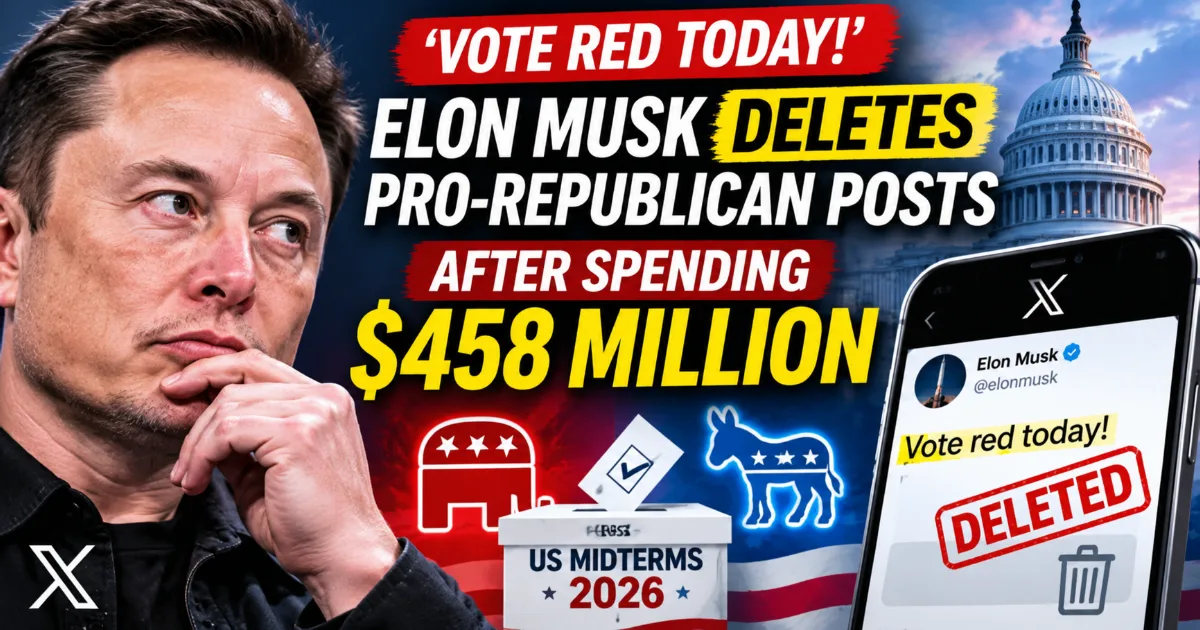
The Tesla and SpaceX Chief Removed His “Vote Red Today!” Appeal and an Earlier Republican Campaign Message After Democrats Made Major Gains in the US Midterm Elections. The Deletions Have Renewed Questions About Billionaire Political Spending, Campaign Influence and the Limits of Wealth in American Elections.
Elon Musk, the world's richest person and one of the most influential figures in American business and technology, has deleted several posts from his social media platform X that urged voters to support Republican candidates in the 2026 US midterm elections. The move came after Democrats achieved major electoral gains, taking control of both chambers of Congress and defeating several candidates who had received substantial financial backing from Musk.
Among the deleted messages was a short Election Day appeal that read, “Vote red today!” Musk had published it on November 3, when Americans went to the polls. He also removed an earlier pinned post, published around October 29, that urged voters to elect Republican senators. The posts disappeared from his profile after the election results began delivering a series of setbacks for Republican candidates.
The deletions attracted attention because Musk had committed hundreds of millions of dollars to Republican-aligned political causes during the election cycle. Reports put his spending at approximately $458 million, while some subsequent estimates based on broader contributions and political spending place the figure closer to $474 million. The difference reflects the scope and timing of the financial calculations, rather than a single universally agreed final figure.
Musk's political involvement had become one of the defining features of the election campaign. Through political action committees, direct contributions and support for conservative causes, he helped finance efforts to elect Republican candidates and influence key races.
Continue Reading
Yet the election delivered results that were very different from the outcome his spending was intended to secure. Democrats made significant gains, including a major victory in Texas, where James Talarico defeated Republican Ken Paxton in a closely watched Senate contest. Paxton had received extensive support from Musk.
The removal of the posts has therefore become more than a social media development. It has raised questions about the relationship between money and political influence, the role of technology billionaires in democratic processes, and whether even the largest individual political donors can translate financial power into electoral success.
Musk has not publicly provided a detailed explanation for deleting the messages. He did, however, respond to the election results with sarcastic comments, including a post saying that his “election-interfering space lasers” had not worked this time. The remark appeared to acknowledge the scale of the Republican setbacks while using humour to respond to criticism.
The episode offers a revealing look at the limits of political spending in a country where campaign finance has become increasingly dominated by wealthy individuals, super PACs and powerful interest groups.
What Exactly Did Elon Musk Delete?
The controversy centres on two messages that Musk had published on X during the final days of the 2026 midterm campaign.
The first was a pinned post from approximately October 29. In it, Musk encouraged Americans to vote for Republican Senate candidates. Pinning a message makes it more prominent on a user's profile, allowing visitors to see it immediately rather than having to search through older posts.
The second was the much shorter Election Day message, “Vote red today!” It was published on November 3 and directly urged voters to support Republicans.
The Election Day message reportedly attracted millions of views and hundreds of thousands of likes before disappearing. An archived version was reported to have received approximately 11.9 million views and 307,000 likes.
The disappearance was noticed by users who were examining Musk's account after the election results began emerging. A screen recording circulated showing the post was no longer accessible. Users also questioned Grok, the artificial intelligence chatbot developed by Musk's xAI and integrated into X, about whether the message had been deleted.
Grok reportedly confirmed that Musk had removed the Election Day post after Republicans suffered major losses. The chatbot's response added another dimension to the story because it was a system operating within the same platform owned by Musk.
Independent reporting and archived records also supported the conclusion that the messages had existed and were subsequently removed. This is important because screenshots of social media posts can be manipulated or circulated without context. In this case, the deletion was not based solely on an isolated screenshot.
However, an important distinction needs to be made. Reports confirm the removal of particular messages, not that Musk erased every post expressing support for Republicans. Other Republican-friendly posts and political content reportedly remained visible on his account.
There is also no confirmed public explanation establishing precisely why Musk deleted the posts. The timing strongly connects the deletions with the election results, but it would be inaccurate to present embarrassment, fear or regret as an established motive.
The facts are straightforward: Musk published direct appeals for Republican votes, Democrats made major gains, and the messages were subsequently removed. The interpretation of his motivation remains a separate question.
The $458 Million Question: How Much Did Musk Spend on Republicans?
The financial scale of Musk's political involvement is one of the most striking aspects of the story.
According to reporting by Forbes, Musk spent at least $458 million supporting conservative candidates and Republican-aligned political causes during the 2026 election cycle. Other reports, using a broader accounting of contributions and spending, put the figure at approximately $474 million.
These sums place Musk among the most significant individual political donors in modern American electoral history.
His spending was not limited to writing cheques to individual candidates. A substantial portion moved through political organisations, including America PAC, the super PAC associated with his political activities.
A super PAC is a political action committee that can raise and spend unlimited amounts of money to support or oppose candidates, provided it does not coordinate its spending directly with the campaigns it supports. These organisations can finance advertising, voter outreach, political messaging and other independent election activities.
Musk's contributions helped fund a broader Republican campaign infrastructure. His political money was directed towards competitive races, voter mobilisation and efforts to support conservative candidates in important states and congressional districts.
The spending also reflected a shift in Musk's public role. For much of his earlier business career, he was primarily known as an entrepreneur associated with electric vehicles, private space exploration, satellite internet and artificial intelligence.
In recent years, however, his political interventions have become increasingly visible. His public endorsements, campaign appearances, social media posts and financial contributions have made him a major participant in American political debate.
The 2026 midterm cycle demonstrated how far that involvement had expanded. Musk was not simply commenting on political developments from the sidelines. He was using his wealth, communication platform and public profile to support a specific electoral outcome.
The defeat of several candidates he supported has now placed the effectiveness of that strategy under scrutiny.
It is important, however, not to interpret the entire $458 million figure as money given directly to individual candidates. Political spending can include contributions to committees, independent advertising and other campaign-related activities. The exact total depends on which categories are included and the reporting period used.
The distinction between the reported $458 million and the broader estimate of approximately $474 million should therefore remain visible in any discussion of the figure.
America PAC and the Machinery Behind Musk's Political Spending
America PAC became one of the central vehicles through which Musk's political money entered the 2026 election cycle.
Political action committees have long been part of the American electoral system. They allow donors, organisations and political interests to raise and spend money in support of candidates and causes.
Super PACs operate under specific campaign finance rules. They can accept very large contributions and spend independently to influence elections, but they are not permitted to coordinate their independent expenditure activities with candidate campaigns.
Musk's financial involvement gave America PAC the resources to participate in several important political contests.
The organisation supported voter turnout operations, advertising and campaign-related messaging. These activities can be particularly important in closely contested races, where a relatively small change in turnout can affect the result.
Political spending can influence the visibility of candidates, the themes dominating public discussion and the ability of campaigns to reach voters. Advertising can highlight policy positions, criticise opponents and encourage supporters to participate.
But the presence of large financial resources does not guarantee electoral success.
Voters are influenced by a wide range of factors, including economic conditions, local concerns, candidate credibility, party identity, national leadership and the performance of the government.
A wealthy donor can help a campaign communicate its message, but cannot fully control how voters respond to it.
The 2026 election illustrated this distinction. Musk's money helped support Republican political efforts, but several candidates associated with that support still lost.
This has revived an important debate in American democracy: how much influence should an individual billionaire be able to exercise over the electoral process?
The legal framework permits substantial independent political spending, but the political and ethical questions surrounding such spending remain contested.
Some argue that wealthy individuals have the same right to political expression as other citizens and should be free to support candidates and causes they believe in. Others argue that enormous financial contributions create an imbalance in political influence and give a small number of wealthy donors disproportionate access to the public debate.
Musk's election spending has become a particularly visible example of this larger argument.
The Texas Senate Race: A Major Setback for Musk's Political Strategy
One of the most closely watched contests of the 2026 midterm elections was the Texas Senate race between Democrat James Talarico and Republican Ken Paxton.
Texas has traditionally been a strong Republican state in federal elections. Its Senate seats have been held by Republicans for decades, making the prospect of a Democratic victory particularly significant.
Musk had invested heavily in supporting Paxton, who was seeking the Republican position in the race. His financial backing and public support made the contest an important test of whether billionaire-funded political mobilisation could help Republicans retain control of a traditionally conservative state.
The result went against those expectations. Democrat James Talarico defeated Paxton, securing a major victory for his party. With 99 per cent of votes counted, reports placed Talarico's winning margin at approximately 12 percentage points. The result marked the first Democratic victory in a Texas Senate race since 1988.
The outcome was particularly damaging to Musk's political effort because Paxton was one of the candidates who had received substantial financial support from him.
The Texas contest also attracted national attention because of the scale of political spending surrounding it. Musk's contributions were part of a much larger financial effort to influence the race, and the result became a symbol of the limits of that spending.
For Democrats, Talarico's victory represented more than a single Senate seat. It demonstrated that Republican candidates could face serious challenges even in states that had long been considered reliable territory for the party.
For Republicans, the defeat raised questions about candidate selection, campaign messaging and the ability of the party to maintain support among voters who had previously backed conservative candidates.
It would be simplistic to claim that Musk's money alone caused Paxton's defeat. Election outcomes are shaped by multiple factors, including the candidates' records, public perceptions, local issues, voter turnout and national political sentiment.
Nevertheless, the result was politically significant for Musk because he had placed considerable resources behind a candidate who ultimately lost.
The Texas race became one of the clearest examples of the gap between financial investment and electoral results during the midterm cycle.
Democrats Make Major Gains in Both Chambers of Congress
The Texas Senate result was part of a much broader electoral setback for Republicans.
Democrats made significant gains in the 2026 midterm elections and secured control of both chambers of Congress, according to the election reporting available after the vote. The outcome represented a major shift in the balance of power in Washington.
The United States Congress consists of two chambers: the Senate and the House of Representatives.
The Senate has 100 members, with each state represented by two senators. The House has 435 voting members, with representation allocated according to population.
Control of these chambers determines much of the legislative agenda. The party holding a majority in either chamber has substantial influence over committee leadership, legislative priorities and the ability to advance or block proposals.
When the same party controls both chambers, it has a stronger position in shaping legislation, although the president's authority, Senate voting requirements and internal party disagreements can still affect what becomes law.
The Democratic gains therefore have implications beyond the individual candidates who won or lost.
They could influence debates over federal spending, taxation, immigration, healthcare, energy policy, technology regulation and oversight of the executive branch.
For the Republican Party, losing control of both chambers represents a serious political challenge. It can make it more difficult to advance legislative priorities and may increase congressional scrutiny of the administration.
For Musk, the result was also a setback because he had publicly supported Republican candidates and committed hundreds of millions of dollars to political causes aligned with their success.
The scale of the Democratic gains made the removal of his election-related posts especially noticeable. The messages had been published as part of a direct appeal to voters, but they disappeared after the electoral outcome moved in the opposite direction.
The broader result also raises questions about whether Republican campaign organisations underestimated voter dissatisfaction or relied too heavily on financial resources and national political messaging.
Those questions will likely remain part of the party's internal debate as it assesses its performance and prepares for future elections.
Why Musk's Money Could Not Guarantee Victory
The election has revived a fundamental question about modern political campaigns: can a billionaire's financial power determine the outcome of an election?
The short answer is that money matters, but it does not guarantee victory.
Political spending can provide candidates with greater visibility, improve campaign organisation and help reach voters through advertising and digital communication. It can also fund voter registration drives, outreach programmes and efforts to encourage supporters to participate.
However, voters do not make decisions based solely on campaign advertisements.
Economic conditions are often among the most important influences on electoral behaviour. Inflation, employment, housing costs, interest rates and household financial pressures can shape how voters evaluate the party in power.
Local concerns also matter. A candidate may receive substantial financial backing from a nationally recognised donor but still struggle to connect with the priorities of the constituency.
Candidate quality is another important factor. Personal credibility, political experience, public reputation and the ability to communicate effectively can influence voter confidence.
In the Texas race, the contest between Talarico and Paxton was shaped by the candidates' individual profiles and the broader political environment. The final result cannot be reduced to the amount of money either side spent.
The 2026 election also demonstrated that voters can reject candidates despite extensive financial support.
Musk's wealth gave Republican-aligned groups significant resources, but it could not guarantee that voters would agree with their positions or support their candidates.
This does not mean that political money has become irrelevant. Financial resources can influence which messages receive attention and which campaigns have the organisational capacity to compete.
The more accurate conclusion is that money is one source of political power among several. It can increase a campaign's reach, but it cannot fully replace public trust, candidate credibility or voter approval.
The distinction is especially important when discussing billionaires who use their wealth to support candidates across multiple states. Their contributions can shape the campaign environment, but the final decision still rests with voters.
Musk's Reaction: Sarcasm, Space Lasers and Data Centres in Space
After the Republican setbacks became clear, Musk returned to X with a series of comments about the election.
One of his most widely discussed remarks was: “Guess my election-interfering space lasers didn't work this time.” He also wrote that data centres in space were looking increasingly appealing.
The comments were widely interpreted as sarcastic responses to criticism of his political spending and influence.
The reference to space-based data centres was particularly interesting because it connected the political controversy to Musk's technology ambitions.
Musk has built his public identity around ambitious technological projects. Tesla is associated with electric vehicles and energy storage, SpaceX with reusable rockets and satellite infrastructure, and xAI with artificial intelligence.
His comments about space-based data centres therefore had a familiar connection to his broader business interests, even as they appeared in the middle of a political controversy.
The remark about election-interfering space lasers was more directly humorous. It appeared to mock the criticism that Musk had attempted to influence the election through his money and public platform.
However, the joke did not resolve the central questions surrounding his political activities.
Musk did not provide a detailed explanation of why he removed the “Vote red today!” message or the earlier pinned appeal. Nor did the remarks establish whether he intended to reduce his political spending in future election cycles.
The comments were a reaction to the results, not a comprehensive statement about his political strategy.
They also illustrated how Musk uses X as a direct communication channel. Instead of relying exclusively on formal interviews or press statements, he frequently responds to controversies through short posts that can quickly reach millions of users.
That approach allows him to control much of his public messaging, but it also means that individual posts can become major news events in their own right.
In this case, the deleted messages and the subsequent jokes became part of the wider story of the election.
The Conflict Between Being a Platform Owner and a Political Participant
Musk's role in the election raises another important question because he is not simply a wealthy donor or a public political commentator. He also owns X, one of the world's most influential social media platforms.
This creates a complicated relationship between personal political expression and control over a major communications network.
As an individual, Musk has the right to express political opinions and support candidates within the applicable laws. As a platform owner, however, his decisions can influence how the service is managed, how political content is distributed and how users perceive the platform's neutrality.
The distinction matters because social media platforms have become central to modern political campaigns.
Candidates use them to communicate with supporters, journalists use them to distribute reporting, political organisations use them to advertise and voters use them to discuss public issues.
When a platform owner publicly supports one political side, questions naturally arise about whether the platform itself provides a fair environment for competing political viewpoints.
Those questions do not automatically establish that the platform has been manipulated or that political opponents have been unfairly treated. Such claims require specific evidence.
Nevertheless, the concentration of platform ownership and political influence in the hands of one individual raises legitimate concerns about transparency and accountability.
Musk's election-related posts were personal communications on his own account. Their deletion was also an action involving his account. But the wider public debate concerns the relationship between his personal political activities and the influence he exercises through X.
The issue is likely to remain relevant as artificial intelligence, social media and digital advertising become increasingly important in political communication.
A platform can influence public debate through recommendation systems, content moderation decisions, advertising policies and the visibility of political messages.
The public interest therefore extends beyond whether a particular post was deleted. It includes questions about how political information is distributed and whether users can trust the systems through which they receive it.
What the Election Means for Musk's Business and Political Influence
The election results also arrived at a time when Musk's business interests were facing considerable public attention.
Tesla, SpaceX, xAI and X operate in sectors where government policy, regulation, public contracts and international relations can have significant consequences.
Tesla's electric vehicle business is influenced by government incentives, environmental regulations, trade policy and competition from international manufacturers. SpaceX operates in a sector closely connected to government contracts, national security and space regulation. Starlink's satellite internet business depends on licensing arrangements and regulatory approvals in different countries.
Artificial intelligence is another area where government decisions could shape the industry's future. Rules concerning data, safety, competition, intellectual property and the use of advanced computing systems are becoming increasingly important.
The political influence of a business leader can therefore attract attention from investors, regulators, customers and employees.
However, the election result should not be interpreted as an immediate threat to Musk's companies. A change in congressional control does not automatically cancel government contracts, alter regulatory approvals or change the commercial position of his businesses.
Congressional oversight can nevertheless influence the environment in which these companies operate. Committees may investigate government spending, regulatory decisions, technology policy and the relationship between major corporations and federal agencies.
A Democratic-controlled Congress could pursue different legislative priorities and exercise greater scrutiny over areas where Musk's companies have significant interests.
The precise consequences will depend on the priorities of congressional leadership, the administration's response and the outcome of future legislative negotiations.
For investors, the important issue is not simply Musk's political donations. It is whether the political environment creates new regulatory uncertainty or changes the commercial opportunities available to his companies.
His public political involvement can also affect how consumers and employees perceive the brands associated with him. Some customers may support his positions, while others may disagree with them.
The long-term business impact is therefore more complex than the immediate reaction to an election result.
Can Billionaires Continue to Shape American Elections?
Musk's spending has renewed debate about the influence of wealthy individuals in American politics.
The United States has a campaign finance system that allows substantial political spending through independent organisations. Super PACs, in particular, can collect large contributions and spend them to support or oppose candidates.
Supporters of this framework argue that political spending is a form of protected expression. They believe individuals and organisations should be able to use their resources to communicate political views and support candidates who represent their interests.
Critics argue that the system gives wealthy donors an influence that ordinary voters cannot match. They are concerned that candidates may become more responsive to major financial contributors than to the broader electorate.
Musk's involvement illustrates both sides of this debate.
His financial contributions gave Republican-aligned political organisations considerable resources. His public profile and ownership of X also provided him with a direct channel to communicate with a large audience.
Yet the election results demonstrated that these advantages did not guarantee the victories he wanted.
This distinction is important for the future of American democracy. Campaign finance can influence the conditions in which elections take place, but it does not remove the ability of voters to reject candidates.
The question facing policymakers is how to maintain freedom of political expression while ensuring that the electoral system remains transparent and accountable.
Potential reforms could focus on disclosure requirements, campaign finance reporting, political advertising transparency and the enforcement of existing rules.
Any reform would need to consider constitutional protections and the practical challenges of regulating modern digital campaigning.
The growth of online political advertising and AI-generated content makes the issue even more complicated. Voters need to understand who is financing political messages, how those messages are targeted and whether the content they encounter is authentic.
Musk's role in the 2026 election may become an important reference point in future discussions about money, technology and political influence.
Did Musk's Political Strategy Fail Completely?
It would be too simplistic to describe the election as a complete failure for Musk or to conclude that every candidate he supported lost.
Political spending must be evaluated across individual races, the overall performance of supported candidates and the broader political objectives of the donor.
Reports on the election indicated that many Musk-backed candidates had lost, while some had won. A WIRED analysis cited by the publication found that, among decided races it examined, more than 99 per cent of the traceable money Musk had put into those contests went towards races won by candidates who ultimately lost. At the time of that report, several races were still uncalled.
That analysis provides a striking measure of the disappointing electoral return on his political investment, but it should not be interpreted as a complete accounting of every contribution or every candidate he supported.
There is also a difference between winning an election and influencing the political conversation.
A donor may fail to elect a preferred candidate but still help shape campaign debates, encourage participation among particular voter groups or strengthen political organisations for future contests.
The long-term effects of political spending are not always visible on election night.
Musk's influence within Republican politics may therefore continue even after the midterm setbacks. His financial resources, public profile and communication platform remain significant.
At the same time, the election could encourage Republican leaders to reassess how closely they align themselves with individual donors and how they respond to voters who are dissatisfied with the party's direction.
For Musk, the results may also influence how he approaches future political involvement. Whether he continues spending at a similar scale, shifts his support towards different candidates or reduces direct public appeals remains uncertain.
No conclusion about a permanent change in his political strategy can be drawn solely from the deletion of two messages.
Conclusion: A Billionaire's Money Could Not Decide the Election
Elon Musk's decision to remove his “Vote red today!” post and an earlier appeal supporting Republican Senate candidates has become one of the most discussed political developments following the 2026 US midterm elections.
The timing was significant. The posts disappeared after Democrats made major gains, secured control of both chambers of Congress and defeated several Republican candidates who had received substantial financial support from Musk.
The reported spending figure of at least $458 million, with broader estimates approaching $474 million, made his involvement one of the most prominent examples of billionaire political spending during the election cycle.
The defeat of Ken Paxton in Texas was particularly symbolic. Musk had strongly supported the Republican candidate, but James Talarico secured a decisive victory, marking a historic Democratic Senate win in the state.
The episode demonstrates that financial power can provide campaigns with visibility, organisation and resources, but it cannot guarantee public support. Voters ultimately make their decisions based on a combination of economic conditions, candidate credibility, local concerns and national political sentiment.
Musk's ownership of X adds another layer to the debate. His personal political activity and control of a major communications platform raise continuing questions about the relationship between technology, wealth and democratic influence.
At the same time, it is important to distinguish verified events from assumptions. The posts were deleted, the election results were unfavourable to Republicans, and Musk made sarcastic comments afterwards. But he has not provided a detailed public explanation for the deletions, and there is no established evidence that a particular motive drove the decision.
The larger lesson is that no individual, regardless of wealth or influence, can guarantee an electoral outcome. Money can shape the campaign environment, but it cannot substitute for the confidence of voters.
For American politics, the 2026 midterms have opened a new chapter in the debate over campaign finance, technology platforms and the power of billionaires. For Musk, they have provided a public reminder that influence and electoral control are not the same thing.
He spent hundreds of millions trying to help Republicans win. The voters delivered a different result, and the posts that once urged them to vote red are now gone.