
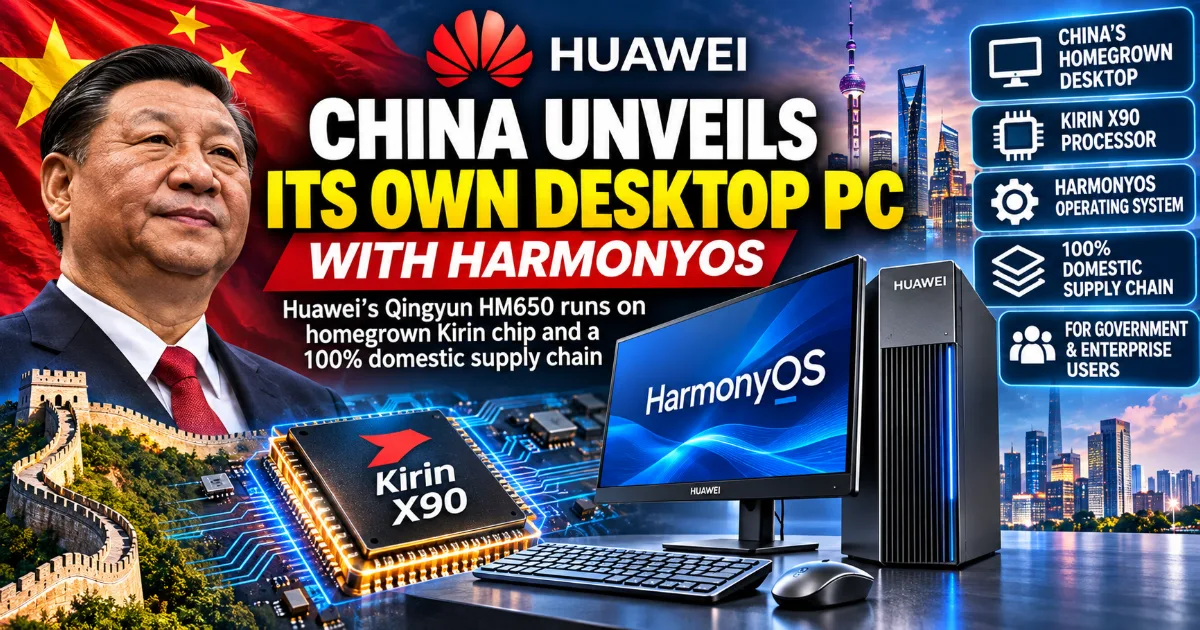
Huawei's Qingyun HM650 Combines a Homegrown Kirin X90 Processor, HarmonyOS and a Claimed 100% Domestic Supply Chain in China's Push for Technology Independence
China's ambition to reduce its dependence on foreign technology has reached another important milestone. Huawei has unveiled its first desktop computer powered by its proprietary HarmonyOS operating system, bringing together a Chinese-designed processor, domestically sourced components and software developed as an alternative to established desktop platforms such as Microsoft Windows.
The new Qingyun HM650 series was formally presented at Huawei's HarmonyOS Office Industry Summit in Wuhan on November 5, 2026. Designed primarily for government departments, public institutions and enterprise customers, the computers represent a significant expansion of Huawei's efforts to build an independent personal computing ecosystem. The company says the machines use entirely Chinese-made components, from the processor to memory modules, and have received what it describes as the industry's first 100% domestic-content certification for a desktop computer. The precise certification criteria and the full scope of the assessment have not been independently established.
The announcement is significant because China's technology ambitions extend well beyond manufacturing smartphones, telecommunications equipment and consumer electronics. Beijing has spent years trying to establish domestic alternatives to foreign processors, operating systems, databases, office software and other technologies considered essential to national infrastructure. The latest Huawei desktop brings several parts of that strategy together in a single commercial product.
The Qingyun HM650 is powered by Huawei's Kirin X90 desktop processor and runs an enterprise edition of HarmonyOS. It is designed to support everyday office work, professional applications, business administration and government computing requirements. Huawei is also positioning the machine as a platform for system-level artificial intelligence features and tighter integration between hardware, software and cloud services.
The launch comes amid continuing tensions between China and the United States over advanced semiconductors, technology exports and access to critical computing infrastructure. Restrictions imposed on Huawei over several years have made it difficult for the company to rely on certain American technologies. Rather than simply replace one processor or operating system, Huawei has been developing a broader domestic technology stack.
The desktop computer is an important addition to that effort. Smartphones and laptops have already helped Huawei establish HarmonyOS as a platform beyond its original mobile-device ambitions. A desktop system introduces a different challenge because office users depend on a much wider range of applications, peripherals, professional tools and established workflows.
The question now is whether Huawei can turn its technological independence into a practical alternative for organisations that have relied on Windows for decades.
Huawei's Qingyun HM650: What Has Been Announced?
The Qingyun HM650 series is Huawei's first desktop computer line running its HarmonyOS PC platform. The launch extends the company's operating system beyond smartphones, tablets and laptops into conventional desktop computing.
The series includes models intended for different professional environments. The HM650 is positioned for enterprise customers, while the HM650G is designed with government and public-sector users in mind. The two configurations reflect Huawei's effort to serve organisations that may have different requirements for computing performance, security management and procurement.
The central feature is the use of Huawei's Kirin X90 processor. Instead of relying on processors from Intel or AMD, the desktop is built around a chip developed within Huawei's own semiconductor ecosystem. The processor is designed to support conventional desktop workloads as well as graphics acceleration and local artificial intelligence processing.
The operating system is equally important. HarmonyOS provides the software environment through which users interact with the computer, run applications, manage files and connect with other devices. The enterprise version is intended to provide centralised administration and security features required by organisations deploying computers across multiple offices.
Huawei has also highlighted its domestic component sourcing. The company says the HM650 has achieved a 100% domestic-content certification, which it presents as a milestone for China's computer industry. This claim is an important part of the product's positioning, although the certification body, assessment methodology and treatment of upstream manufacturing equipment have not been fully disclosed in the available reporting.
The desktop is therefore more than a new product in Huawei's business-computing portfolio. It is an attempt to demonstrate that Chinese companies can assemble a complete desktop computing system using a domestic processor, operating system and supply chain.
The Kirin X90 Processor: The Hardware Behind China's New Desktop
A desktop operating system is only as useful as the hardware supporting it. Huawei's decision to use the Kirin X90 processor is central to the HM650's identity and to China's broader efforts to develop alternatives to foreign computing platforms.
Kirin processors are part of Huawei's semiconductor strategy and are developed through its chip-design operations. The X90 is intended for desktop-class workloads and has been used in Huawei's newer computing products.
Chinese technical reporting on the HM650 describes a configuration with a 10-core, 20-thread CPU design. The processor also includes a graphics component designed to support hardware acceleration and a neural processing unit intended for local AI workloads. The architecture is presented as a combination of general-purpose computing, graphics processing and artificial intelligence capabilities.
These components are important because modern desktop computers perform many different tasks simultaneously. A business user may have spreadsheets, documents, video meetings, browser tabs, databases and communication applications running at the same time. A processor must handle these workloads reliably while maintaining acceptable performance.
The graphics component is also relevant for users working with visual material, presentations, design tools and other applications that benefit from hardware acceleration. The neural processing unit provides a dedicated pathway for certain artificial intelligence operations, potentially reducing the need to send every task to a remote cloud service.
Huawei has promoted the integration of these components as part of a broader hardware and software optimisation strategy. Its argument is that a processor designed alongside the operating system can allow better coordination between system resources and applications.
However, specifications alone cannot establish whether the Kirin X90 is competitive with the latest Intel, AMD or Apple desktop processors. Independent performance testing, thermal measurements, power-consumption results and application benchmarks will be needed to establish how the machine performs under real workloads.
The launch nevertheless represents a meaningful development for Huawei. Developing a desktop processor and deploying it in a commercial product requires coordination between chip design, operating-system engineering, memory, storage, graphics and device manufacturing.
It also gives Huawei an opportunity to collect feedback from enterprise customers and improve its computing platform over time.
HarmonyOS Moves From Mobile Devices to the Desktop
The most important software development in the announcement is the arrival of HarmonyOS on a conventional desktop computer.
For years, the global desktop operating-system market has been dominated by Microsoft Windows and Apple's macOS. Linux distributions have provided another option, particularly among developers, researchers, technical users and organisations that prefer open-source software.
China has developed several domestic operating systems, including KylinOS and UnionTech's UOS. Many of these systems are based on Linux and have been adapted for Chinese hardware, government requirements and local application ecosystems.
Huawei's approach with HarmonyOS is different in its ambition. The company wants to create a consistent software environment that works across smartphones, tablets, laptops, desktop computers and other connected devices.
This approach could offer advantages to organisations that use multiple Huawei products. A worker might use a phone while travelling, a laptop during meetings and a desktop computer at a fixed office workstation. A common operating-system ecosystem could make it easier to transfer files, share information and maintain continuity between devices.
The desktop version must also support the specialised needs of business users. Office software, document management, financial applications, communication tools, databases, design programmes and enterprise security systems are essential parts of a modern workplace.
Huawei has promoted its HarmonyOS PC ecosystem as supporting productivity and professional application scenarios. The company has also highlighted its developer community and the number of applications adapted to its computer platform.
However, the size of an application catalogue does not automatically establish that every application performs as well as its Windows counterpart. Businesses need to know whether the software they depend on is available, whether files remain compatible and whether specialised devices such as printers, scanners and industrial equipment work reliably.
This is where the desktop strategy will face its most important test. Huawei must persuade organisations that switching operating systems will not interrupt their daily operations.
Why China Wants an Alternative to Microsoft Windows
China's interest in domestic desktop operating systems is part of a much longer technology policy. The country has spent years trying to reduce its reliance on foreign suppliers in sectors considered strategically important.
Windows has historically played a major role in China's desktop computing market. Government departments, companies, educational institutions and individual consumers have used Microsoft's operating system for decades.
The dependence creates several concerns for policymakers. Operating systems are deeply integrated into computer hardware, business applications, identity systems, network infrastructure and data-management platforms. A country that relies heavily on foreign software may face difficulties if access to updates, licences, technical support or related technologies becomes restricted.
The issue has become more politically significant as relations between China and the United States have deteriorated. Export restrictions and sanctions have affected Chinese companies operating in semiconductors, telecommunications and advanced computing.
For Beijing, the objective is not simply to replace a familiar product with a domestic brand. It is to develop the ability to control critical parts of the computing ecosystem, including processors, operating systems, applications and manufacturing capabilities.
A domestic operating system can also provide greater flexibility in adapting software to local regulations, security standards and public-sector requirements.
The strategy has implications for government procurement. If public institutions purchase more domestically developed computers and software, they can provide a large initial customer base for Chinese technology companies. That demand may encourage developers to improve compatibility, expand application support and invest in new products.
However, the transition is difficult. Replacing Windows across an organisation involves much more than installing another operating system. It requires application migration, employee training, IT support, cybersecurity testing and compatibility checks.
China's desktop ambitions therefore depend on the ability of domestic companies to build a complete and reliable ecosystem rather than simply manufacture a computer with a locally developed processor.
The US-China Technology Conflict Behind Huawei's Strategy
Huawei's latest desktop launch cannot be understood without considering the technology restrictions imposed by the United States.
In 2019, the US government placed Huawei on its Entity List, restricting the company's access to certain American technologies unless suppliers received the necessary licences. The restrictions affected its ability to work with a range of international technology companies and created uncertainty around its supply chains.
Subsequent measures placed additional pressure on Huawei's access to advanced semiconductor manufacturing technologies. The company had to rethink how it sourced processors and other components for its products.
For a technology company that sells smartphones, networking equipment, laptops and enterprise systems, restrictions on processors and software can have consequences across its entire business.
Huawei responded by accelerating investment in domestic technologies. Its semiconductor design operations continued developing Kirin processors, while its software teams expanded HarmonyOS into a broader operating-system platform.
The desktop launch demonstrates the results of that strategy in one product category. The HM650 combines a Huawei-designed processor with a Huawei-developed operating system and components that the company says are entirely domestic.
This is also a response to the uncertainty associated with international supply chains. Companies that depend on foreign processors, software licences and manufacturing partners can face difficulties when trade restrictions change.
Developing domestic alternatives does not necessarily remove every international dependency. Semiconductor manufacturing is a complex global industry that relies on specialised equipment, materials, software and production expertise. A chip designed in China may still depend on manufacturing technologies with international origins.
This distinction is important when assessing claims of complete technological independence. Domestic ownership of a processor design and the use of locally sourced components are significant achievements, but they do not automatically prove that every stage of the manufacturing process is independent of foreign technology.
Nevertheless, Huawei's strategy shows that export restrictions can accelerate investment in alternatives. The longer-term result may be a more fragmented global technology industry, with countries developing separate computing ecosystems to reduce strategic vulnerabilities.
China's Other Homegrown Desktop Operating Systems
Huawei is not the only Chinese company working to reduce dependence on Windows. Several domestic operating systems have been developed for government offices, businesses and specialised computing environments.
One of the best-known examples is KylinOS, developed by Kylin Software. The operating system has been used in public-sector and enterprise computing environments and is part of China's broader effort to establish domestic alternatives.
Another important platform is UOS, developed by UnionTech. It is based on Linux and has been designed to support desktop computing, enterprise software and government applications.
OpenKylin represents another part of the strategy. Released as an open-source desktop operating system in 2023, it was developed with contributions from a community of Chinese developers and organisations. Its purpose includes creating a more open domestic software ecosystem that can be modified and improved by developers.
These platforms are important because they demonstrate that China's operating-system development effort did not begin with Huawei's latest desktop. The country has spent years building software alternatives, encouraging developers and adapting applications to domestic platforms.
Huawei's HarmonyOS desktop is a new addition to this competitive environment. It may offer advantages through integration with the company's own processors and connected devices, while Linux-based systems have their own established developer communities and software foundations.
The result is not necessarily one single Chinese operating system replacing Windows. China may instead develop several domestic platforms serving different users and sectors.
Government departments may prefer systems that meet specific security and procurement standards. Enterprises may choose platforms based on application compatibility and technical support. Consumers may continue using Windows if it remains the most convenient option for their personal software needs.
The challenge for Chinese companies is to make domestic operating systems attractive enough that users choose them for practical reasons, not simply because government procurement policies encourage their adoption.
China Is Already Moving Government Computers Away From Windows
The Huawei desktop announcement follows a broader push to reduce the use of foreign technology in sensitive government environments.
Reports in August 2026 said Chinese authorities had instructed certain state-linked organisations to remove a customised government version of Windows 10 ahead of its planned retirement. The reported move formed part of a wider effort to increase the use of domestic operating systems and computer hardware.
The affected Windows edition had been developed specifically for the Chinese government environment through a joint venture involving Microsoft and a Chinese state-owned technology company. It included localisation and security-related features intended to meet domestic requirements.
The reported accelerated withdrawal demonstrates that China's technology policy is not limited to encouraging new products. It also involves changing procurement decisions and the software used by public institutions.
The country had already introduced policies encouraging government departments to prioritise technology products that meet domestic security and reliability assessments. These policies have created opportunities for Chinese hardware and software suppliers.
The replacement process is likely to be gradual because government offices use complex systems that cannot be switched overnight. Employees need access to existing records, internal databases, office applications and specialised services.
The government must also ensure that new operating systems can communicate with older systems during the transition. If software compatibility is poor, replacing Windows could create operational difficulties.
Huawei's HM650 may benefit from this policy environment because it is designed specifically for enterprise and government users. The company can work directly with institutional customers to adapt the product to their requirements.
However, the broader Windows replacement effort should not be confused with the complete disappearance of Windows from China. Windows continues to have a strong position in the country's consumer computing market, and many businesses still rely on its extensive application ecosystem.
The Biggest Challenge: Can HarmonyOS Run the Software Businesses Need?
A desktop computer is not judged only by its processor or appearance. For most organisations, the operating system's application ecosystem is just as important as the hardware.
Businesses rely on software that has often been developed and refined over many years. Accounting platforms, enterprise resource planning systems, document management applications, engineering tools, design software and industry-specific databases may have been built specifically for Windows.
Moving these applications to a new operating system can require developers to rewrite code, adapt interfaces and test compatibility. Some applications may be easy to migrate, while others may depend on Windows-specific technologies.
The problem becomes more complicated when companies use older software. A government department or industrial business may depend on a programme that was developed many years ago and is no longer actively maintained. Even if the application still works reliably on Windows, moving it to HarmonyOS may require expensive redevelopment.
Huawei must therefore build an ecosystem that addresses both modern applications and legacy software.
The company has been working with developers and software partners to adapt applications to HarmonyOS PCs. Its strategy includes encouraging native applications and providing development tools intended to make it easier to create software for multiple device types.
This is essential if Huawei wants to move beyond a limited market of organisations that can afford to redesign their workflows.
The availability of familiar office applications is particularly important. Workers expect to open documents, spreadsheets and presentations without formatting problems. They also need reliable access to email, calendars, video meetings and cloud storage.
Professional users have additional requirements. Architects, engineers, designers and researchers may rely on applications that require specialised graphics capabilities or complex hardware integration.
A domestic operating system can become a serious competitor only when it provides a dependable alternative for these everyday tasks.
Artificial Intelligence Could Become a Major Selling Point
Huawei is also positioning the HM650 as an AI-enabled desktop computer. The Kirin X90 includes a neural processing unit, and the company has promoted system-level AI capabilities as part of its HarmonyOS PC strategy.
Artificial intelligence is becoming a major part of the personal computing industry. Computer manufacturers are increasingly integrating dedicated AI hardware to support tasks such as speech recognition, document summarisation, image processing and intelligent search.
Local processing can offer several advantages. Certain tasks can be performed directly on the device without sending all information to a cloud server. This may improve response times, reduce dependence on internet connectivity and provide additional control over sensitive information.
For government departments and businesses handling confidential documents, the ability to perform some AI operations locally may be attractive.
Huawei has also promoted AI assistant features within its HarmonyOS computing environment. These are intended to help users organise information, manage documents and complete routine office tasks.
However, the practical value of AI features will depend on their accuracy, reliability and usefulness. Businesses will want to know whether the tools can handle real workloads rather than simply demonstrate impressive features during product presentations.
They will also need clear policies for handling sensitive information. An AI assistant that can access internal documents must operate within appropriate permissions and security controls.
The integration of AI hardware and software may become an important differentiator for Huawei, but it will not compensate for missing business applications or compatibility problems.
The company must deliver both a strong application ecosystem and useful AI capabilities if it wants to compete in the professional desktop market.
What Does 100% Domestic Manufacturing Really Mean?
Huawei's claim that the HM650 is 100% domestically made is one of the most striking aspects of the announcement.
The company says the desktop uses Chinese-made components, including the processor and memory modules. It has presented the certification as evidence that the domestic supply chain can now support a complete desktop computer.
This is an important achievement if the claim is supported by a robust and transparent assessment. It suggests that Chinese suppliers can provide the components required for a commercial computer without relying directly on foreign-branded parts.
However, the phrase 100% domestic can have different meanings depending on the certification rules.
A component may be designed by a Chinese company, manufactured by a Chinese factory and assembled domestically. But the factory producing that component may still use imported machinery, software or materials.
Semiconductor manufacturing is particularly complex. Chip fabrication depends on highly specialised equipment, chemicals, materials and production processes. Even countries with advanced semiconductor industries participate in global supply chains.
For that reason, domestic component sourcing should not automatically be treated as proof of complete independence from foreign technology at every stage of production.
The available reporting does not provide enough detail to establish the exact scope of the HM650 certification. It would therefore be premature to conclude that the computer has no indirect dependence on foreign technology anywhere in its supply chain.
A more complete assessment would require information about the certification body, component-origin rules, manufacturing equipment and treatment of upstream suppliers.
This does not diminish the significance of Huawei's achievement. It simply places the claim in the correct context.
The broader objective of technological self-reliance is not achieved through one computer. It requires a complete industrial ecosystem capable of designing, manufacturing and maintaining the technologies that businesses and public institutions depend on.
Can Huawei Compete With Dell, HP, Lenovo and Other Desktop Manufacturers?
The global desktop market includes established manufacturers with decades of experience in business computing. Dell, HP and Lenovo serve customers across government, education, healthcare, finance and enterprise markets.
These companies compete through hardware reliability, technical support, supply-chain scale, software compatibility and long-term relationships with corporate customers.
Huawei's entry into the HarmonyOS desktop segment creates another option, particularly for Chinese organisations that want to reduce reliance on foreign technology.
The company has several advantages in its domestic market. It already has relationships with government institutions, telecommunications companies and large enterprises. Its existing experience in networking equipment, smartphones and laptops provides a foundation for expanding into desktop computing.
Huawei can also coordinate hardware and software development within its own ecosystem. This may allow it to optimise the operating system for the processor and integrate management tools for enterprise customers.
However, competing with established manufacturers requires more than technical independence.
Businesses need dependable supply, repair services, warranties, software support and a clear upgrade path. They may also expect standardised device management and compatibility with existing IT infrastructure.
Large organisations typically evaluate computers through extended procurement processes. A product must demonstrate that it can meet performance requirements, comply with security standards and operate reliably across large deployments.
Huawei will need to establish a strong record in these areas.
Its success in China may depend partly on government and enterprise adoption. But becoming a global competitor will require the company to address different regulatory environments, software requirements and customer expectations.
What the Launch Means for China's Technology Industry
The HM650 launch is significant beyond Huawei because it highlights the growing coordination between China's hardware and software industries.
A successful desktop ecosystem requires contributions from semiconductor designers, memory suppliers, storage manufacturers, operating-system developers, application companies and computer manufacturers.
No single company can create all the technologies needed for a modern computer. Even a vertically integrated company depends on suppliers and partners.
Huawei's domestic desktop strategy encourages cooperation across this industrial chain. By creating demand for locally developed components, the company can help suppliers gain experience and improve their products.
Government and enterprise orders may provide an early market for these technologies. Large institutional customers can support deployment at scale, identify compatibility problems and encourage software developers to improve their applications.
This process can gradually strengthen the domestic ecosystem.
However, there is a risk that a market driven mainly by procurement requirements may become less competitive. If customers choose products only because they are encouraged to buy domestic systems, manufacturers may face weaker pressure to improve performance and usability.
Long-term success requires genuine value for customers. Domestic products must become reliable, affordable and capable of meeting the needs of the people who use them.
The challenge is to build an industry that can compete through innovation rather than depend permanently on administrative preference.
Could China's Desktop Strategy Change the Global PC Market?
The global PC industry has traditionally relied on a relatively interconnected technology ecosystem. American companies have played major roles in processors, operating systems and software, while manufacturers across Asia have built and assembled computers for worldwide markets.
China's effort to develop a separate desktop ecosystem could gradually change that structure.
If domestic processors, operating systems and applications become widely adopted in China, the country could reduce its reliance on foreign suppliers in a market of enormous scale.
That may encourage Chinese manufacturers to develop products specifically for HarmonyOS and other domestic operating systems. Over time, this could create an alternative computing ecosystem with its own software standards, hardware requirements and development tools.
The international consequences would depend on whether these technologies remain concentrated in China or become attractive to customers in other countries.
Some governments may be interested in domestic computing platforms because they want greater control over data, infrastructure and technology procurement. Others may prefer established international products because of their broader application support and compatibility.
The desktop market could therefore become more fragmented, particularly in sectors involving government and critical infrastructure.
However, Windows and macOS have substantial advantages. They benefit from established developer communities, mature application ecosystems and decades of user familiarity.
China's domestic systems will need to overcome these advantages through consistent performance, better software support and competitive pricing.
The HM650 is an important step, but it does not by itself signal the end of Windows dominance.
What This Means for Indian Technology Companies and Users
Huawei's announcement also has relevance for India, where the government and technology industry have been discussing digital sovereignty, semiconductor manufacturing and the development of domestic technology capabilities.
India has a large market for personal computers and enterprise software. Its public institutions, banks, educational organisations and private companies depend heavily on operating systems and applications developed by international technology companies.
China's strategy offers an example of how a country can combine hardware development, operating-system investment, government procurement and enterprise partnerships to build a domestic computing ecosystem.
However, India's circumstances are different. The country has a diverse software industry, a large services sector and deep integration with international technology supply chains. Developing a domestic desktop platform would require significant investment in chip design, manufacturing, software engineering, application development and technical support.
India would also need to decide whether to focus on a single national platform or encourage multiple competing systems.
The most important lesson may be that technology independence is not achieved simply by assembling computers locally. It requires control over critical technologies, strong domestic suppliers and an application ecosystem that users genuinely want to adopt.
India's experience with software services and digital infrastructure provides a foundation, but the desktop operating-system market would require a long-term industrial strategy.
Huawei's launch demonstrates how much coordination is needed to bring a domestic computing platform to market.
The Road Ahead: A New Desktop Ecosystem or a Government-Focused Alternative?
The immediate market for the Qingyun HM650 is expected to be government departments and enterprise customers in China. That gives Huawei a defined starting point rather than requiring it to compete directly for every consumer desktop purchase.
Institutional deployments can help the company test the operating system, improve compatibility and build relationships with software developers.
The first major test will be whether the desktop performs reliably in everyday office environments. Organisations will need to evaluate document compatibility, network access, application performance, security management and technical support.
The second test will be the growth of the HarmonyOS application ecosystem. Developers must have enough incentive to create and maintain software for the platform. Without a broad selection of applications, even a technically capable desktop may struggle to attract users.
The third test will be economic competitiveness. Domestic components and software must deliver a compelling combination of performance, price, reliability and long-term support.
Huawei also needs to demonstrate that the system can evolve. Desktop computers are expected to remain in service for several years, particularly in government and enterprise environments. Customers will want assurances that security updates, software compatibility and hardware support will continue throughout the device's life.
If the HM650 succeeds, it could become a foundation for further domestic desktop products. Other Chinese manufacturers may adopt similar processors or operating systems, while software companies may increase investment in HarmonyOS applications.
If adoption remains limited, the computer may still serve an important role as a specialised government and enterprise platform, but it would have a smaller impact on the global desktop market.
Conclusion: Huawei's Desktop Is a Milestone in China's Push for Digital Independence
Huawei's Qingyun HM650 represents a significant development in China's effort to reduce its dependence on foreign computing technologies. By combining the Kirin X90 processor, HarmonyOS and a claimed fully domestic component supply chain, the company has brought several parts of its technology strategy together in one desktop product.
The launch also highlights how the US-China technology conflict is reshaping the global computing industry. Restrictions on access to foreign processors and software have encouraged Huawei to accelerate investment in domestic alternatives. The result is an expanding ecosystem that includes smartphones, laptops, desktop computers, processors and operating systems.
However, technological independence is not the same as market leadership. Huawei must still demonstrate that its desktop can deliver the performance, compatibility, reliability and software support that businesses expect from a professional computer.
The application ecosystem will be especially important. Organisations cannot abandon familiar systems simply because a domestic alternative exists. They need confidence that their documents, databases, business applications and daily workflows will continue to function.
The 100% domestic-content claim is also an important milestone that deserves transparent technical verification. The achievement of domestic component sourcing should be recognised while distinguishing it from complete independence across every stage of semiconductor manufacturing and the wider supply chain.
For now, the HM650 is best understood as a strategic step rather than proof that China has replaced Windows. It gives Huawei a stronger position in domestic enterprise computing and provides China's software and hardware industries with another platform to develop.
The bigger question is whether this effort can create a sustainable alternative to the global desktop ecosystem that has dominated computing for decades. That outcome will depend not only on processors and operating systems, but also on developers, businesses, public institutions and millions of users.
China has made another move towards building its own computing infrastructure. Whether that move becomes a major challenge to Windows will be decided by what happens after the launch, when the computers enter offices and users begin relying on them for everyday work.