Firecracker Smoke Adds to an Already Dangerous Pollution Burden as Delhi Wakes Up to Poor Visibility, Health Concerns and Renewed Questions Over India's Clean-Air Strategy
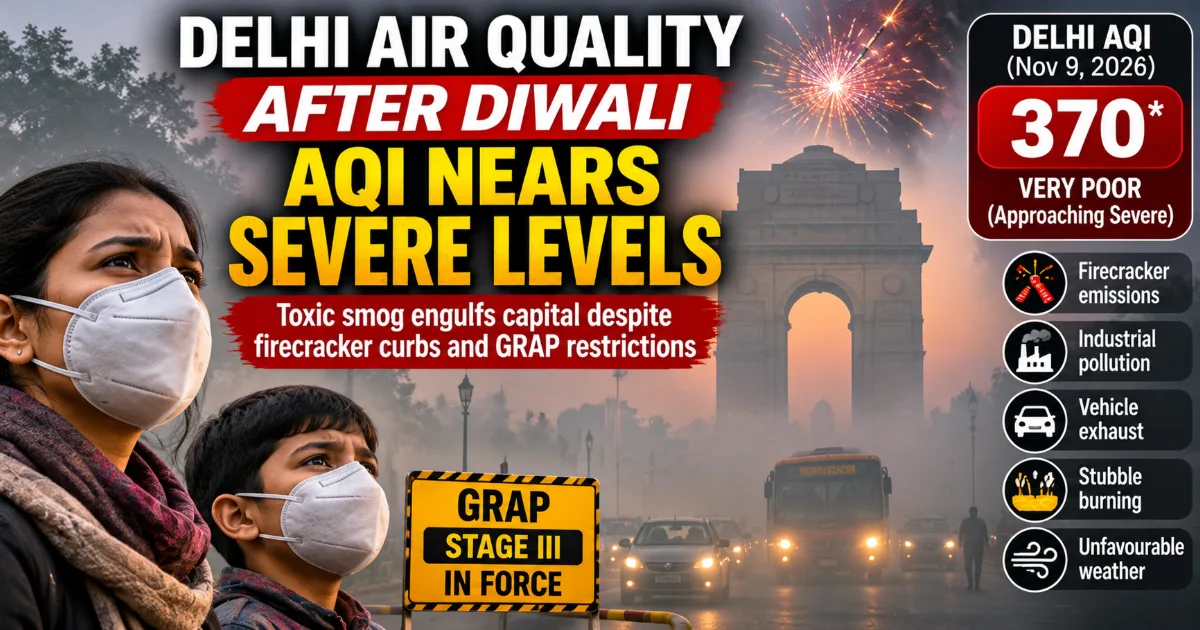
Delhi woke up on November 9 to a thick blanket of grey smog after Diwali celebrations pushed an already polluted atmosphere towards some of the worst air-quality levels of the season. Smoke from firecrackers hung over residential neighbourhoods, roads and prominent landmarks, reducing visibility and leaving many residents complaining of burning eyes, throat irritation and difficulty breathing.
The deterioration came despite restrictions on firecracker use and the implementation of Stage III of the Graded Response Action Plan (GRAP) across Delhi-NCR. Several monitoring stations recorded air quality in the severe category, while the city's overall reading remained in the very poor range in some official snapshots before approaching or entering severe levels in others.
The Central Pollution Control Board's monitoring data showed Delhi's average Air Quality Index at around 368 to 370 on Monday morning in early readings reported by different outlets. Other reports recorded substantially higher readings at individual stations. NDTV reported that the citywide AQI reached 483 at 8:10 am, with at least 15 monitoring locations above 400. The differences reflect changing measurement times and monitoring snapshots, making it important to distinguish a citywide average from individual station readings.
Continue Reading
The pollution episode was not caused by one source alone. Firecracker emissions added a fresh layer of particulate pollution to an atmosphere already burdened by vehicle exhaust, industrial activity, construction dust, waste burning and seasonal smoke from agricultural residue burning in neighbouring states. Unfavourable weather, including low wind speeds and limited atmospheric mixing, made it harder for pollutants to disperse.
The result was another familiar post-Diwali crisis for the national capital. Despite years of restrictions, emergency measures, court interventions and public awareness campaigns, Delhi continues to face a recurring winter pollution emergency. The latest episode raises an uncomfortable question: why does the city remain so vulnerable to a predictable annual combination of festival emissions, regional pollution and unfavourable weather?
Delhi's Air Quality Deteriorates Sharply After Diwali
The change in Delhi's air quality became particularly visible as Diwali celebrations progressed on Sunday, November 8. The city had already been experiencing unhealthy air conditions, with the average AQI remaining in the very poor category. As firecracker use increased during the evening, smoke accumulated across several parts of the capital.
According to reports based on CPCB monitoring data, Delhi's average AQI stood at approximately 376 on Diwali evening. At 10 pm, 20 monitoring stations had entered the severe category. Sonia Vihar recorded an AQI of 463, while Jahangirpuri registered 450. Other neighbourhoods also experienced deteriorating conditions as smoke spread across residential areas and major roads.
The situation continued into Monday morning. A thick haze reduced visibility in several areas, with reports describing landmarks becoming difficult to see from nearby roads and flyovers. Commuters encountered hazy conditions, while residents reported the smell of burnt firecrackers lingering in the air long after the main celebrations had ended.
Different reports published on November 9 cited different readings. News On AIR reported an AQI of 368 at 7 am, while the Hindustan Times reported approximately 366 at 6:15 am. NDTV subsequently reported a citywide reading of 483 at 8:10 am. These figures represent readings at different times and should not be treated as one simultaneous measurement.
The distinction between citywide averages and individual monitoring stations is equally important. Delhi is a large urban region with different pollution sources, traffic patterns, industrial clusters and local weather conditions. A station near a busy road or an area with concentrated emissions can record much worse air quality than another station elsewhere in the city.
This is why residents may experience very different conditions depending on where they live or work. A citywide average can communicate the overall situation, but it does not necessarily describe the air people are breathing at a particular street, school, office or residential building.
Several Areas Enter the Severe Pollution Category
The pollution was widespread, although some neighbourhoods recorded particularly high readings.
Reports from November 9 identified locations including Burari Crossing, Jahangirpuri, Bawana, Rohini, Sonia Vihar, Punjabi Bagh and other parts of north and west Delhi among the areas experiencing severe air quality. NDTV reported readings above 400 at at least 15 monitoring stations, while the Hindustan Times highlighted DTU and Burari Crossing among the locations recording especially high levels in its morning report.
The following readings illustrate the severity reported at selected monitoring locations. They are snapshots from different reports and times, not a simultaneous comparison.
Monitoring location | Reported AQI |
|---|---|
Sonia Vihar | 463 on Diwali night |
Jahangirpuri | 450 on Diwali night |
Burari Crossing | 437 in a Monday morning report |
DTU | 437 in a Monday morning report |
ITO | 407 in a Monday morning report |
Chandni Chowk | 418 in a reported morning reading |
Mundka | 417 in a reported morning reading |
These figures show that the problem was not restricted to one neighbourhood. Areas across the capital experienced a combination of particulate pollution and reduced visibility.
The Central Pollution Control Board classifies AQI readings between 301 and 400 as very poor and readings between 401 and 500 as severe. The severe category represents a particularly dangerous level of air pollution, with the potential for health effects even among people who do not normally experience respiratory problems.
The difference between a reading of 399 and 401 may appear small numerically, but the classification change signals that pollution has crossed an important threshold. More importantly, even readings below 400 can represent unhealthy conditions, particularly for children, older people and those with existing respiratory or cardiovascular vulnerabilities.
It is also necessary to distinguish official Indian AQI readings from figures published by independent air-quality platforms. Some reports on November 9 cited values above 1,000 using alternative platforms and measurement systems. These figures are not directly comparable with the CPCB's Indian AQI scale, which is capped at 500. A headline quoting an AQI above 1,000 should therefore identify the measurement source rather than present it as an official CPCB reading.
Firecrackers Add to an Already Polluted Atmosphere
Firecrackers were one of the immediate contributors to the deterioration after Diwali. Despite restrictions, fireworks were reported across several parts of Delhi during Sunday evening.
Residents and journalists reported firecracker activity in areas such as Pitampura, Burari, Mayur Vihar and parts of Lutyens' Delhi. The smoke accumulated over roads and residential neighbourhoods as celebrations continued. The smell of burnt crackers remained noticeable in several locations, while visibility declined.
Fireworks release a mixture of gases and fine particles into the atmosphere. Their composition depends on the materials used, the type of firecracker and the conditions under which it burns. Some products contain chemical compounds responsible for colour effects, while combustion produces particulate matter and other pollutants.
The immediate concern is the release of fine particles, particularly PM2.5. These particles are small enough to penetrate deep into the respiratory system. Unlike larger dust particles that may be trapped in the upper airways, PM2.5 can travel into the lungs and contribute to inflammation and other health problems.
Firecracker smoke can also contain metals and chemical compounds associated with the materials used in manufacturing. The precise mixture varies, but the health concern is not limited to the visible smoke. Fine particles can remain suspended in the air even when the immediate fireworks display has ended.
The impact becomes more serious when large numbers of fireworks are used over a short period in a densely populated city. Delhi's existing pollution burden means that additional emissions arrive when the atmosphere is already struggling to disperse pollutants.
This helps explain why a few hours of intense firecracker use can have an effect beyond the immediate celebration. When the weather is unfavourable, pollutants may remain trapped near the ground and contribute to poor air quality the following morning.
However, it would be inaccurate to attribute Delhi's entire post-Diwali pollution crisis to firecrackers. They add to the pollution load, but the city's air quality is shaped by multiple sources operating throughout the year. The festival becomes a particularly visible trigger because emissions rise sharply during a short period when seasonal pollution is already increasing.
Why Did Pollution Rise Despite Restrictions?
The return of severe pollution despite restrictions highlights the limitations of relying on emergency measures alone.
The Commission for Air Quality Management had already activated Stage III of the Graded Response Action Plan across Delhi-NCR on November 6, before Diwali. The decision followed forecasts and assessments indicating that air quality could deteriorate further. The restrictions included curbs on certain construction activities and additional controls intended to reduce emissions.
The Supreme Court had also permitted only approved green firecrackers during limited hours on November 7 and 8. The permitted windows were 6 am to 7 am and 8 pm to 10 pm. News On AIR reported that the complete ban on firecrackers in Delhi-NCR was restored from November 9.
Despite these restrictions, firecrackers were used across the capital. This points to a persistent enforcement challenge. A restriction can be legally clear, but its effectiveness depends on public compliance, monitoring, enforcement capacity and the availability of practical alternatives.
Green firecrackers are designed to reduce emissions compared with conventional products, but they should not be understood as pollution-free. They can still release particulate matter and other pollutants. Their use during an already polluted period can add to the overall burden.
The wider challenge is that restrictions on fireworks address only one part of the problem. Vehicles continue to operate, construction and road dust remain sources of particulate pollution, and industrial emissions do not disappear during festivals.
Delhi's post-Diwali experience therefore demonstrates the need for both effective enforcement and long-term pollution reduction. Emergency restrictions may prevent conditions from becoming even worse, but they cannot substitute for structural improvements in transport, energy, construction practices and regional pollution management.
GRAP Stage III: What Restrictions Were in Force?
The Graded Response Action Plan is an emergency framework designed to introduce progressively stricter measures as air quality deteriorates across Delhi-NCR.
It is coordinated by the Commission for Air Quality Management, working with the relevant authorities in Delhi and neighbouring states. The framework is intended to provide a structured response rather than waiting until pollution reaches its most dangerous levels.
Stage III includes restrictions on non-essential construction and demolition activities, along with additional measures targeting polluting vehicles and other emission sources. Depending on the applicable directions, it can also involve changes to school arrangements and other measures intended to reduce exposure and emissions.
The purpose is to lower the pollution burden when forecasts indicate that air quality is likely to become severe or remain severely polluted.
However, GRAP is an emergency response mechanism. It does not remove the sources of pollution permanently. Construction may be restricted temporarily, but road dust remains a problem. Certain vehicles may face restrictions, but traffic emissions continue. Industrial activity may be regulated, but the effectiveness depends on monitoring and compliance.
The activation of Stage III before Diwali was therefore a warning that the pollution situation was already serious. The fact that several monitoring stations entered the severe category after the festival shows that the emergency framework could not prevent the short-term deterioration.
This does not necessarily mean the restrictions had no effect. Without them, pollution might have been worse. Establishing that would require a detailed assessment of emissions, weather conditions and air-quality measurements under comparable circumstances.
The more important question is whether Delhi can reduce its dependence on emergency restrictions by addressing the sources of pollution throughout the year.
The Weather Factor: Why Delhi's Pollution Gets Trapped
Weather plays a major role in determining how quickly pollutants disperse.
During warmer months, stronger sunlight and atmospheric mixing can help disperse pollution under certain conditions. As winter approaches, temperature patterns, wind speeds and atmospheric stability can change. Pollutants may remain concentrated closer to the ground instead of dispersing vertically.
Delhi's post-Diwali pollution episode occurred during a period when meteorological conditions were not favourable for clearing emissions quickly.
The Air Quality Early Warning System had indicated that low wind speeds and a weak ventilation index could limit the dispersal of pollutants. Reports noted that a ventilation index below 6,000 square metres per second, combined with average wind speeds below 10 kilometres per hour, represents an unfavourable situation for effective pollution dispersion.
A ventilation index is used to understand how effectively the atmosphere can dilute and disperse pollutants. When ventilation is weak, emissions from vehicles, industries, fires and other sources can accumulate.
This means the same amount of pollution released on two different days may produce very different air-quality outcomes. On a windy day, some pollutants may disperse more quickly. During stagnant conditions, emissions can remain concentrated over the city.
Temperature inversions can make the situation worse. Under an inversion, a layer of warmer air sits above cooler air near the ground, restricting vertical movement. Pollutants become trapped beneath this layer, contributing to persistent haze.
The interaction between emissions and weather is particularly important during winter in northern India. Pollution sources do not suddenly appear in November, but changing atmospheric conditions can make their effects much more visible and dangerous.
This is why Delhi's winter air crisis cannot be solved through a single intervention. Reducing emissions is essential, but authorities must also use weather forecasts to anticipate periods when pollution is likely to accumulate.
Stubble Burning Remains Part of the Regional Pollution Problem
Agricultural residue burning in neighbouring states is another source of concern during the post-Diwali period.
After harvesting paddy, some farmers burn leftover crop residue to clear their fields quickly for the next agricultural cycle. The practice releases smoke and particulate matter that can travel across state boundaries depending on wind direction and weather conditions.
Punjab and Haryana have frequently been at the centre of discussions about stubble burning and its contribution to Delhi's winter pollution. The issue is particularly sensitive because the agricultural calendar overlaps with the period when Delhi's air quality generally begins to deteriorate.
Reports on November 9 identified stubble burning among the contributing factors alongside firecracker emissions, traffic and unfavourable weather. The contribution varies from day to day and depends on the number and location of fires, wind patterns and atmospheric conditions.
It is important not to treat crop-residue burning as the sole explanation for Delhi's pollution. The contribution from agricultural fires is seasonal and changes with meteorological conditions. Local emissions from transport, industries, construction dust and other activities remain important.
The problem also cannot be solved simply by blaming farmers. Crop-residue burning is connected to agricultural economics, harvesting schedules, machinery availability, labour costs and the limited time available between crops.
Farmers may face financial and logistical barriers when asked to adopt alternative residue-management methods. Machinery such as happy seeders, super seeders and other residue-management equipment can help, but access, affordability and operational support are essential.
Governments need to combine enforcement with practical alternatives. Financial assistance, equipment availability, crop diversification, local biomass markets and reliable procurement arrangements can help make residue management economically viable.
A lasting solution requires cooperation between Delhi, Punjab, Haryana, Uttar Pradesh and other parts of the National Capital Region. Air pollution does not respect state borders, and regional sources require coordinated action.
Vehicles, Construction Dust and Industry Continue to Add to the Burden
While firecrackers receive considerable attention after Diwali, everyday emissions remain a major part of Delhi's pollution problem.
The transport sector contributes pollutants through exhaust emissions, fuel combustion, tyre and brake wear, and the resuspension of road dust. Heavy traffic, congestion and slow-moving vehicles can increase exposure in busy urban corridors.
The Indian Express reported that transport was expected to be the largest contributor to Delhi's pollution on November 8 under the city's Decision Support System, accounting for an estimated 19 per cent. The same report identified a smaller estimated contribution from stubble burning for that day. These are modelled estimates for a particular period, not permanent shares of the city's annual pollution.
Construction and demolition activities can release dust when materials are transported, stored or handled without adequate controls. Unpaved shoulders, damaged roads and poorly managed construction sites can also contribute to particulate pollution.
Industrial emissions add another layer. Factories, power generation, fuel use and other industrial processes can release particulate matter and gases that contribute to poor air quality.
Waste burning is another persistent concern. Burning household waste, leaves and other materials in open spaces releases pollutants close to residential areas. Such emissions may be smaller in scale than major industrial sources, but their proximity to people can increase exposure.
The cumulative effect is important. A city may experience a pollution spike after fireworks, but the atmosphere is already receiving emissions from numerous sources. When weather conditions prevent those pollutants from dispersing, the overall concentration rises.
This is why a serious clean-air strategy must focus on the entire emissions landscape. Reducing fireworks for a few hours cannot compensate for inadequate public transport, poorly managed construction dust, industrial pollution or open waste burning.
What Does Severe AQI Mean for Public Health?
Air pollution is not merely a visibility problem. It is a public-health concern that can affect the respiratory and cardiovascular systems.
The health risks associated with pollution depend on the type of pollutants, their concentration, the duration of exposure and an individual's health condition. Fine particulate matter is particularly concerning because it can penetrate deep into the lungs.
Short-term exposure to high pollution levels may cause irritation of the eyes, nose and throat, coughing, wheezing, chest discomfort and breathing difficulties. People with asthma or other respiratory conditions may experience worsening symptoms.
The effects are not limited to people who already have diagnosed illnesses. Healthy adults can also experience discomfort and reduced respiratory function when exposed to high concentrations of pollutants.
Children are especially vulnerable because their lungs are still developing and they often spend time outdoors. Older adults may also face increased risks, particularly if they have existing heart or lung conditions.
People with cardiovascular disease can be affected because air pollution is associated with inflammation and other processes that place additional stress on the heart and blood vessels.
Longer-term exposure to polluted air is associated with a greater risk of chronic respiratory disease, cardiovascular problems and other serious health outcomes. The effects can accumulate over time, making repeated winter pollution episodes a concern beyond the immediate festival period.
The post-Diwali episode is therefore not just about a few days of haze. It is part of a recurring exposure pattern that can affect millions of people.
Public-health responses must include timely alerts, accessible medical advice, protection for vulnerable groups and better information about local air quality. Hospitals and clinics may also need to prepare for increases in respiratory complaints during severe pollution periods.
Children, Schools and Outdoor Activities Face Greater Risks
Children are among the groups that need particular attention during severe pollution episodes.
Schools, playgrounds and outdoor sports activities can expose children to polluted air during the hours when they are most active. Even when schools remain open, outdoor assemblies, physical education classes and recreational activities may need to be reconsidered.
GRAP Stage III includes provisions that can affect school arrangements, including hybrid options for younger students under applicable directions. The exact measures depend on the orders in force and the authorities responsible for implementation.
Parents should pay attention to official school announcements rather than relying on rumours about closures. Schools should communicate clearly about outdoor activities, transport arrangements and any changes to attendance.
Children with asthma or other respiratory conditions may need additional precautions based on medical advice. Parents should ensure that prescribed medication and action plans are available, especially when pollution levels are high.
Older people also require attention. Those with heart or lung conditions may need to limit strenuous outdoor activity and follow advice from their healthcare providers.
The objective should not be to create unnecessary panic. It is to reduce avoidable exposure during periods when air quality is particularly poor.
What Residents Can Do During a Severe Pollution Episode
Individual precautions cannot solve Delhi's air pollution crisis, but they can reduce exposure during a period of severe air quality.
Residents should first check official air-quality readings and local advisories. Conditions can vary significantly between neighbourhoods, and the citywide average may not represent the pollution level in a particular location.
When air quality is severe, people should reduce strenuous outdoor exercise and avoid unnecessary prolonged outdoor exposure. Running, cycling and intense physical activity increase breathing rates, which can increase the amount of polluted air inhaled.
People who need to travel outdoors may consider a well-fitted particulate respirator such as an N95 or equivalent certified mask. Ordinary cloth masks and loose-fitting coverings do not provide the same level of protection against fine particles.
Keeping windows closed during periods of particularly high outdoor pollution may help reduce indoor exposure, although homes also need appropriate ventilation when outdoor conditions improve. Indoor air purifiers equipped with effective particle filters can help in enclosed spaces when used and maintained correctly.
Residents should avoid adding to indoor pollution by burning incense, candles or other materials unnecessarily. Smoking indoors should also be avoided.
People with asthma or other medical conditions should follow their clinician's advice and continue prescribed treatment. They should seek medical attention if they experience severe breathing difficulty, chest pain or other worrying symptoms.
These measures are protective steps, not a substitute for government action. People should not be expected to solve a public pollution emergency by purchasing expensive equipment or staying indoors indefinitely.
The responsibility for clean air ultimately lies with coordinated public policy, effective regulation, infrastructure investment and enforcement.
Delhi's Pollution Crisis Is Bigger Than Diwali
The recurring post-Diwali pollution spike has become a symbol of Delhi's wider environmental challenge. Every year, the city faces a familiar combination of seasonal emissions, weather conditions and public-health concerns.
The festival is often treated as the main event because the increase in firecracker smoke is immediate and visible. However, the underlying problem begins much earlier and continues long after the celebrations end.
Delhi's winter air quality is influenced by local and regional emissions. Vehicles, industries, construction dust, waste burning, household fuel use and agricultural fires all contribute in varying proportions. Weather conditions determine how quickly those emissions disperse.
This makes the problem difficult to solve through isolated restrictions. A temporary ban on firecrackers may reduce one source of pollution, but it cannot address the emissions generated by millions of vehicles or poorly controlled industrial activity.
Similarly, a construction ban may reduce dust temporarily, but long-term improvement requires better site management, road maintenance and urban planning.
The city also needs reliable public transport that encourages people to reduce private vehicle use. Expanding metro connectivity is useful, but it must be supported by convenient buses, safe walking routes, cycling infrastructure and effective last-mile connectivity.
Industrial emissions require consistent monitoring and enforcement. Waste management must reduce open burning, while municipal authorities need systems for collecting and processing leaves, construction waste and household refuse.
Regional coordination is equally essential. Delhi cannot control all the sources affecting its air quality within its own administrative boundaries. States across the National Capital Region must work together on transport, agriculture, industry and waste management.
Why Repeated Emergency Measures Are Not Enough
Emergency measures are necessary when pollution reaches dangerous levels. They can reduce certain emissions, protect vulnerable groups and prevent conditions from deteriorating further.
But an emergency plan is not a long-term clean-air strategy.
If the same restrictions need to be activated every winter, it suggests that the underlying sources have not been sufficiently controlled. The city continues to respond to pollution after it becomes severe rather than preventing the buildup throughout the year.
A more effective approach would combine continuous emissions reduction with seasonal preparedness.
Transport policy should prioritise cleaner public transport, better traffic management and a gradual transition towards lower-emission vehicles. Industrial regulation should include transparent monitoring and meaningful consequences for violations.
Construction rules should be enforced consistently, not only when the AQI crosses an emergency threshold. Dust control, covered material transport, site inspections and road maintenance should become routine requirements.
Agricultural residue management needs long-term investment. Farmers require affordable machinery, practical alternatives and financial incentives that reflect the real costs of changing established practices.
Air-quality monitoring should also become more transparent and accessible. Residents need reliable information about local pollution, the major sources affecting their areas and the measures authorities are taking.
The public should be able to evaluate whether policies are working through measurable outcomes rather than announcements alone.
A successful clean-air programme should reduce the frequency, duration and intensity of severe pollution episodes over several years. It should also improve average air quality throughout the year, not merely produce short-lived improvements after emergency restrictions.
The Importance of Reliable Pollution Data
The different AQI figures reported after Diwali also highlight the importance of explaining air-quality data carefully.
The CPCB's national AQI system provides a standard framework for communicating pollution levels in India. It uses readings from multiple pollutants and translates them into a scale that helps the public understand health risks.
However, real-time readings can change throughout the day. A station may record a sharp increase during one hour and a lower value later. A citywide average may also differ from the highest individual station reading.
Private air-quality platforms may use different calculation methods, monitoring networks or scales. Some provide estimated values based on additional data sources. Their numbers may be useful for understanding local conditions, but they should not be presented as equivalent to official CPCB readings without explaining the methodology.
This is particularly important when extreme values appear in headlines. A figure above 1,000 on a private platform does not mean that the official CPCB AQI has exceeded its 500-point maximum.
Journalists and public authorities should clearly identify the source, time and location associated with each reading. This would help people understand the severity of the situation without creating confusion.
Better data communication is itself an important part of public health. People need to know whether conditions are improving, worsening or remaining dangerous, and whether the reading refers to their neighbourhood or the entire city.
What Needs to Change Before the Next Winter?
Delhi's post-Diwali pollution crisis should lead to a review of both immediate enforcement and long-term planning.
The first priority is reducing emissions before the seasonal pollution peak. Authorities should not wait until November to address construction dust, vehicle emissions, industrial activity and waste burning.
The second priority is improving coordination across the National Capital Region. Pollution sources are spread across several states, and isolated action by Delhi cannot deliver a lasting solution.
The third priority is creating practical alternatives to activities that contribute to pollution. Farmers need support for residue management, commuters need reliable public transport, and businesses need clear standards and predictable timelines for adopting cleaner technologies.
The fourth priority is strengthening enforcement. Restrictions must be applied consistently, and violations should have consequences. Public announcements have limited value if the rules are not followed on the ground.
The fifth priority is protecting public health. Schools, hospitals, local governments and employers should have clear protocols for responding to severe pollution. People need timely alerts and practical guidance that does not depend on expensive equipment.
Finally, governments should publish regular assessments of what is working and what is failing. Air pollution is a complex problem, but it can be measured. Progress should be judged through changes in pollutant concentrations, emissions, exposure and health outcomes.
Conclusion: Another Diwali Has Passed, but Delhi's Clean-Air Challenge Remains
Delhi's post-Diwali air pollution episode on November 9, 2026, is a reminder of how quickly an already unhealthy atmosphere can deteriorate when additional emissions coincide with unfavourable weather.
Firecracker smoke contributed to the pollution burden, while vehicle emissions, industrial activity, construction dust and seasonal agricultural fires continued to affect the region. Low wind speeds and limited atmospheric ventilation made it harder for pollutants to disperse, leaving large parts of the capital under a thick layer of smog.
The deterioration occurred despite Stage III GRAP restrictions and the Supreme Court's limited permission for approved green firecrackers during specified hours. The experience demonstrates the gap between regulatory measures and their implementation, while also showing the limits of treating firecrackers as the only cause of the crisis.
For residents, the immediate priority is to reduce exposure and follow reliable health advisories. For authorities, the responsibility is much larger. Delhi needs sustained improvements in transport, industrial regulation, construction practices, waste management and regional agricultural policies.
The city cannot afford to repeat the same cycle every winter: pollution rises, emergency restrictions are introduced, residents struggle through hazardous air and public attention fades when conditions temporarily improve.
Clean air should not be treated as a seasonal emergency. It is a basic public-health requirement and an essential part of urban development.
The real measure of success will not be how quickly Delhi returns to its usual pollution levels after Diwali. It will be whether the city can prevent another winter from becoming a public-health crisis in the first place.
#DelhiAirPollution #DelhiAQI #PostDiwaliPollution #DelhiSmog