
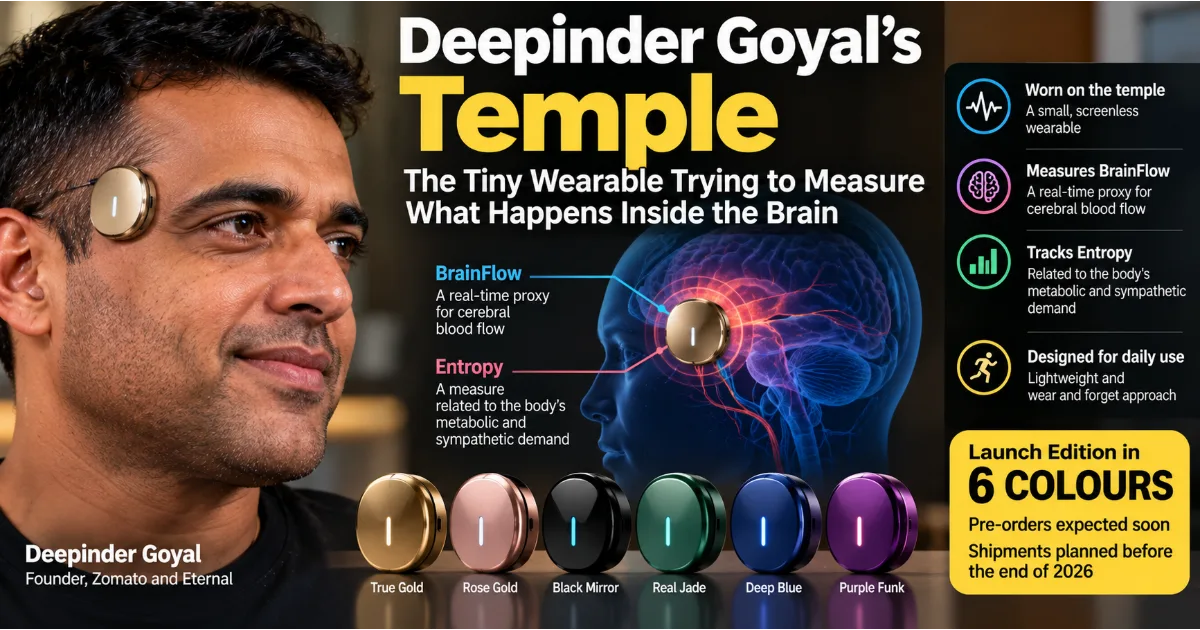
For months, a small metallic device attached to the side of Deepinder Goyal's head attracted almost as much curiosity as the entrepreneur himself. It did not look like a smartwatch, fitness band or conventional medical device. There was no visible screen, no large strap and no familiar display showing steps or heart rate. It simply sat near the temple, creating a question that spread across social media and technology circles: what exactly was that device?
The answer is Temple, an experimental wearable health technology project associated with Goyal, the founder of Zomato and Eternal. The device is designed to be worn on the side of the head and is built around a technology the company calls BrainFlow. According to Temple, BrainFlow is a real-time proxy for cerebral blood flow, giving the wearer a continuously changing measurement intended to reflect changes associated with blood flow to the brain. Temple
The project has now moved considerably closer to becoming a commercial product. Goyal recently revealed that the launch edition of Temple will come in six colours: True Gold, Rose Gold, Black Mirror, Real Jade, Deep Blue and Purple Funk. He has also indicated that pre-orders could begin soon, with people already on the early-access waitlist receiving priority. The company has previously indicated that shipments of the limited launch edition are expected before the end of 2026. The Economic Times
That announcement makes Temple more interesting than simply another unusual gadget. The project sits at the intersection of consumer electronics, neuroscience, wearable technology, artificial intelligence, preventive health and longevity research. It also raises an important question about the future of personal health technology. How much can a tiny sensor attached to the side of someone's head really tell us about the brain?
The Device That Started as a Mystery
Temple did not arrive through the traditional consumer electronics playbook. There was no conventional product launch followed by months of advertisements and retail demonstrations. Instead, public interest began when Goyal appeared in public wearing the small device near his temple.
The unusual appearance immediately attracted attention because it looked unlike almost every mainstream wearable. People were accustomed to seeing smartwatches on wrists, fitness trackers on arms and smart rings on fingers. A small electronic object attached directly to the side of the head was something different.
The mystery itself became part of the product's story. Goyal gradually began explaining that the device was not simply an accessory but part of a much larger experiment involving health, human performance, brain physiology and ageing.
Temple's approach is deliberately different from conventional wearable technology. Instead of putting another screen on the user's wrist, the company is attempting to make the hardware small enough that the user can wear it continuously without having to interact with it constantly. The idea is closer to a passive sensor than a traditional smartwatch.
This is important because most consumer wearables have been built around information that is relatively easy to understand. A person can see that they walked 8,000 steps, slept for seven hours or reached a certain heart rate during exercise. Temple is attempting to move into a much more complicated category involving signals associated with the brain.
What Exactly Is Temple?
Temple is a small wearable designed to attach to the side of the head around the temple region between the forehead and ear. The company describes BrainFlow as a proxy for cerebral blood flow that is measured in real time from the temple. Its website presents BrainFlow as a number that is intended to change in response to behaviours and physiological conditions associated with health. Temple
The basic concept is ambitious. Blood flow to the brain is an important physiological process, and changes in circulation can be associated with exercise, cardiovascular function, posture, sleep and other aspects of human physiology.
The challenge is that measuring something happening inside the brain is significantly more difficult than measuring a signal at the surface of the body.
A smartwatch can measure signals from the wrist because the device has relatively straightforward access to the skin, blood vessels and electrical or optical signals it is designed to detect. A sensor placed near the temple has a different problem. Between the sensor and the deeper structures of the brain are skin, blood vessels, tissue, bone and other layers that can affect optical measurements.
That is why Temple's central scientific claim is also the most important part of the story.
The company is not merely saying that it has created another fitness tracker. It is attempting to develop a wearable method for continuously observing a physiological signal associated with the brain in everyday life.
How BrainFlow Is Supposed to Work
Temple says BrainFlow uses light-based sensing to collect signals from tissue and blood vessels around the temple. The company describes the resulting measurement as a proxy for cerebral blood flow rather than presenting it as a conventional hospital-grade brain scan. Temple
The distinction matters because a proxy is not automatically the same thing as a direct measurement.
In technology and science, proxies are often useful when direct measurement is difficult. A sensor may observe one measurable phenomenon and use it to infer another phenomenon that is more difficult to measure directly. The usefulness of the proxy depends on how strong the relationship is between the measured signal and the underlying phenomenon.
That is why validation is central to Temple's future.
Goyal has increasingly shared research intended to demonstrate that Temple's BrainFlow signal corresponds with changes associated with blood flow in the brain. In September, he shared details of validation work comparing Temple's measurements with established techniques. A study involving 23 healthy adults compared Temple's readings with transcranial Doppler measurements during exercise and found that the device captured changes in brain blood flow trends. The study was submitted for peer review. Gadgets 360
The company later discussed another validation study involving 60 participants and time-domain near-infrared spectroscopy, or TD-NIRS. Goyal said the results showed stronger correlations between Temple's BrainFlow readings and changes in brain blood volume than with scalp blood volume under several physiological challenges. He has also encouraged independent researchers to replicate the findings. The Economic Times
Those developments are significant because Temple's early story involved a large technological claim without a large body of publicly available validation evidence.
The emergence of validation studies does not mean every possible claim about the device has been scientifically established. It means the company is beginning to provide evidence that can be examined, challenged and replicated.
That distinction will become increasingly important as Temple moves from an experimental project toward a consumer product.
Temple Is Not a Medical Diagnosis Machine
This is perhaps the most important point for consumers.
Temple's technology should not be treated as a replacement for clinical diagnosis, neurological examination or established medical investigations. A wearable measurement can potentially provide useful information about trends without being capable of diagnosing a disease.
A person seeing a change in a wearable metric should not automatically conclude that something is wrong with their brain. Likewise, a reassuring number should not be interpreted as proof that a person is medically healthy.
This concern has already been raised by medical experts. Earlier criticism of Temple focused on the difficulty of interpreting a measurement taken from a single external location and using it to draw conclusions about complex processes occurring throughout the brain. The concern was not simply whether a sensor could detect a signal, but whether that signal could accurately represent what is happening deeper inside the brain. The Indian Express
That is a legitimate scientific question.
The brain is not a single uniform organ with identical blood flow everywhere. Blood flow can vary between regions and vessels. A measurement associated with one location cannot automatically be assumed to represent every aspect of cerebral circulation.
Temple's future credibility will therefore depend heavily on how carefully it defines what its measurements mean.
If the company presents BrainFlow as a useful physiological trend that can help people understand how their bodies respond to exercise, sleep, stress and other activities, the proposition is easier to evaluate.
If consumers interpret the number as a complete measure of brain health, the technology could easily be misunderstood.
The Second Number Called Entropy
BrainFlow is not the only concept associated with Temple.
Goyal has also introduced a metric called Entropy, which he describes as a live measurement related to the body's metabolic and sympathetic demand. According to his description, the number changes continuously in response to factors such as sleep, stress, exercise, caffeine and meditation. NDTV
This is another area where language matters.
Temple presents Entropy as an index rather than a conventional medical measurement. The company is attempting to transform complex physiological information into a simple number that changes as the body's state changes.
That idea is familiar in consumer technology. Fitness companies have spent years converting complicated physiological data into scores for readiness, recovery, stress and sleep.
The difference is that Temple wants to use signals obtained from the head to create its own interpretation of the body's state.
The appeal is obvious. Most people cannot interpret raw physiological signals. A simple number could potentially make complicated information easier to understand.
The danger is that a simple number can also create a false impression of certainty.
When an app says that someone has a recovery score of 82 or an entropy score of a particular value, the number can look more scientifically precise than the underlying evidence actually allows.
For Temple, explaining what the numbers mean may be just as important as developing the sensors that generate them.
Why the Temple Location Matters
The decision to place the device near the temple is not simply a design choice.
The company believes the temple region provides access to signals that can be used to study blood flow and other physiological changes. This is why Temple's physical design is so different from conventional wearables.
The location also creates practical challenges.
A wristwatch can be secured using a strap. A ring can remain on a finger. Temple needs to stay attached to a relatively sensitive area of the head while the user moves, exercises and performs ordinary daily activities.
Recent reports say the current version uses adhesive Grips designed to keep the device attached during activities such as exercise and swimming. The company has also been working to make the device considerably smaller. Goyal said in August that the latest version was less than half the size of the earlier version and described it as the smallest wearable by volume, although that description is a company claim rather than an independently established industry ranking. The Print
The smaller size is important because wearable technology is ultimately about behaviour.
A device can have impressive sensors, but if people find it uncomfortable, inconvenient or distracting, they will not wear it consistently.
Temple's entire proposition depends on continuous measurement, which means continuous wearing.
From One Colour to Six
The latest announcement about six colours may look superficial compared with the science behind the device, but it reveals something important about Temple's evolution.
Earlier versions of the device were mostly shown in a metallic gold finish. The launch edition is now expected to offer True Gold, Rose Gold, Black Mirror, Real Jade, Deep Blue and Purple Funk. mint
This suggests that Temple is moving beyond the image of a laboratory experiment.
A research device can be functional without worrying too much about aesthetics. A consumer product cannot.
Once people are expected to pay a significant amount of money for something that remains attached to their head throughout the day, appearance becomes part of the product experience.
The six colours therefore represent more than a cosmetic update. They indicate that Temple is preparing for a consumer market in which personal technology is also part of personal identity.
The company has not yet confirmed that all six colours will remain available permanently. For now, they have been described as launch-edition options.
When Will Temple Be Available?
Goyal's latest update indicates that pre-orders could begin soon, with early-access waitlist members receiving priority. The exact commercial pre-order date was not confirmed in the reports available as of October 8, 2026. The Economic Times
The company has previously indicated that the limited launch edition is expected to ship before the end of 2026.
That means Temple has reached a different stage of development.
For much of its early life, the product was something people watched from a distance. They saw Goyal wearing it, heard claims about brain blood flow and waited for more information.
Now the real consumer test is approaching.
Once people can actually buy the device, the discussion will shift from curiosity to experience.
Will people find it comfortable enough to wear every day? Will the measurements remain consistent outside controlled research environments? Will the software explain the information clearly? Will users understand what the numbers actually mean? Will people find the data useful enough to continue using the device after the novelty disappears?
Those questions cannot be answered by a product announcement.
They can only be answered by real-world use.
What Could Temple Cost?
Temple's final launch price has not been officially confirmed.
Earlier reports suggested an expected price in the range of ₹75,000 to ₹80,000 for the initial device, although consumers should treat that as an indicative figure until the company publishes the final price. More recent reporting has also mentioned a possible price around $1,000, showing that estimates have varied as the product approaches launch. ET Now
At that price, Temple would sit firmly in the premium health technology category.
This changes the commercial challenge.
A smartwatch costing several thousand rupees can justify its value through familiar features such as notifications, activity tracking, heart rate monitoring and sleep tracking.
Temple has to convince customers to pay considerably more for something much less familiar.
Its value proposition therefore depends on whether people believe brain-related physiological information can meaningfully improve their understanding of health, performance and lifestyle.
That is a much harder product to explain.
Temple Has Already Attracted Serious Investment
The project is not being developed as a small experimental gadget without significant financial backing.
Temple raised $54 million in its first funding round in February 2026 at a reported post-money valuation of approximately $190 million. Reports said the investors included Peak XV Partners, Steadview Capital, Dharana Capital and Info Edge Ventures, alongside individual investors and Temple employees. ET Now
That level of funding demonstrates that investors see potential in the underlying idea.
It also increases expectations.
When a startup raises substantial capital around a scientific technology, investors are effectively betting that the technology can eventually become a large commercial category.
Temple's challenge is therefore not simply to build a working wearable. It has to demonstrate that the data it produces can create enough value for a large number of users to justify the cost of the hardware, research and ongoing software development.
The Bigger Bet Is About Longevity
Temple becomes easier to understand when viewed through Goyal's broader interest in health, performance and ageing.
The company describes BrainFlow in the context of behaviours such as exercise, sleep, meditation, cold exposure and healthy eating. The basic idea is that if people can continuously observe how their bodies respond, they may eventually be able to make better decisions about the behaviours that influence their health. Temple
This is part of a larger movement in technology.
The first generation of wearables asked relatively simple questions. How many steps did you take? How fast was your heart beating? How long did you sleep?
The next generation is attempting to ask more complicated questions. How recovered are you? How stressed are you? How does your body respond to training? What happens to your physiology during meditation? How does your body react to changes in sleep and nutrition?
Temple is pushing that idea toward the brain.
If the underlying measurements prove reliable, the long-term opportunity could extend far beyond fitness tracking.
Researchers could potentially use continuous physiological measurements to study how people respond to exercise, stress, sleep, altitude, posture and other conditions.
That does not mean Temple has already achieved those possibilities.
It means the technology is being developed in a direction where such applications could eventually become possible if the measurements are validated and the scientific evidence grows.
The Science Will Matter More Than the Hype
There is a natural tendency for technology stories involving famous entrepreneurs to become personality stories.
Goyal's association with Zomato gives Temple an immediate audience. Every update generates attention because people already know the founder.
But celebrity cannot validate a scientific claim.
The real test will be independent evidence.
Temple has begun sharing validation studies, which is an important step. The company has also said it wants researchers to replicate its findings. Those are positive signs because scientific credibility depends on evidence that can be examined independently rather than simply accepted because the company says it is true. The Economic Times
The next stage will involve peer review, larger studies, replication by independent groups and evidence across different populations and real-world conditions.
A small study involving healthy adults can demonstrate that a technology may work under certain conditions. It does not automatically establish that the device can reliably measure every person's brain blood flow during every activity.
That distinction should remain central to the conversation.
The Privacy Question Could Become Just as Important
There is another issue that becomes increasingly important as wearables move closer to the brain.
Data about someone's sleep, heart rate, exercise and activity is already highly personal.
Data associated with cognitive state, stress, fatigue or brain physiology could be even more sensitive.
If a device continuously collects physiological information, users need to understand who controls that data, how long it is stored, whether it is shared, how it is protected and whether it can be used for purposes beyond the original health application.
The more valuable the data becomes, the more important these questions become.
A wearable that knows when someone sleeps is collecting intimate information.
A wearable that attempts to understand how someone's brain and body respond to stress, exercise and cognitive demands could potentially collect information that users consider even more private.
The future of health technology will therefore require not only better sensors but better privacy standards.
Could Temple Change Fitness Technology?
The most interesting possibility is that Temple could help create a new category of wearable.
For years, the wrist has been the dominant location for consumer health technology. Smartwatches have become increasingly capable, and sensors have improved dramatically.
Temple takes a completely different approach.
Instead of adding more functions to the wrist, it moves the sensor to a location that may provide access to a different class of physiological information.
That could encourage other companies to experiment with new body locations and new forms of sensing.
Technology does not always advance by making existing products more powerful. Sometimes it advances by changing where and how information is collected.
The smartphone did not simply make the landline telephone smaller. It changed the relationship between people and computing.
Similarly, Temple is not simply trying to make another smartwatch.
It is testing whether the head can become a new location for continuous consumer health sensing.
The Six Colours Are Actually Part of a Bigger Transition
The announcement of six colours has received attention because it makes Temple feel more like a finished consumer product.
But the more important development is the transition happening underneath the design.
Temple is moving from mystery to measurement.
It is moving from a device people noticed on Goyal's head to a product with a defined technology platform.
It is moving from broad claims toward publicly discussed validation studies.
It is moving from a single visible prototype toward a smaller commercial design.
It is moving from an experimental project toward pre-orders.
And it is moving from curiosity toward the much harder question of whether ordinary consumers will find the technology genuinely useful.
That final step will determine whether Temple becomes an important wearable technology company or remains an ambitious experiment.
Why Temple Is Different From a Smartwatch
A smartwatch is designed around interaction.
You look at it. You touch it. You receive messages. You change settings. You monitor activity. You respond to notifications.
Temple is being positioned differently.
The company has described its approach as a small, screenless wearable that users can attach to the side of the head and largely forget about while it collects data. Reports have compared the philosophy to a wear-and-forget approach rather than another screen-based device. The Financial Express
That distinction could be important.
People are increasingly surrounded by screens. Phones, watches, computers, televisions and cars all compete for attention.
A health device that does not require constant interaction could therefore have an advantage.
Instead of asking users to look at another screen, Temple's model is to collect information quietly and interpret it through software.
Whether consumers actually prefer this model will become clearer after launch.
What Success Would Look Like
Success for Temple should not simply be measured by how many units are sold.
The more meaningful question is whether the technology can demonstrate reliable measurements that provide useful information to users.
If BrainFlow proves to be a robust physiological signal, it could become the foundation for a new class of research and consumer health applications.
If Entropy can be shown to provide a meaningful and repeatable representation of physiological demand, it could become another layer of personal health analytics.
But if the numbers prove difficult to interpret, inconsistent across people or too disconnected from meaningful health outcomes, the technology could struggle regardless of how attractive the hardware becomes.
That is why Temple's next chapter will be defined by evidence.
The product design has already generated curiosity.
The funding has already generated confidence among investors.
The six colours have already made the product feel closer to the consumer market.
Now the science has to carry the story forward.
The Road Ahead for Deepinder Goyal's Most Unusual Product
Goyal built his public reputation through food technology and then expanded his ambitions through Eternal. Temple represents a very different kind of entrepreneurial bet.
Food delivery is fundamentally a logistics and consumer behaviour problem.
Temple is a science and hardware problem.
The difference is enormous.
Building an app and delivery network can be measured through orders, delivery times, customer retention and revenue.
Building a wearable that attempts to measure signals associated with brain blood flow requires engineering, physiology, clinical research, sensor development, data analysis and long-term validation.
That makes Temple one of the more unusual technology bets to emerge from India's startup ecosystem.
It is also a reminder that Indian entrepreneurship is increasingly moving beyond software platforms and consumer internet businesses.
Companies are beginning to experiment with hardware, biotechnology, artificial intelligence, health technology and scientific research.
Temple sits directly inside that transition.
Beyond the Headline
The headline about Temple launching in six colours is easy to understand.
Six colours sound like a product announcement.
Pre-orders sound like a commercial announcement.
But the more important story is underneath those developments.
A founder who became famous for building a food delivery business is now attempting to create a tiny wearable capable of continuously measuring a signal associated with blood flow to the brain.
That is a remarkably ambitious proposition.
The six colours show that the product is becoming more consumer-friendly. The shrinking size shows that engineering is progressing. The early-access programme shows that the company is preparing for commercial demand. The validation studies show that the company understands the need to support its scientific claims with evidence.
But none of those developments eliminates the fundamental challenge.
Temple must prove that the information it provides is accurate enough, meaningful enough and useful enough to justify its price and place in people's daily lives.
That will take more than social media attention.
It will take research.
It will take independent validation.
It will take transparent communication.
It will take responsible interpretation of health data.
And ultimately, it will take millions of ordinary moments in which people wear the device and decide whether the information genuinely helps them understand their health better.
Temple is therefore not just another wearable.
It is an experiment in whether consumer technology can move closer to the brain without crossing the line between useful personal insight and exaggerated medical promise.
The answer will not be determined by how futuristic the device looks, how many colours it comes in or how famous its founder is.
It will be determined by what the data can actually prove.
And that is what makes Temple worth watching.
#BeyondHeadlines #DeepinderGoyal #Temple #TempleWearable #BrainFlow #HealthTech #WearableTechnology #Neurotechnology #BrainHealth #ArtificialIntelligence #IndianStartups #IndianTechnology #Zomato #Eternal #Longevity #FitnessTechnology #HealthTechnology #ConsumerTechnology #Wearables #BrainScience #CerebralBloodFlow #FutureOfHealth #TechnologyIndia #InnovationIndia #StartupIndia #Neuroscience #DigitalHealth #HealthInnovation #BeyondTheHeadline