
Introduction
For years, India's startup and investment story has been closely associated with a relatively small group of cities. Bengaluru became synonymous with technology and venture capital, Mumbai remained one of the country's most important financial centres, and Delhi NCR developed into another major hub for startups, investors, corporate headquarters and professional talent. These cities have undoubtedly played an enormous role in India's economic transformation, but their success has also created a tendency to view entrepreneurship through a metropolitan lens. A recent LinkedIn post from Startupro, titled "India's Northeast Needs More Investment and Support," brings attention to an important question: what happens when talented entrepreneurs exist outside the country's traditional startup centres but do not receive the same access to capital, mentorship, networks and markets? LinkedIn
The post highlights the perspective of Dr. Tej Chingtham, a Sikkim based professor and startup ecosystem builder, who argues that India needs more investors willing to take meaningful bets on entrepreneurs from the Northeast. His central argument is not simply that the region needs more money. It is that entrepreneurs need access to the broader ecosystem that allows ideas to become businesses and businesses to become scalable companies. Capital matters, but capital without networks, mentorship, market access, infrastructure and institutional support can remain insufficient. LinkedIn
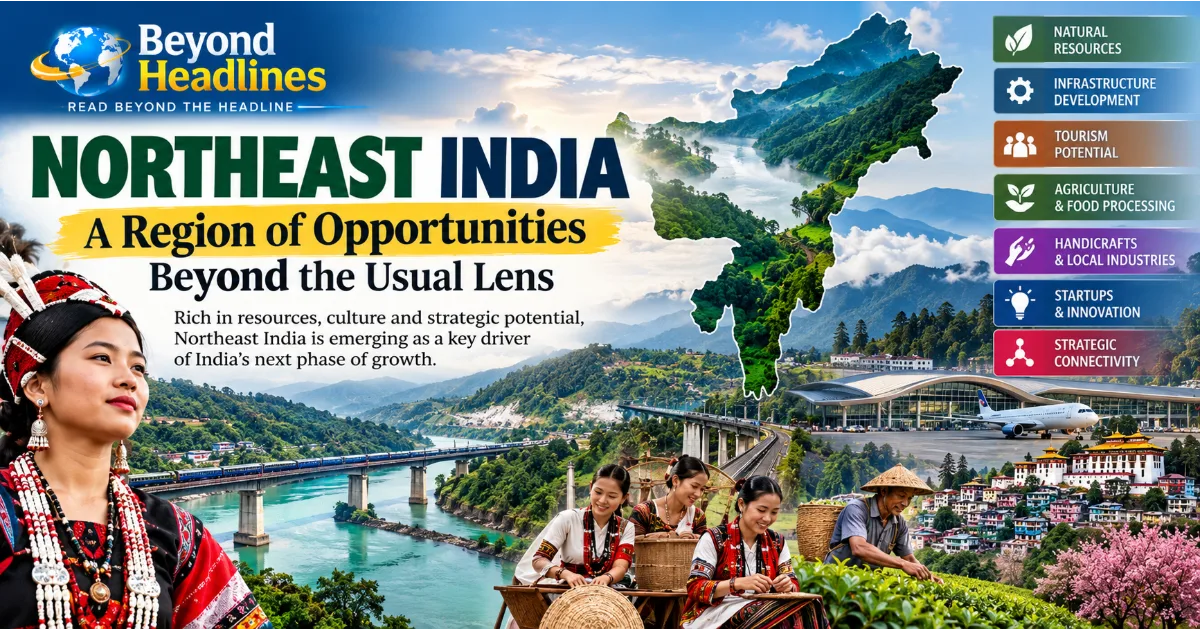
This distinction deserves much more attention because Northeast India should not be viewed merely as a geographically distant part of the country waiting to catch up with established economic centres. The region has its own entrepreneurial communities, educational institutions, natural resources, cultural industries, tourism potential, agricultural opportunities and increasingly important connections with Southeast Asia. The challenge is to connect those strengths with investment, technology, infrastructure and markets in a way that creates sustainable economic growth.
The question, therefore, should not simply be whether investors should put more money into Northeast India. The more important question is whether India can build an economic environment in which talent from the Northeast has the same opportunity to access capital, customers, mentors, technology and national markets as talent emerging from established metropolitan hubs.
The Startup Map of India Is Larger Than Its Famous Cities
India's startup ecosystem has expanded dramatically over the past decade, but public attention remains concentrated around familiar names. Bengaluru, Mumbai, Delhi, Hyderabad, Pune and a handful of other cities dominate conversations about venture capital, technology companies and startup employment. This concentration is understandable because these cities already have established networks of investors, experienced founders, technology companies, universities, accelerators and professional service providers.
However, established ecosystems can create a self-reinforcing cycle. Investors look for startups in places where they already have networks. Founders move to cities where investors are available. Skilled professionals relocate to places where companies are concentrated. Service providers follow the money, while universities and training institutions increasingly orient themselves toward the industries surrounding them. Over time, the ecosystem becomes even stronger in the same locations.
The result is not necessarily a lack of talent elsewhere. It can instead be a lack of visibility and access. A founder in a smaller city may have a strong understanding of a local problem but limited exposure to investors who understand the opportunity. A technically capable entrepreneur may have a product but no strong network for distribution. A promising startup may have early customers but no mentor who has taken a similar company from the first few lakh rupees of revenue to a much larger scale.
This is the context in which the argument for Northeast India becomes important. The issue is not about moving the startup ecosystem away from Bengaluru or Delhi. Those ecosystems will continue to be important. The opportunity lies in expanding the definition of India's startup ecosystem so that the country's entrepreneurial map reflects the actual distribution of talent rather than only the concentration of capital.
The Northeast Should Not Be Treated as a Separate Startup Economy
One of the strongest ideas in the LinkedIn post is that entrepreneurs in the Northeast should not have to develop separately from India's wider startup ecosystem. The region needs stronger connections to investors, mentors, companies and markets across the country. LinkedIn
This is a significant shift in perspective. When a region is repeatedly described as an emerging market that needs development, there is a danger of creating an artificial separation between that region and the national economy. The Northeast becomes something that needs to be "included" rather than an integral part of India's growth story.
A better approach is to think of Northeast India as one part of a much larger national economic network. A startup founded in Manipur, Assam, Meghalaya, Mizoram, Nagaland, Tripura, Arunachal Pradesh or Sikkim should not be limited to customers, investors and partnerships within its immediate geography. Digital infrastructure makes it possible for companies to serve national and international markets from locations that were previously considered peripheral.
The same principle applies to talent. A software developer in Shillong does not necessarily need to relocate to Bengaluru to work with a technology company. A designer in Guwahati can serve customers in Mumbai, London or Singapore. A food-processing company in Assam can potentially sell products to consumers across India. A tourism company in Meghalaya can reach international travellers through digital platforms. A handicraft entrepreneur in Nagaland can build an online customer base far beyond the region.
The physical location of a company still matters, particularly for manufacturing, logistics, tourism and infrastructure intensive businesses, but digital connectivity has changed the relationship between geography and opportunity.
Capital Is Important, But Capital Alone Is Not Enough
It is tempting to interpret calls for more investment as a simple request for venture capital. That would be too narrow. The deeper problem is the availability of the entire ecosystem required to turn capital into sustainable growth.
A founder may receive funding and still struggle if there is no experienced mentor available to help with hiring, pricing, product development or expansion. A startup may have a promising product but struggle to reach national customers because its founders lack relationships with distributors and enterprise buyers. Another company may have strong technical talent but no access to experienced legal, financial, marketing or compliance support.
This is why the concept of ecosystem building is so important. A successful startup ecosystem is not simply a collection of companies receiving investment. It is a network of people and institutions that continuously exchange knowledge, capital, talent, customers and opportunities.
Dr. Tej Chingtham's call for more "adventure capitalists" reflects this broader idea. The challenge is not only persuading investors to write cheques. It is encouraging investors and ecosystem builders to look beyond the locations where investment has historically been concentrated and discover entrepreneurs who may be solving different problems in different markets. LinkedIn
The Northeast Has Existing Economic Strengths
Any serious conversation about investment in Northeast India should begin by recognising that the region already possesses substantial economic strengths. The eight states have significant differences in geography, culture, resources and economic structure, but collectively they offer opportunities across agriculture, food processing, tourism, textiles, handlooms, handicrafts, healthcare, education, information technology, logistics, energy and infrastructure.
The Government of India's Ministry of Development of North Eastern Region identified tourism and hospitality, agro-food processing, textiles, handloom and handicrafts, healthcare, education and skill development, IT and IT enabled services, entertainment and sports, infrastructure and logistics, and energy among the focus sectors at the Rising Northeast Investors Summit. The government said the summit and related roadshows generated investment interest of ₹4.48 lakh crore through memoranda of understanding, letters of intent and qualified leads. Press Information Bureau
The significance of these sectors is that they represent both traditional strengths and emerging opportunities. Agriculture and handicrafts are deeply connected to existing livelihoods, while IT, digital services and startups can create new forms of employment. Tourism can generate demand for hospitality, transportation, food, entertainment and local products. Infrastructure can create the foundation for businesses that do not yet exist.
The investment opportunity should therefore not be reduced to one sector. Northeast India's economic transformation is likely to involve multiple industries developing simultaneously, with stronger connections between them.
Agriculture Can Become More Than Primary Production
Agriculture is one of the areas where Northeast India has the potential to create greater value through processing, branding and market access. The region's agricultural diversity provides opportunities beyond simply selling raw commodities.
The important shift is from primary production toward value addition. Instead of selling a raw agricultural product at the lowest point in the value chain, businesses can process, package, brand and distribute products to larger markets. This creates additional opportunities in food processing, logistics, cold-chain infrastructure, packaging, quality control, digital commerce and marketing.
The challenge is that value-added agriculture requires more than farmers. It requires entrepreneurs, processors, distributors, financial institutions and technology providers working together. A small producer may understand the product but lack the resources to develop packaging or meet the requirements of a large retailer. A startup may solve the distribution problem but require access to working capital. A food-processing company may have demand but struggle with logistics.
This is where ecosystem thinking becomes important. Investment should not be limited to individual companies. It should also support the infrastructure that allows multiple companies to participate in the same value chain.
Tourism Can Create Distributed Economic Opportunity
Tourism is another major opportunity, but its potential extends well beyond hotels and sightseeing. Northeast India has landscapes, biodiversity, cultural traditions, festivals, food, crafts and communities that can support a diverse tourism economy.
A visitor travelling to the region creates demand across multiple businesses. Hotels benefit, but so do local guides, transport operators, restaurants, artisans, photographers, event organisers, tour companies and local producers. Digital platforms can further expand the reach of these businesses by helping them connect directly with travellers.
Sustainable tourism will be especially important because the region's natural environment is one of its greatest economic assets. Development that damages the landscapes and ecosystems attracting visitors in the first place can ultimately undermine the tourism economy.
The goal should therefore be to create tourism models that generate local income while protecting natural and cultural resources. This is an area where local entrepreneurs can have a significant role because they often understand their communities and environments better than outside operators.
Infrastructure Is the Foundation for Investment
No discussion of Northeast India's investment potential can ignore infrastructure. Geography creates real challenges, including mountainous terrain, difficult weather conditions and long distances between economic centres. Roads, bridges, airports, railways, logistics facilities and digital connectivity therefore have a direct impact on the cost of doing business.
Recent infrastructure developments demonstrate the scale of attention being directed toward the region. In June 2026, the Meghalaya government reported that nearly ₹39,800 crore worth of upcoming National Highway projects covering approximately 450 kilometres had been announced for the state. The North East India Infrastructure Summit held in Shillong also focused on infrastructure, logistics, tourism, digital connectivity, industrial growth and investment. Megi Prasad
Connectivity has implications far beyond travel time. Better roads can reduce logistics costs. Improved airports can increase tourism and business travel. Reliable digital networks can allow service companies to operate remotely. Better logistics can make agricultural and manufactured products more competitive in distant markets.
Infrastructure therefore should not be viewed only as government expenditure. It is an economic multiplier. When connectivity improves, previously difficult business opportunities can become commercially viable.
The Northeast's Strategic Position Matters
Northeast India also occupies a strategically important position because of its proximity to Southeast Asia. The government's Act East Policy places the region at the centre of India's engagement with Southeast Asia, with cross-border connectivity forming a major part of the strategy. The India Myanmar Thailand Trilateral Highway and the Kaladan Multimodal Transit Transport Project are among the initiatives identified under this framework. Press Information Bureau
This geographical position creates possibilities for trade, logistics, tourism and cross-border economic activity. If infrastructure and policy frameworks continue to develop, the Northeast could play a larger role in connecting India with neighbouring Southeast Asian markets.
That opportunity should be approached realistically. Geography alone does not create a logistics hub. Roads, customs systems, border infrastructure, warehousing, financial services, digital systems and predictable regulations are all necessary. Businesses also need confidence that cross-border supply chains can operate reliably.
The strategic opportunity is therefore substantial, but converting it into economic value requires long-term execution.
The Startup Opportunity Is Particularly Important
The discussion around investment becomes especially interesting when applied to startups. Startups in Northeast India may face a disadvantage in visibility because investors often discover companies through existing networks. Founders in established hubs meet investors at events, accelerators, universities, corporate offices and industry gatherings. Those networks make discovery easier.
A founder outside those networks may need to work much harder simply to get the first conversation.
This creates a geographic information gap. Investors may not know which founders are building interesting companies in the region, while founders may not know which investors are interested in their sectors.
Technology can reduce that gap, but technology alone will not eliminate it. There must be deliberate efforts to connect founders with investors, mentors, incubators, universities and corporate partners.
The goal should not be to create a special category in which Northeast startups receive support regardless of quality. The goal should be to ensure that geography does not prevent good companies from being discovered.
Talent Exists Outside the Traditional Hubs
One of the most important statements in the LinkedIn discussion is that talent is distributed more widely than opportunity. Several participants echoed the idea that entrepreneurs and skilled professionals outside the major startup cities need greater access to networks, mentorship and capital. LinkedIn
This is a broader issue for India. The country has a huge population of young people, students, engineers, designers, researchers, entrepreneurs and skilled professionals living outside the major metropolitan centres. Not all of them want to move to Bengaluru or Mumbai, and not all of them should have to.
If digital technology allows people to work for national and international companies from smaller cities, then the economic model of the country can become more distributed.
This could create a positive cycle. When high-quality employment becomes available locally, talented people have fewer reasons to leave. When talent remains, local companies have a larger hiring pool. When companies grow, they create demand for services and infrastructure. As the ecosystem expands, more entrepreneurs see opportunities locally.
That is how economic ecosystems develop.
Mentorship May Be as Important as Funding
Funding receives most of the attention in startup discussions, but mentorship can be equally important during the early stages of a company. A first-time founder may understand a customer problem deeply but have little experience with fundraising, hiring, sales management, product strategy or organisational development.
An experienced mentor can help the founder avoid mistakes that could otherwise cost months or years.
This is particularly important in emerging ecosystems because founders may not have easy access to people who have previously built and scaled companies. The solution is not necessarily to relocate every promising entrepreneur to a metropolitan hub. Experienced founders and executives can increasingly mentor companies remotely, while periodic in-person programmes can create deeper relationships.
The challenge is to build systems that make these connections repeatable rather than dependent on individual introductions.
Corporates Have a Role to Play
Large companies can also contribute to the development of Northeast India's entrepreneurial ecosystem. They can become customers, partners, investors, mentors and employers.
For example, a large company expanding into the region can work with local suppliers rather than importing every service from outside. It can create procurement opportunities for small businesses, collaborate with universities and support local skill development.
Corporate partnerships can sometimes be more valuable than startup funding because they provide access to real customers and operational experience.
A startup with a large corporate customer can gain credibility, revenue and practical knowledge. The corporate gains access to local talent and potentially innovative solutions. This creates a relationship in which both sides can benefit.
Universities Can Become Economic Anchors
Universities and colleges in Northeast India can play a much larger role in building local innovation ecosystems. Higher education institutions are natural gathering points for young talent, researchers, entrepreneurs and industry partners.
An effective university ecosystem does not have to focus exclusively on creating venture-backed startups. It can support entrepreneurship through research commercialisation, student businesses, incubation, industry projects, professional training and technology transfer.
Local universities can also become important sources of talent for emerging companies. If businesses know they can recruit capable graduates locally, the attractiveness of investing in the region increases.
This creates another reinforcing cycle in which education supports industry, industry supports employment and employment makes the local ecosystem stronger.
Digital Infrastructure Can Change the Geography of Opportunity
One of the most important differences between today's economy and the economy in which earlier generations built businesses is the role of digital connectivity. A company can now sell services, communicate with customers, recruit employees and collaborate with partners across the country without being physically located in a major city.
For the Northeast, this can be transformative.
A software development company does not need to be next to a technology park in Bengaluru to serve an Indian or international client. A design studio can work with brands in Mumbai. A digital marketing agency can serve customers in Delhi. An online education company can teach students across India. A creator can build an audience globally from a small town.
This does not eliminate the importance of physical infrastructure, but it creates new opportunities where location becomes less restrictive.
The next stage of regional development should therefore combine physical connectivity with digital connectivity.
Meghalaya's Technology Ambition Shows the Direction
Recent developments in Meghalaya illustrate how technology opportunities are beginning to enter the regional development conversation. In October 2026, reporting indicated that Meghalaya was developing an IT policy focused on artificial intelligence and Global Capability Centres, with incentives intended to attract technology companies and investors. Shillong Tech Park II had also been developed, while an AI Centre of Excellence was planned. The Financial Express
Such initiatives matter because they demonstrate that technology growth does not have to remain concentrated in the traditional metropolitan hubs. At the same time, technology companies require reliable infrastructure, skilled workers and access to markets, so policy announcements need to be supported by long-term execution.
The opportunity is not to turn every Northeast city into another Bengaluru. That would miss the point. Different regions can develop different economic identities based on their strengths.
Development Should Not Mean Losing Local Identity
Economic development is sometimes discussed as though success requires every region to look the same. A city becomes successful when it has large offices, technology parks, shopping centres and high-rise buildings.
That is only one model of development.
Northeast India has distinctive cultural identities, languages, crafts, food traditions and community structures. These are not obstacles that development must eliminate. They can become economic assets when approached respectfully.
Handloom, handicrafts, food, music, festivals and cultural tourism can create businesses while preserving local identity. The challenge is ensuring that value reaches the communities producing those cultural assets rather than being captured entirely by intermediaries.
Digital marketplaces can potentially help by allowing artisans and small producers to reach customers directly. Better branding and packaging can also help local products compete in national and international markets.
Investment Must Be Sustainable
More investment is not automatically better investment. The quality, structure and long-term impact of investment matter.
Northeast India contains environmentally sensitive landscapes, forests, rivers and mountains. Large infrastructure and industrial projects therefore need to consider environmental impact alongside economic benefits.
Sustainable development should not be treated as an optional feature added after an investment decision. It should be part of the business model from the beginning.
This is particularly relevant to tourism, agriculture, infrastructure, mining and energy. If development damages the resources on which communities depend, the short-term economic gains may create long-term costs.
A successful regional growth model should therefore ask not only how many jobs or how much investment a project creates, but also whether it strengthens local communities, protects natural resources and remains economically viable over time.
The Investment Opportunity Is Bigger Than Startups
When people hear the word investment, they often think about venture capital and technology startups. But Northeast India's opportunity is much broader.
There is potential for investment in logistics, food processing, tourism, renewable energy, healthcare, education, textiles, manufacturing, digital services, sports, entertainment and infrastructure. The Ministry of Development of North Eastern Region has itself identified many of these areas as priority sectors for investment. Press Information Bureau
This diversity is important because not every talented entrepreneur wants to build a software startup. Some entrepreneurs may want to build a food company. Others may develop a tourism business, logistics operation, healthcare service or manufacturing company.
A healthy regional economy should support different types of entrepreneurship rather than measuring success only through venture-backed technology companies.
Investors Need to Change How They Discover Opportunity
The investor community also has an opportunity to rethink its approach to discovery. Traditional investment networks naturally favour places where investors already spend time. If the same founders, universities, accelerators and events keep producing introductions, the same cities will continue to dominate.
Investors who want exposure to emerging regions need different discovery mechanisms. They can partner with local incubators, universities, industry associations and regional entrepreneurs. They can spend time understanding markets rather than evaluating companies solely through pitch decks.
This requires patience because emerging ecosystems rarely produce a large number of mature companies immediately. The investment thesis has to account for ecosystem development.
The reward, however, can be significant. Investors who identify strong founders early may gain access to businesses before competition becomes intense.
The Northeast Is Not a Charity Case
There is an important difference between development assistance and investment opportunity.
Northeast India should not be approached merely as a region that needs financial support. That framing can unintentionally create the impression that businesses are being encouraged to invest out of social responsibility rather than commercial opportunity.
The better argument is that the region contains economic opportunities that have historically received less attention than they deserve.
Investors should evaluate companies based on business fundamentals, just as they would anywhere else. The difference should be that entrepreneurs from the region receive sufficient visibility and access to compete for that evaluation.
This is ultimately about inclusion in the opportunity system, not lowering the standard for investment.
What a More Distributed Indian Economy Could Look Like
Imagine an India in which entrepreneurship is not concentrated in a handful of cities. A founder in Assam builds a food-processing company that sells nationally. A software team in Meghalaya serves global clients. A tourism startup in Arunachal Pradesh connects travellers with local experiences. A handicraft marketplace in Nagaland enables artisans to reach customers across India. A healthcare company in Manipur uses digital technology to connect specialists with underserved communities.
These are not unrealistic concepts. Variations of these businesses already exist in different parts of India. The larger challenge is creating enough connectivity between entrepreneurs and the resources required to scale them.
If that happens, regional development becomes more than a government programme. It becomes a market-driven process involving entrepreneurs, investors, corporations, universities, communities and consumers.
The Bigger Opportunity Is Human Capital
Infrastructure can be measured in kilometres of roads, number of airports, broadband connections and industrial facilities. Investment can be measured in rupees. Startup funding can be measured in rounds and valuations.
Human potential is harder to measure.
Yet the long-term success of Northeast India will depend heavily on whether talented people can find opportunities to develop their skills and build careers without being forced to leave the region.
That means investment in education, training, entrepreneurship, digital skills and professional networks is just as important as investment in physical infrastructure.
A region becomes economically stronger when young people can imagine building successful careers there.
What India Can Learn From the Northeast
The discussion about Northeast India also exposes a broader issue in India's development model. The country has enormous geographic and cultural diversity, yet economic opportunity remains unevenly distributed.
If India wants sustained growth over the coming decades, it cannot rely indefinitely on a small group of metropolitan engines. Those cities will continue to matter, but new centres of economic activity need to emerge.
The Northeast can be part of that process.
The region's opportunity is not simply about catching up with established cities. It can develop new economic models based on digital services, sustainable tourism, specialised agriculture, cultural industries, cross-border trade and local entrepreneurship.
That requires an investment mindset that sees regional differences as potential strengths rather than weaknesses.
Beyond the Headline
The headline says that Northeast India needs more investment and support. That is true, but it is only the beginning of the conversation.
The deeper issue is access.
Access to capital allows founders to build. Access to mentors allows them to learn from people who have already faced similar challenges. Access to customers allows companies to generate revenue. Access to technology allows businesses to operate more efficiently. Access to infrastructure reduces the cost of moving people and goods. Access to national and international networks allows regional companies to compete beyond their immediate geography.
Without these connections, talent can remain invisible.
With them, a founder in a smaller city can compete on the same fundamental basis as a founder in a major metropolitan hub.
The LinkedIn discussion around Northeast India is therefore valuable because it challenges a familiar assumption about where India's next businesses are supposed to come from. The next generation of entrepreneurs does not necessarily have to emerge from the same cities that produced the previous generation. Some of India's most interesting companies may emerge from places that investors have historically visited less often. LinkedIn
That does not mean every startup outside Bengaluru, Mumbai or Delhi will succeed. Geography does not replace business fundamentals. Entrepreneurs still need strong products, customers, execution, financial discipline and capable teams.
What geography should not determine is whether an entrepreneur gets the opportunity to be discovered.
Conclusion
Northeast India represents an important test for India's next phase of economic growth. The region has talent, natural resources, cultural diversity, agricultural potential, tourism opportunities and an increasingly important strategic position between India and Southeast Asia. Government initiatives and infrastructure investments are already attempting to strengthen connectivity and attract private investment, while the startup conversation is beginning to recognise the entrepreneurial potential beyond traditional metropolitan hubs. Press Information Bureau
But the most important change may need to happen in the way opportunity itself is distributed. India has spent years building powerful economic ecosystems in a handful of cities. The next challenge is to connect those ecosystems with entrepreneurs and businesses across the rest of the country.
For Northeast India, that means creating stronger bridges between local talent and national capital, between universities and companies, between entrepreneurs and mentors, and between regional products and national and international markets.
Investment can provide fuel, but ecosystems provide the infrastructure through which that fuel becomes sustainable growth. Capital can help a company hire people and build products, but networks can help it find customers. Infrastructure can connect markets, but skilled people are needed to create businesses that use those connections effectively.
The opportunity is therefore much larger than simply attracting more investors to the Northeast. It is about building a region in which entrepreneurs can create companies, skilled professionals can build careers, local businesses can reach national markets and communities can participate meaningfully in economic growth.
India's entrepreneurial potential has never belonged to only a few cities. The challenge has always been making that potential visible and giving it the opportunity to scale.
The Northeast does not need to become another Bengaluru, Mumbai or Delhi. It needs the opportunity to become the best version of its own economic ecosystem, connected to the rest of India and increasingly to the wider world.
That is the story beyond the headline.
#BeyondHeadlines #NortheastIndia #NorthEastIndia #InvestmentIndia #InvestInNortheast #StartupIndia #NortheastStartups #Entrepreneurship #IndianStartups #StartupEcosystem #InclusiveGrowth #RegionalDevelopment #EconomicGrowth #InvestmentOpportunities #DigitalIndia #InfrastructureDevelopment #ActEastPolicy #TourismIndia #AgriBusiness #FoodProcessing #Handloom #Handicrafts #InnovationIndia #IndianEntrepreneurs #VentureCapital #AngelInvesting #Talent #SustainableDevelopment #IndiaGrowth #BusinessIndia