
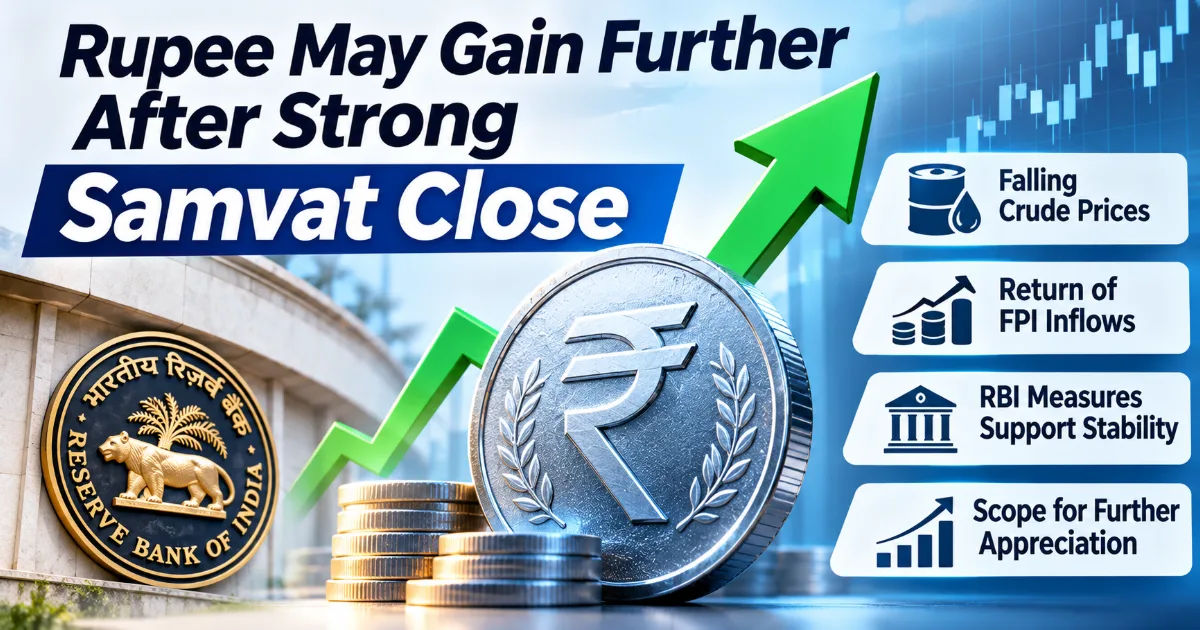
The Rupee's Recovery From Record Lows Has Improved Market Sentiment as Crude Prices Ease and Foreign Investors Return to Indian Equities. Analysts See Scope for Further Gains, but the RBI's Large Forward Dollar Position, Global Geopolitical Risks and India's External Funding Needs Could Limit the Rally.
The Indian rupee has entered the new Samvat year with a more encouraging outlook after staging a significant recovery against the US dollar during the final phase of Samvat 2082. The domestic currency ended the previous trading week at around Rs 93.92 per dollar, its strongest closing level in approximately six months, reversing part of the sharp depreciation that had pushed it to record lows earlier in the year.
The improvement has changed the tone of currency-market discussions. After months of pressure from elevated crude oil prices, foreign portfolio outflows, geopolitical uncertainty and a stronger US dollar, traders and analysts are now assessing whether the rupee can extend its recovery. Some currency experts believe it could strengthen towards Rs 92 per dollar over the coming months, while others expect a more limited appreciation towards the Rs 93.50 level.
The latest movement has been supported by several developments working in India's favour. International crude oil prices have eased, reducing concerns about the country's import bill. Foreign portfolio investors have returned to Indian equities after an extended period of withdrawals. Recent measures by the Reserve Bank of India have also helped reduce pressure in the foreign exchange market.
Continue Reading
However, the recovery should not be mistaken for the beginning of a guaranteed long-term appreciation cycle. India's external financing requirements remain substantial, and the central bank has accumulated a large short-dollar position in the forward market. The RBI may use periods of strong foreign currency inflows to rebuild its reserves rather than allow the rupee to appreciate sharply.
The currency is also exposed to developments beyond India's control. Any escalation in West Asia, a sudden rise in crude prices, renewed strength in the US dollar or a reversal in foreign investor sentiment could quickly change the outlook.
The rupee's performance in Samvat 2083 will therefore depend on whether the recent improvement in global conditions can be sustained and whether India can attract sufficient foreign capital to support its external balance.
A Stronger Finish After a Difficult Samvat 2082
Samvat 2082 was a challenging year for the Indian currency. The rupee experienced sustained pressure as global trade uncertainty, geopolitical tensions, elevated energy prices and foreign capital outflows combined to weaken investor confidence.
The currency touched a record low in May 2026, with the dollar rising to nearly Rs 97 in the domestic market. The decline raised concerns about the cost of imports, inflationary pressures and the financial burden faced by companies that depend on foreign currency payments.
The weakness was particularly significant because India imports a large proportion of its crude oil requirements. When international oil prices rise, Indian refiners and energy companies need more dollars to pay suppliers. This increases demand for foreign currency and can put pressure on the rupee.
The situation became more difficult as foreign investors reduced their exposure to Indian equities. When international funds sell domestic shares and repatriate the proceeds, they generally need to convert rupees into foreign currency. This can increase dollar demand in the market and contribute to currency depreciation.
The US dollar also remained supported by global uncertainty and changing expectations about American economic policy. Trade-related concerns, interest-rate expectations and geopolitical developments encouraged investors to favour the dollar during periods of risk aversion.
The combination of these pressures left the rupee among the weaker-performing Asian currencies during much of the previous Samvat year.
However, conditions improved during the second half. Crude prices retreated from elevated levels, the RBI introduced measures to manage foreign exchange demand, and overseas investors began returning to Indian equities.
The rupee's close near Rs 93.92 per dollar on November 6 marked a significant improvement from its May low. The Financial Express reported that the currency had recovered to its strongest level in six months, although it had still recorded a decline over the full Samvat year.
This distinction is important. The recent rally demonstrates that the pressure on the rupee has eased, but it does not mean that all the structural factors behind its earlier weakness have disappeared.
Why Falling Crude Oil Prices Are Supporting the Rupee
Crude oil is one of the most important variables influencing India's currency outlook.
India is among the world's largest oil-importing economies. Its transport system, industrial sector, aviation industry, petrochemical manufacturers and households all depend directly or indirectly on energy prices.
When oil becomes more expensive, India's import bill increases. Oil companies need more dollars to purchase the same volume of crude, which raises demand for foreign currency. If export earnings and other foreign exchange inflows do not increase at a comparable rate, the pressure can contribute to a wider current account deficit.
A weaker rupee can then make imported oil even more expensive in domestic currency terms. This can create a cycle in which higher dollar demand and a depreciating exchange rate increase the cost of energy imports.
The recent decline in international crude prices has helped reduce these concerns.
Oil prices had risen sharply during the earlier phase of the West Asia conflict, creating uncertainty about supply routes and the possibility of disruptions to energy shipments. The subsequent decline has improved the outlook for oil-importing economies, including India.
Market reports have identified the retreat in crude prices as one of the important factors behind the rupee's recovery. Falling oil prices have reduced immediate pressure on the import bill and improved the currency market's assessment of India's external financing requirements.
The benefit extends beyond the foreign exchange market. Lower energy costs can help reduce input expenses for businesses, ease pressure on transportation and manufacturing, and moderate inflationary risks.
However, the relationship between crude prices and the rupee is not automatic. The impact depends on the scale and duration of the oil-price decline, the volume of imports, domestic fuel pricing and the broader movement of the dollar.
If geopolitical tensions return and crude prices rise sharply, the currency could face renewed pressure. For this reason, analysts will continue monitoring developments in West Asia as closely as domestic economic indicators.
Foreign Portfolio Investors Return to Indian Equities
Another important factor supporting the rupee is the renewed interest of foreign portfolio investors in Indian stocks.
Foreign portfolio investors, commonly known as FPIs, are overseas institutions and funds that invest in financial assets such as shares and bonds. Their investment decisions can influence both the stock market and the foreign exchange market.
When foreign investors purchase Indian equities, they generally need rupees to complete those transactions. This can increase the supply of foreign currency in the domestic market and support the rupee.
The reverse happens when investors sell shares and move money out of India. They convert their rupee proceeds into foreign currency, increasing dollar demand.
The Financial Express reported that foreign portfolio investors purchased approximately $7.4 billion worth of Indian shares over 15 trading sessions, reversing months of sustained outflows. This renewed buying has been identified as a significant source of support for the domestic currency.
The change in investor sentiment has also coincided with improving performance in Indian equities. A stronger stock market can attract additional international capital, particularly when global investors are reassessing the relative attractiveness of emerging markets.
India's economic growth potential, corporate earnings prospects, domestic consumption and expanding digital and infrastructure sectors remain important considerations for international investors.
However, portfolio flows can be volatile. Foreign investors may increase exposure when global financial conditions are favourable and reduce it quickly when uncertainty rises.
A sustained improvement in the rupee will therefore require more than a short burst of equity inflows. India needs consistent foreign investment, stable economic fundamentals and a predictable policy environment.
Foreign investment in equities is also different from long-term foreign direct investment. Portfolio money can move rapidly across borders, while direct investment in factories, infrastructure and businesses is generally tied to longer-term commercial decisions.
For the rupee, both forms of capital matter, but their stability and economic impact are different.
RBI Measures Helped Reduce Pressure on the Currency
The Reserve Bank of India has played an important role in managing the rupee's volatility.
The central bank does not officially target a fixed exchange rate. Its stated approach is to manage excessive volatility and maintain orderly market conditions rather than defend a particular rupee-dollar level indefinitely.
During the period of intense pressure in 2026, the RBI introduced several measures aimed at improving foreign exchange liquidity, reducing speculative demand and attracting foreign currency inflows.
In late March, the central bank moved to restrict banks' net open foreign exchange positions to $100 million. The measure was intended to limit excessive currency exposures and reduce opportunities for speculative trading.
In June, the RBI introduced concessional foreign exchange swap arrangements connected to overseas borrowings and measures intended to support foreign currency deposits. It also expanded the Fully Accessible Route for government securities, allowing eligible foreign investors greater access to specified government bonds.
The government also introduced tax-related measures intended to attract foreign investment into Indian government securities.
In October, the RBI announced another set of steps, including a special dollar window for state-owned oil marketing companies, tighter restrictions on certain foreign exchange derivative positions and additional reserve requirements linked to banks' foreign exchange exposures.
These measures were designed to address different sources of pressure in the currency market.
The special dollar window for oil marketing companies was intended to manage the impact of their foreign currency requirements. Restrictions on derivatives were aimed at limiting certain forms of speculative activity and excessive positions. Measures to attract foreign currency deposits and investment were intended to improve the availability of dollars.
The combined effect has been to reduce some of the immediate imbalances between dollar supply and demand.
However, central bank intervention cannot permanently replace strong external fundamentals. The rupee's long-term direction will still depend on oil prices, trade flows, foreign investment, inflation, interest-rate differences and global financial conditions.
The RBI's $240 Billion Forward Dollar Position: A Major Constraint on Further Gains
One of the most important concerns highlighted by currency analysts is the RBI's large short-dollar position in the forward market.
A forward foreign exchange contract is an agreement to exchange currencies at a predetermined rate on a future date. Central banks and financial institutions use such contracts to manage currency exposure, liquidity and market conditions.
The RBI's net short-dollar forward position means it has future commitments involving the sale of dollars against rupees. The size of this position has become an important consideration because the central bank may need to manage these commitments as contracts mature.
The Financial Express reported that the RBI's short forward dollar position stood at approximately $240 billion, creating a potential constraint on the extent of further rupee appreciation.
This does not mean that the RBI must immediately buy dollars in the spot market or that the rupee cannot strengthen. It means that the central bank has a substantial foreign exchange position that needs to be managed over time.
If the rupee strengthens because of large foreign currency inflows, the RBI may see an opportunity to purchase dollars and rebuild its reserves. Such purchases can increase demand for dollars and moderate the pace of rupee appreciation.
The central bank may prefer a gradual and orderly recovery rather than a sharp rise that could complicate the management of its forward commitments.
The issue is also connected to India's foreign exchange reserves. Reuters reported on November 9 that India's reserves had fallen by approximately $68 billion from their peak, while the RBI's net short-dollar forward position had reached a record level near $240 billion in September. The report noted that traders were watching for possible RBI dollar purchases as the rupee extended its recovery.
Foreign exchange reserves provide a buffer against external shocks. They help the country meet international payment obligations, manage periods of capital outflows and maintain confidence in the economy.
Rebuilding reserves can therefore become a priority when market conditions improve.
The RBI's approach will involve balancing several objectives: limiting excessive volatility, maintaining adequate reserves, managing forward commitments and ensuring that the currency remains competitive for trade.
This is why analysts may expect the rupee to strengthen further while still cautioning that the central bank could limit the pace of appreciation.
What Currency Analysts Expect From the Rupee
The latest analyst projections suggest that the rupee has room for further recovery, although estimates differ depending on assumptions about oil prices, foreign investment and geopolitical developments.
Anindya Banerjee, head of currency and commodity research at Kotak Securities, expects the rupee to strengthen towards Rs 92 per dollar by March, provided there is no major deterioration in global conditions or a renewed surge in crude oil prices.
Ritesh Bhansali, deputy CEO at Mecklai Financial Services, expects the currency to move towards Rs 93.50, while cautioning that the appreciation may be temporary rather than the beginning of a sustained medium-term rally.
Dilip Parmer of HDFC Securities has indicated a broader trading range of Rs 93 to Rs 97, with the currency supported by anticipated foreign institutional inflows and stabilising energy prices.
These projections reflect different views about the strength and durability of the current recovery.
A forecast of Rs 92 per dollar implies a stronger rupee than the recent closing level near Rs 93.92. It would represent further appreciation and could help reduce the cost of imported goods and energy.
The Rs 93.50 projection is more conservative. It suggests that the rupee could make additional gains but may encounter resistance as the RBI manages its foreign exchange position.
The wider Rs 93 to Rs 97 range reflects the uncertainty surrounding the market. It allows for further appreciation but recognises that external shocks could reverse the recent improvement.
Currency forecasts should not be treated as guaranteed outcomes. Exchange rates respond to new information, and a change in geopolitical conditions or monetary policy can quickly alter market expectations.
The projections are best understood as possible scenarios based on the assumptions available to analysts at the time.
West Asia Remains a Major Risk for the Currency
The geopolitical situation in West Asia remains one of the most important risks facing the rupee.
India's dependence on imported crude oil makes its currency particularly sensitive to disruptions in the global energy market. Any escalation involving major oil-producing countries or critical shipping routes could push prices higher.
Even the possibility of supply disruption can influence oil futures and currency markets. Traders may begin pricing in higher energy costs before an actual shortage occurs.
A rise in crude prices would increase India's import bill and could worsen its current account balance. It may also create inflationary pressure by raising transportation, manufacturing and distribution costs.
If oil prices remain elevated for an extended period, the rupee could come under renewed pressure.
The impact could become more complicated if geopolitical tensions also encourage global investors to move towards safe-haven assets such as the US dollar.
During periods of uncertainty, international investors often reduce exposure to emerging-market currencies and seek assets they consider more liquid or secure. This can strengthen the dollar even when the underlying economic conditions in emerging markets have not changed significantly.
The rupee could therefore face pressure from both sides: higher demand for dollars to pay for energy imports and increased demand for the US currency as a global safe-haven asset.
The recent improvement in geopolitical sentiment has helped the currency, but analysts remain cautious because the situation can change quickly.
For India, a stable energy market is not simply a commodity-price issue. It is closely connected to inflation, government finances, trade competitiveness and currency stability.
The US Dollar and Interest-Rate Expectations Will Also Matter
The rupee's movement is not determined only by India's domestic economic performance. It is also influenced by the strength of the US dollar and the relative attractiveness of dollar-denominated assets.
When US interest rates are high or investors expect them to remain elevated, American financial assets may offer attractive returns. This can encourage global capital to move towards the United States, strengthening the dollar against other currencies.
When expectations shift towards lower US interest rates, the dollar may weaken and emerging-market currencies can benefit.
However, the relationship is not always straightforward. Inflation, employment data, economic growth, fiscal policy and geopolitical developments can all influence the dollar.
The Federal Reserve's policy decisions are particularly important because they affect global borrowing costs and investment flows.
If US yields remain attractive, foreign investors may prefer American bonds over assets in emerging markets. This could limit capital inflows into India and reduce support for the rupee.
If global investors become more confident about emerging-market growth and the dollar weakens, India could benefit from additional portfolio investment.
The recent recovery in the rupee has also taken place alongside changes in global investor sentiment. Reuters reported on November 9 that the currency had gained further, reaching a six-month high of around Rs 93.70 per dollar during Monday's trading, with lower oil prices and foreign investment supporting the move.
The dollar's direction will therefore remain an important variable for currency traders.
What a Stronger Rupee Means for Indian Consumers
A stronger rupee can provide several benefits to the domestic economy, particularly for consumers and businesses that depend on imported goods.
When the rupee appreciates against the dollar, imports become less expensive in domestic currency terms, assuming international prices and other costs remain unchanged.
Crude oil is one of the most important examples. A stronger rupee can reduce the amount of domestic currency required to purchase oil priced in dollars.
The benefit can extend to imported electronics, machinery, industrial components, chemicals, medical equipment and other products.
Companies that depend on imported raw materials may experience lower input costs. This can improve profit margins or reduce pressure to increase prices.
Consumers may also benefit if businesses pass on part of the reduction in import costs through lower prices.
A stronger rupee can help moderate imported inflation, especially when global commodity prices are stable or declining.
However, the benefit is not automatic. Import prices are influenced by international commodity prices, shipping expenses, taxes, duties, insurance and domestic distribution costs.
A currency gain may not immediately translate into cheaper fuel or consumer products.
The impact also depends on how much of the appreciation is sustained. A temporary movement may have little effect on long-term contracts and retail prices.
Why Exporters May Face a Different Impact
While importers generally benefit from a stronger rupee, exporters can face a more complicated situation.
Indian exporters receive payments in foreign currencies for goods and services sold overseas. When the rupee strengthens, the same dollar revenue converts into fewer rupees.
For example, an exporter receiving $100,000 would obtain fewer rupees when the exchange rate moves from Rs 94 per dollar to Rs 92 per dollar.
This can reduce the domestic-currency value of export earnings if the company has not protected itself through hedging arrangements.
Exporters with high imported input costs may experience some offsetting benefits because a stronger rupee can reduce the cost of foreign materials and equipment.
The overall impact therefore differs across industries.
Information technology services companies, pharmaceutical exporters, engineering manufacturers, textile businesses and other export-oriented sectors may have different currency exposures and cost structures.
A stronger rupee can also affect the competitiveness of Indian products in international markets if prices rise relative to those of competing exporters.
However, exchange rates are only one part of export competitiveness. Productivity, quality, logistics, labour costs, technology and access to international markets also matter.
A gradual and predictable exchange rate movement is generally easier for exporters to manage than sudden and sharp fluctuations.
This is one reason why central banks often focus on orderly currency conditions rather than encouraging rapid appreciation or depreciation.
Will the Rupee's Recovery Reduce India's Inflation?
Currency appreciation can help reduce imported inflation, but its influence on the broader price level depends on several factors.
India imports energy, fertilisers, electronic components, industrial machinery and several essential raw materials. When the rupee weakens, the domestic cost of these products can rise even if their international prices remain unchanged.
Businesses may pass these higher costs to consumers, contributing to inflation.
A stronger rupee can reverse part of this pressure by lowering the cost of imports.
The benefit is particularly important when crude oil prices are also declining. When both the currency and the international price of oil move in a favourable direction, the domestic cost of imported energy can fall more substantially than when only one variable changes.
However, domestic inflation also depends on food prices, wages, housing costs, services, transportation, taxes and demand conditions.
The rupee cannot independently solve inflationary pressures caused by domestic supply shortages or rising food prices.
The Reserve Bank of India will therefore consider a broad range of indicators when assessing monetary conditions.
A stable currency can make inflation management easier, but it does not remove the need for sound fiscal policy, reliable supply chains and productivity improvements.
The Impact on India's Current Account Deficit
The current account deficit measures the difference between the value of goods, services and income India receives from abroad and the payments it makes to the rest of the world.
India regularly imports more merchandise goods than it exports. The difference is partly offset by services exports, remittances from Indians working overseas and other income flows.
Crude oil plays a major role in the merchandise trade balance. When oil prices rise, the value of India's imports can increase substantially, putting pressure on the current account.
A stronger rupee and lower oil prices can help reduce this pressure. They can lower the domestic cost of imports and improve the country's external balance, provided export earnings and other flows remain supportive.
However, the impact depends on the volume of imports as well as their prices. If lower prices encourage higher import volumes, some of the benefit may be offset.
Foreign portfolio inflows can also support the currency, but they do not directly eliminate the structural trade deficit. They provide financial capital that helps fund India's external requirements.
This distinction is important because a currency supported primarily by volatile portfolio flows may remain vulnerable if international investors suddenly withdraw funds.
For a more durable improvement, India needs stronger exports, stable services earnings, sustained foreign direct investment and manageable energy costs.
What Investors Should Watch in Samvat 2083
The rupee's direction in the new Samvat year will depend on a combination of domestic and international indicators.
The first is crude oil. A sustained decline in global energy prices would reduce pressure on India's import bill and improve the outlook for the currency. Any renewed escalation in West Asia could reverse this trend.
The second is foreign portfolio investment. Continued buying of Indian equities and bonds would support dollar supply in the domestic market. A return to sustained foreign outflows could put pressure on the rupee again.
The third is the RBI's foreign exchange position. Traders will watch how the central bank manages its forward commitments and whether it uses periods of currency strength to rebuild reserves.
The fourth is the US dollar. Changes in American interest-rate expectations, economic data and global risk sentiment can influence capital flows into emerging markets.
The fifth is India's trade balance and current account position. A wider import bill or weaker export performance could increase the need for foreign currency financing.
Finally, inflation and domestic monetary policy will influence the relative attractiveness of Indian assets.
These factors are interconnected. A decline in oil prices can improve the trade balance, strengthen investor confidence and support the rupee. At the same time, a weaker dollar can encourage foreign investment, creating additional currency support.
The opposite combination can also occur. Higher oil prices, a stronger dollar and capital outflows can put pressure on the rupee even when domestic economic growth remains relatively strong.
Could the Rupee Reach Rs 92 Against the Dollar?
The possibility of the rupee strengthening towards Rs 92 per dollar has attracted attention because it would represent a meaningful recovery from the levels seen during the earlier phase of Samvat 2082.
Some analysts believe the target is achievable if crude prices remain moderate, foreign investment continues and geopolitical conditions improve.
But the currency would need sustained support to reach and maintain that level.
The RBI's forward dollar commitments could limit the pace of appreciation. If the central bank decides to rebuild foreign exchange reserves by purchasing dollars, it could absorb some of the additional dollar supply entering the market.
The current account position and India's continuing need for foreign capital are also important. A currency can strengthen temporarily on favourable market sentiment, but a sustained move requires consistent underlying support.
A more cautious scenario would involve the rupee consolidating around recent levels, with occasional appreciation and depreciation depending on global developments.
The Financial Express reported that analysts held differing views, with expectations ranging from a move towards Rs 92 to a more limited appreciation around Rs 93.50. Other market assessments have highlighted a broader range extending towards Rs 97 if external conditions deteriorate.
These are market expectations rather than official RBI targets.
Investors should avoid treating any single exchange-rate projection as certain. Currency markets can react sharply to events that are difficult to predict, including geopolitical developments, policy announcements and sudden changes in international capital flows.
The Larger Picture: A Recovery, Not Yet a Complete Turnaround
The rupee's performance at the end of Samvat 2082 has improved the outlook for India's currency market.
The recovery from the record lows reached in May reflects a combination of easing crude prices, renewed foreign portfolio investment, RBI measures and improved global sentiment.
The latest move towards the Rs 93.70 level on November 9 has reinforced the view that the domestic currency may have further room to strengthen in the near term.
However, the challenges that weakened the rupee earlier in the year have not disappeared entirely.
India remains dependent on imported energy, its external financing needs are significant, and global investors can change their allocation decisions quickly. The RBI must also manage a substantial forward dollar position while maintaining adequate foreign exchange reserves.
For importers, a stronger rupee could provide relief from foreign currency costs. For consumers, it may help reduce imported inflation. Exporters, meanwhile, will need to manage the possibility of lower rupee earnings from foreign currency receipts.
The currency's movement will therefore have different consequences across the economy.
The key question for Samvat 2083 is not simply whether the rupee can reach Rs 92 or Rs 93.50. It is whether the improvement can be sustained without creating new vulnerabilities in India's external accounts.
Conclusion: A Positive Start for the Rupee, but the Road Ahead Remains Uncertain
The Indian rupee has begun Samvat 2083 on a more constructive note after ending the previous Samvat near a six-month high against the US dollar.
Lower crude oil prices have eased pressure on India's import bill, while renewed foreign portfolio investment has improved dollar supply in the domestic market. The Reserve Bank of India's currency-management measures have also helped reduce some of the pressure that weighed on the rupee earlier in the year.
These developments have encouraged analysts to expect further appreciation. Projections towards Rs 92 or Rs 93.50 indicate that the market sees scope for additional gains if favourable conditions continue.
Yet the recovery comes with important qualifications. The RBI's large short forward dollar position, declining foreign exchange reserves from their peak, geopolitical uncertainty and India's continuing external financing requirements could restrict the currency's upward movement.
A stronger rupee would offer meaningful benefits to importers and help moderate imported inflation, but it could also create challenges for exporters whose earnings are denominated in foreign currencies.
For policymakers, the objective will be to maintain stability rather than pursue appreciation at any cost. A predictable exchange rate, adequate reserves and a healthy external balance are more important for long-term economic confidence than a particular dollar-rupee level.
Samvat 2082 demonstrated how quickly global events can change India's currency outlook. The new Samvat has begun with better conditions, but the sustainability of the recovery will depend on oil prices, foreign investment, the US dollar and the RBI's management of currency-market liquidity.
The rupee may have found room to recover, but its next move will be decided as much by global developments as by India's own economic strength.
#RupeeVsDollar #Samvat2083 #ReserveBankOfIndia #CrudeOilPrices #ForexMarket