
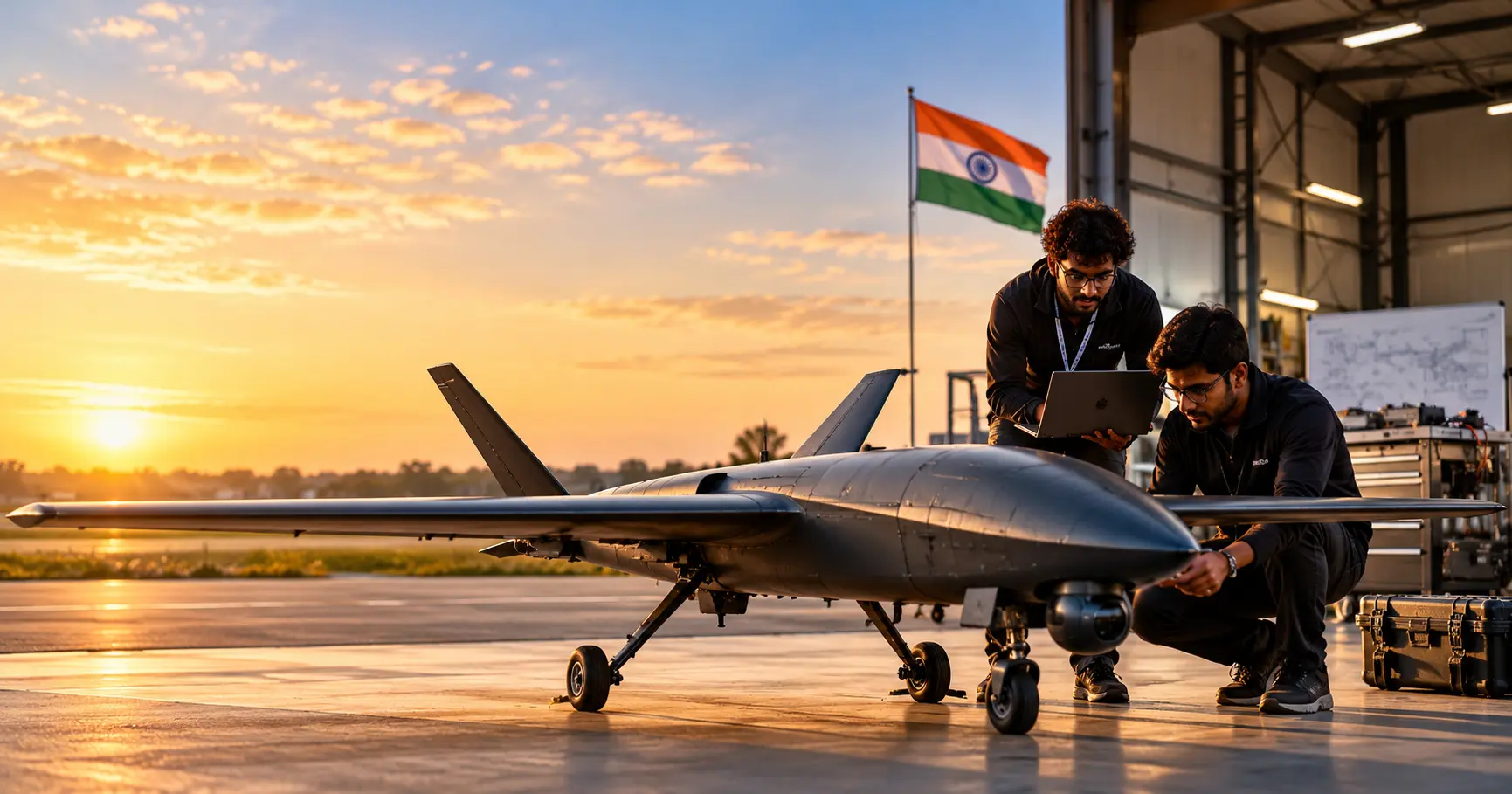
India's Defence Tech Startups: Apollyon Dynamics and the Ahuti Mk II Drone
An Indian defence technology startup is drawing attention for a high-speed interceptor drone reported to have reached nearly 500 kilometres per hour. Hyderabad-based Apollyon Dynamics developed the Ahuti Mk II, which the supplied report says reached 498 km/h and entered the India Book of Records in September 2026. The company is described as having been founded by BITS Pilani Hyderabad students Jayant Khatri and Sourya Choudhury. These specific performance and record claims should be checked against official company and record-holder announcements, but the story highlights the growing interest in India's emerging defence technology ecosystem.
The reported progress from an earlier Ahuti version, said to have reached around 300 km/h in 2025, to the newer model illustrates how quickly a focused engineering team can iterate on an aerospace system. According to the report, the team revised the airframe, propulsion system, and motor configuration to improve performance. For a developing technology company, this kind of iteration can involve testing, redesign, component integration, and repeated evaluation before a system is ready for operational use.
Speed is only one measure of an interceptor drone. Reliability, detection and tracking, communication links, control under difficult conditions, safe operation, maintainability, and performance in realistic trials also matter. The public should distinguish a reported maximum speed from a complete assessment of a system's capabilities or operational readiness.
Continue Reading
Why interceptor drones are attracting attention
Uncrewed aerial systems have become an important part of the modern security environment. Small drones can be relatively inexpensive to acquire and operate, while traditional air-defence responses may involve costly equipment and specialised ammunition. This creates a cost and scale challenge for military planners, especially when they must respond to repeated or coordinated aerial threats.
Interceptor drones are one potential part of a broader response. Rather than relying exclusively on expensive missiles, a defence system may combine radar, electronic detection, command-and-control software, trained operators, and different types of interceptors. The appropriate response depends on the nature of the threat, the surrounding environment, safety requirements, and the likelihood of collateral damage.
No single technology solves every counter-drone problem. Detection can be difficult when targets are small, fly low, or operate near buildings and other sources of interference. Weather, communications, sensor coverage, and the presence of civilian aircraft can also complicate a response. A high-speed platform may offer useful capabilities in some scenarios, but speed alone does not establish effectiveness.
Responsible evaluation therefore requires attention to the complete system, including testing standards, operational constraints, safety procedures, and integration with existing defence infrastructure.
From engineering prototype to dependable system
Developing an aerospace vehicle is a demanding engineering process. Designers must consider structural strength, weight, stability, propulsion, thermal performance, vibration, control systems, power management, and the effect of operating conditions on reliability. A change that improves one performance measure may introduce a new challenge elsewhere.
For example, higher speed can increase aerodynamic loads and heating, while changes to propulsion can affect endurance, control, and maintenance requirements. A prototype that achieves a headline speed in a specific test is not automatically ready for routine use. Repeated testing, quality assurance, environmental evaluation, and documented operating limits are necessary before buyers can make informed decisions about performance.
Manufacturing consistency matters too. A company must be able to produce systems to a repeatable standard, source critical components, maintain traceability, and provide repair and support services. For defence customers, dependable delivery and lifecycle support can be as important as a dramatic demonstration.
The reported development of the Ahuti Mk II is therefore best understood as a milestone in an engineering journey, rather than as a complete measure of the system's capabilities. Independent verification and transparent test information help the public and potential customers assess progress responsibly.
Young engineers and India's defence technology ecosystem
India's defence innovation landscape includes established public-sector organisations, major private manufacturers, research institutions, universities, and younger companies working on specialised technologies. Startups can contribute by focusing on a narrow technical problem, building prototypes quickly, and using feedback to improve their designs.
University experience can provide a foundation in engineering, computing, electronics, materials, and applied research. Turning that knowledge into a product, however, requires more than a strong technical concept. Founders must also manage manufacturing, procurement, testing, regulatory requirements, cybersecurity, staffing, finance, and customer support.
For early-stage companies, access to laboratories, test facilities, experienced mentors, component suppliers, and credible customers can make a substantial difference. Partnerships between startups, universities, research centres, and established manufacturers can help bridge the gap between a promising prototype and a dependable product.
Young engineering teams also benefit from a culture that rewards careful measurement and honest reporting. Acknowledging the limits of a test result is not a weakness. It helps teams identify what still needs improvement and builds confidence among customers and collaborators.
Why domestic capability matters
Domestic defence technology development can support local engineering jobs, build specialised manufacturing knowledge, and reduce dependence on selected overseas suppliers. It can also create opportunities for Indian companies to develop intellectual property and participate in international markets, subject to applicable laws and export controls.
However, domestic capability is not achieved simply by designing a prototype locally. A sustainable industrial base needs reliable components, quality systems, trained technicians, secure software practices, supply-chain resilience, and long-term maintenance capacity. Some components may continue to come from international suppliers, making careful sourcing and contingency planning important.
Procurement decisions should be based on demonstrated performance, safety, reliability, cost over the product's lifetime, and suitability for the intended role. Supporting innovation and maintaining rigorous evaluation are complementary goals. Clear testing and accountability help ensure that promising technology can become useful capability rather than remaining only a headline.
Nightshade and the range of emerging drone applications
The supplied report also says Apollyon Dynamics is developing Nightshade, a jet-powered drone intended for roles such as aerial targets, decoys, and loitering munitions. These are distinct categories with different operational, safety, and regulatory considerations. The mention of a development programme does not by itself confirm that a system is complete, fielded, or approved for any particular use.
Uncrewed aircraft can serve a range of non-combat and defence-related purposes, including research, training, target simulation, inspection, mapping, and evaluation of sensors. Each role has its own performance requirements and risk profile. The design of an aircraft for one role does not automatically establish suitability for another.
For any emerging platform, useful public information includes the intended role, verified test status, safety and compliance measures, and the evidence supporting performance claims. This allows observers to understand progress without confusing a development objective with an established operational capability.
Safety, regulation, and responsible testing
High-speed uncrewed aircraft require disciplined testing and careful control of the environment in which they operate. Test sites, flight permissions, trained personnel, emergency procedures, and clear separation from uninvolved people and aircraft are important considerations. The specific requirements depend on the aircraft, location, purpose, and applicable rules.
Defence-related systems can also raise questions about secure communications, data handling, export controls, and the protection of sensitive technical information. Companies need to understand their legal obligations and establish sound governance as they grow. Strong compliance practices can help protect public safety and support long-term customer confidence.
Responsible reporting matters as well. Public discussion should avoid presenting unverified performance claims as established facts or sharing sensitive operational details that could create safety risks. Broad reporting about innovation, engineering milestones, and industrial development can inform readers without disclosing unnecessary technical information.
What a reported speed of 498 km/h does and does not tell us
A reported maximum speed gives one useful point of reference, but it does not describe the full performance envelope of an aircraft. Readers would need context about the test conditions, measurement method, duration, configuration, and whether the result was independently verified. Those details help distinguish a brief peak measurement from repeatable performance under representative conditions.
Other factors include endurance, payload capacity, navigation, reliability, control response, environmental tolerance, and ease of maintenance. For an interceptor platform, the wider detection and command system is also important. Without that context, a single speed figure should not be used to compare systems as though it were a complete performance score.
The milestone can still be significant. Demonstrating a high-speed flight may show progress in design, propulsion, and integration. The next question is how consistently the platform performs and how well it meets the requirements for its intended role.
Building a durable defence startup
Engineering achievement is one part of building a successful defence company. Startups also need sustainable financing, a clear product strategy, experienced leadership, quality assurance, supplier relationships, and a realistic understanding of procurement timelines. Government and defence sales can involve long evaluation cycles, formal qualification processes, and extensive documentation.
Companies must plan for the period between prototype development and revenue. They may need to fund testing, tooling, production facilities, hiring, and support infrastructure before large orders are secured. Strategic partnerships and a careful approach to cash flow can be important during this stage.
Talent retention is another challenge. Skilled engineers are valuable across aerospace, software, electronics, and advanced manufacturing. A startup that develops a strong learning environment, documents its engineering knowledge, and invests in its people is better positioned to improve its products over time.
Commercial success should ultimately be measured by more than social media attention. Repeatable quality, customer confidence, responsible operation, reliable delivery, and sustained innovation are stronger indicators of a company's long-term potential.
Conclusion: a promising signal from India's engineering community
The reported performance of Apollyon Dynamics' Ahuti Mk II has brought attention to a young Indian defence technology company and the engineers working behind it. The reported 498 km/h result, if confirmed by authoritative records and test documentation, would be a notable milestone for the team. It also illustrates the broader ambition of India's startup ecosystem to develop specialised aerospace and defence technologies.
At the same time, the real value of a high-speed interceptor drone depends on much more than its maximum speed. Reliability, safety, testing, integration, maintainability, compliance, and suitability for the intended role all matter. Claims about performance and records should be checked against primary sources, and development announcements should not be mistaken for proof of operational deployment.
India's defence technology sector can benefit from the energy of young engineers, the support of universities, rigorous testing, and collaboration between startups and established institutions. The strongest progress comes when ambition is matched by evidence, engineering discipline, and responsible development.
#DefenceTech #India #DroneTechnology #IndianStartups #ApollyonDynamics #AhutiMkII #AerospaceIndia #DefenceInnovation #BITS Pilani #HyderabadStartups #IndianEngineering #UncrewedSystems #AerospaceTechnology #MakeInIndia #TechnologyNews