On 27 May 1964, India lost its first Prime Minister, Jawaharlal Nehru. His death marked the end of an era that had shaped the country's political identity, economic direction and international position since independence. For seventeen years, Nehru had led India through the difficult process of building a democratic republic, establishing national institutions, developing industries and defining an independent foreign policy.
His departure created a question that extended far beyond the selection of another Prime Minister. Could India's democratic institutions remain stable without the leader who had dominated national politics since independence? Would the Congress Party continue to hold together the different political interests within the country? Could the new leadership manage India's economic difficulties and growing international tensions?
India was still a young republic. Its population was increasing, agriculture remained vulnerable to drought, poverty affected millions of people and industrial development required enormous investment. Relations with neighbouring countries were also becoming increasingly difficult. The war with China in 1962 had exposed serious weaknesses in India's defence preparations, while tensions with Pakistan continued over Kashmir.
The years following Nehru's death would introduce two very different political leaders to the centre of Indian national life. Lal Bahadur Shastri would become Prime Minister during a period of uncertainty and lead the country through the 1965 war with Pakistan. After his sudden death in January 1966, Indira Gandhi would emerge as his successor, beginning a political journey that would transform the Congress Party and Indian democracy.
These years were not merely a transition between two Prime Ministers. They represented a turning point in India's political history.
The Final Days of the Nehru Era
Jawaharlal Nehru had been India's Prime Minister since independence in 1947. His leadership was closely associated with parliamentary democracy, secular government, scientific development, public-sector industries and non-alignment in international affairs.
However, the final years of his premiership were difficult.
The Sino-Indian War of 1962 had severely damaged India's military confidence. Chinese forces had advanced across disputed Himalayan territories, and the Indian armed forces had struggled with inadequate equipment, difficult terrain and weaknesses in strategic preparation.
The defeat created a national crisis. Questions were raised about defence planning, intelligence failures and the government's understanding of China's intentions.
Nehru's political authority was also affected. His image as a leader who could guide India through international challenges had suffered a serious setback.
The country was simultaneously facing economic difficulties. Agricultural production remained insufficient, industrial growth was uneven and food shortages were becoming increasingly serious.
The government was attempting to maintain ambitious development programmes while responding to the needs of a rapidly growing population.
Nehru's health also deteriorated. In January 1964, he suffered a stroke, although he returned to public duties after recovering. His physical condition remained a concern, and the question of political succession became increasingly important.
On 27 May 1964, Nehru died in New Delhi at the age of seventy-four.
His death was mourned across India. Parliament, political organisations and ordinary citizens recognised that the country had lost the leader who had guided it through independence and its first seventeen years as a republic.
But the immediate challenge was to ensure that the government continued functioning without political instability.
The Search for a New Prime Minister
The Congress Party remained the dominant political organisation in India in 1964. It controlled the central government and governed most states. However, it contained several political groups, regional interests and influential leaders who did not always agree with one another.
The selection of Nehru's successor therefore required political negotiation.
One of the most influential figures in the Congress organisation was K. Kamaraj, the former Chief Minister of Madras State and president of the Indian National Congress.
Kamaraj had become an important political organiser and was respected across different sections of the party. He played a significant role in discussions about the succession.
Several senior leaders were considered possible candidates, including Morarji Desai and Lal Bahadur Shastri.
Morarji Desai had considerable administrative experience and had served in important ministerial positions. He was known for his strong views on government and economic policy.
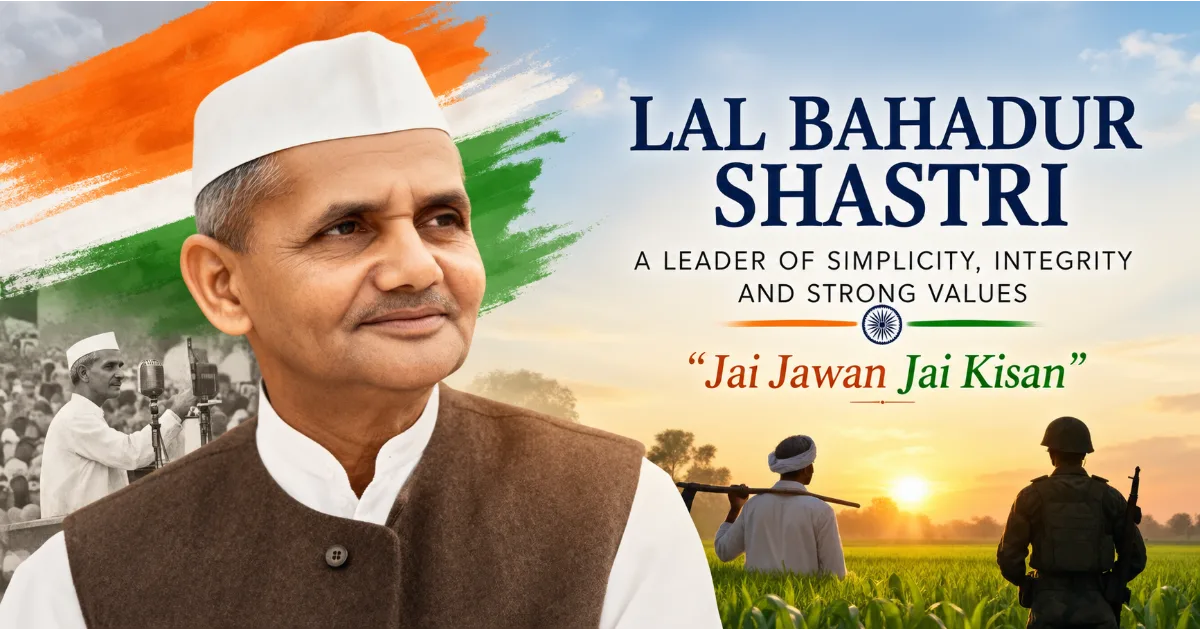
Lal Bahadur Shastri, meanwhile, had developed a reputation for simplicity, discipline and political reliability.
He had served in several ministerial positions and was respected by colleagues across different factions of the Congress Party.
After discussions among senior leaders, Shastri emerged as the consensus candidate.
On 9 June 1964, Lal Bahadur Shastri was sworn in as India's second Prime Minister.
His appointment demonstrated that the country's political institutions could manage a leadership transition through constitutional and parliamentary processes rather than through a struggle for personal power.
This was an important moment for Indian democracy. The country had lost its most prominent political leader, yet its government continued functioning through established institutions.
Lal Bahadur Shastri: A Leader of Simplicity and Determination
Lal Bahadur Shastri was born on 2 October 1904 in Mughalsarai, in present-day Uttar Pradesh. His father died when he was very young, and his family faced financial difficulties.
His childhood experiences influenced his personal character. He developed a reputation for modesty, discipline and dedication to public service.
As a young man, Shastri became involved in the Indian independence movement. He participated in the non-cooperation movement and later became associated with the work of the Indian National Congress.
He was influenced by Mahatma Gandhi's ideas of public service, simplicity and national responsibility.
During the freedom struggle, he faced imprisonment for participating in nationalist activities. His political career developed through the Congress organisation and the provincial political system.
After independence, Shastri served in important administrative positions. He became a minister in the Uttar Pradesh government and later joined the Union Cabinet.
He served as Railway Minister, Home Minister and in other important responsibilities.
In 1956, following two serious railway accidents, Shastri offered his resignation as Railway Minister, accepting moral responsibility for the failures that had occurred. Prime Minister Nehru initially did not accept it, but Shastri resigned after another major accident in 1956.
His decision became an important example in Indian political discussions about ministerial accountability.
When Shastri became Prime Minister in 1964, he inherited a country facing enormous difficulties. His task was not to reproduce Nehru's personality or political style, but to lead India through a new set of challenges.
The Economic Challenges Facing Shastri
The Indian economy was under considerable pressure when Shastri took office.
The country had experienced a difficult period following the 1962 war. Defence expenditure had increased, while resources were also needed for industrial development, infrastructure and social programmes.
Agriculture remained a major concern.
India's population was growing, but food production had not increased sufficiently to meet demand. The agricultural system depended heavily on rainfall, and drought conditions could create severe shortages.
Food imports were necessary to prevent the situation from becoming worse.
The government faced difficult choices. It needed to support farmers, increase agricultural production, maintain economic stability and strengthen national defence.
Shastri recognised that agriculture could not remain secondary to other development priorities.
His government encouraged farmers to increase production and supported efforts to improve agricultural practices.
It also continued examining improved seed varieties and modern farming methods that would later become central to the Green Revolution.
The government began giving greater attention to food security as an essential part of national independence.
The idea that India needed to become more self-reliant in food production was increasingly becoming a central national objective.
Jai Jawan, Jai Kisan
One of the most memorable developments of Shastri's premiership was the slogan "Jai Jawan, Jai Kisan."
The phrase meant "Hail the Soldier, Hail the Farmer."
It reflected two immediate national priorities: defending India's borders and ensuring that the country could feed its people.
The soldier represented national security and the protection of the republic. The farmer represented agricultural production and the economic foundation of everyday life.
Shastri understood that these two responsibilities were closely connected.
A country could not remain secure if it depended excessively on foreign food supplies, just as agricultural progress could not be sustained without peace and national stability.
The slogan became widely associated with his leadership and reflected the challenges India faced during the 1960s.
It also represented a change in the national conversation. Farmers were increasingly recognised as central contributors to India's economic and strategic independence.
Shastri encouraged citizens to support efforts to conserve food and strengthen agricultural production during difficult times.
His government promoted public cooperation, while agricultural researchers and policymakers worked to improve farming methods.
The slogan survived Shastri's short premiership and became one of the most enduring expressions in Indian political history.
India and Pakistan: The Growing Tensions
Relations between India and Pakistan remained difficult after the partition of 1947.
The two countries had already fought a war over Kashmir in 1947-48. Although a ceasefire had been established, the dispute remained unresolved.
The situation became more complicated during the early 1960s.
Pakistan had strengthened its military relationship with the United States and received modern military equipment. It had also developed closer relations with China.
India, meanwhile, was rebuilding its armed forces following the 1962 war with China.
The two countries disagreed over Kashmir, borders and the political future of the region.
In 1965, tensions increased along the international border and in the Rann of Kutch, a marshy region between Gujarat and Sindh.
Clashes occurred between Indian and Pakistani forces in the Rann of Kutch during April 1965. The confrontation was eventually reduced through diplomatic arrangements and an agreement involving British mediation.
However, the larger conflict remained unresolved.
Pakistan's leadership believed that political dissatisfaction in Kashmir might create an opportunity to alter the situation in the region.
This assumption would lead to a much larger military confrontation.
Operation Gibraltar and the Outbreak of War in 1965
During August 1965, Pakistan launched an operation known as Operation Gibraltar.
Its objective was to send armed personnel into Indian-administered Kashmir in the expectation that they would encourage an uprising against Indian authority.
The plan failed to produce the expected popular response.
Indian forces detected the infiltration, and fighting intensified in Kashmir.
The confrontation gradually expanded beyond the disputed region.
In September 1965, Pakistan launched a major attack across the international border in the direction of Punjab.
India responded by opening a broader front across the international border.
The conflict had now developed into a full-scale war between the two countries.
For Shastri, this was the most serious test of his premiership.
India was still recovering from its defeat against China only three years earlier. Its military forces had undergone improvements, but the country remained aware of the difficulties involved in fighting a modern war.
Shastri supported the armed forces and authorised a firm response.
His leadership during the conflict helped strengthen public confidence in the government.
The war also demonstrated that India had learned important lessons from the 1962 conflict and was prepared to defend itself against military pressure.
The War and the Defence of India
The 1965 war involved fighting across several regions, including Kashmir, Punjab and the Rajasthan sector.
Indian and Pakistani forces engaged in major military operations, including tank battles and air operations.
The Battle of Asal Uttar in Punjab became one of the notable engagements of the conflict. Indian forces successfully resisted a major Pakistani armoured advance in the area.
The Battle of Chawinda in the Sialkot sector also became a major tank engagement.
Both countries suffered significant military losses, and neither achieved a decisive victory that settled the Kashmir dispute.
The Indian armed forces demonstrated considerable resilience during the conflict.
The Indian Air Force played an important role, while the army fought across difficult terrain and under challenging conditions.
The Indian Navy also undertook operations along the western coast, although the main fighting took place on land and in the air.
The war had a significant impact on Indian public life.
Citizens followed developments through newspapers and radio broadcasts. Families with relatives serving in the armed forces waited anxiously for information.
The government appealed for national unity and public support.
Shastri's calm public communication became an important part of the national response.
He did not attempt to present the war as an opportunity for personal political popularity. Instead, he emphasised national responsibility and the importance of defending the country.
International Pressure and the United Nations Ceasefire
The 1965 war attracted international attention.
The United States, Soviet Union, Britain and other countries became concerned about the possibility of a prolonged conflict between India and Pakistan.
Both countries had important international relationships, and a larger war could have affected regional stability.
The United Nations Security Council called for an end to the fighting.
On 20 September 1965, the Security Council adopted Resolution 211, calling for a ceasefire.
The ceasefire came into effect on 23 September 1965.
The war ended without a fundamental settlement of the Kashmir dispute.
Both governments presented the outcome as evidence of their military and political strength, but the conflict had caused considerable loss of life and economic disruption.
The war also demonstrated the limits of military action as a solution to long-standing political disagreements.
India and Pakistan would continue to experience tensions over Kashmir in the decades that followed.
For Shastri, however, the immediate priority was to consolidate India's position and prevent another conflict.
The Tashkent Agreement
After the ceasefire, diplomatic efforts began to establish a lasting understanding between India and Pakistan.
The Soviet Union offered to host negotiations in Tashkent, then part of the Soviet Union and now the capital of Uzbekistan.
Soviet Premier Alexei Kosygin played an important role in arranging the meeting.
Lal Bahadur Shastri travelled to Tashkent to meet Pakistan's President, Ayub Khan.
The negotiations took place in January 1966.
Both leaders faced difficult domestic political circumstances. They had to consider public opinion, military expectations and the political consequences of making concessions.
After discussions, the two sides signed the Tashkent Declaration on 10 January 1966.
The agreement committed both countries to withdraw their forces to positions held before the conflict, restore diplomatic relations and work towards resolving disputes through peaceful means.
It also included commitments relating to economic and cultural relations and the avoidance of hostile propaganda.
The agreement did not settle the Kashmir dispute, but it represented an important diplomatic effort to prevent the 1965 war from becoming the beginning of a longer confrontation.
For Shastri, the declaration marked the conclusion of one of the most difficult episodes of his premiership.
However, he would not return to India to continue his work.
The Sudden Death of Lal Bahadur Shastri
In the early hours of 11 January 1966, Lal Bahadur Shastri died in Tashkent.
He was only sixty-one years old.
His sudden death came just hours after the signing of the Tashkent Declaration.
The announcement shocked India.
Shastri had travelled abroad as the country's Prime Minister and had successfully led the government through a major war. His death created an immediate leadership crisis.
The official account attributed his death to a heart attack. However, questions and speculation about the circumstances have continued in public discussion over the decades.
The death of a serving Prime Minister outside India created additional public concern, particularly because it happened so soon after the diplomatic agreement.
His body was brought back to India, where he received a state funeral.
He was cremated at Vijay Ghat in New Delhi.
The country mourned a leader who had served for less than two years but had left a significant impression through his personal simplicity, political conduct and leadership during the 1965 war.
Shastri's premiership had been short, but it had demonstrated that India's democratic leadership could function beyond the era of Jawaharlal Nehru.
The Congress Party Faces Another Succession Crisis
Shastri's death once again forced the Congress Party to select a new Prime Minister.
The party remained powerful, but the question of leadership was becoming increasingly complicated.
Morarji Desai remained an important senior leader and was interested in becoming Prime Minister.
Indira Gandhi, the daughter of Jawaharlal Nehru, was also considered a possible candidate.
She had grown up in the political environment of the independence movement. Her father had been one of the central leaders of the national struggle, and she had been exposed to political discussions from an early age.
She had served as Congress president in 1959 and had later joined Shastri's Cabinet as Minister of Information and Broadcasting.
Her political experience was significant, although she had not previously held the office of Prime Minister.
Some senior Congress leaders believed that her appointment would help maintain party unity.
Others underestimated her political independence and assumed that she would rely heavily on the party organisation for support.
K. Kamaraj again became an influential figure in the leadership discussions.
The Congress parliamentary party had to choose between Desai and Indira Gandhi.
Unlike the relatively smooth selection of Shastri, this time the contest became more direct.
Indira Gandhi Becomes Prime Minister
On 19 January 1966, Indira Gandhi was elected leader of the Congress parliamentary party.
She defeated Morarji Desai in the internal vote.
On 24 January 1966, she was sworn in as India's third Prime Minister.
Her appointment marked a new chapter in Indian politics.
Indira Gandhi was the first woman to become Prime Minister of India.
Her leadership also attracted international attention because she had entered the highest political office in a country facing serious economic and diplomatic difficulties.
However, her position within the Congress Party was not entirely secure.
The organisation contained powerful senior leaders who had supported her appointment but expected to retain considerable influence over political decisions.
Indira Gandhi now had to establish her own authority while managing a party filled with experienced politicians.
She also inherited the economic difficulties that had challenged Nehru and Shastri.
Food shortages, inflation, drought and the need for agricultural modernisation remained urgent issues.
India's international relationships also required careful attention, particularly in the context of the Cold War and the country's relations with Pakistan, China, the United States and the Soviet Union.
The new Prime Minister therefore entered office during one of the most complicated periods in India's early post-independence history.
The Economic Crisis of 1966
Indira Gandhi's first year in office was particularly difficult.
India continued to experience food shortages and economic pressure.
The droughts of 1965 and 1966 had damaged agricultural production, while the country remained dependent on imported grain.
The government required foreign assistance to maintain food supplies.
At the same time, India needed financial resources for development, defence and public services.
In June 1966, the government devalued the Indian rupee.
The decision was intended to improve export competitiveness and address external financial difficulties. It was also connected to negotiations involving international financial assistance.
However, the decision became politically controversial.
Critics argued that it reflected pressure from foreign institutions and questioned whether the policy would produce the expected benefits.
The devaluation did not immediately resolve India's economic problems.
Inflation and food shortages remained serious concerns, and the government faced criticism from opposition parties and sections of the public.
The experience demonstrated the difficulty of managing economic policy in a country where development needs were enormous and financial resources were limited.
It also began to expose differences between Indira Gandhi and sections of the Congress leadership.
The 1967 General Election
India's fourth general election took place in February 1967.
It was an important political turning point.
Until then, the Congress Party had dominated national politics. It had won the first three general elections with strong parliamentary majorities.
However, the political environment had changed.
Economic difficulties, food shortages, rising prices, regional grievances and dissatisfaction with government policies had weakened public confidence in the ruling party.
Opposition political organisations had also become more effective.
The election produced a reduced majority for the Congress Party in the Lok Sabha.
Although Congress remained in power at the national level, it lost control of several state governments.
Opposition parties formed governments in states including Kerala, West Bengal, Punjab, Bihar and others through different political arrangements.
In several states, coalitions brought together parties that had previously been divided by ideology and political interests.
The results demonstrated that Indian voters were willing to challenge the ruling party when they were dissatisfied with its performance.
The election also marked the beginning of a more competitive period in Indian politics.
For the first time since independence, Congress dominance faced serious challenges across several parts of the country.
The Rise of Regional and Opposition Politics
The 1967 election revealed that Indian politics was becoming more diverse.
Regional parties, socialist organisations, communist groups and parties representing different social and economic interests gained influence.
In Tamil Nadu, the Dravida Munnetra Kazhagam, commonly known as the DMK, achieved a major electoral victory and ended Congress rule in the state.
This was a particularly important development because it demonstrated the growing political influence of regional identity and language-based movements.
In Kerala and West Bengal, communist parties and other opposition organisations played important roles in government formation.
In northern India, coalitions brought together different opposition groups that had previously struggled to challenge Congress separately.
The election also revealed growing dissatisfaction among sections of farmers, workers, students and the urban middle class.
Political debate increasingly focused on inflation, unemployment, agricultural policy, corruption and the distribution of economic opportunities.
India's democracy was becoming more competitive and politically fragmented.
The Congress Party could no longer assume that its historical role in the independence movement would guarantee electoral success.
The Congress Party and the Coming Internal Conflict
The Congress Party's reduced performance in 1967 created tensions within its leadership.
Indira Gandhi increasingly sought to establish her independence from senior organisational leaders.
The party's older leadership group included influential politicians such as K. Kamaraj, Morarji Desai, S. Nijalingappa and others.
These leaders were often described collectively as the Syndicate.
They possessed considerable influence over the party organisation and had played an important role in the selection of Indira Gandhi as Prime Minister.
However, differences emerged over economic policy, political appointments and the direction of the government.
Indira Gandhi increasingly developed her own political identity and sought to appeal directly to voters.
She also became more closely associated with policies that emphasised poverty reduction and a stronger role for the state in economic development.
The disagreements would become more serious in the following years.
By 1969, the conflict would lead to a major division within the Congress Party.
That division would reshape Indian politics and strengthen Indira Gandhi's position as a national political leader.
The Changing Meaning of Leadership in India
The years between 1964 and 1967 changed the nature of Indian political leadership.
Nehru had been the central figure of the independence generation. His authority came from his role in the freedom movement, his international standing and his position as the country's first Prime Minister.
Shastri demonstrated that a leader did not need Nehru's international reputation or political background to command national confidence. His premiership showed the importance of personal integrity, administrative responsibility and calm leadership during a crisis.
Indira Gandhi represented a different political generation. Although she belonged to the Nehru family, she faced the challenge of building her own political authority within a party dominated by experienced leaders.
Her rise also reflected the changing expectations of Indian politics.
The country was becoming more complex. Regional movements were gaining influence, opposition parties were becoming stronger, and voters were increasingly evaluating governments on economic performance and local concerns.
The democratic system was moving beyond the political arrangements that had defined its first two decades.
The Legacy of the Years After Nehru
The period following Nehru's death was one of uncertainty, but it also demonstrated the resilience of India's democratic institutions.
The transition to Shastri took place through the Congress parliamentary process. Shastri's government managed a major war and negotiated a diplomatic agreement with Pakistan.
His sudden death created another leadership crisis, but the country once again managed a constitutional transition.
Indira Gandhi's appointment introduced a new phase of political competition within the Congress Party.
The 1967 election weakened the party's dominance in several states and demonstrated that India's voters could produce major political changes without abandoning parliamentary democracy.
These developments were important because they showed that Indian democracy was not permanently dependent on one leader or one political organisation.
However, the coming years would bring even greater challenges.
The Congress Party would experience a major internal split, Indira Gandhi would seek to consolidate her political authority, and the government would introduce policies that changed India's economic and political landscape.
The country that had begun its democratic journey under Nehru was entering a period of intense political transformation.
The story of modern India was moving into a new chapter, one in which the relationship between leadership, political power and democratic institutions would be tested more seriously than ever before.
Next Episode: Episode 66, The Congress Split of 1969 and the Rise of Indira Gandhi
By the end of the 1960s, the differences between Indira Gandhi and the senior Congress leadership had become increasingly difficult to manage. A major political confrontation over the presidential election of 1969 would divide the country's oldest political party. The nationalisation of major banks, the abolition of privy purses and Indira Gandhi's growing political influence would transform the political landscape. The next episode explores how the Congress Party split and how Indira Gandhi emerged as one of the most powerful figures in Indian politics.
#HistoryCorner #IndianHistory #LalBahadurShastri #IndiraGandhi #HistoryCornerSeries