
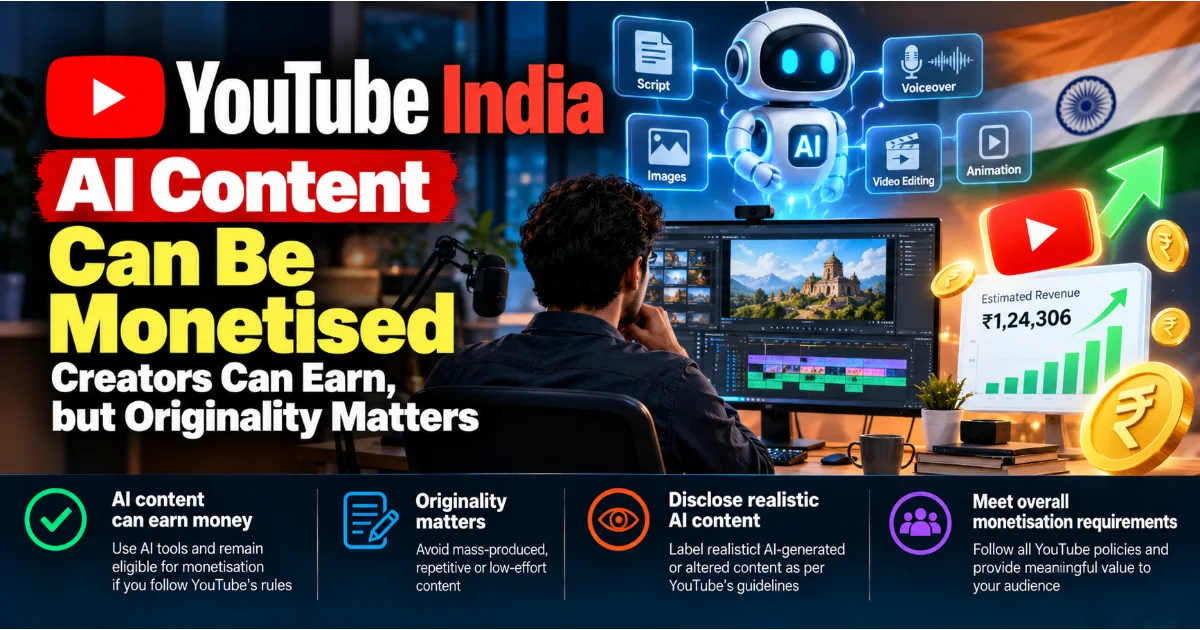
Is YouTube Allowing AI-Generated Videos to Make Money?
Artificial intelligence is changing how videos are written, produced, edited and published. A creator can now use AI tools to develop a script, generate a voiceover, create illustrations, produce animations and assemble a video without operating a traditional camera or recording studio. What once required a team of writers, editors, voice artists and designers can increasingly be completed by a small team or even a single individual using digital tools.
This transformation has created an important question for India's rapidly expanding creator economy: can YouTube channels that use artificial intelligence earn advertising revenue?
The answer is yes, but with important conditions. In a report published on September 29, 2026, YouTube India Managing Director Gunjan Soni clarified that the use of AI does not automatically disqualify a video from monetisation. Creators can use AI tools and still earn money, provided their content meets YouTube's monetisation policies and other applicable requirements.
The clarification is significant because AI-generated content has become a major topic of discussion among creators, particularly those who operate educational channels, news explainers, documentary channels, animation projects and faceless YouTube channels. Many creators use AI to reduce production costs, improve efficiency and experiment with formats that would otherwise be difficult to produce independently.
At the same time, YouTube has concerns about channels that publish large volumes of repetitive, mass-produced or minimally transformed material. The platform's monetisation policies focus on the value and originality of the finished content, not simply on whether a creator used traditional production methods or artificial intelligence. Repetitive videos, generic automated narration and slideshows with little meaningful original contribution may fail to qualify for monetisation.
This distinction is central to understanding the policy. YouTube is not saying that every AI-generated video deserves advertising revenue. It is saying that AI use alone is not a reason to reject a video. Creators must still make content that meets the platform's expectations and provides value to viewers.
For Indian creators, the distinction creates opportunities as well as responsibilities. AI tools can make video production more accessible to people who lack expensive equipment or a large production budget. They can help creators produce content in different languages, explain complicated topics and develop visual storytelling. However, the technology also makes it easier to flood the platform with repetitive videos that offer little beyond automatically assembled text, narration and images.
The future of AI-assisted YouTube content will therefore depend less on whether a creator uses AI and more on how that creator uses it. Original research, meaningful explanations, careful editing, fact-checking, storytelling and a recognisable creative approach can help distinguish valuable AI-assisted content from low-effort automation.
Understanding this distinction is essential for anyone planning to build a YouTube channel around artificial intelligence.
What YouTube's Clarification Actually Means
The most important point is that AI-generated content is not automatically prohibited from monetisation. A creator may use artificial intelligence for writing assistance, voice generation, animation, image creation, editing or other production tasks and still qualify for the YouTube Partner Program, provided the channel and its videos comply with the relevant policies.
This is different from a blanket approval of all AI-generated material. YouTube evaluates the content being published and whether the channel meets its monetisation requirements. The platform can still reject or remove monetisation from content that is repetitive, reused without sufficient original contribution, misleading or otherwise in violation of its policies.
Consider two hypothetical channels that use AI narration. The first publishes educational videos that explain scientific discoveries, historical events or economic concepts. Its creator researches the topic, checks facts, develops a clear script, selects relevant visuals and edits the video to help viewers understand the subject. AI may assist with narration and production, but the creator's editorial decisions shape the final result.
The second channel automatically converts online articles into scripts, uses a generic synthetic voice, places unrelated stock images behind the narration and uploads dozens of nearly identical videos every week. The creator contributes little original analysis or meaningful transformation.
Both channels use AI, but their content offers different levels of originality and viewer value. The first has a stronger basis for demonstrating a distinct creative contribution, while the second risks falling foul of YouTube's rules on inauthentic or repetitive content.
This example illustrates why the technology itself is not the decisive factor. AI can be a production tool, much like a video editor, graphics program or recording application. What matters is the role it plays in creating the finished work and whether the resulting channel provides original, useful or entertaining material.
Creators should also understand that originality does not necessarily mean inventing an entirely new subject. Many successful educational and documentary channels cover topics that other creators have already discussed. Their value can come from better research, a clearer explanation, a distinctive perspective, carefully chosen examples or a more engaging presentation.
A video about the history of India, for example, does not become unoriginal merely because other channels have covered the same historical period. It may offer meaningful value through its research, structure, interpretation and visual explanation. Conversely, simply paraphrasing another creator's video and generating a different synthetic voice may not provide enough original contribution.
The practical lesson is straightforward: use AI to improve production, not as a substitute for the creative work that makes a video worth watching.
Understanding YouTube's Rules on Inauthentic Content
One of the most important policy areas for AI creators is YouTube's treatment of inauthentic content. The platform's monetisation policies address content that is mass-produced or repetitive, including material created from templates with little meaningful variation or original value. These rules are relevant whether the production process uses AI or conventional editing tools.
The term "inauthentic content" is important because it shifts attention away from the production technology and towards the nature of the content. A video can be technically polished yet offer little original value. Equally, a relatively simple video can be useful if it contains meaningful explanation, original reporting, effective teaching or a distinctive creative approach.
For example, a channel might publish a series explaining important economic concepts. Each video may use a consistent intro, title design and narration style. That consistency is not automatically a problem. Educational series naturally share a format, and viewers may appreciate a predictable structure.
The risk increases when the videos differ only in superficial details. If every upload follows the same script pattern, uses interchangeable images and repeats generic statements without meaningful research or explanation, the channel may appear mass-produced rather than genuinely developed for its audience.
A similar distinction applies to automated news videos. A creator can use AI to help organise information, produce narration and prepare visual elements. However, a channel that simply reproduces headlines from other sources without independent reporting, contextual analysis or meaningful editorial contribution may struggle to demonstrate sufficient originality.
The issue is not the number of videos alone. A creator who publishes frequently can still offer original value, while a channel that uploads infrequently can still publish reused or repetitive material. Upload volume becomes a concern when it reflects a production process that prioritises quantity over meaningful variation and audience value.
Creators should therefore examine their entire channel, not just individual uploads. A channel may contain some strong original videos while much of its remaining library consists of repetitive material. Monetisation reviews can consider the channel's overall content and whether it meets the relevant standards.
It is also important to remember that meeting the originality requirement does not guarantee monetisation. Channels must satisfy the YouTube Partner Program's eligibility requirements and comply with other applicable rules, including copyright policies and advertiser-friendly content guidelines. AI use is only one part of a much broader evaluation.
Reused Content: Why Simply Repackaging Existing Material Can Be Risky
Reused content is another important issue for creators using AI. YouTube's monetisation policies distinguish between content that incorporates material from other sources with meaningful original contribution and content that repurposes existing material without adding sufficient value.
A creator might use AI to summarise a news article, generate narration and combine it with photographs taken from the internet. Even if the narration is newly generated, the finished video may still rely heavily on material created by others. Changing the voice or rearranging the images does not automatically make the video sufficiently original.
This is particularly relevant to documentary channels, entertainment commentary, news explainers and faceless channels. Such formats can be legitimate and successful, but creators need to think carefully about what they contribute beyond collecting existing material.
A meaningful contribution could include original research, critical commentary, a carefully developed explanation, a new narrative structure, relevant comparisons or substantial educational context. The contribution must be evident in the finished video rather than merely asserted by the creator.
Copyright is a separate consideration. A video might offer original commentary and still use copyrighted material in a way that creates legal or platform-policy problems. Conversely, a creator might have permission to use certain footage but still face monetisation difficulties if the overall video lacks sufficient original contribution. Copyright compliance and monetisation eligibility are related but distinct questions.
AI-generated images do not automatically solve this problem. If a creator uses AI to produce illustrations for a video that merely reproduces someone else's article or documentary, the use of newly generated visuals does not necessarily transform the underlying work into an original production.
Creators should instead develop a clear editorial process. They can research a topic using multiple reliable sources, organise the information independently, identify what viewers need to understand, write an original script and select visuals that genuinely support the explanation. Where outside material is used, they should consider permissions, licences, copyright limitations and attribution requirements.
The goal is not to avoid all references to existing work. Journalism, education and documentary storytelling regularly draw on existing information. The goal is to make sure the finished video contributes something meaningful rather than functioning as a substitute for the original material.
For creators building long-term channels, this approach is more sustainable than relying on superficial changes to content produced elsewhere.
Can Faceless YouTube Channels Monetise AI Videos?
Yes. A faceless channel can be eligible for monetisation even if the creator never appears on camera. YouTube's rules do not require every creator to show their face, record their own voice or use a traditional filming setup.
Faceless channels cover many legitimate formats, including animated explainers, educational documentaries, history lessons, science videos, financial education, storytelling and software tutorials. AI tools can help these creators produce narration, illustrations, animations and other visual elements without a conventional studio.
The important distinction is between a faceless channel and a low-effort channel. The absence of a visible presenter does not make a video unoriginal. Equally, showing a person's face does not automatically make a video original or eligible for monetisation.
A well-developed faceless history channel, for instance, might investigate a historical event, compare different accounts, explain the broader context and use maps, timelines and illustrations to make the subject easier to understand. AI-generated narration could deliver the script, while an editor assembles the visuals and ensures that the explanation is accurate and coherent.
A weaker version might take a publicly available article, convert it into a generic script, generate narration and display a sequence of unrelated images. If this process is repeated with minimal changes across hundreds of uploads, the channel may face concerns about repetitive or inauthentic content.
The difference is the editorial work behind the video. A successful faceless channel still needs a clear purpose, an understanding of its audience and a reason for viewers to choose its content over the many alternatives available.
There is also no single visual style that guarantees approval. Animation, stock footage, AI illustrations, screen recordings and simple slides can all be used in different types of videos. Their suitability depends on the subject, the way they are used and the overall quality of the finished work.
Creators should therefore avoid assuming that a particular format is automatically safe or automatically prohibited. The better question is whether each video offers a worthwhile experience and whether the channel as a whole demonstrates genuine creative contribution.
AI Voiceovers: Are Synthetic Voices Allowed?
AI-generated voices have become popular because they allow creators to produce narration without recording equipment or hiring a voice artist for every project. They can also make it easier to create versions of videos in different languages, improve audio consistency and revise a script without arranging another recording session.
Synthetic narration is not automatically disqualifying for monetisation. However, a voiceover does not make a video original by itself. YouTube's monetisation policies still apply to the substance of the content, regardless of whether the words are spoken by the creator, a professional narrator or an AI-generated voice.
A creator using a synthetic voice should focus on script quality, pronunciation, pacing and clarity. A video with accurate research and a well-written explanation can benefit from AI narration if the voice helps communicate the material effectively. A video built from repetitive, generic text does not become valuable simply because the narration sounds realistic.
Creators must also be careful about voice imitation. Generating a generic synthetic voice for narration is different from cloning or impersonating a real person without appropriate permission. Using AI to make it appear that a public figure, journalist, expert or private individual said something they never said can raise serious ethical, privacy and platform-policy concerns.
The same principle applies to synthetic voices used in advertising, political commentary, news and educational content. Viewers should not be misled about the identity of a speaker when that distinction is material to understanding the video.
AI voiceovers can also introduce factual risks. A synthetic narrator may pronounce names incorrectly, misread figures or deliver a sentence in a way that changes its intended meaning. These problems can be especially damaging in news reporting, historical documentaries and educational videos, where accuracy is central to the creator's credibility.
Human review remains important. Before publishing, creators should listen to the complete narration, verify the pronunciation of names and places, check figures and dates, and ensure that the spoken words match the intended meaning of the script.
The best use of synthetic narration is not simply to eliminate recording time. It is to make a well-researched, original video easier to produce while maintaining quality and trust.
AI-Generated Images, Animation and Video Clips
Visual production is another area in which AI can reduce the cost of making YouTube videos. Creators can generate illustrations for historical explanations, create conceptual scenes for science videos, develop animated backgrounds, produce visual summaries and design transitions that would otherwise require specialist software or a larger production budget.
For educational and documentary channels, these tools can make complex subjects easier to understand. A video about the solar system might use AI-assisted illustrations to explain planetary formation. A history video might use maps, diagrams and carefully labelled reconstructions to help viewers understand how a region changed over time. A technology explainer could combine screen recordings with generated visual metaphors to describe a difficult concept.
However, AI-generated imagery must be used thoughtfully. A visually attractive image may still be historically inaccurate, scientifically misleading or inconsistent with the accompanying narration. Creators should not assume that generated visuals are factual simply because they look realistic.
This is particularly important when making news videos. If a creator generates an image depicting a real event, a public figure or a crime scene, viewers may interpret it as documentary evidence. A synthetic scene should not be presented in a way that falsely implies that the depicted event was actually photographed or filmed.
YouTube has disclosure requirements for realistic altered or synthetic content that could mislead viewers about real people, places or events. The platform's May 2026 update, according to the reporting available, also introduced more prominent labels for certain realistic AI-generated or meaningfully altered material and additional detection signals. The label itself does not automatically make a video ineligible for monetisation.
Creators should check YouTube's current disclosure instructions before publishing. Not every use of AI requires the same treatment. Assistance with a script, a clearly fictional animation or routine editing may be different from generating realistic footage that makes it appear a real person did or said something they did not.
The underlying principle is transparency where realistic synthetic content could materially affect how viewers interpret a video. Disclosure helps audiences understand what they are watching and reduces the risk of presenting generated material as authentic evidence.
Creators should also consider whether a visual genuinely improves the video. Generating dozens of attractive but irrelevant images may increase production complexity without improving comprehension. A smaller number of accurate, purposeful visuals is often more useful than a large collection of generic scenes.
AI imagery is most effective when it serves the story, supports the explanation and is reviewed by someone who understands the subject.
Do Creators Need to Disclose AI-Generated Content?
Disclosure is one of the most misunderstood aspects of YouTube's AI rules. Creators sometimes assume that any use of AI must be declared, while others believe that generated content never needs a label. The actual requirement depends on the nature of the content and whether it falls within YouTube's disclosure rules for altered or synthetic material.
YouTube requires creators to disclose certain realistic altered or synthetic content, particularly when it makes a real person appear to say or do something they did not, alters footage of a real event or place in a meaningful way, or depicts a realistic event that never occurred. The platform provides a disclosure option during the upload process for applicable content.
For example, a creator who uses AI to generate a realistic video of a real public figure delivering a fabricated statement should not present it as authentic footage. Similarly, a realistic synthetic depiction of a news event should not be passed off as genuine documentary evidence.
By contrast, using AI to brainstorm ideas, improve grammar, generate a basic outline or create certain clearly illustrative elements does not necessarily trigger the same disclosure requirement. Creators should consult the current policy rather than treating every AI-assisted task as identical.
Disclosure should not be viewed as a punishment. It can be a way to maintain trust with viewers by explaining how a video was produced. As generated media becomes more realistic, audiences will increasingly need clear signals that help them distinguish authentic recordings from synthetic representations.
Importantly, disclosure does not automatically guarantee monetisation, just as the presence of a disclosure label does not automatically prevent monetisation. The video must still comply with the relevant content, originality, copyright and advertising policies.
Creators should also avoid relying on labels as a substitute for responsible production. If a video is misleading, violates another person's rights or contains prohibited material, disclosing that it was generated with AI may not resolve the underlying problem.
A responsible creator should therefore ask two separate questions before publishing. First, does this video require an AI disclosure under YouTube's current rules? Second, does the finished video meet the platform's broader standards and provide meaningful value to viewers? Both questions matter.
How Indian Creators Can Build Monetisable AI-Assisted Channels
For Indian creators, AI tools can make it easier to enter video production without major upfront investment. A creator may not need to buy a camera, arrange a studio or hire a full production team to begin publishing educational or documentary videos. AI can support scripting, narration, illustrations, translation and editing, while the creator concentrates on research and storytelling.
However, lower production costs also mean more competition. If thousands of channels can generate similar videos using the same tools, the technology itself is unlikely to provide a lasting advantage. Creators need to develop a recognisable identity and a reason for viewers to return.
One useful approach is to specialise in a subject. A channel that consistently explains Indian history, economics, science, current affairs or competitive examination topics can build an audience around a clear promise. Specialisation helps the creator develop expertise, identify suitable sources and understand what viewers want to learn.
Original research and editorial judgement are particularly valuable. Rather than relying on a single article, creators can consult multiple reputable sources, compare accounts and explain what is known, what remains uncertain and why a development matters. For news content, dates, figures, quotations and claims should be checked before the video is published.
Scripts should be written for the spoken format rather than copied directly from articles. A good video script introduces the topic, explains the context, develops the main points and helps viewers understand the conclusion. It should sound natural when narrated and avoid repeating the same information merely to increase video length.
Visuals should also be selected deliberately. Maps, charts, timelines, demonstrations, screenshots and original illustrations can make information easier to follow. AI-generated scenes can support storytelling, but they should not replace necessary evidence or create a false impression of what actually happened.
Creators should then review the finished video as a viewer would experience it. Is the narration understandable? Are the visuals relevant? Are claims supported? Does the video add something beyond a generic summary? Is the pacing appropriate? Could the viewer learn something useful or gain a meaningful perspective by watching it?
These questions help shift the production process away from simply generating uploads and towards building a genuine media product.
A practical workflow for AI-assisted video production
Choose a clear topic. Focus on a subject that fits the channel's identity and offers something meaningful to the intended audience.
Research before writing. Use reliable sources and verify important facts, especially for news, history, finance and public affairs.
Create an original script. Use AI as a writing assistant if helpful, but develop the explanation, structure and editorial perspective rather than merely paraphrasing existing material.
Produce suitable narration and visuals. Select tools and formats that support the topic, and review synthetic speech and generated imagery for accuracy.
Check rights and disclosure requirements. Review the use of outside footage, music, images, voice likenesses and realistic synthetic content before publishing.
Edit for the viewer. Remove repetition, correct errors, improve pacing and make sure every section contributes to the video.
Review the channel as a whole. Maintain meaningful variation between uploads and ensure that the channel consistently offers original value.
This process does not guarantee approval for monetisation, but it gives creators a stronger foundation than an approach based entirely on high-volume automated publishing.
What About YouTube Partner Program Eligibility?
Even if a video uses AI responsibly and meets the originality requirements, a creator must still qualify for the YouTube Partner Program to earn advertising revenue through the programme.
YouTube has eligibility requirements covering subscriber numbers, valid public watch hours or eligible Shorts views, policy compliance and other account conditions. The precise requirements depend on the monetisation features available and the creator's circumstances. Creators should check the current requirements in YouTube Studio and the official YouTube Partner Program documentation rather than relying on outdated figures circulated online.
Reaching the eligibility threshold does not guarantee acceptance. YouTube reviews channels against its monetisation policies, and a channel can be rejected if its overall content does not meet the required standards.
This means creators should not wait until they have accumulated thousands of subscribers before thinking about originality. The content library they build from the beginning can influence how well the channel demonstrates a consistent creative purpose.
Creators should also understand that monetisation can involve several different revenue sources. Advertising is one option, while eligible channels may have access to features such as memberships, fan funding and other commercial opportunities, depending on the programme requirements and local availability. Each feature may have its own conditions.
For an AI-assisted channel, the sensible strategy is to develop an audience through reliable, original content rather than treating monetisation as an automatic reward for publishing a certain number of videos. A channel that earns viewer trust and provides consistent value is better positioned to build a sustainable business over time.
Conclusion: AI Is a Tool, Not a Guarantee of Income
YouTube India's clarification is an important message for creators who use artificial intelligence: AI-generated content can be monetised, but the use of AI alone does not guarantee approval or revenue. The platform's rules continue to focus on originality, meaningful creative contribution, compliance and the value provided to viewers.
For India's creator economy, this creates a meaningful opportunity. People who lack expensive production equipment can use AI to create educational videos, documentaries, animations, explainers and other forms of digital media. Creators can experiment with new formats, produce narration more efficiently and make information accessible to audiences who speak different languages.
But easier production also raises the standard for originality. When almost anyone can generate a script, voiceover and collection of images, simply producing a video is no longer enough to make a channel distinctive. Creators need to invest in research, judgement, storytelling and quality control.
The most important distinction is between using AI to create something worthwhile and using AI to mass-produce content with little meaningful contribution. A well-researched video with original analysis and carefully selected visuals can use AI extensively while still reflecting substantial creative work. A repetitive video that merely rearranges existing material may struggle even if every element has been generated or edited with sophisticated tools.
Transparency matters as well. Realistic synthetic content that falls within YouTube's disclosure requirements should be labelled appropriately, and creators should take particular care when depicting real people or reporting on real events. AI should help audiences understand information, not mislead them about what happened.
For creators in India, the long-term opportunity lies in combining the efficiency of AI with human creativity and responsibility. Use technology to improve production, verify information before publishing, respect copyright, develop a clear editorial identity and focus on what viewers can learn or experience through the finished video.
YouTube is not closing the door on AI creators. The bigger challenge is proving that a channel offers something original, useful and worth watching. In the emerging creator economy, AI may lower the barrier to production, but creativity, credibility and audience trust will remain essential to building a sustainable channel.
#BeyondHeadlines #YouTubeIndia #AIContent #YouTubeMonetisation #ArtificialIntelligence #CreatorEconomy #YouTubeCreators #FacelessYouTubeChannel #GenerativeAI #DigitalContent #ContentCreation #YouTubePartnerProgram #AIVideo #DigitalIndia #BeyondTheHeadline

