
Introduction
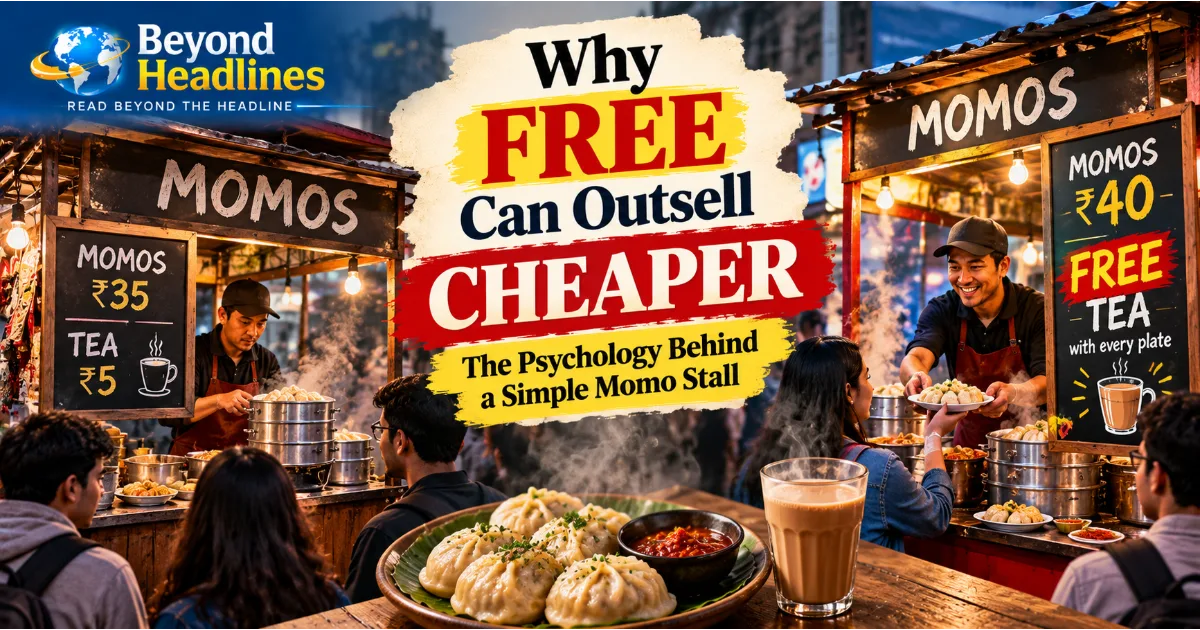
Marketing lessons are often presented through large brands, expensive campaigns and carefully designed advertising strategies, but some of the most useful lessons can be found in ordinary places. A neighbourhood food stall can reveal more about consumer psychology than a polished presentation because the business owner is dealing with real customers, real competition and real purchasing decisions every day. A recent LinkedIn post by Shreya Sinha offers exactly that kind of everyday marketing observation through a simple comparison between two momo stalls. One stall sells momos for ₹35 and tea for ₹5, while another sells momos for ₹40 and offers tea free with the purchase. Despite the higher effective price of the second offer, the stall offering free tea appears to attract significantly more customers. LinkedIn
At first glance, the strategy may look like a straightforward discount. The customer is effectively paying ₹5 more for the momos and receiving tea as a bonus. From a purely mathematical perspective, there is little mystery. The customer who buys ₹35 momos and ₹5 tea spends ₹40, while the customer who buys ₹40 momos with free tea also spends ₹40. Yet the way those two offers are presented can create very different psychological reactions. The word "FREE" changes the way the customer perceives the transaction, even when the final amount spent is the same.
This is one of the most fascinating aspects of marketing. Consumers do not always make decisions by comparing numbers in a perfectly rational manner. Price, presentation, framing, convenience, familiarity and emotion can influence how an offer is perceived. Academic research has documented what is commonly called the zero price effect, where consumers can place disproportionately high value on an option simply because its price has reached zero. Research has also shown that this effect is not unlimited and can depend on circumstances, perceived costs and the way an offer is structured. Wiley Online Library
The momo stall example therefore provides a useful starting point for understanding a much larger marketing principle. The real lesson is not that businesses should give things away for free. The lesson is that customers respond not only to what they receive, but also to how the value of an offer is communicated.
The Momo Stall Is a Marketing Laboratory
The situation described in the LinkedIn post is interesting because there are two businesses competing for essentially the same customer. Both sell momos. Both sell or provide tea. Both operate in the same locality. Both presumably have similar access to potential customers. Yet their offers create different perceptions. The first stall communicates a simple price structure in which customers pay separately for the food and tea. The second stall creates a bundled proposition in which the customer pays ₹40 for the momos and receives tea without an additional charge. LinkedIn
If the two offers were presented only as equations, there would be little reason to expect a dramatic difference in demand. ₹35 plus ₹5 equals ₹40, while ₹40 with complimentary tea also equals ₹40. However, consumers do not encounter businesses as spreadsheets. They encounter signs, menus, advertisements, conversations and visual cues. They process information quickly, particularly when purchasing something as ordinary and low-cost as a snack.
That is why the word "FREE" can become disproportionately powerful. It communicates a benefit immediately and removes the need for the customer to think about the additional payment associated with that benefit. The tea is no longer framed as another item that needs to be evaluated. It becomes a bonus attached to the main purchase.
This distinction is important because marketing is often less about changing the underlying economics of an offer and more about changing how the economics are understood.
Why the Word FREE Feels Different
The most important psychological feature of this example is that zero is not perceived simply as another point on a numerical scale. Moving from ₹10 to ₹5 is a reduction of ₹5. Moving from ₹5 to ₹0 is also a reduction of ₹5. Mathematically, the reductions are identical. Psychologically, they do not necessarily feel identical.
Research on the zero price effect suggests that consumers can respond disproportionately positively when an item becomes free. Studies have found that consumers may overvalue a free option relative to what a conventional cost-benefit calculation would predict. One explanation is that zero price generates a positive emotional response that changes how people evaluate the offer. Wiley Online Library
This helps explain why "free tea" can attract attention even when the overall transaction is not actually cheaper than the competing offer. The customer is not necessarily thinking, "I am spending ₹40 either way, so these offers are identical." The customer may instead think, "For ₹40, I get momos and free tea."
The second statement feels more rewarding because the customer can identify an additional benefit without mentally attaching another price to it.
This is not necessarily irrational in every situation. Customers may value convenience, simplicity and the feeling of receiving an additional benefit. But it demonstrates that perceived value and monetary value are not always identical.
The Difference Between Price and Perceived Value
One of the most important lessons in marketing is that price and value are different concepts. Price is the amount a customer pays. Value is what the customer believes they receive in return.
A business cannot always control how much money a customer has available, but it can influence how the customer perceives the relationship between payment and benefits. This is why two products with similar costs can have completely different perceived values depending on packaging, positioning, service, convenience and communication.
The second momo stall is effectively using the tea to increase perceived value. Instead of telling customers that the meal costs ₹40, it communicates a proposition in which the customer receives an additional item at no extra charge. The business has changed the presentation of the value without necessarily reducing the total amount it receives per transaction.
This can be especially effective in low-ticket purchases because consumers often make quick decisions. Someone walking past a stall may not stop to calculate the relative economics of two menus. A visible "FREE TEA" offer can communicate its benefit in seconds.
That speed matters in marketing. The best message is not always the one containing the most information. It is often the message whose value can be understood immediately.
Why Customers Love a Bonus
There is another psychological element involved in the example. People generally enjoy receiving something that feels like an additional benefit. A bonus creates a sense of gain beyond the primary purchase.
This is why businesses across different industries use phrases such as free delivery, complimentary dessert, free consultation, bonus points, free installation, free upgrade and buy one get one. The underlying economics vary, but the psychological principle is similar. The customer is encouraged to focus on what has been added rather than only on the amount being paid.
The word "bonus" can also create a feeling that the customer has made a smart decision. The person is not merely purchasing something. They are receiving an advantage that another customer might not receive.
This can strengthen the emotional appeal of an offer.
The important point for marketers is that a bonus does not necessarily have to be expensive. It needs to be relevant to the customer and clearly connected to the purchase. In the momo example, tea makes sense because it is naturally consumed alongside a snack. The free item therefore feels useful rather than random.
Relevance Makes the Offer Stronger
Imagine the same momo stall offering a free pencil with every order. The business could technically make the same pricing claim, but the psychological effect would probably be weaker because the free item has little connection with the customer's immediate need.
The effectiveness of a bonus depends partly on relevance.
Tea works because the customer is already buying food. The free item fits naturally into the consumption experience. It does not require the customer to change behaviour or find another use for it.
This is a critical lesson for businesses designing promotions. A free item should ideally complement the main product rather than simply exist as a gimmick.
A restaurant can offer a complimentary beverage. A software company can offer additional storage. A travel company can offer airport transfer. A clothing store can offer free alterations. A service provider can offer a complimentary consultation. In each case, the additional benefit should strengthen the perceived value of the main purchase.
The Hidden Power of Bundling
The momo example is also an example of bundling. Two products are combined into one purchasing proposition, but the way the bundle is communicated makes one component appear free.
Bundling can simplify the customer's decision. Instead of asking whether they want momos and whether they want tea separately, the customer sees one offer. The business can therefore reduce the number of individual purchasing decisions involved in the transaction.
Bundling also allows businesses to move attention away from the price of individual components. If a customer focuses heavily on the ₹5 tea, the business may appear to be competing primarily on price. If the customer instead sees "₹40 momos with free tea," the comparison becomes more emotional and benefit-oriented.
This does not mean businesses should hide prices or manipulate customers. Effective bundling should be transparent. The customer should understand what they are receiving and what they are paying.
The goal is to make the value proposition easier to understand, not to make the transaction confusing.
Free Does Not Mean the Customer Is Getting More Economic Value
This distinction is extremely important. The fact that consumers respond strongly to "free" does not mean that every free offer is financially beneficial to them.
The customer in the momo example spends ₹40 in either case if they want both momos and tea. The difference lies primarily in how the purchase is framed.
This is why marketers need to distinguish between perceived value and actual value. A promotion can feel attractive while providing little economic advantage. Conversely, an offer may provide substantial value but fail to attract customers because the benefit is poorly communicated.
Businesses should therefore avoid treating the word "free" as a magic button. It can attract attention, but the underlying product still has to justify the purchase.
Research has also shown that zero pricing can sometimes produce a negative effect when consumers face significant non-monetary costs. If an offer is free but requires a long journey, excessive waiting or another meaningful sacrifice, the attractiveness of "free" can diminish. Springer
This is an important reminder that price is only one component of the customer experience.
The Customer Is Also Paying With Time
A business owner may think about the transaction primarily in terms of money. The customer thinks about more than money.
They may consider how long they have to wait, how far they have to travel, how difficult the ordering process is and whether the product is reliable. These are forms of non-monetary cost.
This explains why a free offer cannot compensate for a terrible customer experience indefinitely. If the customer has to wait thirty minutes for a free cup of tea, the word "free" may lose its appeal.
The research on the boomerang effect of zero pricing demonstrates this principle. Researchers found that zero pricing can increase demand when incidental costs are low, but the effect can weaken or even reverse when those additional costs become significant. Springer
For marketers, the implication is straightforward. Do not look only at the price. Look at the entire customer journey.
The Free Tea May Be an Acquisition Strategy
From the stall owner's perspective, the free tea may serve as a customer acquisition tool rather than simply a discount.
The owner is effectively saying, "Choose my stall and receive an additional benefit."
If the strategy increases footfall, it may create opportunities for more sales. A customer who comes for the momos and free tea may later become a repeat customer. The customer may also recommend the stall to friends.
This is where marketing becomes more interesting than a simple price comparison.
The business owner is potentially using a small cost to influence a larger behaviour. The tea may cost the stall owner only a fraction of the additional revenue or customer lifetime value generated by the promotion.
This is similar to how digital businesses offer free trials, e-commerce companies offer free delivery thresholds and subscription services offer free introductory periods. The free component is not necessarily the product. It is the mechanism used to reduce resistance to the first purchase.
Acquisition Is Not the Same as Retention
One of the comments under the LinkedIn post makes an important observation. A free offer can bring customers through the door, but product quality and customer experience determine whether those customers return. LinkedIn
This is perhaps the most important qualification to the entire marketing lesson.
A promotion can generate curiosity.
It can create footfall.
It can increase first-time purchases.
But it cannot guarantee loyalty.
If the momos are poor, the service is slow or the experience is disappointing, customers may not return even if the tea is free.
Marketing creates an opportunity for the customer to experience the product. The product itself determines whether that opportunity turns into a relationship.
This distinction separates sustainable marketing from promotional gimmicks.
The First Purchase and the Second Purchase
Businesses often focus heavily on getting the first sale because the first sale is easy to measure. However, the second sale can be more important.
The first purchase answers the question, "Can I convince this person to try?"
The second purchase answers the question, "Did I give this person enough reason to return?"
A free tea promotion may solve the first problem. The quality of the food, speed of service, cleanliness, friendliness of staff and overall experience need to solve the second.
This principle applies to almost every industry.
A digital advertisement can generate the first website visit. The website experience determines whether the visitor signs up. The product determines whether they continue using the service. Customer support determines whether they stay when something goes wrong.
Marketing gets attention. Experience builds relationships.
Why Small Businesses Can Be Brilliant Marketers
One of the most interesting aspects of the momo story is that the stall owner may not have studied marketing formally.
There may be no marketing department, no brand manager and no customer analytics dashboard. Yet the owner is observing customer behaviour every day.
They can see which customers stop.
They can see which offer attracts groups.
They can see what time the stall becomes busy.
They can see whether students respond differently from office workers.
They can observe what customers ask about.
This creates a form of practical market research.
Small businesses are often forced to learn quickly because their margins are limited and customer behaviour has an immediate impact on revenue. A large company might spend weeks conducting research before testing a promotional idea. A local stall owner can test an offer tomorrow and see what happens.
This does not mean intuition is always correct. It means proximity to customers can generate valuable insights.
The Best Marketing Lessons Are Sometimes Invisible
Customers walking past the momo stall may simply think that one seller is generous.
They may not think about behavioral economics, pricing psychology or promotional strategy.
That is precisely what makes the example interesting.
Effective marketing often works without announcing itself as marketing.
A customer sees "free tea."
They notice the crowd.
They compare the offer.
They make a decision.
The psychological process happens quickly.
This is why marketers need to understand human behaviour rather than focusing exclusively on advertising techniques. A beautiful advertisement is not necessarily effective if it does not influence the customer's decision.
The stall owner may have accidentally or deliberately discovered a principle that researchers have studied for years.
The Importance of Price Framing
Price framing refers to how a price or offer is presented rather than merely what the numerical price is.
Consider several ways the same ₹40 transaction could be communicated.
"Momos and tea for ₹40" is straightforward.
"Momos ₹35, tea ₹5" makes the customer think about two separate prices.
"Momos ₹40, free tea" makes the customer focus on the bonus.
"₹40 combo with complimentary tea" creates a bundled value proposition.
The underlying economics may be similar, but the mental framing changes.
Research has shown that even the way a zero-price promotion is described can influence consumer response. One study examining "free" versus "$0" framing found that the wording can affect how consumers focus on the savings associated with an offer. ScienceDirect
This shows that pricing communication is not a trivial detail. The language surrounding the price can influence how customers interpret the value.
The Difference Between Discounting and Adding Value
Businesses often assume that the best way to attract customers is to reduce the main product's price.
That can be dangerous.
If a product normally costs ₹40 and the business repeatedly sells it for ₹30, customers may eventually perceive ₹30 as the normal price. The business has trained customers to expect a lower price.
A bonus can sometimes protect the perceived value of the main product.
Instead of saying "momos are cheaper," the business can say "momos come with an additional benefit."
This distinction matters for brand positioning.
Discounting primarily changes the price.
Value addition changes what the customer receives.
Neither approach is universally better, but they have different long-term implications.
Why Constant Discounting Can Become a Problem
Price-based competition can become difficult because competitors can respond with even lower prices. One stall offers ₹35, another offers ₹30 and another offers ₹25. Eventually, businesses can enter a situation where they are competing primarily on margin.
A business that continually discounts may also weaken its perceived value. Customers can begin to believe that the original price was inflated or that the product is only worth purchasing during promotions.
A well-designed bonus can sometimes avoid that problem because the core price remains relatively stable.
The customer feels rewarded without necessarily being trained to expect the product itself to become cheaper.
This is one reason loyalty programmes, bundles and complementary benefits are widely used across industries.
But Businesses Must Know Their Numbers
The psychological appeal of free does not eliminate basic business economics.
Before offering anything free, a business should understand its cost structure.
If a cup of tea costs the business ₹2 to produce and the promotion generates an additional ₹10 or ₹15 in contribution margin, the offer may make sense.
If the tea costs ₹8 and the promotion only increases sales marginally, the economics may be weaker.
The correct question is not simply, "Will customers like free tea?"
The correct question is, "Does the additional customer behaviour generated by free tea justify its cost?"
That requires measuring sales, margins, repeat purchases and customer acquisition costs.
Even a neighbourhood stall can apply this principle without sophisticated software. The owner can compare sales before and after the offer, observe repeat customers and estimate the additional cost of the promotion.
Marketing Without Measurement Is Guesswork
The visual popularity of the second stall provides an interesting observation, but observation alone does not prove exactly why the stall is busier.
There could be other factors.
Perhaps the second stall has better tasting momos.
Perhaps the service is faster.
Perhaps the location has better visibility.
Perhaps the owner is friendlier.
Perhaps the stall has been operating longer.
Perhaps the free tea attracts customers, but the food quality keeps them there.
This is an important analytical lesson.
Good marketers should be willing to notice patterns without immediately assuming causation.
The free tea may be responsible for some of the difference, but a rigorous business analysis would test the hypothesis.
This is where experimentation becomes valuable.
A Simple Experiment Could Reveal the Answer
The stall owner could test different offers across comparable periods.
For one period, the stall could sell momos for ₹35 and tea for ₹5.
For another period, it could sell momos for ₹40 with tea free.
The owner could then compare the number of customers, total sales, average transaction value and repeat purchases.
An even better experiment could rotate the offer by day or time period while keeping other factors as stable as possible.
The objective would not be to prove that free tea always works. The objective would be to discover whether it works for this particular customer base.
That is the difference between copying a marketing tactic and understanding a marketing principle.
What This Means for Digital Businesses
The same psychology exists online.
A software company may offer a free plan.
An education platform may provide a free introductory course.
An e-commerce store may offer free delivery above a certain order value.
A marketplace may waive a fee for new users.
A financial platform may offer a free account with optional premium services.
These offers can reduce the psychological barrier to trying something new.
Research into freemium business models has specifically examined how consumers respond to free versions of digital services and how the zero-price effect can influence their choices. The research also highlights an important complication: some consumers associate higher prices with higher quality, meaning free can sometimes create doubts as well as attraction. DOI
This is why free is not automatically superior.
Free Can Also Create Suspicion
There is a common assumption that every consumer loves free products.
In reality, free can sometimes create questions.
Why is this free?
Is there a catch?
Is the quality lower?
Will I have to pay later?
Will my data be collected?
Is the company desperate for customers?
These questions become particularly important when the product is expensive, unfamiliar or complex.
The momo stall is a simple example because the customer's perceived risk is low. A cup of tea has limited downside. The customer can try the offer without making a major financial commitment.
For a financial service or enterprise software platform, the psychology may be very different.
This is why marketers need to consider the product category before applying a pricing tactic.
The Free Offer Works Best When the Risk Is Low
The zero price effect tends to be particularly useful when the customer can easily try the product and reverse the decision.
Food is a good example. A customer can buy a plate of momos, consume it and decide whether to return.
Digital services can sometimes work similarly because users can create an account, explore a free plan and upgrade later.
Products involving significant time, trust or commitment require a different strategy.
The customer may need demonstrations, reviews, guarantees, trials or expert recommendations rather than simply a free bonus.
The more complex the decision, the more important the rest of the value proposition becomes.
The Real Lesson Is Not "Make Something Free"
This distinction deserves emphasis because marketing advice is often simplified into catchy rules.
The lesson from the momo stall is not that every business should offer something free.
The lesson is that customers respond strongly to perceived gains, and businesses can design offers that make the value proposition easier to understand.
A free item can be one method.
A bundle can be another.
A guarantee can reduce perceived risk.
A faster delivery time can create convenience.
A personalised service can increase perceived value.
A loyalty reward can encourage repeat purchases.
The best strategy depends on the customer and the product.
Why the Momo Example Is More Powerful Than a Textbook
A textbook can explain the zero price effect through experiments and equations.
The momo stall makes the concept tangible.
A customer walks past two stalls.
One says ₹35 for momos and ₹5 for tea.
The other says ₹40 for momos and free tea.
The second offer feels different even though the combined expenditure is the same.
That simple observation opens the door to a much broader understanding of human decision-making.
Customers are not machines that process prices without emotion. They interpret offers through mental shortcuts, expectations and feelings.
Marketing succeeds when it understands those human responses while remaining honest about the actual value being delivered.
What Small Businesses Can Learn From This
Small businesses should pay close attention to how customers perceive offers rather than focusing exclusively on what competitors charge.
A restaurant could experiment with a complimentary side dish instead of lowering its main menu price.
A salon could include a free consultation with a paid service.
A repair business could provide a free inspection with a paid repair.
A tutor could offer a free assessment before a course purchase.
A local retailer could offer a complementary accessory with a core product.
In each case, the additional benefit should be inexpensive enough for the business to provide sustainably and valuable enough for the customer to notice.
The strategy should be tested rather than assumed to work.
What Startups Can Learn
Startups can apply the same principle to customer acquisition.
Instead of spending heavily on advertising and immediately asking users to pay, a company can reduce the barrier to initial adoption through a free trial or useful free feature.
But the free offering must be designed with the business model in mind.
If the free product is too generous, customers may never have a reason to upgrade.
If it is too limited, users may not experience enough value to become interested.
The goal is to create a free experience that demonstrates the product's usefulness while leaving a natural reason for customers to pay for additional value.
This is one of the central challenges of freemium models.
What Established Brands Can Learn
Large brands can also benefit from the lesson, but they need to think beyond traditional discounts.
Instead of reducing the price of the main product, a company can create complementary value.
A food delivery platform might offer free delivery above a threshold.
A streaming service might provide an introductory trial.
A consumer electronics company might bundle accessories.
A travel company might include an airport transfer.
A software company might provide additional onboarding.
These strategies can preserve the perceived value of the main product while making the overall proposition more attractive.
The key is ensuring that the additional benefit is actually meaningful to the customer.
The Customer's Question Is Simple
Behind every pricing strategy is a basic customer question: "What do I get for what I pay?"
The customer may never articulate it in those exact words, but the decision process revolves around perceived exchange.
The free tea changes the answer from "I pay ₹40 for momos and tea" to "I pay ₹40 for momos and get tea free."
The economic difference may be minimal, but the psychological difference can be meaningful.
This is why successful marketing often depends on translating product features into customer benefits.
A business sells a product.
A marketer communicates why that product is worth choosing.
Beyond the Headline
The headline of the LinkedIn post is essentially a simple observation about a momo stall using free tea as a marketing strategy. The deeper story is about the psychology of value and the difference between what customers pay and what they believe they receive. LinkedIn
The stall owner may not have used terminology such as zero price effect, behavioural economics or price framing, but the offer illustrates these concepts in a practical environment. The word "free" can create a positive emotional response, reduce the psychological resistance associated with paying for an additional item and make a bundled purchase feel more rewarding.
At the same time, the example also demonstrates why marketing should not be separated from product quality. A promotion can attract attention, but it cannot permanently compensate for a weak product. The free tea may persuade someone to try the stall, but the taste of the momos, speed of service and overall experience will influence whether that person returns.
This is where the difference between acquisition and retention becomes critical. Marketing can create the first opportunity. Product quality creates the reason for the second purchase. Customer experience creates the reason for continued loyalty.
The example also shows why marketers should avoid copying tactics without understanding the underlying principle. "Free tea" works in this context because tea is relevant to the customer's purchase, inexpensive enough to provide and easy to understand. The same strategy might fail completely in another business.
The broader principle is therefore not "give customers something free." The broader principle is to understand what customers value, identify a benefit that can be delivered sustainably and communicate that benefit in a way that makes the value obvious.
That is what good marketing does.
It does not merely reduce prices.
It changes how customers understand the exchange.
Conclusion
The two momo stalls described in the LinkedIn post offer a surprisingly rich lesson in marketing. One charges ₹35 for momos and ₹5 for tea, while the other charges ₹40 for momos and presents the tea as free. The total amount spent can be the same, yet the second offer appears more attractive because the customer experiences the tea as an additional benefit rather than another expense. LinkedIn
Behavioral research provides a broader explanation for this reaction. The zero price effect describes the tendency for consumers to respond disproportionately positively to something priced at zero. Researchers have found that the emotional response to "free" can influence demand beyond what a simple calculation of monetary savings would predict. Wiley Online Library
However, the same research also provides an important warning. Free is not automatically better. When consumers face significant time, effort or other non-monetary costs, the psychological advantage of zero pricing can weaken or even reverse. Springer
For businesses, the most useful lesson is therefore not to become obsessed with the word "free." It is to understand the psychology of perceived value.
A customer does not simply buy a product at a price.
The customer evaluates an overall proposition that includes the product, the price, the experience, the convenience, the perceived risk and the additional benefits attached to the purchase.
The momo stall succeeds as a marketing example because it demonstrates this principle in the simplest possible environment. There is no complicated technology, no expensive campaign and no elaborate brand strategy. There is simply an offer that makes customers feel they are receiving something extra.
That small decision can influence attention, footfall and trial.
But the long-term business still depends on what happens after the customer walks in.
If the food is good, the service is reliable and the experience is satisfying, the free tea may become the first step in a customer relationship. If the product disappoints, the promotion becomes only a temporary attraction.
That is perhaps the most important lesson beyond the headline.
Marketing can get the customer to notice you. Value gives the customer a reason to choose you. Quality gives the customer a reason to return.
#Marketing #MarketingStrategy #ConsumerPsychology #BehavioralEconomics #ZeroPriceEffect #PricingStrategy #PricingPsychology #CustomerBehavior #ConsumerBehavior #BrandStrategy #SmallBusiness #BusinessStrategy #CustomerExperience #CustomerRetention #CustomerAcquisition #ValueProposition #SalesStrategy #DigitalMarketing #Entrepreneurship #BusinessLessons #MarketingLessons #IndianBusiness #Momo #FoodBusiness #BeyondHeadlines