The Festival That Reminds India to Choose Righteousness
India is a land of festivals, and each celebration carries stories, traditions, and values passed down through generations. Among these festivals, Vijayadashami, popularly known as Dussehra, holds a special place in Indian culture. It celebrates the victory of good over evil, righteousness over injustice, and truth over falsehood. The festival is observed with devotion, cultural performances, community gatherings, and family celebrations across different parts of the country.
Vijayadashami is celebrated on the tenth day of the Hindu lunar month of Ashwin, following the nine days of Navratri. The word Vijayadashami combines two Sanskrit words: Vijaya, meaning victory, and Dashami, referring to the tenth day. Together, the name represents victory on the tenth day.
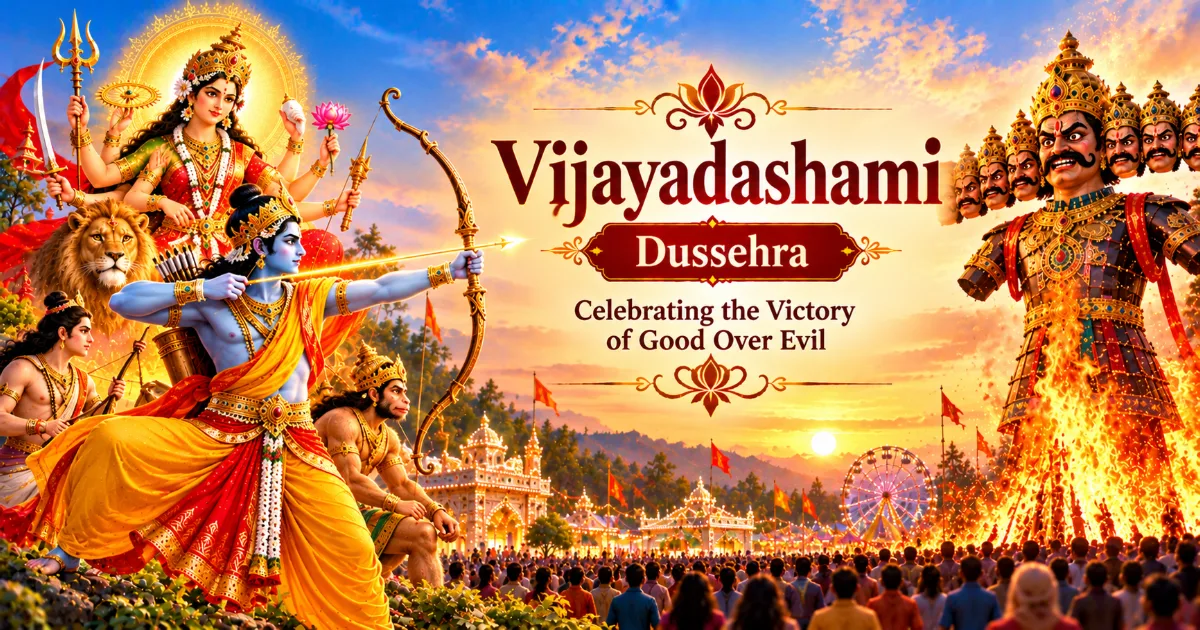
For many people, Dussehra is associated with the story of Lord Rama defeating Ravana, the powerful king of Lanka. In another important tradition, the day celebrates Goddess Durga's victory over the buffalo demon Mahishasura. Although these stories differ, both express a shared message: arrogance, injustice, and destructive behaviour cannot ultimately overcome righteousness and divine power.
Vijayadashami is more than a remembrance of ancient stories. It encourages people to examine their own behaviour, overcome negative qualities, respect others, and make choices guided by truth and responsibility.
The Story of Lord Rama and Ravana
One of the most widely recognised traditions associated with Dussehra comes from the Hindu epic Ramayana. The story describes the life of Lord Rama, his commitment to dharma, and his struggle against Ravana, the king of Lanka.
Lord Rama is revered as an ideal of righteousness, duty, courage, and compassion. His life illustrates the importance of keeping one's promises, fulfilling responsibilities, and remaining committed to moral principles even when circumstances become difficult.
According to the Ramayana, Lord Rama was exiled from his kingdom and spent years living in the forest with his wife, Sita, and his brother, Lakshmana. During this period, Ravana abducted Sita and took her to Lanka. This act led to the great conflict between Rama and Ravana.
Lord Rama, accompanied by Lakshmana and an army of devoted allies that included Hanuman and the vanara forces, began the journey to rescue Sita. Their efforts culminated in a major battle against Ravana and his forces.
Ravana was a powerful ruler, known in tradition for his knowledge, strength, and mastery of various disciplines. However, his pride and decision to abduct Sita and disregard rightful counsel brought destruction upon himself and his kingdom.
The battle ended with Lord Rama defeating Ravana. In many regions, this victory is remembered on Vijayadashami through the burning of large effigies of Ravana, often accompanied by representations of his son Meghnada and brother Kumbhakarna.
The burning of these effigies is not simply a dramatic recreation of an epic battle. It symbolises the rejection of arrogance, cruelty, greed, and the misuse of power. The story encourages people to remember that knowledge and strength lose their true value when they are separated from wisdom and ethical conduct.
What Does the Victory of Lord Rama Teach Us?
The story of Rama and Ravana offers several lessons for everyday life. It reminds us that power does not justify wrongdoing and that personal desires should never become an excuse to harm others.
Lord Rama's conduct highlights the importance of responsibility, patience, and perseverance. Ravana's downfall, meanwhile, is often understood as a warning against unchecked pride and the belief that intelligence or authority places someone above moral principles.
The story also shows that challenges can be overcome through cooperation. Rama's success depended not only on his own courage but also on the dedication, loyalty, and contributions of his allies.
In modern life, these lessons remain relevant. Whether in families, workplaces, schools, or communities, people can create a healthier society by respecting boundaries, listening to wise advice, cooperating with others, and refusing to misuse their influence.
Goddess Durga's Victory Over Mahishasura
Another major tradition associated with Vijayadashami celebrates the victory of Goddess Durga over Mahishasura. This story is especially significant during Navratri and Durga Puja, which are celebrated with great devotion in many regions of India.
According to Hindu mythology, Mahishasura was a powerful asura who challenged the authority of the gods and brought disorder to the world. Unable to overcome him through their individual efforts, the gods joined their divine energies to manifest Goddess Durga.
Durga appeared as a powerful form of the Divine Mother, equipped with divine weapons and the strength to confront Mahishasura. The battle between the Goddess and the asura became a symbol of the struggle between divine order and destructive forces.
After a fierce conflict, Goddess Durga defeated Mahishasura. Her victory is celebrated as the triumph of divine power, courage, and righteousness over arrogance and oppression.
This tradition gives Vijayadashami a powerful connection with the feminine divine. Goddess Durga represents strength, protection, determination, and the ability to confront injustice. Her story reminds devotees that courage and compassion can coexist and that protecting others from harm is an important responsibility.
The Significance of Shakti
The concept of Shakti refers to divine energy and power in Hindu traditions. Goddess Durga embodies this power through her ability to protect the world and restore balance when destructive forces threaten it.
Her victory over Mahishasura can also be understood as a symbolic reminder that negative tendencies must be confronted rather than ignored. Fear, cruelty, dishonesty, and oppression can grow when people remain silent or refuse to act.
The story inspires people to develop inner strength, stand against unfair treatment, and support those who are vulnerable. It also encourages respect for women and girls, whose dignity, safety, education, and opportunities should be protected throughout the year.
Why Is Vijayadashami Celebrated on the Tenth Day?
Vijayadashami marks the tenth day following the nine days of Navratri. During Navratri, devotees worship the nine forms of Goddess Durga, reflecting on qualities such as courage, discipline, devotion, compassion, and spiritual awareness.
The tenth day represents the culmination of this journey and the victory of righteousness over destructive forces. In traditions associated with Lord Rama, it commemorates his victory over Ravana. In traditions associated with Goddess Durga, it celebrates her triumph over Mahishasura.
The two narratives give the festival a broader cultural meaning. One highlights the importance of moral responsibility and the consequences of arrogance, while the other celebrates divine feminine strength and the restoration of balance.
Vijayadashami is therefore both a celebration of victory and an invitation to reflect. It asks people to consider what they need to overcome within themselves and how they can contribute to a more just and compassionate society.
How Vijayadashami Is Celebrated Across India
India's cultural diversity is reflected in the many ways Vijayadashami is observed. The central message remains similar, but the rituals, performances, foods, and local customs differ from region to region.
1. North India: Ram Lila and the Burning of Ravana's Effigies
In many parts of North India, Dussehra is celebrated through Ram Lila, theatrical performances that narrate episodes from the Ramayana. These performances may take place over several days and involve actors portraying Lord Rama, Sita, Lakshmana, Hanuman, Ravana, and other characters.
On Vijayadashami, the celebrations often culminate in the burning of large effigies of Ravana. Crowds gather to watch the event, which is frequently accompanied by music, fireworks where permitted, fairs, and community activities.
The ceremony provides an opportunity for families and communities to come together while remembering the epic's moral lessons.
2. West Bengal: Durga Puja and Vijayadashami
In West Bengal, Vijayadashami is closely associated with the conclusion of Durga Puja. Elaborately decorated pandals display artistic representations of Goddess Durga and her family, while communities organise devotional programmes, cultural performances, and social gatherings.
On the final day, many devotees offer sindoor to the Goddess and participate in rituals that mark her farewell. The immersion of Durga idols in rivers or other designated water bodies is a major part of the traditional celebration, carried out according to local arrangements and environmental guidelines.
Durga Puja is both a religious observance and a cultural celebration that brings together art, music, craftsmanship, food, and community life. Vijayadashami marks an emotional conclusion to the festivities while renewing the hope that the Goddess's blessings will remain with her devotees.
3. Karnataka: Mysuru Dasara
Mysuru Dasara is one of Karnataka's best-known cultural celebrations. The festival has a long association with the royal traditions of Mysuru and is recognised for its processions, decorated surroundings, cultural programmes, and public celebrations.
The historic Mysuru Palace becomes a major focus of attention, often illuminated during the festival period. Traditional music, dance performances, exhibitions, and other cultural activities highlight Karnataka's artistic heritage.
The grand procession, traditionally known as Jamboo Savari, is an important feature of the celebration. Its organisation and specific details may vary from year to year.
Mysuru Dasara demonstrates how a religious festival can also preserve regional history, traditional arts, craftsmanship, and community identity.
4. Tamil Nadu: Golu and the Celebration of Knowledge
In Tamil Nadu and some neighbouring regions, Navratri is associated with the tradition of Golu, in which dolls and figurines are arranged in steps or specially prepared displays inside homes.
The displays may include representations of deities, scenes from mythology, village life, traditional occupations, and cultural stories. Families invite relatives and friends to view their arrangements, exchange greetings, and participate in devotional activities.
The final days of Navratri and Vijayadashami are also associated in many families with the celebration of learning, music, and new beginnings. Children may begin learning an instrument, writing, or another skill on this auspicious occasion, according to family tradition.
This custom highlights the importance of education, creativity, and the preservation of cultural knowledge.
5. Kerala: Vidyarambham and the Beginning of Learning
In Kerala, Vijayadashami is widely associated with Vidyarambham, a ceremony marking the beginning of formal learning for young children.
During the ceremony, children are introduced to letters and writing with the guidance of parents, teachers, or spiritual mentors. The ritual reflects the cultural importance given to knowledge, education, and respect for teachers.
Vidyarambham is a reminder that learning is not simply a means to obtain qualifications or employment. It also helps individuals develop understanding, judgement, creativity, and the ability to participate meaningfully in society.
6. Maharashtra: Seemollanghan and the Exchange of Apta Leaves
In Maharashtra, Vijayadashami is associated with customs that symbolise prosperity, goodwill, and new beginnings. One such tradition is Seemollanghan, which historically involves crossing boundaries and is interpreted in different ways across communities.
Another custom involves exchanging leaves of the apta tree, traditionally regarded as symbolic of gold. People exchange these leaves with relatives, friends, and neighbours as a gesture of affection and prosperity.
The practice illustrates how cultural traditions can turn ordinary interactions into opportunities to express goodwill and strengthen social relationships.
7. Other Regional Traditions
In different parts of India, Vijayadashami may be observed through temple visits, special prayers, processions, community gatherings, traditional performances, or family rituals.
In some regions, the festival is associated with the return of the Goddess to her divine abode. In others, it marks the conclusion of local Navratri celebrations or the beginning of a new phase of work and study.
These variations reflect India's cultural richness. Although the details differ, many traditions share the ideas of gratitude, renewal, courage, and the triumph of good over evil.
The Tradition of Beginning New Work on Vijayadashami
Vijayadashami is considered an auspicious occasion for beginning new activities in several Indian traditions. Families may choose this day to begin a course of study, purchase tools, start a business, or undertake a new personal or professional responsibility.
In some communities, tools, books, musical instruments, vehicles, or other objects associated with work and learning are honoured through rituals. Such practices are connected with the idea that the means through which people earn a livelihood or develop knowledge deserve care and respect.
The deeper message is not that success will automatically follow from starting something on a particular day. Rather, the festival provides an opportunity to begin with a positive intention, a sense of responsibility, and renewed commitment.
A new beginning becomes meaningful when it is supported by planning, consistent effort, ethical conduct, and a willingness to learn from experience.
The Symbolism of Burning Ravana's Effigy
The burning of Ravana's effigy is one of the most recognisable images of Dussehra. It creates a dramatic public moment, but its symbolism extends beyond the physical act.
Ravana is often remembered as a learned and powerful figure whose pride and wrongful actions led to his downfall. The effigy-burning ceremony therefore invites people to think about the qualities that can damage individuals and communities when left unchecked.
These qualities may include arrogance, greed, anger, dishonesty, jealousy, cruelty, and the misuse of authority. The festival encourages people to identify these tendencies within themselves rather than treating evil as something that exists only in other people.
The ritual can become especially meaningful when families discuss the values behind the story with children. Instead of focusing only on the spectacle, they can talk about respecting others, admitting mistakes, keeping promises, and using power fairly.
The tradition should also be approached with consideration for public safety and the environment. Communities can follow local rules, use safer celebration practices, and choose environmentally responsible materials and methods.
What Vijayadashami Teaches Us in Modern Life
The stories associated with Vijayadashami come from ancient religious traditions, but their ethical themes remain relevant to contemporary society.
1. Goodness Requires Courage
Doing the right thing is not always easy. People may face pressure to remain silent, ignore unfairness, or follow a harmful decision because it appears convenient.
The stories of Lord Rama and Goddess Durga remind us that courage involves standing for what is right, even when doing so requires patience and effort. In everyday life, this may mean speaking honestly, supporting someone who is being treated unfairly, or accepting responsibility for a difficult decision.
2. Arrogance Can Destroy Even Great Achievements
Knowledge, wealth, talent, and authority can help people accomplish important goals. However, these qualities become dangerous when they encourage someone to believe that rules and responsibilities do not apply to them.
Ravana's story is often interpreted as a warning about the consequences of unchecked pride. It reminds us to remain open to advice, acknowledge our mistakes, and treat others with respect regardless of their position.
3. Respect for Others Is a Sign of Strength
The festival encourages reflection on how we treat people whose opinions, backgrounds, or circumstances differ from our own.
True strength does not require humiliation or domination. It involves protecting dignity, respecting boundaries, and resolving disagreements without unnecessary cruelty.
Families, workplaces, and communities become healthier when people learn to listen, communicate honestly, and recognise the rights of others.
4. Cooperation Makes Difficult Goals Possible
Lord Rama's journey illustrates the importance of allies and collective effort. His success was supported by individuals who contributed their skills, courage, and dedication.
The same principle applies to modern life. Schools, businesses, neighbourhoods, and public institutions depend on cooperation. People can achieve more when they share knowledge, respect different strengths, and work towards common goals.
5. Knowledge Must Be Guided by Ethics
The story of Ravana is particularly relevant when considering the relationship between intelligence and character. Knowledge alone does not guarantee wise decisions.
Education and professional skills are most valuable when they are guided by honesty, empathy, and a sense of responsibility. People who possess influence or expertise have an opportunity to use it to solve problems and improve the lives of others.
6. Every Person Has Something to Improve
Vijayadashami encourages people to look inward. Instead of identifying only the mistakes of others, we can examine our own habits, attitudes, and decisions.
Someone may need to control anger, become more patient, stop making unfair assumptions, or become more consistent in fulfilling responsibilities. Personal growth begins when people acknowledge these weaknesses and take practical steps to improve.
How Families Can Celebrate Vijayadashami Meaningfully
Families can celebrate Vijayadashami by participating in local traditions, visiting temples where appropriate, reading stories from the Ramayana, or learning about the cultural practices of different Indian regions.
Parents and teachers can use the festival to explain the difference between power and responsibility, courage and aggression, or confidence and arrogance. Children can be encouraged to discuss how the characters in the stories make decisions and what they can learn from those choices.
Families may also begin a new educational or creative activity, honour the tools they use in their work, or spend time helping someone in need. Community members can organise cultural programmes that respect local customs while remaining mindful of safety and environmental concerns.
The most meaningful celebration is one that combines devotion with good conduct. A festival becomes more than a yearly event when its values influence the way people speak, work, learn, and treat one another.
Vijayadashami and the Rich Cultural Heritage of India
Vijayadashami demonstrates how a shared festival can take many different forms across India. The Ram Lila performances of North India, Durga Puja celebrations of Bengal, Mysuru Dasara of Karnataka, Golu displays of Tamil Nadu, and Vidyarambham ceremonies of Kerala all reveal different aspects of India's cultural heritage.
These traditions preserve stories, music, dance, theatre, craftsmanship, regional languages, family customs, and community memories. They also create opportunities for younger generations to learn about the history and values of their communities.
Cultural preservation does not require every region to celebrate in the same way. The diversity of Indian traditions is itself an important part of the country's identity. Learning about different customs encourages mutual respect and a deeper appreciation of the people who make up India's cultural landscape.
For a community such as Cultures of India, Vijayadashami provides an opportunity to explore both the religious significance of the festival and the many ways it connects people through shared stories and regional traditions.
Conclusion: Let the Victory of Good Begin Within Us
Vijayadashami, or Dussehra, is a festival of victory, renewal, and moral reflection. Through the stories of Lord Rama's victory over Ravana and Goddess Durga's victory over Mahishasura, it celebrates the triumph of righteousness over destructive forces.
Its message goes beyond the burning of effigies or the conclusion of Navratri. It encourages us to recognise our responsibilities, overcome harmful habits, respect the dignity of others, and use our abilities for constructive purposes.
As we celebrate Vijayadashami, we can make a personal commitment to become more honest, patient, courageous, and compassionate. We can choose understanding over hatred, responsibility over selfishness, and fairness over the misuse of power.
May the spirit of Vijayadashami bring peace, wisdom, harmony, and hope to every home. May the festival inspire us not only to celebrate the victory of good but also to practise goodness in our daily lives.
Happy Vijayadashami! Shubh Dussehra!
Jai Shri Ram! Jai Maa Durga!
#Vijayadashami #Dussehra #Navratri #MaaDurga #LordRama #IndianCulture #CulturesOfIndia #IndianFestivals #TraditionsOfIndia #VictoryOfGoodOverEvil