
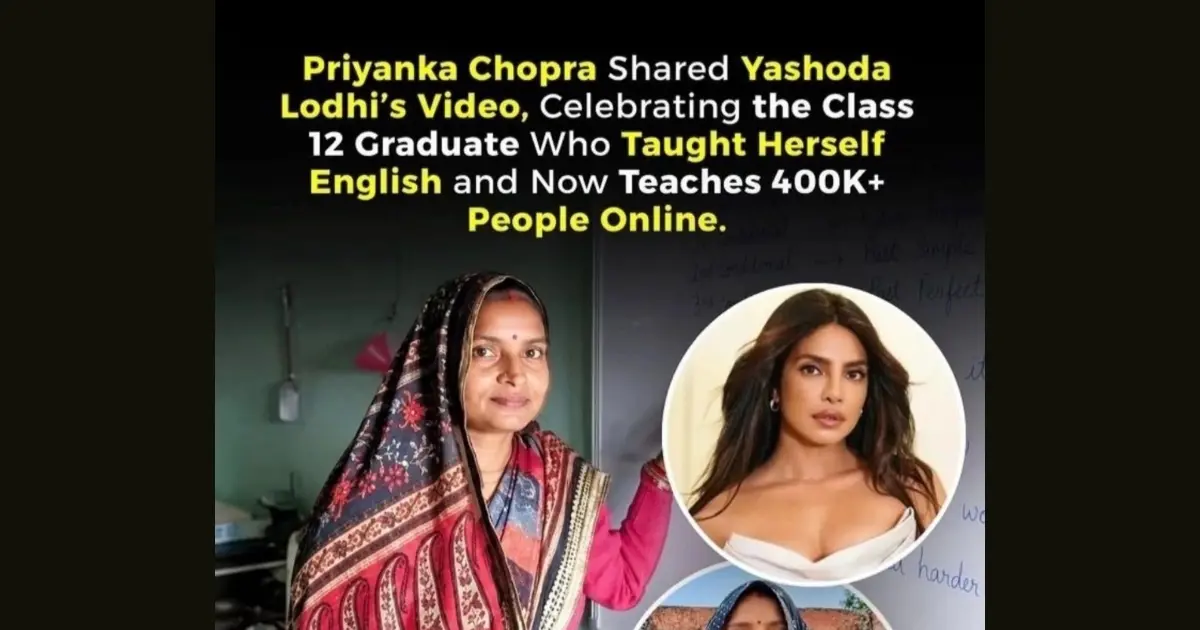
Yashoda Lodhi’s story is a powerful reminder that the circumstances in which we begin do not have to define how far we can go. With a Class 12 education, a smartphone, access to the internet and a determination to learn, she taught herself English. Today, she reportedly teaches more than 400,000 people online, turning a personal learning journey into an opportunity for a much wider community. Her story gained further attention after Priyanka Chopra shared her video.
What makes this story meaningful is not simply the size of an online audience. It is the path behind it. Learning a language can be intimidating, particularly when someone does not have access to expensive coaching, well-connected mentors or a traditional classroom environment. Yet Yashoda’s journey shows how curiosity, persistence and digital access can help people build skills and share them with others.
Your starting point is not your ceiling
People often measure potential through formal qualifications, prestigious institutions, job titles or the opportunities available to someone early in life. These things can matter. Education can provide structure, credentials can open doors, and supportive networks can make progress easier. But they are not the only measures of ability, and they do not tell the whole story of what a person can learn or contribute.
Yashoda’s experience challenges the assumption that a person must follow a conventional path before they can become useful to others. She did not need to wait for perfect circumstances to begin learning. She started with the resources available to her and continued developing her skills. That process eventually became something she could share with a large audience.
This does not mean formal education is unimportant or that everyone can overcome every barrier through determination alone. Access to time, devices, reliable internet, safe learning environments and financial stability remains unequal. The lesson is more practical: the starting point may shape the journey, but it does not have to be the final limit. Skills can grow when people have the opportunity to practise, receive feedback and keep going.
Teach what you learn
One of the most inspiring parts of this story is the way personal learning became a source of value for other people. When someone learns a difficult skill, they begin to understand not only the subject itself but also the obstacles that make it difficult for beginners. They remember the confusion, the mistakes and the small breakthroughs that more experienced people sometimes take for granted.
That perspective can make a teacher especially relatable. A person who recently struggled with pronunciation, grammar or confidence may be able to explain those challenges in simple language. They can share the methods that helped them, identify common mistakes and reassure learners that progress does not require perfection from day one.
Teaching is also a way to deepen understanding. Explaining a concept requires a learner to organise what they know, notice gaps and find examples that make the idea clearer. Sharing knowledge can therefore help both the teacher and the audience. The process turns learning from a private activity into a contribution that others can build on.
Anyone can apply this principle on a smaller scale. A student can explain a topic to classmates. A new employee can document a process that was difficult to learn. Someone who has become comfortable with spreadsheets, design, coding, cooking or a new language can create a guide for beginners. You do not have to know everything to help someone take the next step. You do need to be honest about what you know and remain willing to learn more.
A smartphone can become a classroom
Digital access has changed the way people learn and teach. A smartphone can provide videos, practice exercises, communities, dictionaries, discussion groups and opportunities to reach learners far beyond one neighbourhood. Someone who once depended on a physical classroom can now learn from a range of resources and share lessons with people in different cities or countries.
For language learners, short online lessons can make practice easier to fit into daily life. A learner can listen to a sentence, repeat it, review vocabulary and return to the material later. Teachers can demonstrate pronunciation, explain expressions in context and respond to questions. Social platforms can help people discover lessons they might never have found through traditional channels.
But a device alone does not guarantee learning. Reliable connectivity, affordable data, accessible content and the ability to use digital tools all matter. Learners also need time to practise and a way to distinguish accurate guidance from misinformation. The strongest digital learning experiences combine access with consistency, clear explanations and opportunities to apply what has been taught.
Yashoda’s story highlights the possibilities of technology when it is paired with purpose. The smartphone is not the achievement by itself. It is a tool that becomes powerful because someone uses it persistently, develops a skill and shares that skill with others.
Visibility follows value
In a world where people often chase views, followers and viral moments, it is worth remembering that attention can come from useful work. The story shared in the screenshot suggests that Yashoda’s teaching reached a large audience because people found value in her learning journey and lessons. The attention from Priyanka Chopra brought additional visibility, but the underlying work was the development and sharing of a skill.
There is no guaranteed formula for becoming visible online. Many people work hard without receiving widespread attention, and algorithms can be unpredictable. Still, creating something genuinely helpful gives people a reason to return, share it and recommend it to others. A clear explanation, a practical demonstration or an encouraging lesson can build trust over time.
For creators and professionals, this is a healthier goal than trying to manufacture a viral moment. Ask what problem your work helps solve. Is it easier to understand, more accessible, more useful or more encouraging than what someone has seen before? Are you communicating consistently? Are you listening to the people you hope to help? These questions focus attention on value rather than vanity metrics.
Confidence grows through practice
Learning English is not only about vocabulary and grammar. For many learners, it also involves confidence. They may worry about making mistakes, being judged for an accent or being unable to express a thought quickly. Those fears can make people avoid speaking, which then limits the practice that would help them improve.
A supportive learning environment can change that cycle. When learners see someone explain a concept in an approachable way, they may feel that improvement is possible for them too. When mistakes are treated as a normal part of learning rather than a reason for embarrassment, people are more willing to try. Repeated practice can gradually make unfamiliar words and sentence patterns feel natural.
Confidence should not be confused with pretending to know everything. Real confidence includes the ability to ask questions, accept correction and keep practising when progress feels slow. A learner can be proud of improvement while still recognising how much there is left to learn. That combination of self-belief and humility is useful far beyond language learning.
What her journey can teach students
Students can take a simple lesson from this story: do not wait until you feel completely ready to begin. Choose a skill, create a routine and practise in manageable steps. If you are learning a language, that might mean reading a short passage aloud each day, learning a few useful phrases, listening carefully to spoken English or recording yourself and noticing where you can improve.
It also helps to make learning active. Watching a video can introduce an idea, but using the idea is what makes it stick. Write your own sentences, explain a concept to a friend, solve a problem without looking at the answer or create a small project. If possible, seek feedback from someone who can help you identify errors and improve.
Students should also remember that comparison can be misleading. Someone else's progress may reflect years of practice, support or circumstances that are not visible in a short video. Use inspiring stories as evidence that growth is possible, not as a reason to judge yourself for moving at a different pace. A consistent routine is more useful than a burst of motivation followed by exhaustion.
What professionals can learn from it
For working professionals, Yashoda’s story offers a reminder that learning does not end when formal education finishes. Industries change, tools evolve and new skills become valuable. People who continue learning can adapt more effectively, but they do not always need to return to a formal course to make progress. Short lessons, peer learning, practice projects and thoughtful use of online resources can all contribute.
Another lesson is to share knowledge instead of treating it only as a personal advantage. Experienced colleagues can mentor newcomers, explain lessons learned and make useful processes easier to understand. Organisations often become stronger when knowledge is documented and accessible rather than concentrated in a few individuals. Teaching can also reveal where a team needs better training or clearer communication.
Finally, professionals can benefit from communicating their expertise in public. A useful article, tutorial or case study can help others while demonstrating how a person thinks about a problem. The goal does not have to be building a huge following. It can simply be making knowledge easier to find and helping the right people learn something useful.
Why accessible education matters
Stories like this are inspiring, but they also point to a wider responsibility. Not everyone has the same resources or the same freedom to spend hours learning. Some people have to balance work, family responsibilities, travel and financial pressure. Others live in areas where internet access is unreliable or educational support is limited. Individual effort matters, but opportunity matters too.
Schools, public institutions, community organisations and technology companies can help by making learning resources easier to access. That includes affordable connectivity, locally relevant content, accessible design, support for teachers and opportunities for learners to practise. Community learning groups can provide encouragement and accountability for people who might otherwise study alone.
Digital educators can contribute by making lessons clear, respectful and practical. They can avoid shaming beginners, explain concepts in multiple ways and recognise that learners have different needs. When content is free or affordable, it can reduce one barrier to entry, though it does not remove every obstacle. The larger aim should be to give more people a realistic chance to develop skills and use them.
Inspiration should lead to action
It is easy to admire a story, feel motivated for a moment and then return to the same routine. A more lasting response is to identify one action the story encourages. If you want to learn English, schedule ten minutes of practice. If you want to develop a professional skill, choose a beginner project. If you already know something useful, share a simple explanation with someone who could benefit.
Small actions may seem insignificant compared with a creator reaching hundreds of thousands of learners, but meaningful progress usually begins at a manageable scale. A daily habit can compound. One explanation can help one person. One person who gains confidence may then help someone else. The impact of learning is not always visible immediately, and it is not always measured by audience size.
It is also worth remembering that every inspiring public story shows only part of a person's life. We should celebrate the achievement without assuming that success came easily or that the same path will work for everyone. Respect means recognising effort while leaving room for the unseen challenges behind the headline.
The real lesson: skill, grit and generosity
Yashoda Lodhi’s story, as described in the shared post, brings together three powerful ideas. Skill grows through learning and practice. Grit helps people continue when the process is difficult. Generosity turns personal progress into something that can benefit others. None of these qualities requires a prestigious title to begin, although support and opportunity can make the journey easier.
Her story also challenges us to rethink where expertise can come from. A person's formal credentials may tell us something about their education, but they do not reveal the full extent of their curiosity, discipline or ability to explain a subject. We should be willing to learn from people who have built knowledge through different routes, while still valuing accuracy, honesty and continuous improvement.
The wider promise of online learning is that useful knowledge can travel farther than a classroom's walls. A phone and an internet connection can help someone begin, practise and reach an audience. With good teaching and consistent effort, that access can become an opportunity to grow. With a supportive community, the opportunity can spread even further.
Final thoughts
The most important part of this story is not celebrity attention or a large follower count. It is the idea that a person can start with what they have, keep learning and create value for others. Yashoda’s reported journey from teaching herself English to teaching a large online audience is a reminder that progress can take unexpected forms.
We cannot control every circumstance or guarantee that hard work will become viral success. We can, however, choose to keep learning, practise consistently, help others where we can and remain open to opportunities beyond the path we first imagined. Credentials can open doors, but curiosity and persistence help us make use of them. And when we share what we learn, our progress can become a starting point for someone else.
What is one skill you taught yourself that changed your path? Share it in the comments. Your experience might give someone else the encouragement to begin.
#SelfLearning #Education #Inspiration #GrowthMindset #EdTech #WomenEmpowerment #LifelongLearning #EnglishLearning #DigitalEducation #SkillDevelopment #YashodaLodhi #Startupro

