From the Earliest Humans to the Foundations of the Ancient World
European history began long before the rise of famous empires, magnificent palaces, and powerful kings. Thousands of years before ancient Rome became a dominant force, and long before Greek philosophers began questioning the nature of knowledge and government, the European continent was home to early human communities learning to survive, adapt, farm, build settlements, and organize their societies.
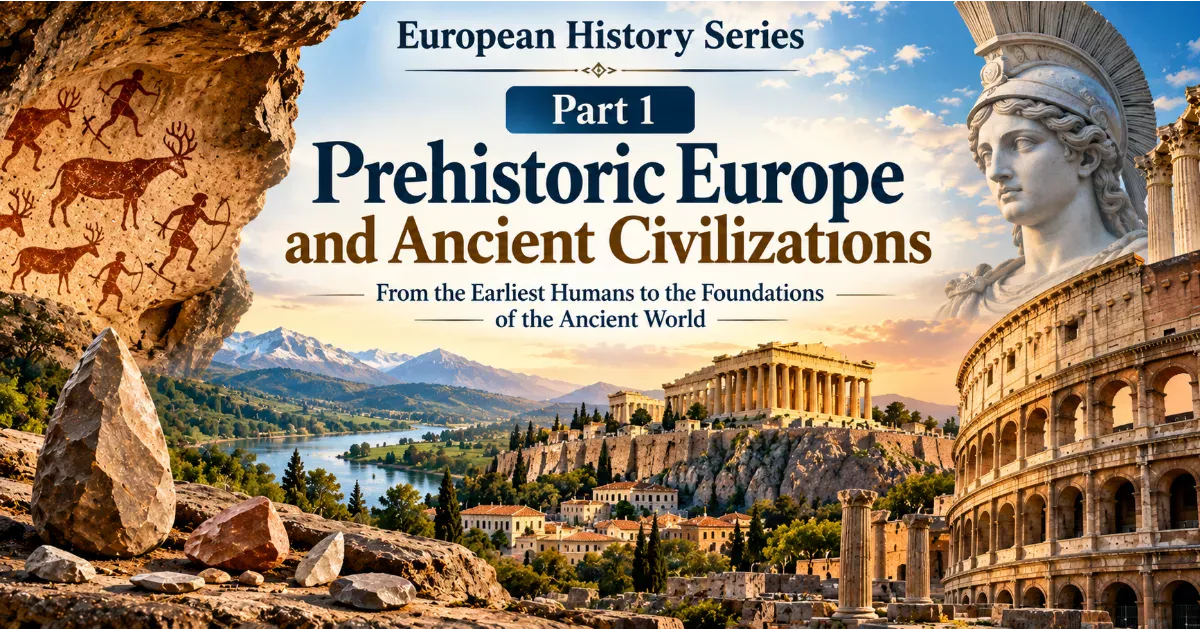
This first part of our European History series takes us back to the earliest chapters of the continent's past. We will explore how prehistoric humans lived, how agriculture transformed communities, how early civilizations developed around the Mediterranean, and how ancient Greece and Rome eventually influenced the political, cultural, and legal traditions of Europe.
From Prehistoric Life to Permanent Settlements
The earliest chapters of European history reveal a world very different from the one we know today. Early humans depended on hunting, gathering, and their understanding of the natural environment. Over generations, technological innovations, the control of fire, the development of tools, and changing patterns of migration helped human communities adapt to different climates and landscapes.
One of the most important transformations occurred when some communities gradually adopted farming and animal domestication. Instead of relying entirely on wild resources, people began cultivating crops, raising animals, and establishing more permanent settlements. These changes encouraged population growth, new forms of cooperation, and the development of increasingly complex social structures.
The Rise of Ancient Civilizations
As communities expanded, different societies developed distinctive systems of government, religion, trade, art, and warfare. The Mediterranean became an important region for the exchange of goods, ideas, and cultural practices. Among the civilizations that emerged in this wider world were the Minoans of Crete and the Mycenaeans of mainland Greece, whose achievements helped shape the early history of the Aegean region.
Ancient Greece later became famous for its philosophical traditions, political experiments, literature, mathematics, architecture, and contributions to scientific thought. Its city states developed different forms of government and social organization, while Greek culture spread across the Mediterranean and beyond through trade, settlement, and conquest.
Rome followed a different path, growing from a small settlement into a republic and eventually a vast empire. Roman political institutions, engineering, roads, legal traditions, and administrative systems left a lasting mark on many regions of Europe. Although the Western Roman Empire collapsed in the fifth century CE, its cultural and institutional legacy continued to influence later European societies.
Why This Part of History Matters
Understanding prehistoric Europe and ancient civilizations helps us see that modern societies did not emerge suddenly. They developed through centuries of experimentation, migration, conflict, cooperation, and cultural exchange. Ideas about citizenship, political authority, law, education, architecture, and public life have long histories, and studying their origins helps us understand how they changed over time.
Throughout this first part, we will examine these developments in chronological order, from the earliest human communities to the civilizations of ancient Greece and Rome. Each article will explore a specific period, event, or civilization in detail, helping us understand not only what happened, but also why it mattered.
Join the journey through European history and discover how the distant past helped shape the world we live in today.
Discussion question: Which ancient civilization do you think has had the greatest influence on the modern world, and why?
#EuropeanHistory #HistoryCorner #AncientHistory #AncientGreece #AncientRome #WorldHistory #LearnWithUrNextDoor

