
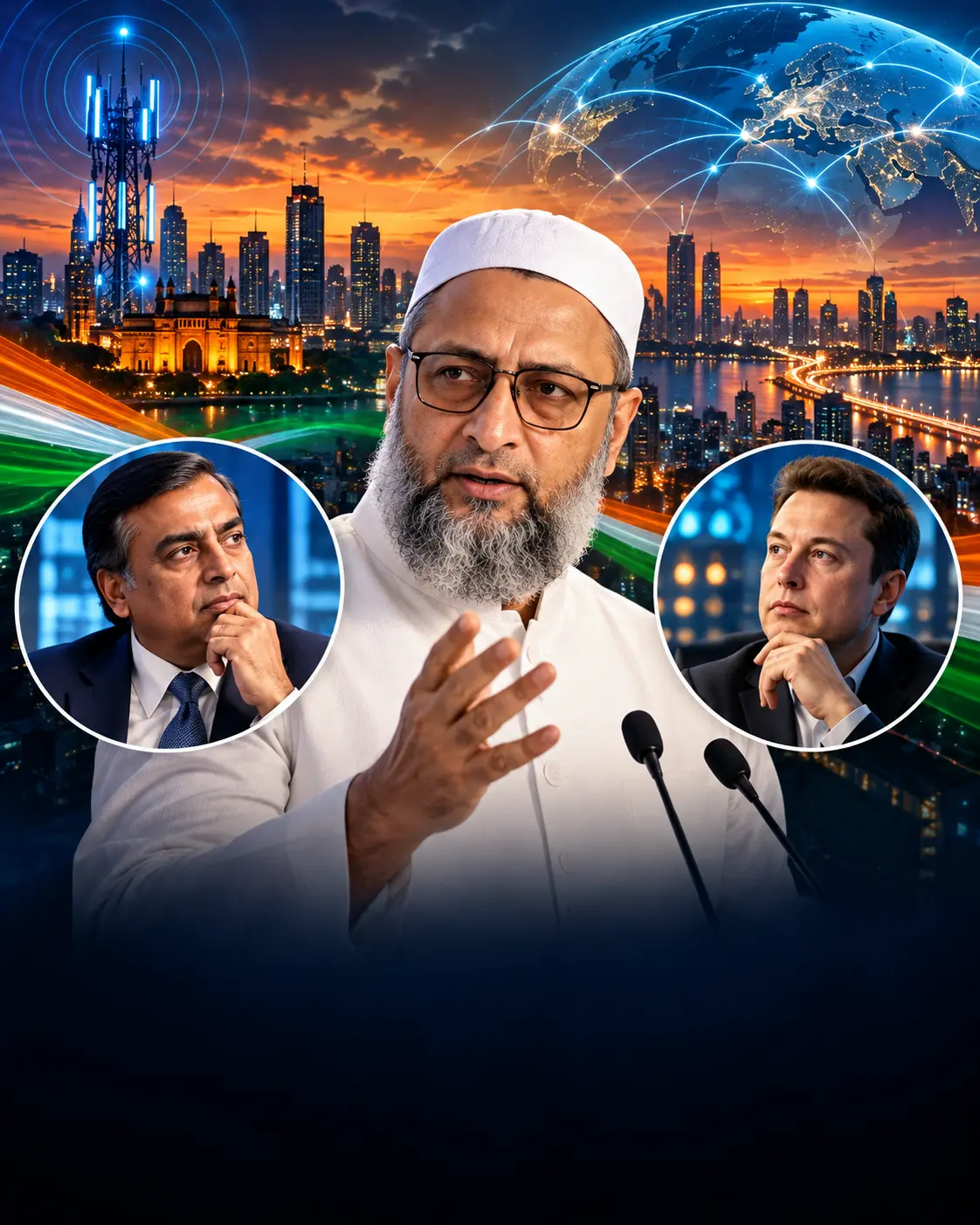
Owaisi's Message on National Dignity, Political Differences, and Foreign Influence
A political statement can attract attention for many reasons. Sometimes it reflects a disagreement between leaders. Sometimes it raises questions about national sovereignty, international influence, or the relationship between domestic politics and global technology. And sometimes, a statement becomes widely discussed because it comes from someone who is known for challenging the government while also defending a position on national interest.
A recent news post attributes a strong message to Asaduddin Owaisi, the AIMIM chief and Member of Parliament from Hyderabad. According to the report, Owaisi said that he has numerous disagreements with Prime Minister Narendra Modi but would not tolerate an insult to India or the office of the Prime Minister. The report frames the remarks as a response to Elon Musk and a wider discussion about foreign voices commenting on India's leadership.
The distinction is important. Political disagreement within a democracy is normal, and criticism of elected leaders is part of public life. At the same time, debates about how foreign individuals, corporations, and influential technology figures engage with another country's political affairs can raise legitimate questions about sovereignty, accountability, and respect.
The reported remarks offer an opportunity to explore these issues beyond the headline.
Political disagreement and national interest can coexist
Democracy is built on the idea that citizens can disagree with the people who govern them. Opposition parties question government decisions, elected representatives challenge policies, journalists investigate public claims, and citizens express approval or dissatisfaction through peaceful political participation.
None of this is inherently unpatriotic. In fact, the ability to question those in power is one of the important features of a democratic society.
A person can disagree with a government on economic policy, employment, education, civil liberties, taxation, public services, or foreign relations while remaining deeply committed to the country. Political loyalty to a party and commitment to the nation are not necessarily the same thing.
That distinction is central to understanding the reported statement attributed to Owaisi. The message, as described in the reference, separates his disagreements with the Prime Minister from his position on the dignity of the country and its highest political office.
People will interpret such a statement differently depending on their political outlook. Some may view it as a principled distinction between political opposition and national interest. Others may ask how national dignity should be defined and whether criticism of a leader should be distinguished from an insult to the country.
These are legitimate questions for public debate.
The important point is that democratic disagreement should not automatically be treated as hostility toward the nation. Equally, invoking national pride should not prevent citizens from examining government decisions or holding public officials accountable.
A mature democracy needs room for both national confidence and open criticism.
Why the office of the Prime Minister matters
The Prime Minister is the head of India's Union government and occupies a prominent position in the country's domestic and international affairs. The office represents executive leadership, policy direction, and the government that engages with other countries and international institutions.
For this reason, comments about a sitting Prime Minister can become larger than a personal exchange. They may be interpreted as comments about the government, the country, or the way India is perceived internationally.
However, there is an important distinction between criticising a Prime Minister's actions and insulting the country itself. A leader is a public official and can be questioned, criticised, challenged, and held accountable. Such scrutiny is part of political responsibility.
At the same time, many citizens attach symbolic significance to the office because it represents the constitutional government of the country. They may therefore expect foreign commentators to understand the political and cultural context in which their remarks will be received.
The challenge is to maintain this distinction without treating every disagreement as an attack on national identity.
Public discussion becomes more useful when people examine the actual words spoken, the context in which they were delivered, and the argument being made. Headlines can draw attention, but the substance of a political exchange deserves careful consideration.
The growing influence of global technology leaders
Elon Musk is a prominent technology entrepreneur associated with companies operating in areas such as electric vehicles, space technology, satellite communications, and social media. His public statements can receive significant international attention because of his business influence and large online audience.
The influence of technology executives has grown alongside the importance of digital platforms in modern life. A statement posted online can spread across countries within minutes. A policy announcement by a technology company can affect businesses, governments, customers, and workers across multiple markets.
This creates a complicated relationship between private enterprise and public affairs.
Technology companies provide services that people use for communication, commerce, entertainment, education, and access to information. Their decisions can shape which content is visible, how users interact, and what kinds of services are available in different regions.
As a result, the leaders of these companies may find themselves participating in discussions that extend far beyond their products.
Their comments can influence public debate, but their business positions can also give them interests that are different from those of ordinary citizens. This is why transparency and accountability matter when influential business leaders comment on public policy.
The same standard should apply regardless of nationality or political alignment. A powerful businessperson should be free to express opinions within the applicable law, and the public should be free to evaluate those opinions critically.
Neither celebrity nor wealth makes an argument automatically correct.
National sovereignty in a connected world
National sovereignty refers broadly to a country's authority to govern itself and make decisions within its constitutional and legal framework. In a connected world, sovereignty involves more than territory and traditional diplomacy.
It also intersects with digital infrastructure, telecommunications, data governance, trade, finance, cybersecurity, and the operations of multinational corporations.
Countries increasingly depend on technology platforms and infrastructure that operate across borders. Satellite networks can provide connectivity. Cloud platforms can host essential business systems. Social networks can influence how information travels. International companies can make decisions that affect millions of users in a particular market.
These developments create practical questions for governments and citizens.
Who sets the rules for services operating within a country's jurisdiction? How should disputes between companies and regulators be resolved? What responsibilities do platforms have toward users? How can governments protect national security without unnecessarily restricting legitimate speech or innovation?
There are no simple answers to every question. Different countries have different legal systems, constitutional protections, economic priorities, and regulatory approaches.
A constructive debate about sovereignty should therefore focus on clear principles and workable policies rather than simply on the nationality of the person involved.
India, like other countries, has an interest in protecting its legal authority, ensuring that businesses comply with applicable laws, and preserving the ability of its institutions to make decisions through legitimate processes.
At the same time, international engagement and open communication remain important to trade, innovation, research, and diplomacy.
Strong sovereignty and international cooperation are not necessarily opposites. A country can defend its interests while continuing to work with people and institutions around the world.
The role of social media in political debate
Social media has changed how political statements are published, distributed, and interpreted. In the past, a political comment might have reached the public through a press conference, newspaper report, or television interview. Today, a short post can be reproduced across numerous platforms, translated into several languages, and discussed by people who may never see the original context.
This speed creates opportunities for public participation. Citizens can respond directly to political leaders, access different viewpoints, and share information outside traditional media channels.
However, it also creates risks.
Short clips and screenshots can omit important context. Headlines may simplify complex arguments. A claim can circulate widely before it has been independently checked. Emotionally charged language can attract more engagement than careful explanation.
Political content is particularly vulnerable to these problems because audiences may already have strong views about the people involved.
Readers should therefore distinguish between a direct quotation, a journalist's summary, an opinion, and an independently verified fact. These categories are not interchangeable.
In the present case, the reference provides a report attributing remarks to Owaisi. The exact context of the exchange, the complete statements by the people involved, and any direct response should be checked before drawing broader conclusions about the dispute.
This is not a reason to ignore the story. It is a reason to discuss it responsibly.
A well-informed public does not simply react to a headline. It asks what happened, what evidence is available, and which parts of the story remain uncertain.
Why India's international image matters
India is a large democracy with a diverse population, a substantial economy, an influential diaspora, and growing roles in technology, manufacturing, services, and international diplomacy.
Its global image is shaped by many factors, including economic performance, scientific achievements, cultural influence, public institutions, foreign policy, and the experiences of people who interact with Indian organisations.
No single political statement can define the country. Nor should a nation's reputation depend entirely on whether international commentators agree with its government.
A country's long-term standing is strengthened by capable institutions, dependable economic partnerships, scientific and technological progress, and the confidence to engage with criticism thoughtfully.
National pride can be a positive force when it encourages citizens to contribute to society, support public institutions, improve communities, and pursue excellence. It becomes less useful when it prevents honest discussion or turns every disagreement into a test of loyalty.
India's democratic strength lies partly in its ability to accommodate a wide range of opinions while maintaining a shared constitutional framework.
That includes the right to support the government, the right to oppose it, and the responsibility to evaluate claims on their merits.
International observers may disagree with Indian policies. Indian citizens may disagree with foreign commentary. These disagreements are not inherently harmful. The way they are handled is what matters.
How should influential business leaders engage with other countries?
Global business leaders operate in a world where commercial decisions often intersect with public policy. Their companies may depend on government licences, telecommunications rules, market access, public infrastructure, and regulatory approvals.
This gives their statements a significance that may exceed ordinary personal commentary.
When a technology executive discusses another country, several questions are worth considering. Is the statement based on accurate information? Does it acknowledge the local context? Is the speaker addressing a genuine policy issue, defending a commercial interest, or expressing a personal opinion? Are the same standards being applied to everyone involved?
These questions should be asked consistently, whether the speaker is Indian, American, European, or from another part of the world.
It is reasonable for citizens to expect foreign companies operating in their country to respect its laws. It is also reasonable to expect public debate to remain open to criticism, disagreement, and scrutiny.
Respect should not mean automatic agreement. And disagreement should not automatically be interpreted as disrespect.
This distinction helps prevent a discussion about a specific issue from becoming a general argument between nationalities.
The objective should be a fair exchange of ideas in which claims can be challenged, evidence can be examined, and decisions are made through legitimate institutions.
What Indian citizens should take from this debate
For Indian citizens, the most useful response to a political controversy is not necessarily to choose a side immediately. It can be more productive to examine the underlying questions.
First, what exactly was said? The wording and context matter. A headline may capture the central idea, but it cannot always convey the full argument.
Second, what issue is actually being discussed? Is the dispute about a policy, an individual leader, a country's sovereignty, a technology platform, or a business relationship? These topics can overlap, but they require different forms of analysis.
Third, what evidence supports the claims being made? Reliable reporting, direct statements, official documents, and clearly identified sources can help separate fact from interpretation.
Fourth, what principles should apply consistently? Freedom of expression, national sovereignty, democratic accountability, and respect for the law should not be applied selectively according to political preference.
Finally, what outcome would serve the public interest? A debate that produces greater clarity about rules, responsibilities, and institutional accountability can be more valuable than one that generates only temporary outrage.
Citizens do not need to agree on every conclusion. They can still benefit from a discussion that is accurate, measured, and grounded in democratic principles.
Political opposition is part of democracy
India's political system includes parties with different ideologies, constituencies, and policy priorities. Opposition parties may challenge government decisions in Parliament, state legislatures, public meetings, and the media.
This disagreement is a normal part of democratic life. It can expose weaknesses, bring neglected issues into public discussion, and encourage governments to explain their decisions.
Opposition is most effective when it combines criticism with evidence, policy alternatives, and a willingness to engage with difficult questions. Governments, in turn, benefit when they respond to scrutiny with transparency and substantive answers.
A citizen can support the country without supporting every government decision. A citizen can also support a particular policy while disagreeing with the party that proposed it.
These distinctions make political discussion more meaningful because they allow people to evaluate individual issues rather than treating politics as an all-or-nothing choice.
The reported statement attributed to Owaisi is notable because it has been presented as an example of this distinction. Whether readers agree with his position or not, the underlying question is worth discussing: how can political opponents disagree strongly while retaining a shared commitment to the country and its democratic institutions?
That is a question relevant to every democracy.
A balanced way forward
Public controversies involving political leaders and technology executives are likely to continue. Digital platforms are global, business interests cross borders, and public figures often comment on matters beyond their immediate professional responsibilities.
The answer is not to remove disagreement from public life. Nor is it to assume that every provocative statement represents the position of an entire country or industry.
Instead, public discussion should be based on several practical principles.
Accuracy matters. Statements should be presented in their proper context, and uncertain claims should be identified as such.
Consistency matters. The same standards of evidence, accountability, and respect should apply regardless of whether a speaker agrees with our preferred political position.
Democratic rights matter. Citizens must be able to question elected officials, and public institutions must be able to operate under the law.
National sovereignty matters. Countries need the ability to make legitimate decisions through their constitutional institutions and to enforce applicable rules fairly.
International cooperation matters too. Technology, trade, research, and communication create shared interests that cannot be managed effectively through hostility alone.
Finally, public responsibility matters. Leaders, businesses, journalists, and citizens all influence the quality of public debate. Their words can clarify an issue or make it harder to understand.
The most constructive response to a controversial statement is to examine its substance, establish the facts, and discuss the principles at stake.
Conclusion: Confidence without closing the door to criticism
The reported remarks attributed to Asaduddin Owaisi have drawn attention to the relationship between political disagreement, national dignity, and foreign influence. They also provide a broader opportunity to consider how India should engage with influential global figures in an increasingly connected world.
A confident democracy does not need to avoid criticism. It needs institutions capable of responding to criticism, citizens who can evaluate competing claims, and public debate that allows disagreement without abandoning respect for the law.
National pride and political accountability can coexist. International cooperation and national sovereignty can coexist. Strong opinions and careful reasoning can coexist.
The challenge is to maintain these distinctions when a headline encourages an immediate emotional reaction.
India's long-term interests are best served by informed citizens, capable institutions, clear rules, and a public culture that values both national confidence and democratic scrutiny.
The most important lesson is simple: defend principles consistently, verify claims carefully, and judge arguments by their substance rather than the identity of the person making them.
#AsaduddinOwaisi #IndianPolitics #IndiaNews #NationalSovereignty #DigitalIndia #ElonMusk #PMModi #IndianDemocracy #PoliticalAnalysis #TechnologyAndSociety #IndiaGlobal #PublicDebate #Hyderabad #CurrentAffairs #ResponsibleJournalism
Source: linkedin.com

