
A Case That Shocked the Country
The Meerut blue drum murder case became one of India's most widely discussed criminal investigations after the discovery of the dismembered remains of Saurabh Rajput, a former Merchant Navy officer, inside a blue plastic drum filled with cement and other material. The discovery in March 2025 brought investigators to a case involving a killing inside a domestic setting, the concealment of a body and allegations of a conspiracy involving people close to the victim. As details emerged through police statements and media reporting, the case drew nationwide attention and raised difficult questions about violence, trust, evidence and the criminal justice system.
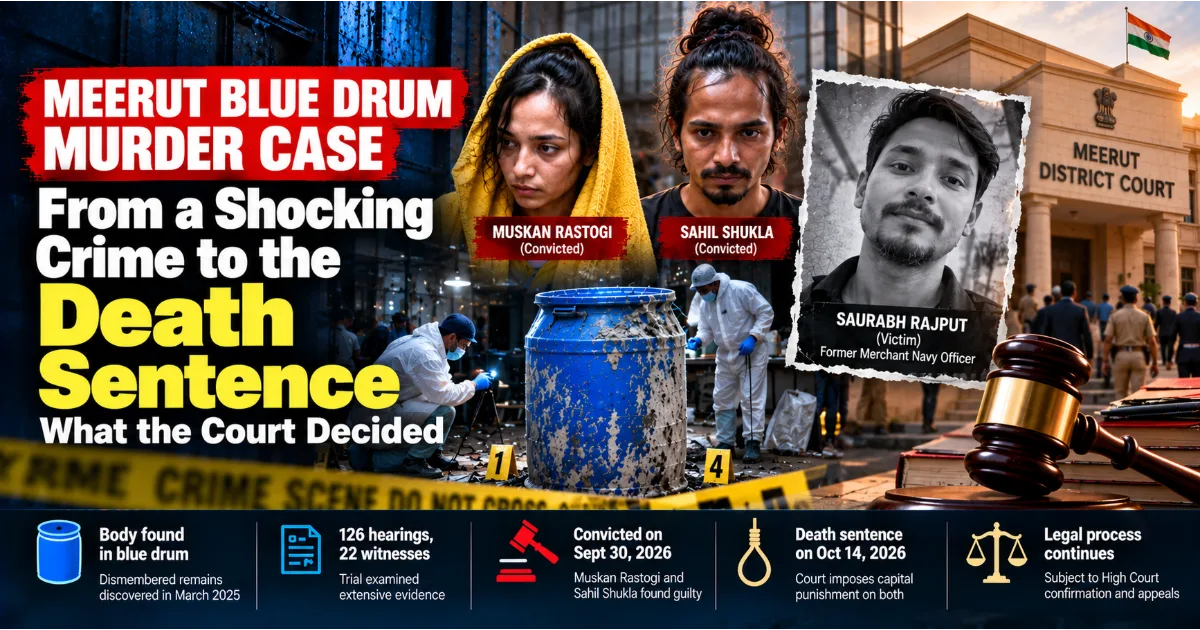
The case reached a major judicial milestone in October 2026. According to reports published after the trial, a Meerut court convicted Muskan Rastogi, Rajput's wife, and Sahil Shukla in connection with his murder and sentenced both to death on October 14. The sentencing followed their reported conviction on September 30, after a trial that included 126 hearings and testimony from 22 prosecution witnesses.
The sentence marks a significant development, but it is important to understand what it means and what it does not mean. A death sentence imposed by a trial court is not the same as an execution, and the Indian legal system provides further judicial procedures for cases involving capital punishment. The outcome can therefore be described as a major trial court decision without implying that every possible legal step has been completed.
The case has attracted attention partly because of the circumstances described by investigators, but its significance extends beyond the disturbing details. It raises questions about how police reconstruct events when a victim cannot provide an account, how circumstantial and forensic evidence are evaluated, how courts assess the prosecution's case and how the law determines punishment after conviction.
It has also generated intense public discussion about relationships, motive and responsibility. In such cases, public reaction can move faster than the judicial process, with unverified claims and dramatic narratives spreading across social media. A responsible account must distinguish between what investigators alleged, what the prosecution presented, what the court found and what remains subject to further legal scrutiny.
The most important principle is that the case must be understood through the evidence and the legal findings rather than through sensational descriptions. The discovery of Rajput's remains brought the investigation into the public eye, but the trial and its outcome required a more detailed examination of the evidence, the accused persons' roles and the applicable law.
The October 2026 sentencing has brought the trial court proceedings to a decisive stage. Yet the broader story concerns not only the punishment announced by the court, but also the process through which investigators, prosecutors and judges attempted to establish responsibility for a serious crime.
The Background: Who Was Saurabh Rajput?
Saurabh Rajput was a former Merchant Navy officer whose murder became the centre of the Meerut investigation. He had been married to Muskan Rastogi, and their relationship and family circumstances became relevant to the prosecution's account of the events leading up to his death. The case also brought attention to their family members, who were drawn into the investigation and the public discussion that followed.
According to reports published after the verdict, Rajput returned to Meerut from London in late February 2025. The family celebrated Muskan's birthday around that time, followed by their daughter's birthday. These ordinary family occasions became part of the timeline examined by investigators as they attempted to establish what happened in the days before Rajput's death.
The prosecution alleged that Rajput was killed in early March 2025 as part of a plan involving Muskan and Sahil Shukla. The case presented in court was that Rajput was incapacitated and then murdered, after which his remains were concealed inside a blue plastic drum using cement and other material. These details formed part of the prosecution's account, which the court later considered alongside the evidence produced during the trial.
It is important to separate the chronology established through the investigation from speculation about the private lives of the people involved. Media coverage of criminal cases often focuses heavily on relationships, alleged affairs and family disputes because these details attract attention. But a relationship issue, by itself, does not prove a murder or establish a person's criminal responsibility. That responsibility must be established through evidence and legal findings.
The court's reported conviction of Muskan Rastogi and Sahil Shukla is the central judicial finding in this case. The prosecution's allegations about planning, the killing and the concealment of evidence were not simply matters of public debate by the time the trial court delivered its verdict. They formed part of a case examined through a formal judicial process.
At the same time, the personal background of the victim should not be reduced to a dramatic plot. Saurabh Rajput was a person with family relationships, a professional life and a future that was cut short. The crime affected people beyond the accused and the victim, including relatives who had to deal with the loss while participating in a long and emotionally demanding legal process.
The case also highlights the importance of responsible reporting about families connected to criminal proceedings. Relatives may be witnesses, victims of secondary harm or people trying to care for children during an extraordinarily difficult period. Their private lives should not become material for unsupported allegations or online harassment.
How the Case Came to Light in March 2025
The case became public in March 2025, when police investigating the circumstances at a residence in Meerut discovered Rajput's remains concealed inside a blue plastic drum. The discovery changed the investigation from an inquiry into a missing or unaccounted-for person into a homicide case involving the concealment of a body and the suspected destruction of evidence.
Reports indicate that the discovery occurred around March 17, after the circumstances surrounding Rajput's absence and the condition of the residence raised concerns. Police recovered the remains and began gathering evidence to determine how he had died, who was responsible and what had happened after the killing. Muskan Rastogi and Sahil Shukla were arrested in March 2025.
The blue drum quickly became the defining object associated with the case. Its importance was not simply symbolic. Investigators had to establish what it contained, how the remains had been concealed and whether physical evidence could connect the accused to the crime. The recovery also required careful documentation because evidence recovered from a scene must be handled in a way that allows it to be examined and presented in court.
Investigations involving concealed remains can be complex. Investigators may need to examine the scene, collect physical traces, obtain medical findings, establish a timeline and determine whether other evidence supports or contradicts statements made by witnesses. The quality of this work can influence whether a prosecution is able to present a coherent account of events.
Police also sought to reconstruct the movements of the people involved before and after the suspected killing. Media reports about the case describe the use of records and witness statements relating to purchases and travel. Such information can help investigators establish where people were, what materials they may have obtained and whether their movements are consistent with the prosecution's timeline. However, each piece of evidence must be assessed in context rather than treated as conclusive on its own.
The discovery of the drum generated intense public reaction because the concealment of a body in such a manner was disturbing. Yet the investigation could not rely on public outrage. Investigators had to gather admissible evidence, preserve relevant material and establish a case that could withstand scrutiny in court.
This distinction is essential in any criminal investigation. A shocking discovery can create a strong public impression of what happened, but the legal process requires evidence that connects specific people to specific acts. Suspicion may justify investigation, but conviction requires the court to evaluate the prosecution's case according to the applicable legal standard.
The Investigation: Reconstructing Events Without an Eyewitness
One of the reported challenges in the Meerut case was that the prosecution did not have an eyewitness who directly observed the killing. According to reporting from the trial, the prosecution therefore relied on a body of circumstantial, forensic and testimonial evidence to establish its case. The defence highlighted the absence of an eyewitness while contesting the allegations.
Circumstantial evidence is evidence from which a court may draw conclusions about events that were not directly observed by a witness. For example, records of a person's movements, physical evidence recovered from a location, medical findings and testimony about events before or after a crime may help establish a sequence. A single circumstance may have several possible explanations, which is why courts examine how the different pieces of evidence fit together.
The absence of an eyewitness does not automatically prevent a conviction. Many serious crimes occur in private, without anyone directly witnessing the act. In such cases, a court must examine whether the circumstances relied upon by the prosecution are established and whether, considered together, they support the conclusion required for conviction. The prosecution must still meet its legal burden, and the defence must have a fair opportunity to challenge the evidence.
Reports about the Meerut trial describe a chargesheet of roughly 1,000 pages and evidence gathered from a range of sources. Witnesses reportedly included family members, police personnel, medical and forensic witnesses, and people associated with the alleged purchase of items relevant to the investigation. Reporting also referred to travel-related evidence and records used to reconstruct movements after the killing.
Each category of evidence serves a different purpose. Medical evidence can assist in establishing the cause and nature of injuries. Forensic examination can help assess physical material recovered during an investigation. Purchase records or testimony from sellers may help establish whether particular items were obtained. Travel records and witness accounts may help establish where people went and when. None of these categories should be assumed to prove every aspect of a case by itself.
The strength of a circumstantial case depends on the reliability of the individual circumstances and the way they fit together. Investigators and prosecutors must account for gaps, alternative explanations and contradictions. The defence can challenge the collection of evidence, the interpretation placed on it and the credibility of witnesses.
The reported trial demonstrates how a case without an eyewitness can involve substantial investigative work. It also illustrates why public summaries often fail to capture the complexity of a criminal proceeding. A short headline may identify the accused and the alleged crime, but a court must consider a much larger record before deciding whether the charges have been proved.
The Chargesheet and the Role of Witnesses
Police reportedly filed a chargesheet running to approximately 1,000 pages in May 2025. The document set out the prosecution's case and the material gathered during the investigation. A chargesheet is a formal investigative document that presents the alleged offences, the evidence collected and the witnesses the prosecution intends to rely on. Filing it does not itself establish guilt; that question is decided through the trial.
The distinction between investigation and trial is fundamental. During an investigation, police collect material and develop a theory of what occurred. During the trial, the prosecution presents evidence to the court, witnesses may be questioned and cross-examined, and the defence can challenge the allegations. The judge must then evaluate the record according to the law.
Reports indicate that 22 prosecution witnesses were examined during the Meerut trial. The proceedings involved testimony from people connected with the investigation and the events surrounding the case. Witnesses who sold items allegedly connected to the crime, for example, may provide information about purchases, while police and forensic witnesses may explain how evidence was recovered, preserved or analysed.
Witness testimony is not simply a count of how many people support a particular version. Courts consider what each witness actually knows, whether the account is consistent with other evidence and whether it withstands cross-examination. A witness who directly observed an event is in a different position from someone who learned about it later. Both may provide relevant information, but their testimony must be evaluated according to its nature and limitations.
Documentary and physical evidence can support or contradict oral testimony. For example, a record may help verify a date or location, while forensic evidence may help establish whether a particular account is consistent with the physical findings. Courts consider the evidence as a whole, rather than treating the number of witnesses as an automatic measure of reliability.
The defence also has an important role in testing the prosecution's case. Challenging the reliability of a witness or the interpretation of an item of evidence is part of the adversarial process. The purpose is to ensure that a conviction rests on evidence that has been tested, rather than on an accusation accepted without scrutiny.
The trial court ultimately convicted Muskan Rastogi and Sahil Shukla on September 30, 2026, according to published reports. The court then heard or considered the question of sentence before imposing the death penalty on October 14.
The sequence matters because conviction and sentencing are distinct judicial stages. First, the court determines whether the charges have been proved. After conviction, it considers the appropriate punishment under the law, including the circumstances relevant to sentencing. In a capital case, the severity of the possible punishment makes the sentencing stage especially consequential.
What the Court Decided on September 30 and October 14, 2026
The judicial outcome unfolded in two major stages. On September 30, 2026, the Meerut court convicted Muskan Rastogi and Sahil Shukla in connection with Rajput's murder and the destruction or concealment of evidence. On October 14, the court sentenced both to death. Reports stated that the trial had involved 126 hearings and the examination of 22 prosecution witnesses over approximately 13 months.
The prosecution had sought the death penalty, arguing that the crime fell within the category of cases for which capital punishment could be justified. The court accepted that request when it announced the sentence. The reported order also included financial penalties for the offences. According to reporting on the sentencing, the court imposed fines of Rs 50,000 each in connection with the murder conviction and additional fines for the offence relating to the disappearance of evidence.
The court's decision represents the trial judge's assessment of the evidence and the applicable law. It should not be confused with a general public verdict based on the emotional impact of the case. The judicial process required the prosecution to present its evidence and the defence to respond, with the court responsible for determining whether the charges had been established.
The sentencing also drew attention because the court reportedly referred to the Mahabharata while explaining the principle that punishment should reflect the gravity of the crime. According to the prosecution lawyer quoted in media reports, the judge invoked the idea that punishing the guilty in accordance with the seriousness of their actions is also a matter of dharma.
Such references can attract public attention, particularly when a case has already generated strong emotions. But the legal foundation for punishment remains the applicable criminal law and the reasoning of the court. Cultural or philosophical references do not replace the requirement to justify a sentence within the legal framework.
The outcome was a major development for Rajput's family, who had waited through a lengthy trial. Media reports recorded the family's demand for severe punishment following the conviction. Their response reflects the grief and frustration often experienced by families who have to follow a criminal case over many months. However, the court's duty remains distinct from the family's wishes or public opinion. It must apply the law to the evidence before it.
The death sentence is also not the final stage of the legal process. Under Indian criminal procedure, a death sentence imposed by a Sessions Court must be submitted to the High Court for confirmation before it can be carried out. The convicted persons can pursue the remedies available to them, including appeals and further judicial review in accordance with the law. The sentence should therefore be described accurately as a death sentence imposed by the trial court, not as an execution or as a matter beyond further legal scrutiny.
Why the Death Penalty Is a Serious Legal Question
The death penalty remains one of the most consequential punishments in Indian criminal law. It is reserved for a narrow category of cases, and the Supreme Court's established jurisprudence has repeatedly emphasised that capital punishment should be imposed only in the most exceptional circumstances, commonly described as the "rarest of the rare" doctrine.
This principle reflects the irreversible nature of the punishment. A prison sentence can, at least in theory, be revised if a conviction is later overturned. An execution cannot be undone. For that reason, sentencing courts must consider not only the gravity of the offence but also the legal principles governing whether the death penalty is warranted.
In a case such as the Meerut blue drum murder, the court was required to consider the prosecution's arguments about the nature of the crime and the circumstances established during the trial. The prosecution sought capital punishment, and the trial court imposed it. The detailed legal reasoning, and any assessment made by higher courts in subsequent proceedings, remain important to the full legal history of the case.
The debate over capital punishment often involves competing concerns. Supporters argue that the most serious crimes warrant the strongest punishment and that severe sentences can express society's condemnation of extreme violence. Critics raise concerns about the possibility of wrongful convictions, the irreversibility of execution and whether capital punishment achieves the broader goals of criminal justice.
Those arguments do not alter the facts of this particular verdict, but they explain why the legal process surrounding a death sentence is especially significant. A court must apply the law rather than simply reflect public anger. The emotional intensity of a crime cannot, by itself, settle every question about the appropriate sentence.
The requirement of High Court confirmation serves as an important procedural safeguard. It creates a further judicial stage in which the conviction and sentence can be examined under the applicable law. Appeals and other remedies provide additional opportunities for legal arguments to be considered. These safeguards are not technical obstacles to justice; they are part of the legal system's effort to ensure that the most severe punishment is imposed only through a process that meets the required standards.
It is therefore important for reporting on the Meerut case to explain both the seriousness of the court's decision and the procedures that remain available. The trial court has imposed the death sentence, but the final legal status of that sentence depends on the subsequent process.
The Family's Loss and the Human Cost of the Crime
Behind the court proceedings is the loss experienced by Saurabh Rajput's family. A criminal case can be followed through dates, charges, hearings and judgments, but those details do not fully express what a death means to the people who knew the victim. The family has had to cope with the loss while also participating in a legal process that continued for more than a year.
Relatives of victims may be required to give statements, attend hearings, respond to media attention and wait for the court to reach a decision. The process can involve repeated reminders of the crime and uncertainty about how long the case will take. When the matter attracts nationwide attention, family members may also find themselves at the centre of public discussion that they did not seek.
Reports about the Meerut case included statements from Rajput's mother and other relatives, who demanded justice and expressed concerns about the circumstances of his death. Such statements help explain the family's perspective, but they should be presented as their accounts and feelings rather than treated as substitutes for judicial findings.
The case also involves children and extended family members whose lives may be affected long after the headlines disappear. Their welfare deserves attention without exposing them to unnecessary publicity or assigning responsibility to them for the actions of adults. Children connected to criminal cases are not responsible for the offences alleged or proved against their relatives.
Public discussion often concentrates on punishment because the sentence provides a clear point of resolution. Yet the consequences of a violent crime continue beyond the announcement of a verdict. Families may need emotional support, practical assistance and privacy as they rebuild their lives. The justice system's response is important, but it cannot restore the person who was killed.
Recognising the human cost does not require graphic descriptions of the crime. Respectful reporting can communicate the gravity of the offence without repeating disturbing details for dramatic effect. It can also acknowledge the family without turning private grief into a spectacle.
For readers, this perspective is important because it shifts attention away from sensational curiosity and towards the real consequences of violence. A victim is more than the circumstances of their death, and the people left behind deserve to be treated with dignity.
Media Coverage, Social Media and the Danger of Trial by Public Opinion
The Meerut blue drum murder case illustrates how quickly a criminal investigation can become a national conversation. Once the discovery of Rajput's remains became public, the case attracted extensive coverage across television, newspapers and digital platforms. The unusual circumstances, the relationship between the victim and the accused, and the subsequent court proceedings all contributed to sustained public interest.
Social media can help people follow developments in cases that might otherwise receive limited attention. It allows journalists, legal experts and members of the public to discuss evidence, explain legal procedures and question how institutions respond to serious crimes. However, the same platforms can also spread unverified claims, misleading timelines and allegations about people who have not been accused of any offence.
This creates a challenge for responsible journalism. Reports should distinguish clearly between allegations made during an investigation, evidence presented by the prosecution, arguments raised by the defence and findings recorded by the court. Once a verdict is delivered, the court's findings can be reported as such, but details outside those findings should not automatically be presented as established fact.
The distinction matters particularly when reporting on motive. A case may involve claims about relationships, money, family disagreements or personal conflicts, but not every public theory about motive is supported by evidence. Unless a particular explanation is established in the court record or clearly attributed to a reliable source, it should not be presented as a definitive account.
Sensational coverage can also affect people who have no responsibility for the crime. Relatives, children, neighbours and other witnesses may face online abuse or unwanted attention. Publishing unnecessary private information can compound the harm already caused by a criminal case.
A responsible approach does not mean avoiding difficult facts. It means explaining them accurately, proportionately and with respect for the people affected. The severity of a crime can be conveyed through the evidence, the charges and the judicial outcome without turning violence into entertainment.
The public has a legitimate interest in understanding how a serious case was investigated and decided. That interest is best served by careful reporting that values accuracy over speculation and legal context over dramatic exaggeration.
What Happens Next in the Legal Process?
The October 14, 2026, sentencing marks a major milestone, but the death sentence imposed by the Meerut trial court is subject to the procedures governing capital punishment in India. A Sessions Court cannot carry out a death sentence unless the High Court confirms it. The convicted persons also have access to the legal remedies available under the applicable procedural framework.
This means that the next stage involves further judicial scrutiny. The High Court will consider the death sentence through the confirmation process, and the convicted persons may challenge the conviction and sentence through the remedies provided by law. Depending on the outcomes of those proceedings, further review may be available under the Indian legal system.
It is important not to speculate about what those courts will decide. Their task is to assess the legal record, the grounds raised by the parties and the applicable principles. The existence of an appeal does not itself establish that the trial court was wrong, just as a trial court's sentence does not mean that further scrutiny is unnecessary.
For the public, this stage is a reminder that criminal justice involves more than one announcement. Investigation, prosecution, trial, conviction, sentencing and appellate review serve different purposes. Each stage has its own requirements, and the safeguards become particularly important when the punishment is irreversible.
The case also highlights the importance of preserving records and presenting evidence in a way that can be independently examined by courts. A thorough investigation is essential, but so is a fair trial. Both are necessary for a judicial outcome to command confidence.
Conclusion: A Major Verdict, but Justice Must Follow Due Process
The Meerut blue drum murder case has reached a significant turning point with the conviction of Muskan Rastogi and Sahil Shukla on September 30, 2026, and the death sentence imposed by the trial court on October 14. The proceedings followed a lengthy investigation and trial involving 126 hearings and 22 prosecution witnesses, according to published reports. The court found the two guilty in connection with the murder of Saurabh Rajput and the concealment of his remains.
The case has drawn national attention because of the circumstances of the crime, the evidence gathered by investigators and the severity of the punishment. But its importance lies in more than the disturbing details that first brought it to public notice. It demonstrates how investigators must reconstruct events when there is no eyewitness, how prosecutors assemble different forms of evidence, how the defence challenges allegations and how a court evaluates the case before reaching a verdict.
It also highlights the difference between public outrage and the requirements of justice. Serious crimes naturally provoke grief and anger, particularly when a victim's family has suffered an irreversible loss. Yet a fair criminal justice system must rely on evidence and law rather than public pressure. The same principle that supports accountability also requires procedural safeguards, especially when a court imposes capital punishment.
The family of Saurabh Rajput has endured a profound loss. The judicial proceedings provide a formal means of determining criminal responsibility, but they cannot undo that loss. Respect for the victim and his relatives requires more than attention to the most shocking aspects of the case. It requires acknowledging the human consequences and avoiding unnecessary speculation about people whose lives have been affected.
The legal process is also not necessarily complete with the trial court's sentence. The death penalty requires High Court confirmation, and the convicted persons can pursue the legal remedies available to them. Reporting should therefore reflect the current procedural position rather than treating the sentencing as an execution or as the end of every possible judicial step.
Ultimately, the Meerut blue drum murder case is a reminder that justice depends on several elements working together: effective investigation, reliable evidence, a fair trial, proportionate sentencing and meaningful judicial review. A verdict is a major step in that process, but confidence in the outcome also depends on the law being followed at every stage.
The most important lesson is that justice must be firm when guilt is established, careful when evidence is assessed and fair throughout the process. In a case that has captured national attention, the strength of the justice system will be measured not only by the severity of its punishment, but also by its commitment to due process and the rule of law.
#BeyondHeadlines #MeerutBlueDrumCase #SaurabhRajput #MeerutMurderCase #IndianJudiciary #CrimeNews #JusticeSystem #CourtVerdict #CriminalJustice #UttarPradeshNews #LegalAwareness #IndianLaw #BeyondTheHeadline

