
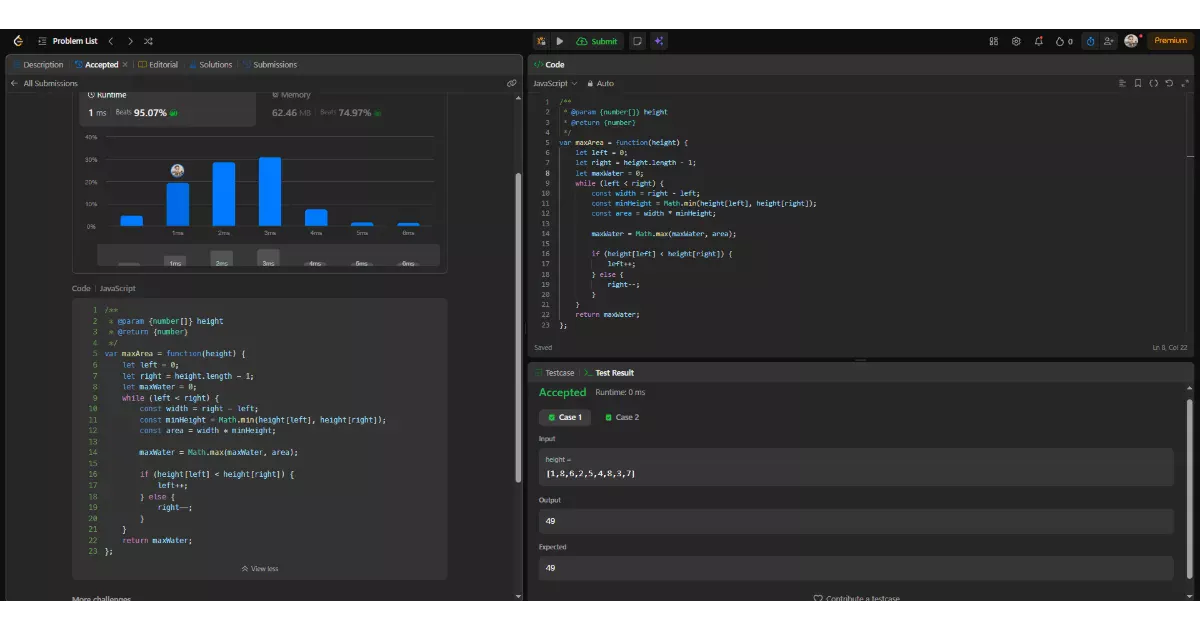
This problem is an excellent example of how choosing the right algorithm can significantly improve performance and efficiency.
📌 Problem Overview:
Given an array of non-negative integers representing the heights of vertical lines, the goal is to find two lines that, together with the x-axis, can hold the maximum amount of water.
The challenge is to maximize the area between two lines while considering the distance between them and their heights.
💡 My Approach: Two-Pointer Technique
Instead of checking every possible pair of lines using nested loops, I used the two-pointer approach to solve the problem efficiently.
Here's how it works:
✅ Initialize two pointers: one at the beginning and one at the end of the array.
✅ Calculate the width between the pointers.
✅ Find the minimum height of the two lines.
✅ Calculate the area using the formula:
Area = Width × Minimum Height
✅ Update the maximum area whenever a larger value is found.
✅ Move the pointer pointing to the shorter line inward, because moving the taller line cannot improve the area while the shorter line remains the limiting factor.
🔍 Time and Space Complexity:
⏱️ Time Complexity: O(n) — Each pointer moves toward the other at most once per step.
💾 Space Complexity: O(1) — Only a few variables are required.
🏆 What I Learned:
This problem strengthened my understanding of the two-pointer technique, greedy decision-making, and algorithm optimization. It also reminded me that solving coding problems is not just about getting the correct output; it's about finding a solution that is both clean and efficient.
Every problem solved is another step toward becoming a better developer. I'll continue practicing and improving my problem-solving skills! 🚀
Have you solved this problem? Share your approach in the comments!
#LeetCode #JavaScript #DSA #DataStructures #Algorithms #CodingChallenge #TwoPointers #ProblemSolving #100DaysOfCode #WebDevelopment #SoftwareDevelopment #CodingJourney #DeveloperCommunity