
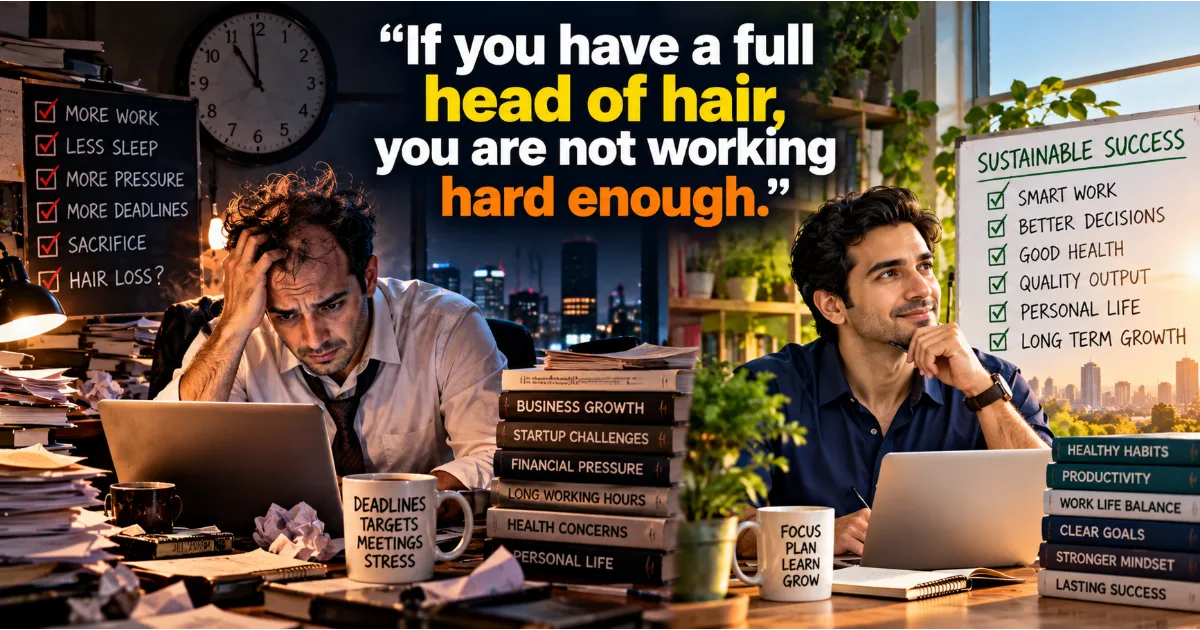
When Exhaustion Becomes a Badge of Honour
The saying, “If you have a full head of hair, you are not working hard enough,” is a provocative line that connects professional ambition with the physical signs of stress and exhaustion. It is usually understood as a joke or an exaggerated expression of the belief that building a successful career or business requires extraordinary sacrifice. The underlying message is familiar in entrepreneurial circles: if you want exceptional results, you must be prepared to work harder than everyone else.
But should exhaustion be treated as proof of dedication? Does losing sleep, sacrificing personal relationships and constantly feeling overwhelmed make someone a better entrepreneur? Or has modern work culture confused being busy with being productive, and suffering with succeeding?
The saying is memorable because it turns a complicated question about ambition into a simple, dramatic image. Hair loss becomes a symbol of the pressure associated with long working hours, relentless deadlines and the uncertainty of building a business. Yet the joke also exposes a troubling assumption: that a person who appears healthy, rested and balanced must not be working hard enough.
There is no reliable source establishing the exact origin or original speaker of this particular saying. It should therefore be treated as an unattributed expression rather than confidently credited to a famous entrepreneur. Its broader message, however, provides a useful starting point for examining the culture of overwork that has become common in discussions about startups, business leadership and career success.
Entrepreneurship is demanding. Building a business can require financial risk, difficult decisions, long periods of uncertainty and the willingness to continue when early efforts produce little reward. A founder may work late to meet a deadline, spend weekends serving customers or devote years to developing a product. These sacrifices can sometimes be necessary, particularly during the early stages of a venture.
The problem begins when temporary intensity becomes a permanent lifestyle and when visible suffering is treated as evidence of superior commitment. Working hard can help a business grow, but working without limits can damage the very judgement, creativity and consistency that success requires.
The real question is not whether people should work hard. It is whether they are working in a way that creates lasting value. There is a difference between being committed to a goal and allowing that goal to consume every part of life.
Understanding that difference is essential for entrepreneurs, employees, managers and anyone trying to build a meaningful career in a world that often celebrates hustle without discussing its costs.
The Rise of Hustle Culture in the Modern Business World
Hustle culture is the belief that success requires constant effort, relentless productivity and a willingness to place work above almost everything else. It celebrates early mornings, late nights, packed calendars, ambitious targets and the idea that every spare hour should be used to advance a career or business.
Some of its principles are valuable. Discipline matters. Consistency matters. People who build meaningful careers often have to learn skills, solve difficult problems and continue working when motivation disappears. Entrepreneurs must frequently handle uncertainty without knowing whether their efforts will produce a financial return.
The problem is not ambition itself. The problem is the idea that ambition must always be visible through exhaustion.
In the world of social media, work has increasingly become part of personal branding. Entrepreneurs post photographs from offices late at night, describe sleeping only a few hours and celebrate working through weekends. Startup founders share stories about sacrifices made during their early years. Professionals compare schedules, productivity routines and the number of hours they spend working.
These stories can inspire people to become more disciplined. They can also create an unrealistic picture of what successful work looks like. The audience sees the late-night photograph but may not see the business systems, financial resources, team support, personal circumstances or years of experience behind the achievement.
A founder who announces that they worked for 18 hours may receive admiration even when the actual results of those hours remain unknown. Someone who completes an important project in six focused hours may receive less recognition, despite producing a better outcome.
This creates a dangerous incentive. People begin to optimise their behaviour for the appearance of hard work instead of the value of the work itself.
The pressure can be especially strong for young entrepreneurs. When a business is new, its founder may feel that every competitor is moving faster, every opportunity is disappearing and every moment away from work represents a lost advantage. The fear of falling behind can make rest feel irresponsible.
Yet a business is not a competition to see who can tolerate the most exhaustion. It is a system that must create value for customers, manage money, retain capable people and adapt to changing conditions. The founder's energy is one resource within that system, and it must be managed carefully.
A culture that celebrates effort without examining outcomes can reward the wrong behaviour. The better question is not how long someone stayed at work, but what they accomplished, what they learned and whether their approach can be sustained.
Does Working Longer Actually Mean Working Better?
The relationship between working hours and productivity is more complicated than hustle culture suggests. Additional hours can be useful when a deadline is approaching, a customer needs urgent help or a business is navigating a temporary crisis. In those circumstances, a concentrated period of extra effort may protect an important outcome.
However, more hours do not automatically produce proportionately better results. People have limited attention, physical energy and capacity for complex decision-making. As fatigue increases, routine tasks may take longer, mistakes may become more likely and difficult problems may require additional effort to resolve.
The International Labour Organization has reported that longer working hours are generally associated with lower unit labour productivity, while shorter working hours can be associated with higher productivity. Its research on working time also highlights the importance of how hours are organised, rather than looking only at the total number of hours worked.
Consider two employees responsible for completing a business report. The first spends 12 hours working on it, frequently switching between messages, meetings and unrelated tasks. The second spends seven hours concentrating on the analysis, checking the figures and presenting the findings clearly. If the second report is more accurate and useful, the longer working day has not necessarily produced the better result.
The same principle applies to entrepreneurship. A founder can spend an entire day redesigning a logo while avoiding the more difficult task of speaking to customers. Another founder can spend two focused hours interviewing potential customers and discover why the product is not selling. The first person may feel busier, but the second may have made more meaningful progress.
This distinction matters because business success depends on the quality of decisions as much as the amount of effort invested. Founders must choose which products to develop, which markets to enter, how much money to spend and when to abandon an approach that is not working. These decisions require analysis, patience and the willingness to recognise mistakes.
Exhaustion can interfere with those abilities. Research on sleep deprivation has found that inadequate sleep can impair decision-making in situations involving unexpected developments, changing plans, innovation and effective communication. These are precisely the kinds of challenges that leaders and entrepreneurs frequently face.
The lesson is not that people should avoid demanding work. It is that effort should be directed towards meaningful outcomes. Hours matter when they are needed to complete important tasks, but hours alone are a poor measure of professional value.
A business owner should therefore evaluate progress through indicators such as customer satisfaction, revenue quality, cash flow, product improvements, delivery reliability and the ability to solve problems. An employee should consider the quality of their contribution, not just the time spent appearing occupied.
Hard work is important. Productive hard work is even more important.
The Hidden Cost of Overwork
The most concerning aspect of the hair quote is the suggestion that physical deterioration is an acceptable sign of professional commitment. Hair loss can have many causes, including genetics, medical conditions, hormonal changes, nutritional factors and some forms of physical or emotional stress. It is not a reliable measure of how hard someone works.
The same caution applies to other visible signs of exhaustion. Dark circles, a tired appearance, frequent illness or an inability to disconnect from work should not be celebrated as proof of superior ambition. They may instead indicate that a person's current routine is not sustainable.
The health consequences of excessive working hours are supported by substantial public health evidence. A joint analysis by the World Health Organization and the International Labour Organization estimated that working at least 55 hours per week was associated with a 35% higher risk of stroke and a 17% higher risk of dying from ischaemic heart disease compared with working 35 to 40 hours per week. Their analysis attributed 745,000 deaths from stroke and heart disease worldwide in 2016 to long working hours.
These figures do not mean that every person working long hours will develop a serious illness. Individual risk depends on many factors, and working hours are only one part of a person's overall health circumstances. They do show, however, that chronic overwork should not be dismissed as an unavoidable price of ambition.
The consequences can also extend into personal life. Someone who regularly works late may have less time for family responsibilities, friendships, exercise and activities that provide emotional recovery. Relationships can suffer when conversations are repeatedly interrupted by work messages or when every weekend becomes another opportunity to catch up on unfinished tasks.
Over time, a person may lose the ability to distinguish between a genuine emergency and an ordinary work request. The phone becomes a permanent extension of the office. Days off feel uncomfortable. Rest creates guilt instead of relief. Even when the workload temporarily decreases, the person may continue behaving as though they are behind.
This is one reason why sustainable working habits need to be established before exhaustion becomes severe. A routine built entirely around emergency effort is difficult to maintain because emergencies eventually become the normal operating condition.
The cost is not limited to individuals. Employers can also lose experienced workers, face higher turnover and suffer from mistakes associated with fatigue. The International Labour Organization's 2026 report on psychosocial risks at work identifies long hours, job insecurity and poorly managed working environments among the factors associated with serious health and economic consequences.
A company that repeatedly relies on exhausted employees may appear productive in the short term while quietly weakening its ability to perform over the long term. A founder who never rests may initially move quickly but eventually struggle to maintain the judgement and energy required to lead the business.
The objective should not be to eliminate demanding work. It should be to prevent avoidable damage caused by treating chronic exhaustion as a business strategy.
Why Entrepreneurs Feel They Must Sacrifice Everything
Entrepreneurs face a distinctive form of pressure because the consequences of failure can be personal as well as professional. An employee may be responsible for a particular role, while a founder may feel responsible for the entire organisation. Salaries, customer commitments, investor expectations, supplier payments and family finances can all depend on decisions made by one person or a small leadership team.
During the early stages of a business, this pressure can be intense. Revenue may be unpredictable, the product may still be developing and customers may take longer than expected to arrive. A founder may spend months building something without knowing whether the market will respond positively.
Under those conditions, working longer can feel like the only available solution. If sales are weak, the founder may spend more time marketing. If the product has problems, the founder may work late to fix them. If the business is running short of money, the founder may attempt to handle tasks that would normally be delegated to other people.
Some of these responses are reasonable in the short term. Early-stage businesses often operate with limited resources, and founders must sometimes perform several roles. The danger appears when every problem is answered with additional hours, regardless of whether those hours address the underlying cause.
A business that is not attracting customers may not need more advertising activity. It may need a better product, a clearer value proposition or a more suitable target market. A team missing deadlines may not need to work through the night. It may need realistic planning, clearer responsibilities or fewer competing priorities.
When founders treat effort as the solution to every problem, they risk overlooking the structural changes that would make the business more effective.
Financial pressure can make this even harder. A founder who has invested personal savings may feel unable to slow down because the consequences of a failed venture could affect the household. Someone supporting employees may feel morally obligated to keep the business moving regardless of personal fatigue.
These responsibilities deserve respect. Entrepreneurship is not always a comfortable or predictable journey, and people should not be encouraged to abandon their commitments whenever work becomes difficult. But responsibility also includes making decisions that protect the future of the business.
A founder who becomes too exhausted to evaluate risks, communicate clearly or recognise a failing strategy may unintentionally create greater problems for the people depending on them.
The better approach is to distinguish between sacrifice that serves a clear purpose and sacrifice that has become habitual. Working late to resolve a genuine crisis may be justified. Working late every night because the business has no clear priorities is a warning that the operating model needs attention.
The Difference Between Discipline and Self-Destruction
Discipline means doing what matters even when it is difficult. It includes maintaining commitments, developing skills, following through on responsibilities and continuing to make progress when immediate rewards are limited. It also involves the ability to prioritise, evaluate results and change direction when necessary.
Self-destruction is different. It occurs when people repeatedly damage their health, relationships or judgement in pursuit of a goal without considering whether the damage is necessary or whether the approach is working.
The two can look similar from the outside. Both may involve long hours, difficult decisions and periods of discomfort. The distinction lies in the purpose, duration and consequences of the behaviour.
A disciplined entrepreneur might work an unusually long day to launch a product, then return to a more sustainable schedule. A person trapped in destructive overwork may work similarly long hours every day because they believe reducing the workload would prove that they lack ambition.
A disciplined employee learns to manage time, communicate expectations and complete important tasks reliably. An employee trapped in an unhealthy work culture may remain online late into the night because colleagues are doing the same, even when the additional work produces little value.
Discipline requires the courage to continue when work is hard. It also requires the judgement to recognise when a strategy is ineffective. If a business model is failing, repeating the same activities for longer is not necessarily perseverance. Sometimes the most disciplined decision is to change the model.
This is particularly important for people who associate personal identity with professional achievement. When someone believes that their worth depends entirely on their productivity, rest can feel like failure and a setback can feel like a personal verdict. That mindset can make it difficult to acknowledge limits or ask for help.
Professional ambition is healthier when it is connected to purpose rather than punishment. People can pursue demanding goals while maintaining relationships, seeking medical advice when needed and creating routines that allow recovery.
A successful career should not require a person to demonstrate constant suffering. The more useful measure is whether their habits enable them to keep contributing, learning and improving over time.
What Successful Business Owners Should Measure Instead
If working until exhaustion is not a reliable measure of commitment, what should entrepreneurs use instead? The answer depends on the business, but a few principles apply across many industries.
The first is meaningful progress. A founder should ask whether the work completed during the day moved the business closer to a clear objective. That objective might be acquiring paying customers, improving customer retention, reducing production errors, launching a product or strengthening cash flow. The point is to connect activity to an outcome.
The second is customer value. Businesses exist because they provide something that customers need or want. A team can remain busy for weeks without improving the customer experience. By listening to customers, examining complaints and measuring satisfaction, business owners can identify whether their efforts are solving real problems.
The third is financial health. Revenue alone does not necessarily indicate a sustainable business. Owners must also understand costs, margins, payment cycles, debt and the amount of cash available to meet future obligations. Working longer hours does not guarantee that the financial model is sound.
The fourth is operational reliability. A company that depends on its founder to personally handle every decision may struggle to grow. Clear processes, documented responsibilities and appropriate delegation can help a business continue operating even when its founder is unavailable. Building those systems may require effort initially, but they can reduce unnecessary dependence on constant personal intervention.
The fifth is the quality of decision-making. Leaders should evaluate whether they are making thoughtful choices or simply reacting to the latest crisis. A founder who reserves time to review performance, examine risks and consider alternatives may make better decisions than one who spends every waking hour responding to messages.
Finally, sustainability matters. A useful working routine should enable a person to maintain performance without repeatedly sacrificing essential rest and personal responsibilities. If the business can function only when its owner is exhausted, the model may need redesigning.
These measures do not eliminate the need for hard work. In many cases, building reliable systems and understanding customers require more patience and concentration than simply adding more hours. But they direct effort towards results that can be observed, evaluated and improved.
The most effective business owners are not necessarily those who work the longest. They are those who learn to identify which work matters most and organise their time and resources accordingly.
The Indian Context: Long Hours, Competition and the Pressure to Prove Yourself
In India, the pressure to work harder can emerge from several directions. Young professionals compete for limited opportunities in some sectors, entrepreneurs navigate uncertain markets, and employees may feel that demonstrating constant availability is necessary to advance their careers. For people supporting families, professional success can also carry the weight of financial security and social expectations.
The startup ecosystem adds another dimension. Founders are often encouraged to think big, move quickly and build businesses that can scale. Stories about entrepreneurs who worked from small rooms, operated with limited resources or continued through repeated setbacks can be inspiring. They remind people that meaningful achievements often require persistence.
However, the public version of these stories can sometimes leave out important details. It may celebrate the founder's long working hours without explaining the role of market timing, customer demand, financial backing, team capability or the decisions that made the business viable. It may present an extraordinary period of effort as though it were a universal formula for success.
This can create unrealistic expectations among aspiring entrepreneurs. A person may assume that if a business is struggling, the answer must be to work even longer. They may compare their own progress with carefully selected success stories and conclude that they are not committed enough.
The reality is that businesses operate under different conditions. A local shop, a technology startup, a manufacturing company and a freelance service provider do not face identical challenges. Their customers, capital requirements, operating costs and routes to growth can differ substantially. There is no single schedule that guarantees success across all of them.
India's workforce also includes people whose long hours are not a lifestyle choice. Workers may have little control over shifts, overtime or job security. For them, advice to work less can be unrealistic unless employers provide fair conditions and a reliable income. Discussions about work-life balance must recognise the difference between a founder choosing to work late and an employee who fears losing a job for refusing additional hours.
This is why responsibility cannot rest entirely on individuals. Businesses should set realistic workloads, evaluate employees on meaningful contributions and avoid rewarding constant online availability over actual performance. Leaders should also be willing to challenge workplace habits that make people feel guilty for taking legitimate time off.
Ambition is important for India's economic future, but it should be accompanied by thoughtful management and respect for workers' well-being. A competitive economy needs people who can learn, innovate and contribute over time, not merely people who can tolerate the greatest amount of exhaustion.
How to Work Hard Without Making Exhaustion the Goal
A healthier approach to ambition begins with clarity. Before starting the day, identify the tasks that are most likely to produce meaningful progress. This can help prevent the common habit of spending hours on messages, minor adjustments and urgent requests while postponing important work.
It also helps to distinguish between activity and achievement. A long to-do list can create the impression of productivity, but completing every item is not always the most valuable outcome. Sometimes one important customer conversation, one carefully considered decision or one improvement to a business process can matter more than a dozen minor tasks.
Protecting focused time is another useful practice. Constantly switching between unrelated activities can make demanding work more difficult. Setting aside uninterrupted periods for analysis, planning or creative tasks can help people use their attention more effectively.
Delegation is equally important for business owners. Founders may initially perform many jobs themselves, but a growing business eventually needs clear responsibilities and dependable processes. Delegating appropriate tasks allows the owner to focus on decisions that require their particular knowledge or authority.
Rest should also be treated as part of a sustainable working routine rather than a reward that must be earned through exhaustion. Adequate sleep, regular physical activity and time away from work can support concentration and general well-being. People experiencing persistent fatigue, significant hair loss or other concerning symptoms should not automatically attribute them to ambition or stress. These symptoms can have multiple causes and may warrant professional medical assessment.
Finally, review the way work is organised. If the same emergency occurs every week, investigate why. If a team repeatedly misses deadlines, examine workload and planning. If a founder must personally approve every small decision, improve the process. The aim is not to eliminate effort, but to reduce avoidable effort that produces little value.
These habits do not promise effortless success. Difficult periods will still occur, and some goals will require substantial sacrifice. But people can approach those challenges with a clear purpose rather than assuming that more suffering must always produce better results.
Conclusion: Your Hair Is Not a Measure of Your Ambition
The saying, “If you have a full head of hair, you are not working hard enough,” is memorable because it exaggerates a belief that remains common in business culture: that exceptional success requires exceptional suffering. Its humour depends on the idea that a person should be visibly worn down by their ambitions.
But the appearance of exhaustion tells us very little about the quality of someone's work. Hair loss is not a reliable measure of effort, long working hours do not automatically translate into greater productivity, and personal sacrifice does not guarantee a successful business.
The evidence on excessive working hours makes the distinction especially important. The World Health Organization and the International Labour Organization have linked working at least 55 hours per week with increased risks of stroke and ischaemic heart disease compared with working 35 to 40 hours per week.
Entrepreneurs need persistence, employees need discipline, and businesses need people who are willing to take responsibility. None of those qualities requires treating chronic exhaustion as a badge of honour. The goal should be to build the capacity to perform well over time, not to prove commitment through visible suffering.
Work hard enough to develop your skills, understand your customers, improve your decisions and follow through on your responsibilities. Be willing to face difficult periods when they serve a clear purpose. But also recognise when a problem requires a better strategy rather than another sleepless night.
The strongest form of ambition is not the ability to ignore every limit. It is the ability to keep moving towards meaningful goals while making decisions that protect your long-term capacity to succeed.
Do not measure your ambition by how exhausted you look. Measure it by what you build, the problems you solve, the value you create and your ability to keep improving.
#BeyondHeadlines #HustleCulture #Entrepreneurship #BusinessMindset #WorkLifeBalance #Productivity #StartupLife #Leadership #CareerGrowth #MentalWellbeing #SustainableSuccess #WorkCulture #BusinessLessons #BeyondTheHeadline

