
Introduction
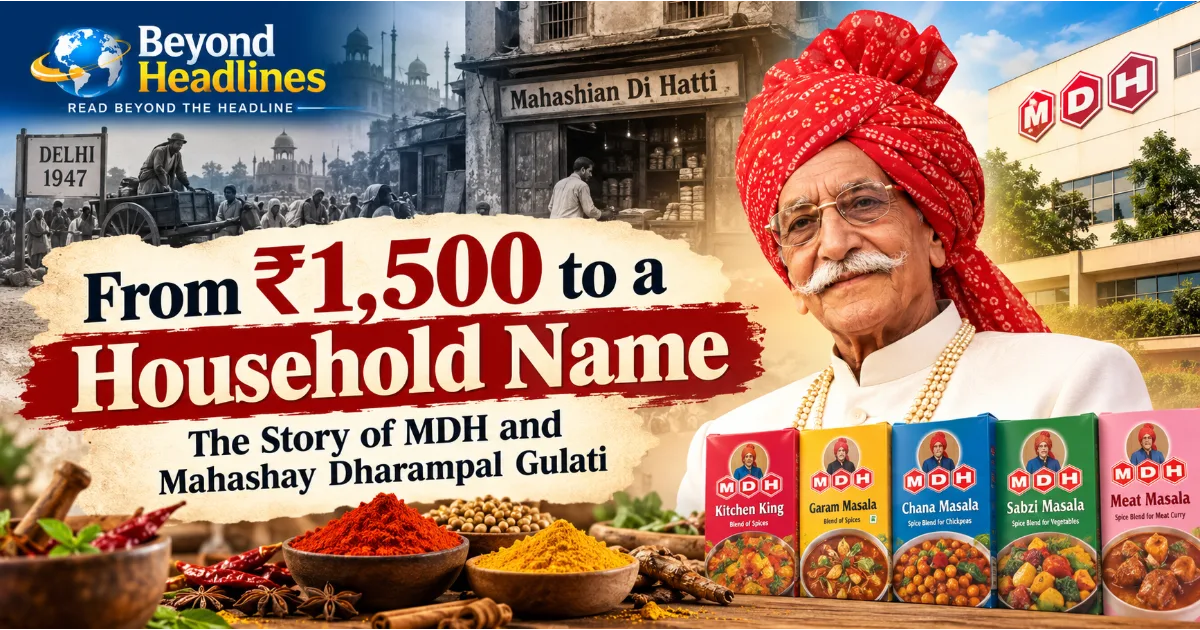
Some business stories begin with a large investment, a sophisticated business plan and access to established markets. The story of MDH began under very different circumstances. In 1947, Mahashay Dharampal Gulati arrived in Delhi from Sialkot after the Partition of India with ₹1,500 and the experience of a family that had already built a business around spices. The circumstances forced him to start again, but the knowledge of the trade remained with him. What followed was the rebuilding of a family business that eventually became one of India's best known spice brands. The LinkedIn post that inspired this article captures the broad journey from ₹1,500 to a nationally recognised brand and highlights an important connection between the founder's personal identity and the company's brand identity. LinkedIn
The story is interesting because MDH was not built simply by selling spices. Spices were already deeply embedded in Indian cooking, and selling them was hardly a new concept. The larger achievement was transforming an everyday commodity into a recognisable packaged brand that consumers could identify, remember and repeatedly choose. The journey involved rebuilding after Partition, understanding an existing market, establishing manufacturing, creating product consistency, expanding distribution and developing a memorable identity around the founder himself. Looking at MDH through that wider lens reveals lessons about resilience, entrepreneurship, branding, consumer trust and the long-term value of being known for something specific.
A Business That Existed Before MDH Became a Household Name
The MDH story did not actually begin in Delhi. The roots of the business go back to Sialkot, where Mahashay Chunnilal Gulati established Mahashian Di Hatti, the business that later became known as MDH. The family had developed a reputation in the spice trade, and Dharampal Gulati became involved in the family business at a young age. Historical accounts describe him as leaving school early and trying different forms of work before becoming more deeply involved in his father's spice business. Business Standard
This background matters because Dharampal Gulati did not enter the spice industry as an outsider looking for a business opportunity. He grew up around the trade and understood the product, the customers and the traditional business model. That experience became extremely valuable later when circumstances forced the family to leave Sialkot. While the physical business could not simply be transferred from one city to another, the knowledge behind the business could travel with him.
That distinction is important for entrepreneurs. A business may own shops, equipment, inventory and other physical assets, but the knowledge accumulated by the people running it can be equally valuable. Understanding customers, suppliers, product quality, pricing and distribution creates a foundation that cannot always be seen on a balance sheet. In Gulati's case, the knowledge of spices became something he could carry with him when almost everything else had to be rebuilt.
Partition Changed Everything
The Partition of India in 1947 transformed the lives of millions of people, and the Gulati family was among those forced to leave Sialkot. Dharampal Gulati came to Delhi carrying not only limited financial resources but also the experience of having lost the business environment in which his family had operated. The Indian Express reported that he arrived with ₹1,500, while other accounts describe the difficult transition from Sialkot to Delhi and his early attempts to establish a livelihood in a completely new environment. The Indian Express
The ₹1,500 figure has become one of the most repeated parts of the MDH story because it provides a simple way of understanding the scale of the challenge. However, the real significance of that amount lies in the circumstances surrounding it. This was not simply a young entrepreneur starting a business with a small budget. It was someone rebuilding after displacement, entering a new city and attempting to create stability after losing the established environment of the family business.
The early stage was not a straight path toward success. Gulati purchased a tonga and used it to earn a living in Delhi. Accounts of his journey describe this period as an attempt to make ends meet before he eventually decided to return to the family trade. He also experimented with other forms of work, reinforcing the fact that the eventual success of MDH did not emerge from a perfectly executed plan from the beginning. mint
The Tonga Was Not the Destination
The tonga is an important part of the story because it shows that entrepreneurship rarely follows the neat sequence presented in hindsight. When people look at a successful company decades later, it is tempting to imagine that the founder always knew where the business was going. Gulati's early experience demonstrates the opposite.
He tried something that could provide an immediate source of income, discovered that it was not the right long-term path and eventually returned to what he knew. That decision was significant because he did not treat an unsuccessful attempt as proof that he had failed at everything. He treated it as information about what was not working.
This is a useful distinction for anyone building a business today. A failed product, unsuccessful marketing campaign or business model that does not work does not necessarily mean the entrepreneur has reached the end of the road. Sometimes it reveals where the founder's strongest knowledge and opportunity actually lie. Gulati's experience eventually led him back to spices, a category in which he already possessed experience and credibility.
Starting Again in Karol Bagh
After returning to the spice business, Gulati established a small shop in Delhi's Karol Bagh area under the name Mahashian Di Hatti. The business carried forward the identity of the family enterprise from Sialkot, giving the new operation a connection to the brand's earlier history. The scale was modest, but the significance of the decision was much larger because it represented the beginning of the business's second chapter in India. Business Standard
At that point, there was no nationwide distribution network and no large manufacturing operation behind the name. There was simply a shop serving customers in a local market. The challenge was therefore not just to sell spices but to create enough trust and demand to allow the business to expand beyond its immediate surroundings.
The first stage of growth for many consumer businesses begins exactly this way. The founder has to understand what customers actually want, what they are willing to pay for and what makes them return. In a local store, feedback is immediate. Customers ask questions, compare products, complain about quality and make purchasing decisions directly in front of the seller. That direct relationship can provide valuable insight into the market.
Turning an Everyday Commodity Into a Brand
Spices were not an innovative product category. Indian households had been buying, grinding and using spices for generations. The opportunity was not to invent the need for spices but to make the purchasing experience more consistent and recognisable.
MDH eventually became associated with packaged spice products and blends designed for familiar Indian dishes. Historical accounts describe Gulati as a pioneer in the development of ready-to-use ground spices at a time when many Indian households continued to grind spices at home. Wikipedia
That transition from an everyday commodity to a branded packaged product was strategically important. When a customer buys an unbranded commodity, the primary consideration may be price, appearance or the seller's recommendation. When a customer buys a recognised brand, additional factors enter the decision. Familiarity, perceived quality, consistency and previous experience become part of the purchase.
This is one of the fundamental principles of consumer branding. A brand reduces uncertainty. When consumers repeatedly purchase the same product and receive an experience they consider satisfactory, the brand becomes a shortcut in their decision-making process. They no longer have to evaluate every available option from scratch.
Manufacturing Created the Possibility of Scale
A local shop can serve a local customer base, but a national brand requires systems capable of producing and distributing products on a much larger scale. Gulati moved in that direction when he established a manufacturing facility in Delhi's Kirti Nagar area in the late 1950s. Historical accounts place the establishment of the facility around 1959, marking an important transition from a small retail operation toward organised production. Business Standard
Manufacturing changes the nature of a business because it introduces the ability to reproduce a product consistently. Instead of producing or selling only what one shop can handle, the company can begin thinking about volume, packaging, quality control and distribution.
Scale, however, creates its own problems. Producing more does not automatically mean producing better. A business that expands too quickly can damage its reputation if customers receive inconsistent products. For a food company, the importance of consistency is particularly high because consumers build expectations around taste and quality.
MDH's development therefore involved more than increasing output. The company needed to create a repeatable system capable of delivering products to customers in different locations while maintaining the characteristics associated with the brand.
The Importance of Consistency in a Spice Brand
The strength of a packaged spice brand depends heavily on consistency. A customer purchasing a familiar masala expects the product to perform in a reasonably predictable way. The flavour, aroma, texture and overall cooking experience become part of the consumer's expectations.
This is why branding in the food industry cannot be separated from product quality. Advertising can make people notice a product, but repeated purchases depend on what happens after the package is opened and used. If the experience consistently meets expectations, the customer has a reason to purchase again. If it repeatedly disappoints, advertising becomes less effective over time.
MDH has long positioned quality and purity as important parts of its identity, while its present company information describes processes involving sourcing, cleaning, drying, testing and grinding. Wikipedia The broader lesson is that brand promises have to be supported by operational systems. Marketing can communicate an expectation, but the business has to deliver the experience that makes the expectation credible.
The Founder Became the Face of the Company
Perhaps the most remarkable element of the MDH story was the decision to make Dharampal Gulati himself central to the brand's public identity. His red turban, distinctive moustache, glasses and traditional appearance became familiar through MDH advertising and packaging. His image eventually became one of the strongest visual associations with the company. mint
This was particularly effective because Gulati was not an actor playing the role of a fictional businessman. He was the person behind the company. His presence gave the brand a human face and created a direct connection between the founder and the product.
The LinkedIn post highlights this part of the story as an example of personal branding, arguing that the founder's face, expertise and identity can create opportunities beyond the immediate business. That observation is relevant to today's professional environment, where founders and professionals increasingly use their personal reputation as an extension of their work. LinkedIn
However, the MDH example also shows why personal branding works best when it is connected to genuine expertise. Gulati was not simply attaching his face to a random product. His identity was directly connected to the business he had spent decades building. The person and the category reinforced each other.
Personal Branding Before the Term Became Popular
The idea of personal branding is often associated with social media, LinkedIn creators, YouTube channels and online entrepreneurs. Yet the underlying concept is much older. People have always associated businesses with the individuals who build them.
Dharampal Gulati became an unusually powerful example because his appearance was repeated across advertisements and product packaging for years. Consumers did not have to remember an abstract corporate identity. They could remember a person.
That creates an interesting lesson for modern professionals. Being known for something specific can be more valuable than simply being visible. A person who becomes strongly associated with a particular area of knowledge has created a form of reputation that can travel across opportunities.
For a founder, this could mean becoming known for a particular industry problem. For a consultant, it could mean developing expertise around a specific subject. For a creator, it could mean consistently explaining one category better than others. The underlying principle is the same: recognition becomes stronger when identity, expertise and repeated communication point in the same direction.
Familiarity Became a Competitive Advantage
The repeated use of Gulati's image was not simply an advertising trick. It created familiarity over time. Consumers encountered the same face, the same brand name and the same category association repeatedly.
Familiarity matters because consumers often make everyday purchasing decisions quickly. People do not conduct extensive research before buying every packet of spices. They rely on previous experience, recommendations and brands they already recognise.
This creates a powerful cycle. A customer sees a brand, tries it, has an acceptable experience and becomes more familiar with it. The next time the customer encounters the same product, the decision becomes easier. If the experience remains positive, repeat purchases strengthen the relationship further.
Brand equity is built through these repeated interactions. It is rarely created by one advertisement.
Distribution Was as Important as Advertising
It is easy to focus on Gulati's face and advertising because those are the most visible aspects of the MDH story. However, a consumer brand cannot become a household name through advertising alone. The product has to be available where customers shop.
The company expanded beyond its original Karol Bagh operation and developed manufacturing and distribution capabilities that allowed MDH products to reach wider markets. Contemporary accounts describe MDH as a significant packaged spice business with a strong presence in northern India and export markets. mint
Distribution is often an invisible part of consumer brand success. Consumers see the product on a shelf, but they do not see the network of manufacturers, distributors, wholesalers, retailers and logistics systems that made the product available.
For entrepreneurs, this is an important reminder that building demand and building access are separate challenges. Marketing may convince someone to want a product, but distribution determines whether the customer can actually purchase it.
The Power of a Familiar Product
MDH also benefited from selling products that were already deeply connected to Indian cooking. The company did not need to teach consumers why spices were necessary. The use case already existed.
The opportunity was to make familiar products more convenient and more consistently packaged. This is an important business strategy because not every successful innovation has to create an entirely new category. Some of the strongest businesses improve an existing behaviour.
Consumers already cooked at home. They already used spices. They already prepared dishes such as curries and other traditional foods. Packaged spice blends could make the process more convenient while giving consumers a recognisable product to purchase.
For modern startups, this is a valuable way of looking at innovation. Instead of asking only what completely new thing can be created, entrepreneurs can ask what existing activity is frustrating, inconvenient, inconsistent or unnecessarily complicated.
Building a Brand Around Indian Food Culture
Another important factor in MDH's success was its connection to Indian food culture. The brand was not trying to create an artificial association between its products and something unfamiliar. Its products were directly connected to dishes and cooking practices that consumers already understood.
That cultural familiarity gave the brand a natural foundation. A product associated with a known dish can communicate its purpose immediately. Consumers do not need a lengthy explanation to understand why a particular masala exists.
This demonstrates the importance of cultural context in marketing. A successful brand does not simply sell a product. It understands how that product fits into the lives of the people buying it.
When marketing reflects existing habits, traditions and experiences, consumers can recognise themselves in the brand more easily.
The Numbers Tell Only Part of the Story
The financial growth associated with MDH is impressive, but revenue and market share do not fully explain why the brand became memorable. Contemporary reporting stated that MDH had revenue of approximately ₹1,095 crore for the year ended March 2018, while Dharampal Gulati was also reported as one of India's highest-paid FMCG CEOs at the time. mint
Those figures show the scale the company eventually reached, but they are outcomes rather than the entire story. Behind those numbers were decades of product development, distribution, manufacturing, marketing and customer relationships.
This distinction is important because business success is often reduced to financial milestones. Revenue tells us how much a company sold. Profit tells us something about its economics. Market share tells us about its position relative to competitors. None of these numbers alone explains why customers remember a brand.
Brand recognition is an intangible asset. It develops gradually through repeated exposure and experience.
The Long-Term Value of Trust
Spices are a category in which trust can be particularly important because consumers are putting the product directly into food prepared for themselves and their families. Questions about purity, quality and consistency therefore influence purchasing decisions.
This helps explain why a familiar brand can have a significant advantage. Once consumers have incorporated a product into their routine and believe it delivers a reliable experience, switching may not feel necessary.
The trust associated with a brand can also extend beyond a single product. A customer who recognises one product may be more willing to try another product from the same company. This creates an opportunity for brands to expand their product portfolio while benefiting from existing consumer recognition.
The challenge is that brand trust is easier to damage than to build. A single poor experience may not destroy a major brand, but repeated failures can weaken the relationship that took years to establish.
What MDH Teaches About Resilience
The most obvious lesson from the MDH story is resilience, but resilience should not be confused with simply refusing to give up. The more useful lesson is the ability to adapt while retaining a clear understanding of one's strengths.
Gulati's early experiences in Delhi did not immediately produce the business that would define his career. He tried the tonga business and other activities before returning to spices. The ability to recognise that his strongest opportunity lay in his existing knowledge was part of the journey. Wikipedia
Modern entrepreneurship often celebrates disruption and reinvention, but there is equal value in knowing when to return to fundamentals. A founder does not always need to abandon everything and start in an unrelated field. Sometimes the strongest opportunity is hidden inside experience that already exists.
What MDH Teaches About Starting Small
The image of a large manufacturing company can make it difficult to remember that many consumer brands begin with very modest operations. MDH's journey from a small shop to a much larger business demonstrates how scale can develop gradually.
Starting small provides an opportunity to learn before making major commitments. A local operation can reveal which products customers prefer, which messages resonate and which aspects of the business need improvement.
The goal should not be to remain small. The goal should be to learn efficiently at a small scale and then build systems that allow successful elements to scale.
This principle applies to modern digital businesses as well. A founder can test a service with a small customer group, validate demand, improve the offering and only then invest heavily in marketing or infrastructure.
What MDH Teaches About Brand Identity
The MDH identity was strengthened because several elements reinforced each other. The company name was consistent, the product category was clear, the packaging was recognisable and the founder became visually associated with the business.
This created a strong mental connection between the brand and the product.
Modern businesses can learn from this without copying the visual approach. A technology company does not need a founder in every advertisement, and a startup does not need a mascot to build recognition. What matters is consistency.
The name, visual identity, product promise, communication style and customer experience should not constantly contradict one another. When all of those elements reinforce the same idea, recognition becomes easier.
The Founder as an Asset and a Responsibility
Making the founder the face of a company can be powerful, but it also creates responsibility. When the public strongly associates an individual with a company, the founder's behaviour can affect the brand directly.
Gulati's public identity became inseparable from MDH. That helped create familiarity, but it also meant that the company's story was closely connected to his personal reputation.
This is an important consideration for today's founders who build audiences online. Personal branding can create opportunities, but it also means that the founder becomes part of the company's public identity. Consistency, credibility and professionalism therefore become increasingly important.
A founder should ideally build both personal reputation and organisational strength so that the company can continue to grow even when the founder is no longer the centre of attention.
The Importance of Building Something That Can Outlive the Founder
Dharampal Gulati died in December 2020 at the age of 98. By then, the company had already developed into a major spice business, and his face had become part of the brand's long-standing identity. The Indian Express
His death illustrates an important question for every founder: what remains when the founder is no longer present?
A business that depends entirely on one individual may struggle during succession. A business that has developed strong products, systems, distribution and customer trust has a better chance of continuing.
The ultimate achievement of a founder is therefore not simply becoming indispensable. It is building an organisation whose value extends beyond the founder's personal involvement.
Why the MDH Story Still Matters Today
The business environment has changed dramatically since MDH began expanding. Entrepreneurs today can launch online stores from home, advertise to customers through social media, accept digital payments and reach international audiences without opening a physical shop in every city.
Yet the fundamentals of brand building remain remarkably similar.
Customers still want products they can trust. Businesses still need distribution. Product quality still matters. Recognition still matters. Consistency still matters. A strong reputation still takes time to develop.
Technology has changed the tools available to businesses, but it has not eliminated the basic requirement to create something customers value.
That is why the MDH story remains relevant. The specific circumstances belong to another era, but the underlying principles remain applicable.
Beyond the ₹1,500 Headline
The most interesting part of the MDH story is not actually the ₹1,500.
The number provides a powerful opening because it captures the contrast between a modest beginning and the scale the business eventually achieved. But the real story lies in everything that happened afterward.
The founder had to rebuild after Partition. He had to find a livelihood in a new city. He had to recognise that spices remained his strongest area of knowledge. He had to establish a new shop, develop manufacturing capabilities, expand distribution and create a brand that customers could recognise.
He also made himself part of the brand in a way that was unusual for the time. His face became familiar to consumers, and that familiarity reinforced the identity of MDH.
The result was not simply a successful spice business. It was a brand with a distinctive place in Indian consumer memory.
What Entrepreneurs Should Take Away
Entrepreneurs can take several lessons from the MDH journey without treating it as a formula that can simply be copied. The first is that setbacks do not necessarily invalidate a person's entrepreneurial potential. Gulati's early experiences show that an unsuccessful direction can lead to a better understanding of where one's strengths actually lie.
The second lesson is that strong brands are built around consistency. Consumers need a reason to remember a company and a reason to trust it. That reason can come from product quality, service, expertise, convenience or a combination of these factors, but the promise has to be delivered repeatedly.
The third lesson is that personal reputation can strengthen a business when it is connected authentically to expertise. Gulati became memorable because he was not merely promoting a product. He was the person behind the business, and his identity became associated with the category.
The fourth lesson is that distribution and accessibility are critical. A business can have an excellent product and strong advertising, but if customers cannot find the product, growth becomes difficult. Physical businesses need retail and logistics networks, while digital businesses need their own forms of distribution through search, platforms, communities, partnerships and other channels.
The final lesson is patience. MDH was not built in a few months. Its development took decades. Modern businesses can move faster in many respects, but meaningful trust and brand recognition still require repeated customer experiences over time.
Conclusion
The story of Mahashay Dharampal Gulati is often remembered as the story of a man who arrived in Delhi with ₹1,500 and eventually built a major spice brand. That version is powerful, but it becomes far more meaningful when the journey between those two points is examined carefully.
He came from a family with experience in the spice trade, lost the security of that established business during Partition, experimented with different ways of earning a living and eventually returned to the category he understood. From a modest shop in Karol Bagh, the business developed manufacturing and distribution capabilities and eventually became a widely recognised consumer brand. The Indian Express
What made the story particularly distinctive was the role of the founder himself in the company's identity. Dharampal Gulati became more than the person who ran the business. His face, appearance and personality became closely associated with MDH, creating a form of brand recognition that many companies spend enormous amounts of money trying to achieve through advertising.
The larger lesson is not that every entrepreneur needs to become the face of a company. It is that businesses become memorable when there is a clear connection between what they offer, who they serve and what they stand for. MDH built that connection over many years through products, distribution, consistency and a founder whose personal identity became part of the brand.
The ₹1,500 beginning is certainly worth remembering, but it should not become the entire story. Capital was only the starting resource. The greater assets were experience, adaptability, persistence, product knowledge, customer understanding and the willingness to continue building after circumstances had forced a complete restart.
That is what makes the MDH journey relevant even today. Businesses may now have access to technologies and marketing channels that were unimaginable when Gulati rebuilt his family's spice business in Delhi, but the fundamentals remain familiar. Build something people value, make it reliable, earn their trust, create a clear identity and continue improving the business long enough for those efforts to compound.
The most valuable part of the story is therefore not simply how much money the business eventually made. It is how a displaced entrepreneur took what he knew, started again in a new place and gradually turned that knowledge into a brand that millions of people could recognise.
That is the part of the story that lies beyond the headline.
#MDH #MahashayDharampalGulati #IndianBrands #BrandStory #IndianBusiness #BusinessStory #Entrepreneurship #EntrepreneurialJourney #BrandBuilding #BrandStrategy #PersonalBranding #FMCG #FMCGIndia #IndianEntrepreneurs #BusinessLessons #FounderStory #ConsumerBrands #MarketingStrategy #IndianBusinessStories #BusinessGrowth #MadeInIndia #BeyondHeadlines