
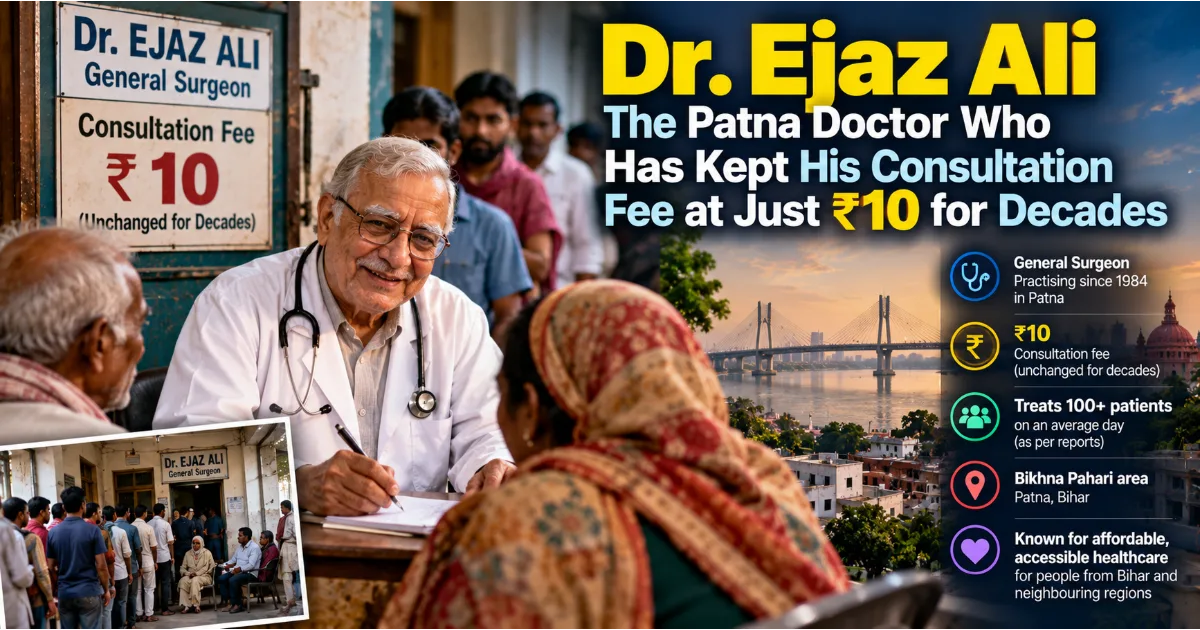
A Doctor Who Puts Affordability at the Centre of His Practice
In a country where the cost of healthcare can place enormous pressure on household finances, the story of a doctor who continues to charge just ₹10 for a consultation offers a powerful perspective on medical service. In Patna, Bihar, Dr. Ejaz Ali has become known for maintaining an exceptionally low consultation fee while treating patients who might otherwise struggle to afford medical advice.
Reports published in September 2026 describe Dr. Ali as a general surgeon who began practising in Patna in 1984 and has reportedly kept his consultation fee at ₹10 for decades. His practice in the Bikhna Pahari area has attracted patients from Bihar and neighbouring regions, including people seeking affordable consultations and treatment.
His story has drawn attention because it challenges a difficult question in modern healthcare: how can medical treatment remain accessible to people with limited incomes when the cost of consultations, investigations, medicines and hospital procedures continues to concern families?
For many households, even a relatively small medical expense can become significant when combined with lost wages, transport costs and the possibility of repeated visits. A patient who earns a daily wage may have to choose between seeking treatment and completing a day's work. A family managing several financial responsibilities may delay medical advice because it is uncertain how much the entire process will cost.
In this context, an affordable consultation can make a meaningful difference. It can lower one of the first barriers to seeking medical attention and encourage people to discuss symptoms before they become more difficult to manage. It cannot eliminate every healthcare expense, but it can make the initial step more accessible.
Dr. Ali's practice also raises questions about the relationship between professional responsibility and financial sustainability. Doctors must support their own livelihoods, maintain facilities, employ staff and meet the costs associated with medical practice. An exceptionally low consultation fee is therefore not a simple model that every practitioner can adopt without considering their circumstances.
The importance of his story lies in the principle it brings into focus. Healthcare is not merely a commercial transaction. It is also a service connected to human dignity, public health and the ability of people to live healthy lives regardless of their financial position.
His example invites a wider discussion about how doctors, hospitals, governments and communities can make healthcare more affordable without compromising clinical quality or the sustainability of medical services.
Who Is Dr. Ejaz Ali?
Dr. Ejaz Ali is a Patna-based doctor known for his long-standing commitment to low-cost consultations. News reports identify him as a general surgeon who began practising in 1984. His medical work has made him a familiar name among people seeking affordable healthcare in Bihar, particularly those who are concerned about the cost of visiting a doctor.
His reputation rests largely on the reported ₹10 consultation fee. In an environment where medical expenses can vary widely depending on the doctor, hospital and nature of the treatment, such a low fee stands out. For patients who need medical advice but have limited financial resources, the difference between an affordable consultation and a costly appointment can influence whether they seek care promptly.
Reports describe his practice in the Bikhna Pahari area of Patna as a destination for patients arriving from different parts of Bihar and neighbouring regions. Some travel considerable distances because they believe the low fee makes a medical consultation more accessible. The number of patients visiting a practice can fluctuate from day to day, and reported patient volumes should not be interpreted as independently audited figures. Nevertheless, the continuing attention to his work reflects the public interest in affordable medical care.
His professional life has also extended beyond clinical practice. Dr. Ali previously served as a member of the Rajya Sabha from Bihar between 2008 and 2010 and founded the All-India Backward Muslim Morcha, an organisation associated with the representation of disadvantaged communities.
These aspects of his life place his medical work within a broader social context. Healthcare access, economic disadvantage and representation of marginalised communities are connected questions in a country where income, geography and social circumstances can affect people's ability to obtain treatment.
However, it is important to distinguish documented information from assumptions. His political background does not, by itself, explain his pricing decisions, and his low consultation fee does not establish the quality or outcome of every treatment he provides. Those questions require separate evidence.
What can be said is that Dr. Ali's reported practice has become a point of discussion about the responsibilities of medical professionals and the importance of affordable healthcare. His example invites attention not only to one doctor, but also to the wider system in which patients make decisions about when and where to seek medical help.
Why a ₹10 Consultation Fee Matters
The value of a ₹10 consultation becomes clearer when viewed through the financial realities of patients who live on limited or irregular incomes. For someone with a stable salary, the cost of a doctor's appointment may be manageable. For a daily-wage worker, a street vendor, a domestic worker or a family already dealing with debt, even modest expenses can require careful planning.
Medical care rarely involves only one payment. A patient may need to pay for transport, consultation, diagnostic tests, prescribed medicines and follow-up visits. If a condition requires a specialist, hospital admission or surgery, the total cost can increase considerably. The initial consultation is only one part of the overall expense, but it is often the point at which the patient begins navigating the healthcare system.
A low consultation fee can reduce the financial hurdle at that first stage. It may make it easier for a person to seek medical advice instead of ignoring symptoms or waiting until the condition becomes more serious. Early medical assessment can be valuable because some health problems are easier to manage when they are identified promptly.
Affordability can also influence continuity of care. Some patients need multiple visits to monitor symptoms, review test results or adjust treatment. If every appointment places a substantial burden on the household budget, patients may miss follow-ups or stop treatment earlier than advised. Lower consultation costs can reduce one part of that burden.
There is an important qualification, however. An inexpensive consultation does not mean that the complete course of treatment will cost ₹10. Tests, medicines, procedures and hospital services may involve separate expenses. Patients need clear information about those costs so that they can make informed decisions.
Nor should the fee alone be treated as evidence that a doctor provides better care than someone who charges more. Medical quality depends on clinical judgement, appropriate investigations, safe procedures, effective communication and responsible follow-up. A fair assessment must consider the care delivered, not just the price of the appointment.
The broader lesson is that affordability and quality should be pursued together. A healthcare system must make it possible for people to seek treatment without forcing them to choose between essential medical care and basic household needs. Dr. Ali's reported fee brings that objective into public conversation.
The Financial Reality Facing Patients in India
Healthcare spending can be particularly difficult for households that do not have comprehensive insurance or enough savings to absorb an unexpected expense. A sudden illness or injury can disrupt a family's financial stability, especially when the person who becomes ill is also the primary earner.
The cost of care may extend beyond the hospital bill. Patients and relatives can lose income while attending appointments, arranging transport, staying with a hospitalised family member or recovering from an illness. People travelling from rural areas to larger towns may also face accommodation and food expenses during treatment.
These indirect costs are often less visible than the consultation fee, but they can affect whether people seek care. A patient may postpone an appointment because reaching the clinic requires a day's travel or the loss of a day's wages. Another may delay investigations because the household cannot afford both the test and other essential expenses.
Affordable consultations can help, but they cannot solve every part of this problem. A person who pays ₹10 to see a doctor may still be unable to afford the recommended tests or medicines. A patient who requires surgery may need financial support far beyond the cost of the initial appointment.
This is why the affordability of healthcare should be considered across the entire treatment pathway. The system needs accessible primary care, appropriate referral services, affordable diagnostics, dependable medicine supplies and financial protection for patients who require hospital treatment.
Public health programmes and government hospitals play an important role in providing services at subsidised rates. Private practitioners and charitable organisations can also contribute by offering affordable care, transparent pricing or assistance to patients who cannot pay the full cost of treatment.
The challenge is to ensure that these different parts of the system work together. Affordable consultations are most effective when patients can also access the tests, medicines and specialist services needed to complete their treatment.
Dr. Ali's reported fee offers a visible example of how one part of the healthcare experience can be made less expensive. The wider task is to make affordability a dependable feature of the healthcare system rather than something patients must search for through individual acts of generosity.
Healthcare as a Public Service, Not Just a Commercial Transaction
Medicine is a profession that requires years of education, practical training, continuing learning and considerable responsibility. Doctors must make decisions that can affect patients' health, mobility, independence and sometimes their survival. They also operate within a system that requires equipment, trained staff, medicines, diagnostic facilities and reliable administrative support.
It would therefore be misleading to suggest that doctors should not earn a fair income. Medical professionals need financial stability to maintain their practices, support their families, invest in training and provide safe services. A healthcare system that expects doctors to work indefinitely without adequate compensation would struggle to retain skilled professionals and maintain quality.
At the same time, healthcare is different from many ordinary commercial services because patients often seek it when they are vulnerable. Someone experiencing pain, facing a serious diagnosis or worried about a family member may not be in a strong position to compare prices or evaluate every available option. This makes clear communication, professional ethics and respect for patients especially important.
The responsibility of a doctor includes explaining a diagnosis, discussing appropriate treatment options, communicating risks and helping patients understand what needs to happen next. A patient should not feel pressured into unnecessary investigations or procedures, nor should financial limitations prevent a doctor from recommending clinically necessary care.
Affordable medical practice can be one way to express a commitment to accessibility. However, affordability should be accompanied by appropriate clinical standards, informed consent and responsible follow-up. A low fee is meaningful when patients receive care that meets their needs.
Dr. Ali's reported ₹10 consultation fee has attracted public attention because it places affordability at the centre of his professional image. His example invites reflection on how the medical profession can respond to the needs of patients with limited means while maintaining the standards required for safe practice.
The most productive interpretation is not that every doctor should charge the same amount. Medical practices differ in location, specialisation, operating costs and the complexity of services provided. A surgeon working in a fully equipped hospital faces a different cost structure from a doctor providing outpatient consultations in a small clinic.
Instead, the larger principle is that access to care should not depend entirely on a person's ability to pay the full market price at the moment they become ill. Public funding, insurance, charitable support, transparent pricing and carefully designed subsidised services can help bridge the gap between the cost of providing care and what patients can afford.
This approach recognises both sides of the equation: doctors need sustainable working conditions, and patients need a realistic opportunity to obtain treatment.
Why Affordable Care Requires More Than One Doctor
Individual doctors can make a meaningful contribution, but the responsibility for affordable healthcare cannot rest on individual practitioners alone. A sustainable system requires cooperation between governments, hospitals, medical professionals, insurers, charitable organisations and communities.
Government healthcare facilities provide essential services to large populations, particularly people who cannot afford expensive private treatment. Their effectiveness depends on adequate staffing, reliable supplies, functioning equipment, clean facilities and timely access to diagnostic services. When public facilities are accessible and dependable, they can reduce the financial burden on families.
Primary healthcare is especially important. Many health concerns can be assessed initially through local clinics and primary health centres, which can provide basic treatment, preventive advice and referrals when specialist care is required. A strong primary healthcare network can help people obtain advice before conditions become more complicated.
Diagnostic services also matter. A low-cost consultation cannot provide a complete solution if the patient cannot afford the investigations needed to establish a diagnosis. Affordable laboratory testing, imaging services and access to essential medicines can help turn an initial medical visit into an effective treatment plan.
Financial protection is another essential element. Health insurance and public assistance programmes can reduce the direct cost of eligible treatment, although coverage, eligibility and out-of-pocket expenses vary. Patients need clear information about what is covered, where services are available and which expenses they may still have to pay.
Charitable clinics and community health initiatives can fill some gaps, particularly for vulnerable populations. They may offer subsidised consultations, screening programmes or assistance with particular treatments. Such services can be valuable, but they work best when they are connected to broader referral systems and can direct patients towards appropriate care when more advanced treatment is required.
Private medical practitioners can contribute through transparent fee structures, concessions for patients in financial difficulty and responsible referral practices. Hospitals can explore subsidised services or structured assistance programmes, provided those arrangements are financially viable and clinically appropriate.
The objective should be to create a system in which affordability is not dependent on whether a patient happens to find a particular doctor. A person should be able to identify an appropriate, reliable and financially accessible route to care regardless of where they live.
Dr. Ali's example is noteworthy precisely because it highlights a need that extends beyond one practice. It raises the question of how affordable care can become a more consistent feature of the healthcare system.
The Importance of Dignity and Respect in Medical Care
Healthcare affordability is not only about money. It is also about how patients are treated when they seek help.
People who cannot afford expensive treatment may already feel anxious about their circumstances. They may worry about the cost of tests, the possibility of missing work or the impact of illness on their families. If they also feel judged because of their financial situation, they may hesitate to seek help or ask important questions.
Respectful treatment can make a significant difference to the patient experience. Doctors and healthcare staff can explain costs clearly, listen to concerns, discuss practical treatment options and avoid making patients feel embarrassed about their financial limitations. These practices help people participate more actively in decisions about their care.
A low consultation fee can make a clinic more accessible, but dignity requires more than a low price. Patients need privacy, clear explanations, appropriate examinations and honest information about the limits of a consultation. They should understand when a condition requires additional tests or referral to another facility.
It is equally important not to assume that every patient who seeks inexpensive treatment is poor or that every patient who pays more receives better care. Financial circumstances differ, and medical needs vary. The purpose of accessible healthcare is to ensure that people can obtain appropriate treatment without unnecessary financial hardship.
Dr. Ali's story has attracted attention because the reported fee is strikingly low and has reportedly remained unchanged for decades. It encourages discussion about the relationship between compassion, professional responsibility and affordability. Yet the wider principle applies to every healthcare setting, regardless of the fee charged.
Respect for patients should not be treated as an optional feature reserved for charitable clinics. It is a basic expectation of ethical medical practice. A patient who receives clear information, fair treatment and appropriate care is better equipped to make decisions about their health.
For healthcare institutions, this also has practical value. Trust encourages patients to communicate their symptoms accurately, ask questions and follow medical advice. Good communication can improve the quality of the clinical relationship and help patients understand why certain investigations or treatments are recommended.
Affordability and dignity reinforce one another when care is designed around the needs of the patient rather than the convenience of the institution alone.
Dr. Ejaz Ali's Public Life and His Connection to Social Advocacy
Dr. Ejaz Ali's story also extends beyond his medical practice. He previously served in the Rajya Sabha, India's upper house of Parliament, representing Bihar between 2008 and 2010. He is also associated with the founding of the All-India Backward Muslim Morcha, an organisation focused on the representation of disadvantaged communities.
His public life provides another perspective on the questions raised by his medical work. Access to healthcare is closely connected to wider issues of economic inequality, social opportunity and public services. Families with limited resources can face barriers not only in healthcare, but also in education, housing, employment and access to legal or administrative assistance.
When people have limited financial resources, an unexpected illness can make existing difficulties worse. A worker who cannot earn during treatment may lose income at the same time that medical expenses increase. A family may have to borrow money, reduce other spending or postpone important purchases to pay for care. These pressures show why healthcare affordability is not merely a question of the price charged by a doctor.
However, it is important to keep the different aspects of Dr. Ali's public life distinct. His political service and social advocacy are matters of public record, while the reasons behind his decision to maintain a low consultation fee should not be assumed without a reliable statement from him. The significance of his medical practice can be discussed on its own terms without attributing unverified motivations to him.
His story nonetheless provides an opportunity to consider how healthcare professionals can contribute to society through their work. Some do so through subsidised consultations, others through research, public health programmes, medical education or service in underserved regions. These contributions take different forms, but they share an underlying concern with improving access to appropriate medical care.
The larger challenge is to ensure that such contributions are supported by institutions capable of extending their benefits to more people. A healthcare system should appreciate individual commitment while also developing reliable structures that make affordable treatment available across communities.
A Health Update and the Importance of Verified Information
Earlier reports published in January 2026 stated that Bihar Governor Arif Mohammed Khan visited Dr. Ali at his residence to enquire about his health following a reported angioplasty procedure. That coverage provides historical context, but it does not establish his present medical condition.
This distinction matters when reporting on public figures and healthcare professionals. A past medical procedure should not be treated as evidence of someone's current health, and readers should be cautious about social media posts that claim to provide updates without reliable confirmation.
The attention surrounding Dr. Ali's work also demonstrates how public interest can grow around a simple but unusual practice. A reported consultation fee of ₹10 is easy to communicate and remember, but the real story involves more than a number. It concerns the financial barriers patients face, the practical challenges of running a medical practice and the role of accessible care in a society with varied income levels.
Responsible reporting should therefore focus on verified information, explain what remains unknown and avoid turning a doctor's personal circumstances into speculation. That approach respects both the individual and the readers who want to understand the broader issue.
Conclusion: Affordable Healthcare Should Not Depend on Luck
Dr. Ejaz Ali's reported decision to maintain a ₹10 consultation fee for decades has made him a notable figure in discussions about affordable healthcare in India. His practice in Patna highlights how the cost of an initial medical appointment can influence whether people seek advice, especially when they have limited or irregular incomes.
The significance of his story is not that every doctor must charge ₹10. Medical professionals face different costs and responsibilities, and sustainable healthcare requires adequate resources, trained staff, reliable equipment and appropriate clinical standards. A low fee alone cannot establish the quality of care or eliminate the expenses associated with tests, medicines and hospital treatment.
The broader lesson is that healthcare should remain accessible to people who cannot comfortably afford expensive private services. That requires dependable public facilities, affordable diagnostics and medicines, effective financial protection, transparent pricing and medical professionals who treat patients with dignity.
Individual doctors can make a meaningful difference, but a lasting solution requires institutions and policies that allow affordable care to reach people consistently. No patient should have to postpone essential medical attention simply because the first consultation feels financially out of reach.
Dr. Ali's story brings this challenge into focus. It reminds us that the value of healthcare cannot be measured by the consultation fee alone, and that the strength of a healthcare system is reflected in how effectively it serves people with different financial circumstances.
The real goal should be a healthcare system where affordable treatment is not an extraordinary exception, but a dependable option for every person who needs it.
#BeyondHeadlines #DrEjazAli #Patna #Bihar #AffordableHealthcare #HealthcareAccess #MedicalEthics #IndianHealthcare #HealthcareForAll #PublicHealth #HealthcareAffordability #SocialImpact #MedicalProfession #BeyondTheHeadline

