
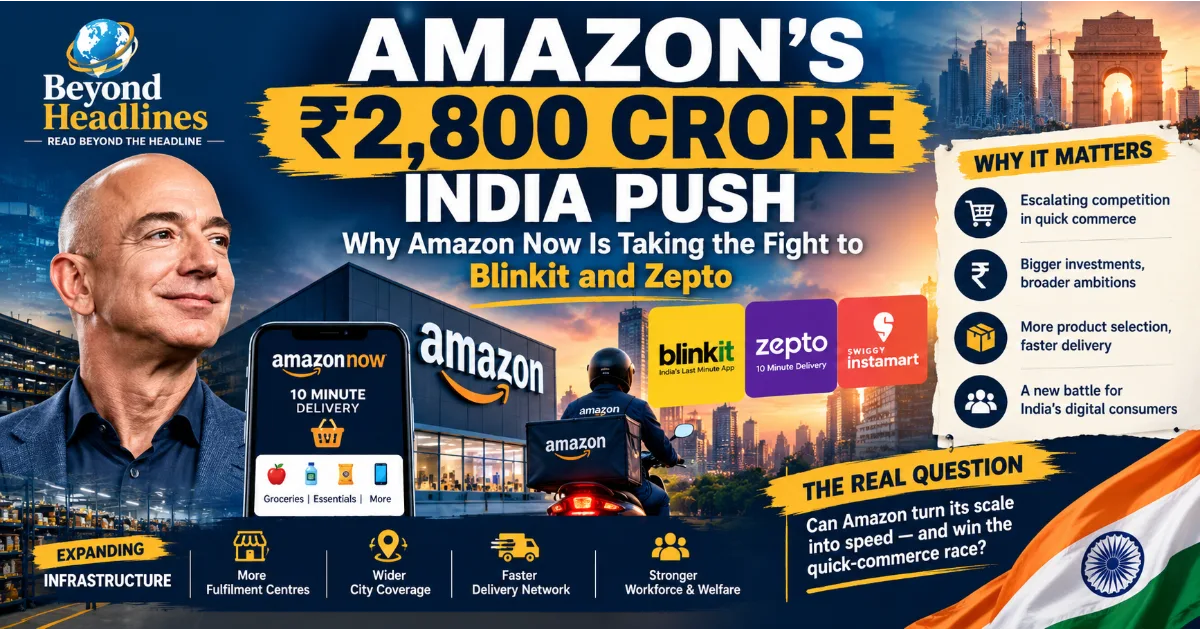
India’s quick-commerce battle has entered a new phase, and Amazon is no longer treating rapid delivery as a side experiment. The company is putting substantial money and infrastructure behind Amazon Now, its ultra-fast delivery service, as it attempts to establish a meaningful position in a market already shaped by Blinkit, Zepto and Swiggy Instamart, with Flipkart Minutes and other players expanding rapidly as well.
A widely circulated graphic describes the development as Amazon India announcing a ₹2,800 crore investment to challenge the “Zepto-Blinkit duopoly” and rapidly scale Amazon Now in metro cities. There is an important distinction to make, however. Amazon did announce an investment of more than ₹2,800 crore in April 2026, but the investment is broader than Amazon Now alone. Amazon said the money would strengthen its pan-India operations network as well as associate safety, health and financial wellbeing. At the same time, the company said part of the investment would support expansion of Amazon Now. (US Press Center)
The quick-commerce component has since moved much faster than the April announcement might have suggested. By September 15, Amazon said Amazon Now had crossed $1 billion in annualised gross sales in India, with orders doubling every quarter since launch. The service had expanded to more than 60 cities and towns through a network of more than 750 micro-fulfilment and urban fulfilment centres, and Amazon said it was on track to reach 100 cities by Diwali. (About Amazon)
That makes the real story considerably bigger than a ₹2,800 crore investment announcement.
Amazon is trying to build a nationwide quick-commerce infrastructure at the same time that the economics of the sector are becoming more demanding. Blinkit is expanding aggressively, Zepto is defending its position while preparing for a future public-market listing, Swiggy Instamart remains a major competitor and Flipkart Minutes is rapidly increasing its footprint. The result is a market where speed alone is no longer enough. Companies increasingly need dense fulfilment networks, large assortments, high order frequency, efficient inventory management and enough volume per store to make the economics work.
Amazon is entering that contest with an unusual advantage: an enormous existing e-commerce ecosystem, millions of customers, a large seller base, Prime membership, established logistics infrastructure and years of experience managing inventory and delivery at scale.
The question is whether those advantages can be translated into the hyperlocal economics of ten-minute commerce.
Amazon is no longer testing the quick-commerce market
Amazon Now launched in India in January 2025 with four micro-fulfilment centres in Bengaluru. Amazon says the initial project was designed specifically around Indian consumer behaviour and the logistical challenges of delivering thousands of everyday products within minutes. The company has since assessed more than 9,000 potential locations and has been moving toward a network of more than 1,000 micro-fulfilment centres. (About Amazon)
The significance of that trajectory should not be underestimated.
Traditional e-commerce and quick commerce are fundamentally different operational businesses.
A conventional Amazon order can travel through a large fulfilment centre, move through a sortation facility and then reach a delivery station before being delivered to the customer. The customer is generally willing to wait a day or two, and sometimes longer, because the value proposition is product selection rather than immediate availability.
Quick commerce reverses that equation.
The customer is no longer primarily asking, “Can I buy this online?”
The question becomes, “Can I have it within minutes?”
That seemingly small change has enormous implications for logistics.
A warehouse located 30 or 40 kilometres away is perfectly acceptable for next-day delivery. It is almost useless for a ten-minute delivery promise. Inventory has to be positioned much closer to customers. That means a large number of smaller facilities, carefully selected locations, local inventory forecasting, fast picking and packing, short delivery routes and a large pool of delivery workers operating within small geographic areas.
Amazon therefore needs to build something that resembles a network of neighbourhood warehouses rather than a traditional e-commerce fulfilment system.
This is why the company's investment in infrastructure matters.
What exactly is the ₹2,800 crore investment?
Amazon announced in April that it would invest more than ₹2,800 crore, approximately $300 million, to strengthen associate safety, health and financial wellbeing while expanding its pan-India operations network. The company said the investment was part of its broader plan to invest more than $35 billion in India by 2030. (US Press Center)
Amazon also said the investment would support both its core e-commerce network and quick-commerce operations.
The company planned to expand and upgrade fulfilment centres, sortation centres and delivery stations, while also more than doubling Amazon Now's footprint in cities where it was already operating and expanding into additional cities. (About Amazon)
This is important because the ₹2,800 crore figure should not be interpreted as a ₹2,800 crore cheque exclusively for fighting Blinkit and Zepto.
The money is part of a broader infrastructure and workforce investment.
Amazon has also linked the spending to delivery-associate welfare. Its programmes include Project Ashray, health and wellness initiatives, insurance and financial inclusion programmes. Amazon said Ashray rest facilities were serving more than 150,000 delivery associates each month and that the company intended to expand the network. (About Amazon)
At the same time, Amazon is investing in the infrastructure needed to make delivery faster.
That combination is significant because quick commerce is not simply a software business. It requires physical assets.
Dark stores and micro-fulfilment centres cost money to build, lease, equip and operate. Inventory has to be financed. Delivery workers have to be available. Products have to be replenished. Technology has to predict demand. Wastage must be controlled for categories such as fresh food.
Speed has a physical cost.
Amazon Now is growing unusually quickly
The most striking development in September is the speed at which Amazon Now has scaled.
Amazon said on September 15 that the service had crossed $1 billion in annualised gross sales in India based on the preceding three-month period. Orders, according to the company, have doubled every quarter since launch. Amazon described Amazon Now as the fastest-growing e-commerce business unit in its Indian operation. (About Amazon)
The service had reached more than 60 cities and towns in less than ten weeks after rapidly expanding its geographic footprint. Amazon said it was on track to reach 100 cities by Diwali. (Business Standard)
The expansion is not confined to India's biggest metros.
Amazon Now has reached cities and towns including Padubidri, Tirupati, Guntur, Gurdaspur, Jalandhar, Vellore, Dharwad, Warangal and Berhampur, alongside larger markets. (About Amazon)
That is important because India's quick-commerce market is beginning to move beyond the assumption that instant delivery is exclusively a metropolitan phenomenon.
The economics still work best where population density and purchasing power are high. But once a company has developed the technology and operational model to support quick commerce, expanding into additional urban centres can become a logical next step.
Amazon's stated longer-term ambition is even larger.
In June, the company said it planned to take Amazon Now to more than 300 cities, positioning it as potentially the largest delivery-in-minutes network in India. (About Amazon)
The sequence is therefore becoming clear.
The ₹2,800 crore investment supports the broader infrastructure.
Amazon Now is rapidly increasing its city footprint.
The company has crossed $1 billion in annualised gross sales.
And the longer-term objective is a network extending beyond 300 cities.
That is a much more serious commitment than a limited metro-city experiment.
Why Blinkit and Zepto matter
Amazon is entering a market where competitors have already spent years building consumer habits.
Blinkit has become the most visible example of the quick-commerce model in India. In Eternal's first-quarter FY27 results, Blinkit's net order value rose 86.2% year over year to ₹17,132 crore. The company added 200 stores during the quarter, taking its total to 2,443 as of June 30, 2026. Blinkit also reported positive adjusted EBITDA of ₹102 crore for the quarter. (Business Standard)
That combination is crucial.
Blinkit is no longer merely proving that customers want ten-minute delivery.
It is also demonstrating that a large quick-commerce network can move toward profitability.
Eternal has said the business is becoming more efficient as stores mature, order density rises and infrastructure investments begin generating operating leverage. Reuters reported in July that Blinkit's adjusted EBITDA margin had reached 0.6% of net order value in the June quarter and that Eternal expected the long-term margin to reach the upper end of its previous 5% to 6% range. (Reuters)
This changes the competitive equation for Amazon.
If quick commerce were still an unproven concept, Amazon could afford to experiment slowly.
But competitors are now demonstrating both consumer demand and a path toward better economics.
Amazon is therefore arriving at a point when the market is already becoming structurally important.
Zepto represents a different kind of competitor.
It is younger, more concentrated on quick commerce and has built its identity around speed and convenience. In July, reports said Zepto was preparing to raise around ₹1,000 crore in pre-IPO funding at a valuation of roughly $4.5 billion while postponing its IPO plans. (Business Standard)
The postponement does not mean the company's competitive position has disappeared. It highlights something else about the market: quick commerce now requires very large amounts of capital, and investors are paying close attention to whether these businesses can eventually convert enormous order volumes and large store networks into sustainable profits.
Amazon is entering precisely that environment.
The real competition is not about ten minutes
The phrase “ten-minute delivery” makes the market sound like a race in which the company with the fastest rider wins.
The actual competition is much more complicated.
Imagine two companies promising delivery within ten minutes.
One has 5,000 products available at a nearby store.
The other has 30,000.
The first company may be faster.
The second may still win the customer because it has the item they actually want.
This is why Amazon's traditional strength in selection could become relevant.
Amazon has spent years building one of India's largest online product catalogues. Its challenge is to translate that selection into local inventory that can be delivered rapidly.
Amazon has already begun expanding the categories available through Amazon Now. The company announced plans for more than 100 Urban Fulfilment Centres, which are larger facilities intended to provide roughly four times the selection available through the existing Amazon Now format. These facilities are designed to add categories such as apparel, electronics, jewellery, footwear, luggage, watches, wireless accessories, musical instruments and furniture to the rapid-delivery network. (About Amazon)
This could become an important differentiator.
Quick commerce started primarily with groceries, household essentials and convenience products.
It is gradually moving toward a much broader concept of instant retail.
A customer might want milk and vegetables.
But the customer might also want a phone charger, headphones, cosmetics, a kitchen accessory, a toy, a birthday gift or a small appliance.
If Amazon can make a much broader selection available within minutes, its proposition begins to look less like a grocery-delivery service and more like a compressed version of its traditional e-commerce marketplace.
That is where Amazon's existing capabilities could become strategically important.
The dark-store economics are brutal
There is, however, a major challenge.
Quick commerce requires physical density.
Eternal's experience illustrates the scale of capital involved. The company said its steady-state capital expenditure assumption per Blinkit store, including warehousing, had increased to approximately ₹2.5 crore from ₹1 crore a year earlier. (The Financial Express)
That means a large store network can require thousands of crores in cumulative investment.
Amazon has the financial capacity to make such investments, but that does not make the economics automatically attractive.
Every micro-fulfilment centre has to generate enough orders to justify its costs.
If the store is located in an area with insufficient demand, inventory sits idle and fixed costs remain.
If inventory is too limited, customers cannot find what they want.
If inventory is too large, working capital requirements rise.
If delivery distances become too long, the ten-minute promise becomes difficult.
If competition forces heavy discounts, revenue per order may not be enough to cover the cost of fulfilment and delivery.
This is why scale alone does not guarantee profitability.
The objective is not simply to have more stores.
The objective is to have stores with sufficient demand density.
Amazon's advantage is also its potential weakness
Amazon's enormous scale gives it several advantages.
It already has a huge customer base in India.
It has Prime.
It has relationships with millions of sellers.
It has established fulfilment infrastructure.
It has sophisticated supply-chain technology.
It has years of data on consumer purchasing patterns.
It has a powerful brand.
And it has the financial resources to invest for a long period.
But those strengths do not automatically translate into an advantage in quick commerce.
Quick commerce rewards hyperlocal execution.
A customer does not care that Amazon has a massive fulfilment centre 25 kilometres away.
The customer cares whether the nearby Amazon Now store has the product and whether a delivery worker can reach the address quickly.
This creates a different kind of operational discipline.
Amazon must essentially become more local while using the advantages of being a national company.
That is a difficult combination.
The Indian geography changes the equation
India's cities are not uniform grids.
Road congestion varies dramatically between neighbourhoods. Addresses can be difficult to interpret. Weather conditions can disrupt deliveries. Traffic patterns can change throughout the day. Apartment complexes can have security procedures and restricted entry. Dense urban neighbourhoods can be extremely efficient for delivery in some places and surprisingly difficult in others.
Amazon has acknowledged that the Indian environment required the company to build its quick-commerce model specifically around local conditions. The team behind Amazon Now says it assessed thousands of potential locations while developing the network. (About Amazon)
That experience could become valuable as the network expands.
Amazon's broader logistics infrastructure also gives it access to technology, routing systems and operational knowledge that smaller companies may not possess.
But established competitors have their own local expertise.
Blinkit and Zepto have built their businesses around this exact problem.
The competitive question therefore becomes one of execution.
Who can consistently put the right products in the right neighbourhood at the right time and deliver them economically?
The battle is moving from discounts to infrastructure
Another major change is happening underneath the headline competition.
The first phase of Indian quick commerce was heavily associated with discounts and customer acquisition.
Platforms wanted consumers to develop a habit.
The next phase is increasingly about infrastructure.
Eternal has said it is prioritising assortment expansion, geographic expansion and demand densification rather than simply relying on aggressive discounting. Reuters reported that the company sees larger stores and infrastructure investment as important drivers of future efficiency. (Reuters)
That is an important shift.
Once customers become accustomed to rapid delivery, the competitive advantage of another ₹20 discount may diminish.
Instead, customers may care more about availability, reliability, selection and delivery time.
Amazon is particularly well positioned for this stage because its historical business has been built around selection and logistics rather than only discounts.
The company can potentially connect its traditional marketplace with quick commerce.
That creates a broader strategic possibility.
Amazon Now does not have to replace Amazon's existing e-commerce operation.
It can complement it.
A customer could receive groceries and household essentials within minutes, another category later the same day and a more specialised product the next day.
Amazon is effectively trying to create multiple delivery speeds within the same ecosystem.
The company itself has described its proposition in those terms, with products available in minutes or hours, a wider selection available the same day, millions of products available the next day and Prime delivery for broader selection. (About Amazon)
That is more ambitious than simply competing for grocery orders.
Amazon is also betting on the festive season
The timing of the latest expansion is significant.
India's festive shopping season can dramatically increase online demand.
Amazon has announced a broader operations expansion for the festive period, including 20 new fulfilment centres, six new sortation centres and 150 new last-mile delivery stations. The company said the expansion would increase storage capacity by 50% to 64 million cubic feet. (About Amazon)
Amazon has also announced 160,000 seasonal job opportunities across its operations network, covering both core and quick-commerce operations across roughly 400 cities. (About Amazon)
This creates an unusually important testing period for Amazon Now.
Festivals can generate spikes in demand for groceries, snacks, beverages, personal care, gifts, electronics and household products.
If Amazon Now can handle that demand while maintaining its delivery promise, the company could use the festive season to build customer habits.
The objective is not necessarily to convince customers to order everything through Amazon Now.
It is to make the service feel reliable enough that consumers begin to think of Amazon when they need something immediately.
That is a different psychological position from traditional online shopping.
The meaning of $1 billion in annualised sales
Amazon's announcement that Amazon Now crossed $1 billion in annualised gross sales is significant, but the terminology needs to be understood correctly.
Annualised sales are not the same thing as $1 billion in revenue already generated during a full year.
It is a run-rate calculation based on recent performance.
That distinction matters because Amazon Now remains a relatively young business.
Still, the milestone provides an indication of how quickly the service has scaled.
Amazon said orders have doubled every quarter since launch, and the service expanded to more than 60 cities in less than ten weeks. (About Amazon)
Those are strong growth indicators.
But the next question is more difficult.
Can that growth translate into sustainable profitability?
Revenue growth alone does not answer that question.
The company has to consider fulfilment-centre costs, employee and delivery-partner expenses, inventory, wastage, technology, discounts, customer acquisition and the cost of expanding into new cities.
Amazon has not disclosed a standalone profitability figure for Amazon Now in the public announcements cited here.
That means the $1 billion milestone should primarily be viewed as evidence of customer demand and rapid scale, not proof that the business has already reached mature profitability.
Why the “duopoly” description needs caution
The viral graphic describes the market as a Zepto-Blinkit duopoly.
That description reflects their importance, but the current Indian quick-commerce market is broader than two companies.
Swiggy Instamart remains a major national player. Flipkart Minutes has expanded rapidly. BigBasket is active in the category. Amazon Now is expanding. Other companies are also experimenting with rapid delivery.
Recent mapping by CLSA, reported by Moneycontrol, showed Blinkit with the largest dark-store presence across India's top 10 cities, followed by Zepto and other competitors, while Flipkart Minutes had overtaken Swiggy Instamart in dark-store count across those markets. (Moneycontrol)
Business Standard reported in September that the quick-commerce footprint had expanded to 477 cities nationally, with thousands of dark stores across the leading platforms. It also reported that Blinkit, Zepto, Swiggy Instamart, Flipkart Minutes and BigBasket were all part of the competitive landscape. (Business Standard)
So Amazon is not simply entering a two-player market.
It is entering a rapidly consolidating but highly competitive multi-player ecosystem.
What Amazon could bring to the market
Amazon's arrival could have effects beyond its own market share.
Competition can pressure platforms to improve delivery reliability.
It can encourage wider product selection.
It can accelerate investment in fulfilment infrastructure.
It can push companies to develop more efficient inventory systems.
It can also influence pricing and customer expectations.
For consumers, the most visible outcome could be an expansion in the number of products that can be delivered rapidly.
Quick commerce originally focused on products people bought frequently.
Amazon's strategy could help push the sector toward products people buy less frequently but still occasionally need immediately.
A customer who suddenly needs a laptop accessory, beauty product, kitchen appliance or gift could potentially consider a rapid-delivery platform rather than visiting a physical store.
That expands the addressable market.
It also raises the value of Amazon's enormous catalogue.
But speed has a limit
There is another question that the industry will eventually have to confront.
How much speed does the consumer actually need?
There is a difference between wanting a product today and wanting it in ten minutes.
The additional speed requires additional infrastructure.
If a customer is happy to wait two hours, a larger fulfilment centre can serve many neighbourhoods.
If the customer expects ten minutes, the inventory has to be much closer.
That increases cost.
The economic model therefore depends on customers placing enough orders frequently enough to justify the infrastructure.
This is why demand density matters so much.
A successful quick-commerce store is not simply a warehouse.
It is a neighbourhood economic engine.
The more customers it serves, the more efficiently its fixed costs can be distributed across orders.
That is also why the battle for dense urban neighbourhoods remains so important even as companies announce expansion into hundreds of cities.
The next phase will be about selection and profitability
Amazon's latest moves suggest that the quick-commerce race is evolving.
The first question was whether Indians would order groceries online.
The second was whether they would pay for ten-minute delivery.
The third is whether companies can make that model profitable.
Now another question is emerging.
Can quick commerce become a full-scale retail infrastructure?
Amazon's strategy points strongly in that direction.
Its Urban Fulfilment Centres are designed to broaden the assortment beyond traditional quick-commerce products. Its micro-fulfilment network is expanding rapidly. Its existing seller ecosystem provides a potential source of additional inventory. And its traditional logistics infrastructure can support delivery speeds ranging from minutes to days. (About Amazon)
If that strategy succeeds, Amazon Now could become more than another grocery-delivery application.
It could become the rapid-delivery layer of Amazon's entire Indian marketplace.
That would make the competition considerably more consequential.
What to watch next
The next several quarters will provide more meaningful evidence than the investment announcement itself.
One key metric will be order frequency.
Amazon says orders have been doubling every quarter, but sustained growth will require consumers to make Amazon Now a regular part of their shopping routine.
Another will be average order value.
A larger basket can make fulfilment economics more attractive, provided customers do not rely excessively on discounts.
A third will be store productivity.
Opening hundreds of fulfilment centres is relatively straightforward for a company with enough capital.
Making each centre economically productive is considerably harder.
A fourth will be assortment.
If Amazon can use its broader marketplace to offer products that competitors cannot easily provide through quick commerce, it could create a meaningful reason for consumers to choose Amazon Now.
A fifth will be profitability.
That will ultimately determine whether the expansion is merely a race for market share or the foundation of a sustainable retail business.
And finally, investors and consumers will watch what happens to the competitive structure.
Blinkit is expanding.
Zepto is preparing for the next stage of its corporate journey.
Swiggy and Flipkart are continuing to invest.
Amazon has entered with enormous resources.
The market may therefore become more competitive before it becomes more consolidated.
The bigger story behind Amazon’s ₹2,800 crore
The headline number is ₹2,800 crore.
The more important number may eventually be $1 billion.
But neither number tells the whole story.
The ₹2,800 crore investment is broader than Amazon Now. It covers operations infrastructure and associate welfare as well as quick commerce. (US Press Center)
The $1 billion figure is an annualised gross-sales run rate rather than a year's realised revenue. (About Amazon)
The more revealing development is the speed with which Amazon is expanding the physical infrastructure needed to make instant commerce work.
Amazon Now went from a small experiment launched in Bengaluru to more than 60 cities and towns in a remarkably short period. Amazon says it is targeting 100 cities by Diwali and more than 300 cities over the longer term. (About Amazon)
That puts Amazon directly into one of India's most important consumer-technology battles.
Blinkit has built a large and increasingly efficient network.
Zepto has established a strong quick-commerce brand and continues to raise capital for its next stage.
Swiggy remains deeply embedded in India's food and delivery ecosystem.
Flipkart is aggressively expanding Minutes.
Amazon brings something different: an existing nationwide marketplace, a massive logistics operation, Prime, millions of sellers and the financial ability to invest for years.
The outcome will depend on how effectively Amazon combines those assets with the hyperlocal execution required by quick commerce.
The real battle is therefore not simply Amazon versus Blinkit or Amazon versus Zepto.
It is a battle over how Indians will shop in the next decade.
Will consumers continue to divide their shopping between supermarkets, traditional e-commerce and specialised quick-commerce apps?
Or will a single ecosystem eventually provide everything from groceries needed in ten minutes to electronics delivered the next day?
Amazon's strategy suggests it wants the second possibility.
The company is trying to build an infrastructure in which delivery speed becomes a choice rather than a separate shopping category.
Minutes.
Hours.
Same day.
Next day.
That is the larger vision behind Amazon Now.
And if the company succeeds in making that model economically sustainable, India's quick-commerce competition will no longer be just about who can deliver groceries fastest.
It will be about who can build the most efficient retail infrastructure closest to the consumer.
For Blinkit and Zepto, Amazon's expansion represents a company with enormous financial resources entering their core battlefield.
For Amazon, the challenge is equally significant. It has to prove that the world's largest e-commerce companies can translate traditional scale into neighbourhood-level speed without allowing the cost of that speed to overwhelm the economics.
The next phase of India's quick-commerce story will be decided not by the loudest delivery promise, but by the companies that can make speed, selection, convenience and profitability work together.
That is why Amazon's ₹2,800 crore investment deserves attention.
The money is only the beginning.
The real contest is for the doorstep.
#BeyondHeadlines #AmazonIndia #AmazonNow #Amazon #QuickCommerce #QuickCommerceIndia #Blinkit #Zepto #SwiggyInstamart #FlipkartMinutes #EcommerceIndia #IndianEcommerce #DigitalCommerce #RetailIndia #AmazonInvestment #AmazonNowIndia #IndianStartups #StartupNews #BusinessNews #TechnologyNews #ConsumerTech #EcommerceNews #DarkStores #MicroFulfilment #QuickDelivery #IndiaBusiness #IndiaEconomy #RetailTech #FutureOfRetail #BeyondTheHeadline