
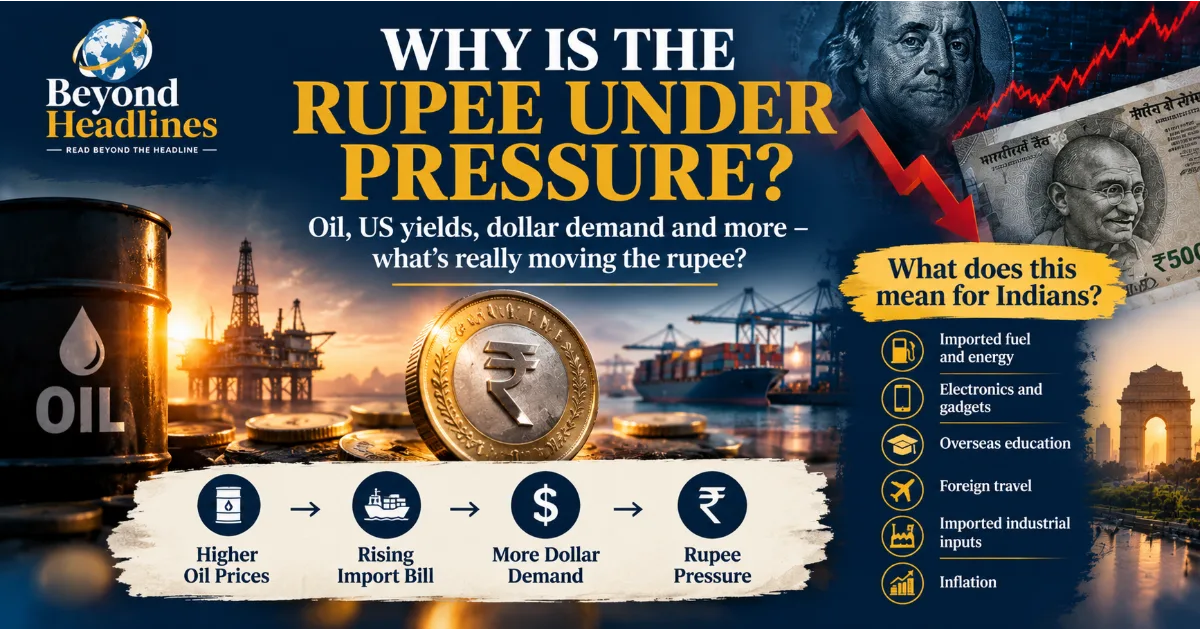
The Indian rupee has once again moved close to a psychologically important level against the US dollar, and the latest weakness is not being driven by one isolated event. It is the result of several forces operating at the same time: elevated crude oil prices, stronger demand for dollars from Indian importers, rising US Treasury yields, expectations of tighter US monetary policy, global geopolitical uncertainty and changing capital flows. On September 15, the rupee fell to 95.96 per US dollar, its weakest level since late July, after losing about 1.2% over five trading sessions. On September 16, it remained close to the 96-per-dollar level as financial markets waited for the US Federal Reserve's policy decision.
The number itself can look alarming because exchange rates are highly visible. A move from ₹90 to ₹96, for example, means that an importer needs more rupees to purchase the same amount of dollars. But the more important question is not simply whether the rupee is approaching ₹96. The important question is why the currency is under pressure and how long those pressures could last. The answer involves India's dependence on imported energy, the international role of the US dollar, interest-rate differences between countries, foreign capital movements and the Reserve Bank of India's role in managing excessive currency volatility.
The current episode is particularly important because crude oil prices have risen sharply at the same time that US bond yields have climbed. Brent crude has been trading above $100 a barrel, reaching around $107 to $108 in recent sessions, while the US 10-year Treasury yield has moved above 5%. Those two developments matter considerably for India because higher oil prices increase the country's dollar requirements, while higher US yields can make dollar-denominated assets relatively more attractive to international investors. Reuters reported on September 15 that the rupee had fallen more than 1% during the previous week as oil remained above $100 and expectations of a Federal Reserve rate hike increased.
The first pressure point is oil
To understand the rupee, it is useful to begin with crude oil. India is one of the world's major energy consumers, but a substantial share of the crude oil used by its refineries comes from abroad. Reuters reported on September 14 that India imports nearly 85% of its oil requirements, with more than half of those imports coming from the Middle East. This makes the country's external accounts sensitive to international oil prices.
Imagine that an Indian oil company needs to purchase $10 billion worth of crude. If the price of oil rises substantially while the quantity imported remains broadly similar, the company needs more dollars. To obtain those dollars, it generally needs to buy them in the foreign-exchange market using rupees. When many companies simultaneously need more dollars, demand for the US currency increases. If the supply of dollars does not rise proportionately, the rupee can come under downward pressure.
This relationship does not mean that every increase in crude prices automatically produces an equivalent fall in the rupee. Currency markets are influenced by many other factors. Export receipts, foreign investment, remittances, central-bank intervention, portfolio flows and the broader direction of the dollar all matter. Nevertheless, oil is particularly important for India because energy imports represent a large structural demand for foreign currency.
The latest oil shock has been connected to supply disruptions and geopolitical tensions in the Middle East. Brent crude moved above $100 and was trading around $107 to $108 in the middle of September. Reuters and other market reports have linked the elevated prices to disruptions and uncertainty surrounding regional energy supplies.
The problem becomes more complicated when expensive oil and a weaker rupee occur together. Suppose crude remains at $100 a barrel, but the exchange rate moves from ₹90 to ₹96 per dollar. The dollar price of the oil has not changed, but the rupee cost of purchasing that oil has increased. That is the basic mechanism through which currency depreciation can amplify the domestic impact of an international commodity shock.
For consumers, however, the final effect is not as simple as multiplying the oil price by the exchange rate. Indian fuel prices depend on international crude prices, refinery costs, taxes, transportation, marketing margins and government policy, among other factors. A weaker rupee therefore does not mechanically translate into an identical increase at petrol pumps. The broader economic impact can instead appear through several channels, including transportation costs, industrial inputs, petrochemicals, logistics and imported goods.
The second pressure point is the US dollar
The rupee is also being affected by the strength of the US dollar globally. The dollar remains the principal currency for international trade and financial transactions, particularly commodities such as crude oil. When investors and companies increase their demand for dollars, emerging-market currencies can face pressure.
The dollar's strength is closely connected to expectations about US interest rates and Treasury yields. As of September 16, markets were preparing for a Federal Reserve decision that traders widely expected to involve a 25-basis-point increase, potentially taking the US policy range to 3.75% to 4%. Reuters reported that the decision would be the first US rate increase since 2023, with investors paying close attention not only to the decision itself but also to Federal Reserve Chair Kevin Warsh's comments about the future path of monetary policy.
Higher US interest rates can influence currency markets because they change the relative attractiveness of dollar-denominated assets. If US government bonds offer higher yields, some global investors may prefer holding more US assets, particularly when uncertainty is elevated elsewhere. The resulting demand for dollars can put pressure on emerging-market currencies.
This is one reason why the US Treasury market matters to India even though it is thousands of kilometres away. A rise in US yields can affect the cost and attractiveness of capital across the global financial system. Indian government bonds, corporate debt, equities and the rupee all exist within this international capital environment.
The current situation has been particularly notable because the US 10-year Treasury yield crossed 5%. Moneycontrol reported that the benchmark yield had moved above that level while Brent crude remained above $100, creating what analysts described as a difficult combination for the rupee.
There is another important connection. Higher oil prices can themselves contribute to inflation expectations in the United States and elsewhere. If investors believe inflation will remain elevated because energy costs are rising, they may expect central banks to keep interest rates higher for longer. That can reinforce upward pressure on bond yields and the dollar.
In other words, oil and US interest rates are not completely separate stories. They can reinforce each other through inflation expectations and monetary policy.
Why the Federal Reserve matters to India
The US Federal Reserve does not set Indian interest rates, but its decisions can have major consequences for Indian financial markets.
When the Federal Reserve raises rates or signals that rates could remain high, global investors reassess the relative returns available in different countries. India may continue to offer attractive growth prospects, but investors also consider currency risk. An investment that generates a strong rupee return can produce a weaker dollar return if the rupee depreciates significantly.
This does not mean that foreign investors automatically leave India whenever the Federal Reserve raises rates. Capital flows depend on many factors, including corporate earnings, economic growth, valuations, fiscal conditions and investor expectations. India can continue attracting capital even during periods of strong dollar demand.
The important point is that higher US yields can change the international financial environment in which Indian assets are priced.
That pressure becomes more significant when India is simultaneously dealing with expensive oil. One force increases demand for dollars from importers, while another can increase the attractiveness of dollar assets. The result is a more difficult environment for the rupee.
Reuters reported on September 16 that the rupee had closed at ₹95.9550 per dollar after briefly touching ₹95.9750. The report attributed the recent weakness to strong dollar demand from Indian companies and expectations of a Federal Reserve rate increase, while noting that RBI intervention had helped keep the currency from weakening further.
What exactly does a weaker rupee mean for ordinary Indians?
For most people, the exchange rate matters not because they trade currencies every day, but because the rupee is connected to the prices of goods, services and financial obligations that involve foreign currencies.
The most direct impact can be seen in imported goods. Electronics, components, machinery, chemicals, industrial equipment and certain pharmaceutical inputs may become more expensive in rupee terms when the currency weakens, assuming international prices remain unchanged.
A smartphone imported for $500 illustrates the basic mathematics. At ₹90 to the dollar, the dollar component of the price is equivalent to ₹45,000. At ₹96, the same $500 becomes ₹48,000 before taxes, distribution costs, retailer margins and other expenses are considered. The actual retail price may not move by the same proportion because companies hedge currency risk, negotiate contracts in advance, maintain inventory or adjust margins.
The same principle applies to businesses importing machinery. A manufacturer planning to purchase a $1 million machine from abroad would need ₹90 crore at an exchange rate of ₹90 per dollar, compared with ₹96 crore at ₹96 per dollar, before considering financing and other transaction costs. For businesses operating with narrow margins, exchange-rate movements can therefore become significant.
Overseas education is another area where currency movements can become visible to households. Tuition fees and living expenses are often denominated in foreign currencies. A family sending money abroad therefore needs more rupees when the rupee weakens, assuming the foreign-currency cost remains unchanged.
Foreign travel can also become more expensive for the same reason. Hotel bookings, international flights, foreign-currency spending and other overseas expenses can all be affected by the exchange rate.
However, there is another side to currency depreciation. Indian exporters receive foreign-currency revenues. When those revenues are converted into rupees, a weaker rupee can increase the rupee value of their earnings, provided their costs and other factors remain constant. This is one reason why the effect of currency depreciation differs across sectors.
An exporter who earns dollars but has most of its costs in rupees can benefit from a weaker domestic currency. An importer that pays for raw materials in dollars can face the opposite effect. Companies with both exports and imports may experience a more complicated result.
This is why it is misleading to describe a weaker rupee as universally good or universally bad for every company and every household. The economic effect depends heavily on exposure to foreign currencies.
The inflation connection
One of the biggest concerns surrounding prolonged rupee weakness is imported inflation.
India's retail inflation accelerated to 4.82% in August 2026 from 4.45% in July, according to government data reported by Reuters. The August reading was the highest under the new inflation series that began in January, while food inflation also increased. Reuters noted that rising crude prices were adding to concerns about future inflation.
Currency depreciation can add to this problem because imported products become more expensive in rupee terms. Energy is particularly important because oil affects transportation, manufacturing and logistics throughout the economy.
Consider a simple supply chain. Crude oil is imported and processed into fuels and petrochemical products. Fuel is then used to transport goods. Businesses also use petroleum-based products and energy-intensive inputs. If the cost of those inputs rises, companies face a choice between absorbing the additional expense and passing some of it on to customers.
The final inflation effect depends on the scale and duration of the shock. A short period of rupee weakness may have limited consequences if oil prices fall or companies absorb some of the additional costs. A prolonged combination of expensive oil and currency depreciation presents a more difficult challenge because businesses have more time to adjust prices and expectations can change.
This is one reason the Reserve Bank of India watches the currency even though its formal monetary-policy framework is centred on inflation and economic conditions rather than targeting a particular exchange-rate level.
The RBI's role
The Reserve Bank of India does not generally announce a fixed rupee value that it promises to defend indefinitely. Instead, the central bank can intervene in the foreign-exchange market to manage excessive volatility and maintain orderly market conditions.
When the RBI sells dollars, it increases the supply of dollars available to the market and absorbs rupees. This can reduce the speed or intensity of a currency decline, depending on market conditions.
Recent reports indicate that RBI intervention has been an important factor limiting the rupee's losses. Reuters reported on September 16 that persistent intervention had helped keep the currency above the ₹96 level in recent sessions.
The RBI also has a significant reserve buffer. Reuters reported earlier in September that India's foreign-exchange reserves had reached a record $729.33 billion in the week ended August 21 after the central bank attracted substantial foreign-currency inflows through special measures. Those measures generated $136.38 billion in total inflows, including $127.23 billion through non-resident foreign-currency deposits.
Those inflows strengthen the central bank's capacity to manage short-term foreign-exchange pressure. But they are not equivalent to free money. Foreign-currency deposits create future liabilities because the funds eventually have to be returned according to the terms of the arrangements. Reuters reported that the RBI's forward foreign-currency liabilities had increased significantly as a result of the inflows.
This illustrates an important distinction in understanding currency management. A central bank can reduce volatility and smooth market conditions, but it cannot permanently eliminate the economic forces that create demand for dollars. If oil remains extremely expensive for an extended period or global interest rates remain elevated, underlying pressure can continue even when intervention limits day-to-day movements.
Why ₹96 matters psychologically
Currency markets are influenced by numerical levels because traders and businesses often monitor specific exchange-rate thresholds. The move toward ₹96 therefore attracts attention not simply because of the number itself, but because markets interpret certain levels as technical or psychological markers.
On September 15, the rupee closed at ₹95.96 after falling 0.4% in a single session. The currency had already weakened over several consecutive sessions.
But crossing a round number such as ₹96 does not automatically create a new economic crisis. Exchange rates are continuously moving prices, and a one-rupee change should be viewed in the context of broader trends rather than treated as an isolated event.
What matters more is whether the underlying pressures persist. If crude oil retreats substantially, US yields decline and dollar demand eases, the rupee could experience less pressure. If oil remains elevated while US monetary policy becomes tighter and global investors continue preferring dollar assets, the pressure could persist.
That is why analysts have focused on the interaction between crude prices and US yields rather than the ₹96 level alone.
The bigger issue is the trade balance
India's currency position is closely connected to its external trade.
When a country imports more goods and services than it exports, it needs sufficient foreign-currency inflows from exports, services, remittances, investments and other sources to finance the external deficit.
India has important sources of foreign-currency earnings. Its services exports, particularly information technology and business services, generate substantial dollar revenues. Remittances from Indians working abroad are another major source of foreign exchange. Foreign direct investment and portfolio flows can also provide capital.
These inflows can offset some of the foreign-currency demand generated by oil and other imports.
The challenge emerges when several pressures occur together. If the oil bill rises sharply at the same time as portfolio flows weaken and the dollar strengthens globally, the currency can face greater stress.
Conversely, strong services exports, robust remittances and sustained investment inflows can provide support.
This explains why the rupee cannot be understood simply by looking at India's oil imports. The entire balance of payments matters.
Does a weaker rupee automatically mean the Indian economy is weakening?
Not necessarily.
Exchange rates reflect relative prices and global financial conditions as well as domestic economic performance. A country can experience currency depreciation even when its economy continues to grow because external shocks can dominate currency markets for a period.
India's first-quarter economic growth was reported at 7.8% in recent data, while inflation has been rising. That combination creates a complicated policy environment because strong growth can coexist with external pressures and rising prices.
The current rupee movement should therefore not be interpreted as a single measure of the health of the Indian economy. The currency is one indicator among many.
At the same time, persistent depreciation can create economic consequences if it raises imported costs and inflation expectations. The distinction is important. A weaker currency is not itself proof of economic weakness, but prolonged currency weakness can become an economic problem under certain conditions.
What should Indians watch next?
The next phase of the rupee story will depend heavily on a few interconnected variables.
The first is crude oil. If Brent prices remain above $100 for an extended period, India's import bill could remain under pressure. If supply conditions improve and crude prices fall substantially, some of the immediate pressure on the currency could ease.
The second is the Federal Reserve. Markets are watching not only the September policy decision but also what US officials signal about future interest rates. Reuters reported that investors were particularly focused on Chair Kevin Warsh's communication and whether the September move would represent the beginning of a broader tightening cycle.
The third is US Treasury yields. A sustained yield above 5% would keep the global interest-rate environment challenging for emerging-market currencies, particularly if the dollar remains strong.
The fourth is capital inflows into India. Foreign investment, non-resident deposits and other foreign-currency flows can provide an important counterweight to importer demand for dollars.
The fifth is the RBI's response. Market participants will continue watching whether the central bank intervenes aggressively enough to limit volatility and how it manages the liquidity consequences of foreign-currency inflows.
Finally, inflation will matter. India's August retail inflation reading of 4.82% was already above the RBI's 4% medium-term target, making the combination of a weaker rupee and expensive energy particularly important for monetary policy.
The rupee story is bigger than a single exchange-rate number
The image of a rupee coin falling against a rising dollar chart captures only one part of what is happening. The real story is a chain of interconnected forces.
Higher oil prices increase India's foreign-currency requirements. Greater demand for dollars can pressure the rupee. A weaker rupee raises the rupee cost of imported goods. Higher US yields can encourage global investors to favour dollar assets. Stronger dollar demand can place additional pressure on emerging-market currencies. If imported costs begin feeding into domestic prices, inflation becomes another part of the equation. The RBI can intervene to manage excessive volatility, but intervention cannot permanently remove structural demand for foreign currency.
That is why the question is not simply whether the rupee reaches ₹96, ₹97 or another round number. The more important question is what happens to the forces behind the exchange rate.
If oil prices moderate, US yields stabilise and capital inflows remain strong, pressure could ease. If oil remains expensive, the dollar remains strong and global interest rates stay elevated, the currency could continue facing challenging conditions. The outcome will depend on the interaction of these forces rather than any single headline.
For Indian households, the practical lesson is equally important. A currency headline should not automatically be interpreted as a direct change in everyone's cost of living. The impact varies according to whether a household buys imported products, pays foreign-currency expenses, travels abroad, sends money overseas or remains largely exposed to domestically produced goods and services.
For businesses, the effect depends on whether they are importers, exporters or a combination of both. For policymakers, the challenge is to balance currency stability, inflation, growth, liquidity and financial-market conditions without treating any one indicator in isolation.
The rupee's latest move is therefore best understood as a window into the wider global economy. India's currency is being pulled by oil markets, US monetary policy, international capital flows and domestic economic conditions simultaneously. What happens next will depend not only on New Delhi and Mumbai, but also on events in Washington, global bond markets, energy markets and the geopolitics of the Middle East.
That is the part of the story beyond the headline. ₹96 per dollar is the number people see. Oil, interest rates, capital flows, inflation and global risk are the forces underneath it.
#BeyondHeadlines #Rupee #IndianRupee #USDINR #IndiaEconomy #IndianEconomy #RBI #USFederalReserve #CrudeOil #OilPrices #Inflation #CurrencyMarkets #Forex #Dollar #IndianMarkets #GlobalEconomy #BusinessNews #EconomicNews #IndiaNews #FinancialNews #BeyondTheHeadline