
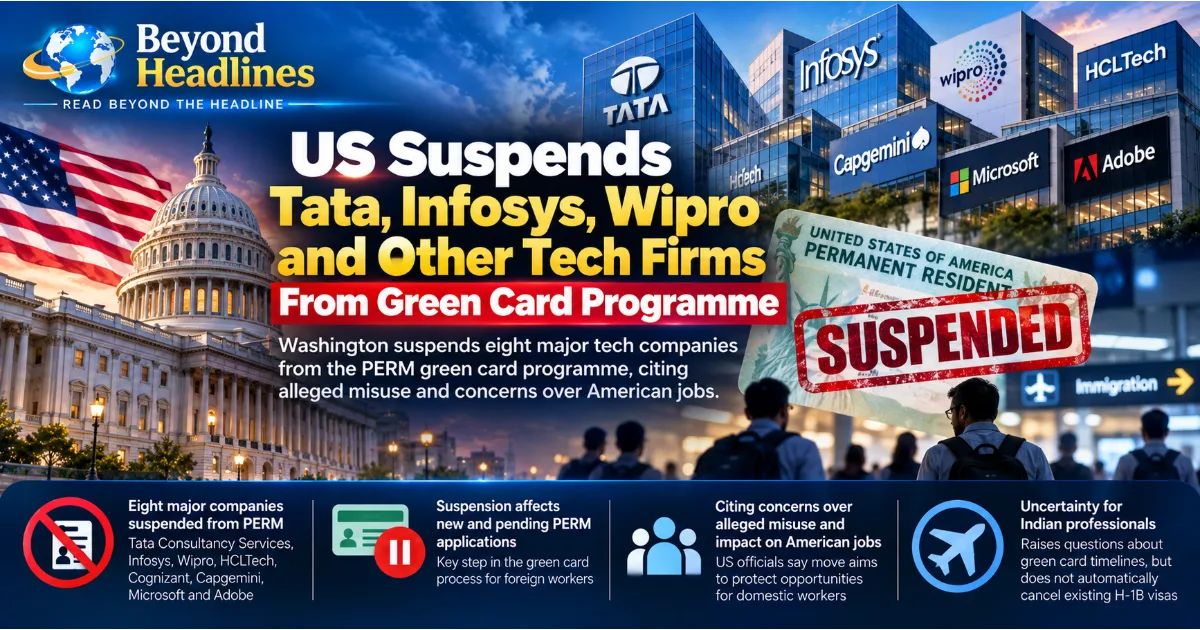
The United States has taken a significant step in its effort to tighten employment-based immigration rules, suspending eight major technology companies from a programme that helps employers sponsor foreign workers for permanent residency. The companies named in the October 8, 2026 announcement include Tata Consultancy Services, Infosys, Wipro, HCL Technologies, Cognizant, Capgemini, Microsoft and Adobe. The decision has raised concerns among Indian technology professionals who are working in the United States and hoping to secure long-term residency through employer sponsorship.
The move comes amid a wider debate in Washington about immigration, employment opportunities for American workers and the role of foreign professionals in the technology sector. US officials have accused the affected companies of misusing the employment-based immigration system and allowing foreign recruitment practices to disadvantage domestic workers. The administration has said it intends to scrutinise the companies' compliance with labour certification requirements while prioritising employment opportunities for Americans.
For Indian IT professionals, the announcement touches on something much larger than a corporate dispute. For many workers, a US job represents years of education, professional development, relocation, financial planning and family sacrifice. Permanent residency can provide greater stability, allow families to plan their futures and reduce dependence on temporary immigration status. Any interruption to the process can therefore create uncertainty that extends well beyond the workplace.
However, the announcement needs to be understood carefully. The US government has suspended the named companies from the Permanent Labour Certification programme, commonly known as PERM. This is an important step in many employment-based green card cases, but it is not the same as cancelling every green card, banning all Indian workers from the United States or automatically terminating existing H-1B visas.
The distinction matters because immigration headlines can easily create confusion among workers and families trying to understand what has actually changed. The immediate concern is the processing of PERM applications associated with the affected employers. The longer-term implications will depend on the investigations, the government's subsequent decisions and the ability of companies and employees to navigate the immigration system under the new restrictions.
The development also raises broader questions about the future of India's technology services industry in the United States. Indian IT companies have spent decades building client relationships, delivery centres and professional networks in the American market. They now face a policy environment in which immigration compliance, local hiring and the movement of skilled workers are receiving renewed scrutiny.
Understanding the announcement requires looking beyond the list of companies. It is necessary to examine how PERM works, why the US government has taken action, how Indian professionals may be affected and what the decision could mean for the relationship between the American technology industry and India's IT services sector.
What Exactly Has the US Government Suspended?
The decision announced on October 8, 2026, targets the Permanent Labour Certification programme, known as PERM. The programme is administered by the US Department of Labor and is an important part of the process through which employers sponsor certain foreign workers for employment-based permanent residency.
The companies identified in the announcement are Microsoft, Adobe, Cognizant, Infosys, Tata Consultancy Services, Wipro, HCL Technologies and Capgemini. US officials said the department would stop accepting new PERM applications from these companies and would not continue processing their pending applications while the suspensions and related investigations remain in effect.
The government has framed the action as an effort to address suspected misuse of employment-based immigration procedures. Officials have raised concerns about whether some employers are adequately protecting opportunities for American workers and complying with the requirements that apply when companies seek to sponsor foreign employees.
These are allegations and grounds cited by the administration, not a blanket judicial finding that every affected company has committed fraud. The distinction is important because the companies operate across different businesses, employ workers in different circumstances and may have different compliance records. The investigations and any subsequent proceedings will determine the specific issues that need to be resolved.
The immediate effect is that the affected employers cannot proceed normally with the relevant PERM applications. Workers whose immigration plans depend on those applications may face delays or uncertainty while the restrictions remain in place.
However, the announcement should not be interpreted as a general suspension of every immigration programme used by these companies. PERM is one component of the employment-based immigration system. It is distinct from the H-1B temporary work visa programme, and the suspension described in the announcement does not automatically cancel existing H-1B visas.
For workers, this means the specific stage of their immigration case matters. Someone who has not yet started the PERM process may face a different situation from someone whose labour certification application is pending or whose employer has already completed that stage. Other people may have progressed further toward permanent residency and need to establish how the new action affects their particular circumstances.
Understanding PERM and the Green Card Process
The PERM programme exists to help ensure that hiring a foreign worker for a particular permanent job does not improperly disadvantage qualified American workers. In many employment-based green card cases, an employer must complete labour certification before it can file the relevant immigrant petition.
The process generally requires the employer to define the position, establish the applicable job requirements and undertake recruitment designed to determine whether qualified, willing and available US workers can fill the role. The employer must follow the applicable rules and document the recruitment process.
If the requirements are satisfied, the employer can submit a PERM application to the Department of Labor. Approval of the labour certification is not itself a green card. It allows the employer to move to the next relevant stage, which typically involves an immigrant petition filed with US Citizenship and Immigration Services.
The worker must then satisfy the requirements for the relevant immigrant category. Depending on the category and circumstances, the process may also involve an immigrant visa application or adjustment of status, together with background checks and other eligibility requirements. Visa availability and country-specific backlogs can add further delays.
This is particularly important for Indian professionals because employment-based immigration categories have historically faced substantial demand from India. Even when an employer successfully completes one stage, the worker may have to wait for a visa number to become available before completing the process.
PERM is therefore a gateway in many employer-sponsored cases, but it is not the entire immigration system. Suspending this stage can prevent affected employers from moving cases forward, yet the consequences for individual workers depend on where their cases stand and which immigration category applies.
A worker should not assume that a green card has been cancelled simply because a company's PERM applications have been suspended. Nor should a worker assume that an existing visa or pending application is automatically unaffected. The correct interpretation depends on the specific status of the case and the scope of the government's order.
Why Has Washington Taken This Step?
The Trump administration has made domestic employment a central part of its immigration policy. Its stated position is that employers should prioritise American workers and that temporary and employment-based immigration programmes must not be used to avoid hiring qualified domestic candidates.
The affected companies operate in an industry where international recruitment is common. Technology businesses often need professionals with experience in enterprise software, cloud computing, cybersecurity, data engineering, application development and large-scale digital transformation. Employers may recruit internationally when they believe that the necessary skills are difficult to obtain locally or when particular projects require specialised expertise.
US officials have questioned whether some companies have used foreign-worker programmes in ways that disadvantage American employees. The suspension forms part of a broader enforcement effort involving scrutiny of immigration-related hiring practices and investigations into alleged violations.
The government has also pointed to the scale of foreign-worker requests made by the companies over a period extending back to 2009. During the announcement, officials cited nearly three million requests for foreign workers by the named firms collectively. That figure was used to illustrate the scale of their participation in employment-related immigration programmes.
However, the number should not be confused with three million permanent residents, three million approved green cards or three million workers currently employed in the United States. Requests made over many years can involve different programmes, stages and outcomes. Some applications may be denied, withdrawn, duplicated across reporting categories or relate to workers whose circumstances subsequently changed.
The figures also need to be interpreted in the context of the size of the businesses concerned. Large multinational technology companies may submit substantial numbers of immigration applications because they employ thousands of professionals across multiple locations. The volume of applications alone does not establish that a company has violated the law.
The key questions are whether the companies complied with the applicable requirements, whether recruitment processes were genuine, whether the information supplied was accurate and whether any identified practices improperly disadvantaged American workers. Those questions require evidence and a company-specific assessment rather than conclusions based solely on aggregate figures.
Why Are Indian IT Companies in the Spotlight?
Indian technology services companies have developed a major presence in the US market over several decades. Tata Consultancy Services, Infosys, Wipro, HCL Technologies and Cognizant serve customers across banking, healthcare, retail, manufacturing, telecommunications, insurance and government-related industries.
Their business models often involve a combination of local employees, professionals temporarily assigned to client locations, teams working from offshore delivery centres and specialists supporting projects across multiple countries. This arrangement allows companies to combine local customer engagement with large technical teams in India and other delivery locations.
The model has helped US companies access specialised skills and manage technology costs. Indian IT firms have supported software modernisation, enterprise resource planning, cloud migration, cybersecurity, data management and digital transformation programmes. Many American businesses depend on technology services that require teams spread across several locations and time zones.
At the same time, the model has attracted criticism over wages, recruitment practices and the potential replacement of domestic workers. Critics argue that some employers may use immigration programmes to recruit foreign workers at lower costs or maintain staffing arrangements that limit opportunities for American professionals.
Industry representatives have challenged broad generalisations about foreign workers. They argue that skilled immigration allows companies to access specialised expertise, supports international business operations and helps US-based businesses compete globally. They also point to the growth of local hiring by Indian technology companies in the United States.
The debate is therefore not simply a question of whether foreign professionals contribute to the American economy. They clearly form part of many technology businesses. The policy dispute concerns how employers should demonstrate genuine labour needs, meet wage and recruitment requirements, and ensure that immigration programmes operate according to their intended purpose.
The new suspension places these questions directly before some of the most recognisable companies in the global IT services industry. It may also encourage other employers to review their own recruitment procedures and immigration compliance systems.
What Does This Mean for Indian Professionals on H-1B Visas?
The H-1B programme allows eligible US employers to employ foreign professionals in qualifying specialty occupations, subject to the applicable rules and requirements. Many Indian technology workers use this visa category to work in the United States, particularly in software engineering, consulting, data services and other technical roles.
An H-1B visa and an employment-based green card serve different purposes. The H-1B provides temporary employment authorisation under specific conditions, while a green card provides lawful permanent resident status. Some workers begin their US careers on an H-1B visa and later pursue permanent residency through employer sponsorship.
The PERM suspension affects an important pathway for some of those workers, but it does not automatically invalidate their existing H-1B status. An employee who holds a valid H-1B approval must still follow the conditions of that status, including the rules concerning employment, authorised periods of stay and any required extensions or changes.
The more immediate concern is for workers who were relying on their employers to start or advance the labour certification stage. If the employer cannot submit a new application or continue processing a pending one under the suspension, the worker's green card timeline may be disrupted.
For some professionals, this could mean waiting longer before they can move to the next stage of the process. For others, the impact may be less immediate, particularly if they have already completed PERM and progressed to a later stage. The exact consequences will depend on the terms of the suspension and the individual's immigration history.
Workers should also distinguish between maintaining current work authorisation and pursuing permanent residency. A delay in a green card process does not necessarily mean that someone must leave the country immediately. However, the ability to continue working and remain lawfully present depends on the person's existing status, eligibility for extensions and other applicable rules.
Professionals affected by the announcement should seek advice based on their individual circumstances rather than relying on social media summaries. Immigration cases can differ significantly, and a general news report cannot determine the legal position of every employee.
The Particular Challenge for Indian Workers Waiting for Green Cards
Indian professionals have long faced extended waits in certain employment-based green card categories because demand exceeds the number of immigrant visas available. Annual numerical limits and per-country limits contribute to the backlog.
For workers in these categories, the immigration process can become a long-term planning exercise. Employees may remain on temporary work visas while waiting for the next stage of permanent residency to become available. Their ability to change jobs, relocate, plan for children and make major financial commitments can be affected by the uncertainty.
The PERM suspension adds another potential obstacle for workers whose cases have not progressed beyond the labour certification stage. Even if the suspension is eventually lifted, a delayed application may still need to move through the relevant processing steps, and visa availability may remain a separate constraint.
The implications can extend to families. A professional's immigration status may affect a spouse's work authorisation, children's education planning, decisions about buying a home and whether the family can commit to living in the United States for the long term. These decisions are difficult when the timing of permanent residency becomes less predictable.
Workers who are approaching the end of an authorised stay period may have additional concerns. Some immigration rules provide options for eligible employees whose employment-based green card processes have reached certain stages, but eligibility depends on specific legal requirements. The existence of a pending or suspended PERM application does not automatically provide every worker with an extension of status.
It is therefore essential for employees and employers to review timelines, filing dates and alternative options carefully. The announcement creates uncertainty, but it does not produce the same outcome for every Indian professional.
Will the Decision Affect H-1B Applications Too?
This is one of the most important distinctions for employees and employers to understand. The suspension announced on October 8 targets PERM labour certification applications involving the named companies. It should not be interpreted as a blanket cancellation of their H-1B visas or an automatic ban on every H-1B petition they might file.
The two systems have different purposes and are administered through different procedures. H-1B petitions concern temporary employment in qualifying positions, while PERM is associated with the labour certification stage of many employment-based permanent residency cases.
That does not mean the broader immigration environment is unchanged. Increased scrutiny of one programme can prompt employers to review their recruitment, documentation and compliance practices across related programmes. Government investigations may also uncover issues that lead to further action, depending on the evidence and applicable law.
For now, employees should avoid assuming that the PERM suspension automatically ends their ability to work. They should instead verify the status of their existing work authorisation, understand any deadlines and consult qualified immigration counsel when necessary.
The distinction is especially important for workers who may encounter alarming headlines suggesting that every green card or work visa associated with the affected companies has been cancelled. Such a conclusion goes beyond what the announced PERM action establishes.
What Have the Companies Said?
The suspension has prompted questions about the operational impact on the companies involved. Tata Consultancy Services has indicated that the development will not change its broader hiring strategy or its commitment to serving US customers. The company has also highlighted its plans to expand hiring in the United States over the coming years.
This response reflects a broader strategy pursued by major Indian technology services firms. They have increasingly hired American workers and built local teams to serve customers, manage projects and support business development. Local recruitment can reduce dependence on transferring workers internationally for every project, although it does not remove the need for specialised immigration pathways.
The long-term response of the affected companies will depend on the details of the government action and the outcome of any investigations. They may need to review documentation, recruitment procedures and compliance systems, while also determining how to support employees whose green card applications are affected.
For companies with large international workforces, immigration compliance is not simply an administrative function. It is connected to staffing, client delivery, employee retention and long-term business planning. A prolonged suspension could require adjustments to how particular roles are filled and how employees plan their careers.
At the same time, the effect on daily operations may be different from the effect on individual workers. A company could continue delivering projects through its existing US workforce and offshore teams even as some employees experience delays in permanent residency. This is one reason the immediate business impact and the personal impact should be considered separately.
The coming weeks will be important in clarifying the scope of the suspensions, the status of pending cases and any steps the companies may take in response.
What Does This Mean for the US Technology Industry?
The US technology sector depends on a broad mix of domestic and international talent. Companies recruit professionals from universities, train employees internally, hire experienced workers from competitors and bring in specialists from overseas when their skills are needed.
Immigration policy affects how that talent is accessed. Stricter rules may encourage companies to recruit more American workers, invest in training and build larger local teams. They may also increase the administrative burden on employers and make it more difficult to fill certain positions quickly.
The impact will depend on how the rules are implemented and how companies respond. If employers can recruit qualified workers domestically for roles that previously depended on overseas recruitment, the policy may shift hiring patterns toward US candidates. If particular roles require highly specialised skills that are difficult to source locally, companies may face longer recruitment timelines or higher costs.
There is also a potential effect on international competitiveness. US technology companies compete with businesses in Europe, India, China and other markets. Their ability to recruit the right people can influence how quickly they develop products, serve customers and expand operations.
The immigration debate therefore involves several competing objectives. Policymakers want to protect opportunities for domestic workers, ensure fair wages and prevent misuse of immigration programmes. Employers want predictable rules and access to the skills required to run their businesses. Workers want clear procedures and a reasonable opportunity to build their careers.
The challenge is to design and enforce policies that address legitimate concerns without creating unnecessary uncertainty for employers and employees who comply with the law.
Could This Change the Business Model of Indian IT Companies?
Indian IT services companies have already been adapting to changes in technology, customer expectations and global labour markets. Automation, artificial intelligence, cloud computing and software platforms are changing how projects are delivered and how many traditional services are priced.
The PERM suspension could reinforce the incentive to build a larger local workforce in the United States. Companies may place greater emphasis on hiring US-based professionals, developing local leadership teams and reducing the need for certain employee transfers. They may also review which roles require a physical presence at a customer site and which can be performed remotely or from offshore delivery centres.
Such changes would not necessarily eliminate international mobility. Large technology projects often require collaboration between local consultants, technical specialists, project managers and offshore engineering teams. Some assignments depend on direct customer engagement, access to local facilities or specialised knowledge that cannot be transferred easily through remote working.
However, companies may become more selective about which employees they seek to relocate. They could invest more in training local staff and build systems that allow teams to collaborate across countries without relying on the movement of every specialist.
The shift could also create opportunities for American technology professionals if employers expand domestic recruitment. But local hiring involves costs, and businesses will need to balance wage levels, skill availability and client budgets. Companies that fail to adapt their delivery models could find it harder to maintain the cost advantages on which parts of the IT services industry have traditionally depended.
For Indian companies, the central challenge will be to remain competitive while complying with the immigration rules of the markets in which they operate. That requires investment in people, technology, local recruitment and operational flexibility.
The Importance of Compliance and Transparency
The latest action highlights the importance of maintaining accurate records and following immigration procedures carefully. Employers sponsoring foreign workers must ensure that job descriptions, recruitment steps, wage information and supporting documentation satisfy the relevant legal requirements.
A strong compliance system should be built into routine business operations rather than treated as a task undertaken only when a government agency raises questions. Companies need to monitor applications, retain supporting records, train relevant staff and work with qualified professionals who understand the applicable rules.
Transparency is equally important. Employees should receive clear information about the status of their cases, the role of their employer and the possible consequences of changes in policy. Uncertainty is unavoidable in some immigration processes, but poor communication can make an already difficult situation more stressful.
The government also has a responsibility to explain the scope of its actions clearly. When a suspension affects thousands of employees across multiple companies, precise communication helps workers understand which applications are affected and what steps may be available to them.
Investigations should establish specific facts and apply the relevant legal standards. The size of a company, the number of foreign workers it employs or the nationality of its employees should not substitute for evidence about whether particular rules were followed.
The credibility of the system depends on consistent enforcement, fair procedures and clear distinctions between allegations and established violations.
What Should Affected Employees Do Now?
Employees whose green card cases involve one of the named companies should first establish exactly where their applications stand. They should determine whether their employer has started PERM, submitted an application that remains pending, obtained labour certification or already moved to a later stage of the employment-based immigration process.
They should then obtain an explanation from the company's immigration team or qualified legal counsel about how the suspension applies to their specific case. The answer may depend on the wording and duration of the government action, the employee's current immigration status and the requirements of the relevant visa category.
Workers should keep copies of important immigration documents, including approval notices, filing receipts, passport information and communications from their employer's legal representatives. They should pay attention to the expiration dates of existing work authorisation and avoid assuming that a delayed green card application automatically extends their right to work.
Anyone considering changing employers, relocating or making a major financial commitment should understand the immigration consequences before acting. A move that appears straightforward from a career perspective may affect an employment-based immigration case, depending on its stage and the rules that apply.
Employees should also be cautious about unverified claims circulating online. The suspension does not mean that every Indian worker employed by the named companies must leave the United States. Nor does it mean that every pending green card case has been permanently denied.
The best response is to establish the facts of the individual case and obtain advice that reflects the current rules rather than making decisions based on the headline alone.
What Happens Next?
The immediate priority will be determining how the Department of Labor implements the suspensions and how the investigations proceed. The affected companies may seek clarification, challenge aspects of the action or provide information in response to the government's concerns, depending on the procedures available to them.
The duration of the restrictions will be an important factor. A short suspension could create delays that can be addressed as cases resume processing. A prolonged suspension could require more substantial changes to employee immigration plans, recruitment strategies and workforce management.
The investigations may also influence how the government approaches employment-based immigration more broadly. If officials identify specific violations, they may pursue enforcement actions under the relevant legal framework. If the companies demonstrate compliance or resolve the issues raised, the restrictions could eventually change, depending on the applicable procedures and decisions.
Other employers will be watching closely. The announcement sends a message that the government is willing to scrutinise major companies' participation in employment-based immigration programmes. Businesses may respond by strengthening compliance procedures and reviewing whether their hiring practices are adequately documented.
For Indian technology professionals, the main uncertainty is how long the disruption will last and how individual cases will be handled. Those questions cannot be answered solely by the initial announcement.
Conclusion: A Policy Shift With Consequences Beyond the Headlines
The US suspension of Tata Consultancy Services, Infosys, Wipro, HCL Technologies, Cognizant, Capgemini, Microsoft and Adobe from the PERM programme marks a significant development in the administration's effort to tighten oversight of employment-based immigration.
The government's stated objective is to protect opportunities for American workers and address alleged misuse of the labour certification system. The affected companies now face restrictions on new and pending PERM applications while the relevant investigations and enforcement processes continue.
For Indian professionals, the decision creates uncertainty around an important route to permanent residency. Workers whose cases depend on the affected employers may face delays, while others who have progressed further through the process may experience different consequences. Existing H-1B visas are not automatically cancelled by the PERM suspension, and the announcement should not be treated as a blanket prohibition on all Indian professionals working in the United States.
For the technology industry, the development could accelerate changes in hiring, local workforce development and international staffing models. Indian IT companies may place greater emphasis on domestic recruitment in the United States, while continuing to rely on international teams to deliver complex technology projects.
The broader policy debate will continue to centre on how the United States balances domestic employment priorities with its need for skilled professionals. Employers must comply with immigration law, protect workers' rights and demonstrate that their recruitment practices meet the applicable requirements. Policymakers must also ensure that enforcement decisions are based on evidence and that the scope of restrictions is communicated clearly.
The most important distinction is between the government's allegations against particular employers and the circumstances of individual employees. A company-wide suspension can have serious consequences, but it does not establish that every worker's immigration case is invalid or that every employee has violated a rule.
For now, affected professionals should focus on understanding their individual immigration status, checking the position of their applications and obtaining qualified advice. The future impact will depend on how the suspensions are implemented, what the investigations establish and whether the affected companies can resume the relevant processes.
The headline concerns eight major technology companies. The deeper story is about the future of skilled immigration, the relationship between global technology businesses and domestic labour markets, and the millions of professional decisions that depend on predictable immigration rules.
#BeyondHeadlines #USImmigration #GreenCard #PERM #H1BVisa #IndianIT #TCS #TataConsultancyServices #Infosys #Wipro #HCLTech #Cognizant #Capgemini #Microsoft #Adobe #IndianProfessionals #ImmigrationPolicy #USJobs #TechnologyIndustry #ITServices #SkilledWorkers #EmploymentBasedImmigration #PermanentResidency #IndianDiaspora #GlobalTalent #USLabourMarket #TechIndustry #WorkVisa #ImmigrationNews #CareerPlanning #BeyondTheHeadline