
India's Unified Payments Interface (UPI) has transformed the country's payment system. From a small digital-payment platform launched in 2016, UPI has become one of the world's largest real-time payment systems. Millions of Indians now use UPI every day for everything from buying groceries and paying utility bills to purchasing electronics, paying school fees and transferring money to family members.
For years, one of UPI's biggest advantages has been its zero-MDR model for ordinary bank-account-based payments. Customers generally do not pay a transaction fee, and merchants have generally been able to accept bank-to-bank UPI payments without paying the kind of merchant discount rate associated with cards.
That model is now changing.
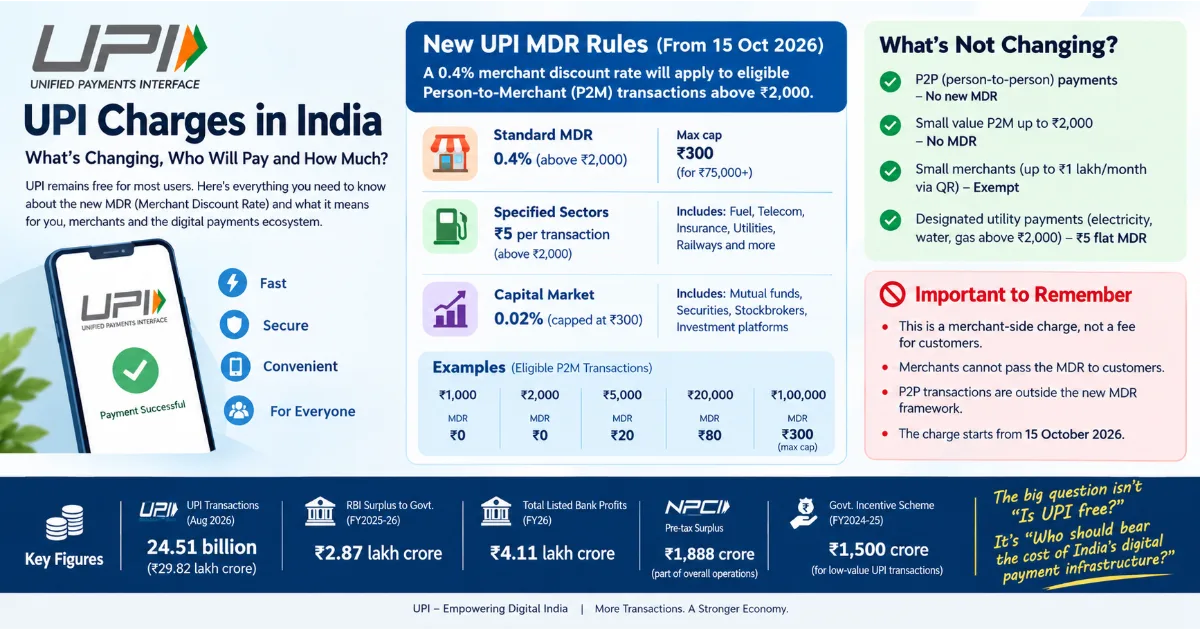
On 15 September 2026, the government/NPCI announced a new Merchant Discount Rate (MDR) framework for selected UPI person-to-merchant transactions. The new framework is scheduled to take effect from 15 October 2026. Under the new framework, a 0.4% MDR will apply to eligible P2M UPI transactions above ₹2,000, with a maximum charge of ₹300 for transactions of ₹75,000 or more. Certain sectors will instead have a flat ₹5 MDR. Importantly, the charge is structured as a merchant-side charge, not a customer transaction fee.
This has created considerable debate about whether UPI should remain completely free, who should bear its infrastructure costs, whether government incentives amount to a subsidy, and whether a new MDR is economically necessary.
Below is a detailed explanation.
1. What exactly is UPI?
UPI stands for Unified Payments Interface.
It is an instant payment system developed by the National Payments Corporation of India (NPCI), an RBI-regulated entity. It allows money to move directly between bank accounts through participating apps and banks. (NPCI)
A simplified UPI transaction looks like this:
Customer's bank → UPI/NPCI infrastructure → Merchant's bank
The customer might interact with an app such as a bank's application or a third-party UPI app, but the underlying payment infrastructure involves multiple participants.
For example:
You purchase a ₹3,000 product.
You scan the merchant's QR.
Your UPI application initiates the transaction.
Your bank authenticates the payment.
NPCI's UPI infrastructure processes/routs the transaction.
The merchant's bank receives the transaction.
The merchant gets the money.
The transaction appears almost instantaneous to the customer, but behind the scenes there are costs associated with servers, connectivity, fraud monitoring, cybersecurity, dispute handling, bank infrastructure, compliance and customer support.
NPCI's official statistics show the scale of this infrastructure. In August 2026, UPI processed approximately 24.51 billion transactions, worth about ₹29.82 lakh crore. (NPCI)
That scale explains why the economics of UPI have become an important policy issue.
2. What does "zero UPI charge" actually mean?
One of the biggest misconceptions about UPI is that "free for the customer" means "cost-free."
It doesn't.
There is a difference between:
Customer fee
Merchant MDR
Interchange fee
Government incentive
Platform/service fees
Infrastructure cost
Historically, ordinary bank-account-to-bank-account UPI payments have generally been available to customers without a transaction fee, while the merchant-side MDR on bank-account UPI has been zero.
The government has also used incentive schemes to support the ecosystem.
Therefore, when someone says:
"UPI is free."
The more accurate interpretation is:
The customer generally does not pay a transaction fee for normal bank-account-based UPI payments, and the traditional MDR model has largely been zero.
That does not mean banks, fintech companies, NPCI and other participants have zero operating costs.
3. What is MDR?
MDR means Merchant Discount Rate.
It is a fee associated with accepting a digital payment from a customer.
Suppose a merchant sells a product for ₹10,000.
If MDR were 0.4%, then:
₹10,000 × 0.4% = ₹40
The merchant's payment ecosystem would therefore involve a ₹40 MDR.
Under the newly announced UPI framework, this is intended to be a merchant-side charge.
The government has said merchants should not pass the MDR to customers, and the framework explicitly states that merchants cannot pass the MDR to buyers.
So:
Customer buys for ₹10,000
Customer pays:
₹10,000
Eligible merchant MDR:
0.4% = ₹40
The ₹40 is an ecosystem charge rather than an additional ₹40 that the customer is supposed to pay.
4. What is changing from October 15, 2026?
This is the most important part.
Starting 15 October 2026, the new framework provides:
| UPI payment | MDR |
|---|---|
| P2P transfer | No MDR |
| P2M up to ₹2,000 | No MDR |
| Eligible P2M above ₹2,000 | 0.4% |
| ₹75,000 and above | Maximum ₹300 |
| Certain specified sectors | ₹5 flat MDR |
| Capital-market transactions | 0.02%, capped at ₹300 |
The government FAQ says the 0.4% rate applies to Person-to-Merchant transactions above ₹2,000 and is capped at ₹300 for transactions of ₹75,000 or more.
Example 1: ₹1,000 payment
₹1,000 UPI payment to a merchant.
MDR = ₹0
Example 2: ₹2,000 payment
₹2,000 payment.
MDR = ₹0
Example 3: ₹3,000 payment
0.4% of ₹3,000:
₹12
Example 4: ₹10,000 payment
0.4% of ₹10,000:
₹40
Example 5: ₹50,000 payment
0.4% of ₹50,000:
₹200
Example 6: ₹1,00,000 payment
0.4% would mathematically equal ₹400.
But because the maximum is ₹300:
MDR = ₹300
The government's FAQ gives essentially these examples.
5. Does this mean customers will now pay for UPI?
Not under the announced framework.
This distinction is extremely important.
The new MDR is designed as a merchant-side charge.
The government's FAQ explicitly says merchants cannot pass the MDR on to customers.
The Finance Ministry has also advised banks to ensure that merchants do not pass the MDR cost to customers. Reuters reported that UPI app providers are prohibited from adding platform fees or hidden charges and that banks have been advised to prevent merchants from passing the MDR to customers. (Reuters)
So the headline:
"UPI will now charge customers 0.4%"
would be misleading.
A more accurate headline would be:
"Eligible merchant UPI transactions above ₹2,000 will attract a merchant-side MDR from October 15, 2026."
6. What about person-to-person UPI?
This is another important distinction.
Suppose you send:
₹500 to your friend
₹10,000 to your brother
₹50,000 to your parents
₹1 lakh to another individual
These are P2P transactions, not P2M merchant transactions.
The newly announced MDR framework is specifically aimed at Person-to-Merchant (P2M) transactions.
Therefore, the new 0.4% MDR should not be interpreted as a 0.4% charge on every UPI transfer.
The government FAQ describes the 0.4% rate specifically for P2M transactions.
7. Why is ₹2,000 an important threshold?
The government is trying to protect everyday, low-value digital payments.
According to the government's FAQ, transactions up to ₹2,000 represent more than 95% of UPI P2M transaction volume.
That means a large number of everyday transactions remain outside the new percentage-based MDR.
For example:
₹150 tea payment → no MDR
₹500 grocery purchase → no MDR
₹800 restaurant payment → no MDR
₹1,500 local shopping → no MDR
₹2,000 purchase → no MDR
The new charge primarily affects higher-value merchant payments.
8. What about small merchants?
Small merchants are another major part of the new framework.
The government says small merchants receiving up to ₹1 lakh per month through QR-code UPI payments will be exempt from MDR under the relevant small-merchant category. (Reuters)
The FAQ also says GST registration is not required merely to qualify for the zero-MDR protection, with eligibility based on the applicable transaction/monthly collection and bank categorisation criteria.
This is important because India's UPI ecosystem includes enormous numbers of:
street vendors
small grocery shops
local restaurants
mechanics
home businesses
small retailers
service providers
small online sellers
A universal MDR could affect these businesses disproportionately.
The announced structure attempts to shield at least the smallest merchants.
9. What happens to large merchants?
Large merchants and e-commerce companies will generally be more exposed to the new MDR framework.
Consider an online retailer receiving:
₹10 crore of eligible UPI payments
If all of those transactions fell into the 0.4% category, the theoretical MDR would be:
₹10 crore × 0.4%
= ₹4 lakh
The actual amount will depend on the applicable transaction categories, merchant classification, exemptions and caps.
The important point is that the new system creates a revenue stream associated with higher-value merchant UPI transactions.
10. Why is the government introducing MDR?
The official explanation focuses on long-term sustainability of UPI infrastructure.
The government's September 15 FAQ says UPI processes billions of transactions every month and that MDR revenue will be distributed within the UPI ecosystem for investment in:
infrastructure resilience
innovation
cybersecurity
customer service
It also says industry estimates put the cost of maintaining UPI payment operations, server bandwidth, fraud-prevention systems and bank technical support at around ₹20,000 crore annually.
This is the central economic argument behind the new system:
UPI has become enormous.
More transactions mean:
more server capacity
more fraud detection
more cybersecurity
more customer support
more bank infrastructure
more dispute processing
more technology investment
greater reliability requirements
The question therefore becomes:
Who should ultimately pay for maintaining this infrastructure?
11. What was the government subsidy/incentive?
This is where the debate shown in your image comes from.
The government has historically provided incentives for low-value UPI payments.
In March 2025, the Union Cabinet approved a ₹1,500 crore incentive scheme for FY 2024-25 for low-value BHIM-UPI P2M transactions. The scheme covered transactions up to ₹2,000 made to small merchants and provided a 0.15% incentive. (Press Information Bureau)
The important point is that this was not simply:
"The government pays the merchant."
The incentive is designed to support participants in the payment ecosystem.
The government explained that the incentive is paid to the acquiring bank and then shared among relevant stakeholders such as:
issuing banks
payment service provider banks
third-party application providers
depending on the applicable scheme. (Press Information Bureau)
Therefore, calling the entire UPI system a "₹1,500 crore government subsidy" is an oversimplification.
It was an incentive scheme designed to encourage digital payments, particularly among smaller merchants.
12. Is UPI actually costing the government ₹1,500 crore?
Not exactly.
The ₹1,500 crore figure was the estimated outlay for a particular incentive scheme for FY 2024-25.
It should not automatically be interpreted as:
"The government spends ₹1,500 crore every year to keep UPI alive."
The government's incentive programs have changed over time, and the ₹1,500 crore figure relates to a specific scheme and financial year.
The government itself describes these incentives as supporting adoption and ecosystem participation.
Therefore, when discussing UPI economics, we should distinguish:
Government incentive
from
total cost of operating UPI
and from
revenue/profit earned by ecosystem participants.
They are three different concepts.
13. What about the ₹2.87 lakh crore RBI surplus?
The image you shared highlights:
RBI surplus to Government: ₹2.87 lakh crore
This figure is broadly consistent with the RBI's FY2025-26 surplus transfer.
The RBI approved a transfer of approximately ₹2.866 lakh crore to the Central Government for the accounting year 2025-26. (Moneycontrol)
However, this needs to be interpreted carefully.
The RBI's surplus is not UPI revenue.
The RBI is India's central bank. Its income and surplus arise from a much broader set of activities and financial operations.
Therefore:
RBI surplus ≠ UPI profit
and
RBI dividend to government ≠ money generated by UPI
The two numbers may be relevant to a broader public-finance debate, but they should not be directly treated as components of UPI's business model.
14. What about ₹4.11 lakh crore bank profits?
The image also states:
Total listed bank profits: ₹4.11 lakh crore
This figure is consistent with reports on Indian banks' consolidated FY2025-26 profits. The Economic Times reported consolidated banking-industry profit of approximately ₹4.11 lakh crore in FY26. (The Economic Times)
Again, however, this number should not be confused with UPI earnings.
Banks make money from many activities:
loans
interest income
investments
fees
treasury operations
credit cards
foreign exchange
wealth management
other financial services
Therefore:
₹4.11 lakh crore bank profit does not mean banks earned ₹4.11 lakh crore from UPI.
It is a much broader banking-sector figure.
15. What about NPCI's ₹1,888 crore "surplus"?
The image cites an NPCI pre-tax surplus of around ₹1,888 crore.
NPCI is particularly relevant because it operates UPI infrastructure.
But even here, there is an important accounting distinction.
NPCI is involved in multiple payment systems and services, not only UPI.
Its financial statements therefore should not automatically be interpreted as:
"UPI generated ₹1,888 crore profit."
The figure cited in the image is being used in the broader argument about the financial position of the payment ecosystem.
NPCI's own published financial statements show that the organisation's financial results encompass its wider operations. (NPCI)
So a careful analysis should say:
NPCI has a surplus/profit position, but that does not establish that UPI itself generates ₹1,888 crore of standalone profit.
16. Why are ATM costs being compared with UPI?
Your image also mentions approximately:
₹30,500 crore cost of running ATMs and cash logistics.
This comparison is part of the argument being made by Ashneer Grover.
His argument is essentially:
If India wants to encourage digital payments and reduce dependence on physical cash infrastructure, then policymakers should consider the costs of maintaining the cash ecosystem as well.
The ₹30,500 crore figure is therefore being used as a comparison between:
cash infrastructure
and
digital-payment infrastructure.
It is an argument about economic efficiency rather than proof that UPI itself costs nothing.
This distinction matters.
A country needs both:
digital payment infrastructure
cash infrastructure
and different users and businesses rely on each.
17. Is the new UPI MDR a "tax"?
This is one of the most debated questions.
The answer depends on what exactly is meant by "tax."
Technically, the announced MDR is a payment-processing charge, not a conventional government tax such as GST, income tax or corporate tax.
The official framework describes it as an MDR distributed among participants in the payment ecosystem. The government's FAQ says the money is intended to support infrastructure, cybersecurity, innovation and customer service.
Reuters reports that the fee will be distributed among payment ecosystem participants, with the largest share going to the bank of the person making the payment and the remainder distributed among other participating entities. (Reuters)
So technically:
MDR ≠ GST
MDR ≠ income tax
MDR ≠ government tax revenue
However, critics may still describe the economic effect as a "levy" or "tax-like charge" because it introduces a mandatory cost where there previously was none.
Ashneer Grover has specifically characterized the proposed levy as "tax collection" and questioned why UPI needs such a charge. That is his argument, not a description of the government's legal classification. (ABP Live English)
18. Where does the MDR money go?
According to the government's framework, MDR is intended to stay within the UPI ecosystem.
The participants can include:
issuing bank
acquiring bank
payment service provider
payment application/provider
other ecosystem participants
The precise distribution is determined through the UPI ecosystem's operational framework.
Reuters reported that the largest portion is expected to go to the bank of the person making the payment, with the remainder shared among the acquiring bank, payment app and payment service providers. (Reuters)
The government's FAQ says the fee-distribution and operational parameters are determined through the UPI and Services Steering Committee headed by NPCI.
19. What happens in special sectors?
The government has created special categories.
For certain sectors, instead of the normal 0.4% rate, the MDR is:
₹5 per transaction above ₹2,000.
The FAQ lists categories including:
railways
telecom
insurance
fuel
certain utilities
other designated industry categories
For example, a ₹20,000 eligible fuel payment would not necessarily generate a 0.4% MDR of ₹80. Under the specified concessional structure, the applicable MDR is ₹5.
This is designed to avoid disproportionately increasing costs in sectors where transaction values can be high but margins may be relatively thin.
20. What about electricity and water bills?
The new framework also provides concessional treatment for certain utility payments.
The government FAQ says designated utility payments such as electricity, municipal water and piped natural gas above ₹2,000 can attract a flat ₹5 MDR, rather than the standard 0.4% rate. Payments below ₹2,000 remain at zero MDR.
This means a ₹10,000 electricity payment does not automatically translate into a ₹40 MDR under the standard rate if the transaction falls within the designated concessional category.
21. What about investments and stock-market payments?
Capital-market transactions have their own rate.
The new framework specifies:
0.02% MDR
with a maximum of:
₹300 per transaction.
The category includes certain payments related to:
mutual funds
securities
stockbrokers
dealers
investment platforms
according to the government's FAQ.
This is considerably lower than the standard 0.4% rate.
22. What about RuPay credit cards on UPI?
This is another area where people can become confused.
A bank-account UPI payment is different from a credit-linked UPI payment.
For example:
Normal UPI
Bank account → Merchant bank account
RuPay Credit Card on UPI
Credit card/credit facility → UPI merchant
Credit-linked transactions have a different economic structure because there is a credit issuer and credit-related costs.
The government's FAQ explicitly says the new MDR discussed in the September 2026 framework applies specifically to direct user-account-to-merchant-account UPI transactions, while credit-linked UPI transactions operate under separate credit-product rules.
Therefore, you should not automatically apply the new 0.4% rule to every RuPay-credit-card-on-UPI transaction.
23. Will the new charge destroy UPI adoption?
There is no factual basis yet to say that it will.
The policy only takes effect on 15 October 2026, so its long-term effect on transaction volumes, merchant behaviour and consumer pricing cannot yet be observed.
What can be said is that the government has deliberately protected:
P2P transactions
transactions up to ₹2,000
qualifying small merchants
certain rural/semi-urban QR payments
specified essential/service categories
This means the policy is not a universal charge on every UPI transaction.
24. The biggest economic question: who ultimately bears the cost?
On paper, the merchant bears the MDR.
But economics can be more complicated.
A merchant has several possible responses:
Option 1: Absorb the cost
The merchant accepts slightly lower margins.
Option 2: Increase prices
The merchant could theoretically increase product prices.
Option 3: Encourage another payment method
The merchant might promote cash, cards or another payment mechanism.
Option 4: Negotiate payment-processing costs
Large businesses may negotiate with acquiring banks/payment providers.
The official framework says MDR should not be passed directly to customers.
However, whether businesses indirectly adjust prices in response to their overall costs is an empirical question that can only be evaluated after implementation.
25. Is 0.4% expensive compared with cards?
According to the government's FAQ, traditional credit-card MDRs typically range from around 1.5% to 2.5%, while debit-card MDR can be capped at up to around 0.90%, depending on the applicable framework.
The new UPI baseline is 0.4%, with a ₹300 maximum for ₹75,000+ transactions.
For example:
₹10,000 payment
UPI MDR:
₹40
A hypothetical 2% card MDR:
₹200
The comparison shows why policymakers describe the new UPI MDR as relatively low compared with some card-processing costs.
However, this comparison should not be taken to mean that every card transaction actually costs exactly 2%, because actual card MDR varies according to card type, merchant category, acquiring arrangements and other factors.
26. Why did India originally keep UPI at zero MDR?
The zero-MDR approach helped accelerate digital payments.
The government has repeatedly used incentives and policy support to encourage merchants to adopt digital payments.
The Finance Ministry reported that UPI's transaction value increased dramatically over the years, with UPI becoming a dominant component of India's digital-payment ecosystem. (Press Information Bureau)
The basic economic logic was:
Low/no merchant cost → more merchants accept UPI → more customers use UPI → digital payment adoption increases.
This created a powerful network effect.
Once almost every shop accepts a QR code, customers have less reason to carry cash.
27. The problem with permanently zero MDR
There is another side to the argument.
Suppose UPI transaction volumes continue increasing rapidly.
The infrastructure must continue investing in:
cybersecurity
fraud prevention
data centres
network reliability
disaster recovery
transaction processing
dispute resolution
technical support
bank infrastructure
If merchants pay zero MDR indefinitely, someone else must finance those costs.
Possible sources include:
Government incentives
Bank cross-subsidisation
Fintech business models
Advertising
Other financial products
Investment income
Alternative transaction revenue
Merchant fees in selected categories
The government's argument is that relying primarily on government incentives is not necessarily sustainable as UPI becomes larger.
Its September 2026 FAQ explicitly describes government incentives as an early-adoption support mechanism and argues that a commercial, threshold-based model can provide more predictable funding for technology investment.
28. The counterargument
The counterargument is that UPI generates enormous economic value beyond direct transaction fees.
For example, UPI:
reduces cash handling
reduces the need for physical payment infrastructure
improves transaction traceability
helps businesses receive money instantly
enables e-commerce
helps small businesses participate in digital commerce
reduces friction in payments
creates financial data that can support other services
enables fintech innovation
Critics therefore argue that the indirect economic benefits may justify continued public support.
Ashneer Grover's recent comments fall broadly into this line of argument. He cited the RBI's surplus, bank profitability, NPCI's financial position and cash-infrastructure costs while questioning the need for a UPI levy. (ABP Live English)
That is an argument about how the costs and benefits of India's payment infrastructure should be allocated.
29. What the image gets right
The image you shared raises several legitimate points for discussion.
It correctly highlights that:
the RBI is transferring a very large surplus to the government;
Indian banks generated very large profits in FY26;
NPCI operates UPI and has a substantial financial position;
cash and ATM infrastructure also has significant costs;
the new UPI MDR is creating debate about who should finance digital-payment infrastructure.
The cited ₹2.87 lakh crore RBI transfer and ₹4.11 lakh crore banking-sector profit are supported by current reporting. (Moneycontrol)
30. What the image needs more context on
Several statements in the image should not be interpreted literally.
"RBI surplus = money available to pay for UPI"
Not necessarily.
RBI surplus is not UPI revenue.
"₹4.11 lakh crore bank profit = banks don't need UPI MDR"
Not necessarily.
Bank profitability is generated from the entire banking business, not UPI alone.
"NPCI ₹1,888 crore surplus = UPI profit"
Not necessarily.
NPCI operates multiple payment systems and services.
"₹1,500 crore government incentive = total UPI cost"
No.
It was a specific government incentive scheme for low-value UPI transactions in FY2024-25. (Press Information Bureau)
"MDR is a tax"
Legally/economically, the announced MDR is a payment-processing charge rather than a conventional government tax. The funds are intended to be distributed within the payment ecosystem.
31. What happens to UPI users from October 15?
For an ordinary consumer, the immediate practical picture is relatively simple:
If you send money to another person
No new 0.4% MDR.
If you pay a merchant ₹500
No MDR.
If you pay a merchant ₹2,000
No MDR.
If you pay an eligible merchant ₹5,000
Merchant-side MDR:
₹20
If you pay an eligible merchant ₹20,000
Merchant-side MDR:
₹80
If you pay an eligible merchant ₹1,00,000
0.4% = ₹400, but the cap applies.
Merchant-side MDR:
₹300
The consumer is not supposed to be separately charged the MDR.
32. The bigger picture
The UPI debate is ultimately not simply:
"Should UPI be free or paid?"
It is actually a debate about the economics of digital public infrastructure.
There are three broad models:
Model A: Completely government-funded
The government funds infrastructure and users/merchants pay nothing.
Model B: Completely commercial
Users or merchants pay transaction fees sufficient to finance the system.
Model C: Hybrid
Government support continues for small-value and socially important transactions while higher-value commercial transactions contribute to infrastructure costs.
The new 2026 framework is moving toward Model C.
Small transactions remain protected, small merchants receive exemptions, essential categories receive concessional pricing, while higher-value commercial transactions contribute through MDR.
33. Final conclusion
India's UPI system is entering a new phase.
For more than six years, its zero-MDR model helped UPI become an extremely widely used payment network. But maintaining an infrastructure processing billions of transactions every month requires continuous spending on technology, cybersecurity, fraud prevention, banking infrastructure and customer support.
From 15 October 2026, eligible UPI merchant transactions above ₹2,000 will face a 0.4% MDR, subject to a ₹300 maximum for transactions of ₹75,000 or more. Certain sectors such as fuel, insurance, telecom and utilities will receive a ₹5 flat-rate structure for qualifying transactions above ₹2,000. Small merchants within the prescribed category and low-value transactions remain protected.
Most importantly, this should not be described as a 0.4% charge on every UPI payment. Person-to-person payments remain outside the new MDR framework, and consumers are not supposed to be charged the merchant MDR.
At the same time, the debate raised in the image is important. The fact that the RBI is transferring a large surplus to the government, Indian banks are profitable, and NPCI has its own financial position does not by itself prove that UPI infrastructure has no cost or that MDR is unnecessary. Those figures belong to broader organisations and financial systems, whereas UPI has its own operating and ecosystem costs.
Likewise, the existence of a government incentive scheme does not mean the entire UPI system is "subsidised by ₹1,500 crore." The ₹1,500 crore figure related to a specific FY2024-25 incentive program for low-value BHIM-UPI P2M transactions. (Press Information Bureau)
The real question is therefore not simply "Is UPI free?"
It is:
Who should finance the cost of maintaining India's enormous digital-payment infrastructure: taxpayers, banks, payment companies, merchants, or some combination of all of them?
The 2026 framework represents a shift toward making higher-value commercial transactions contribute to those costs while attempting to protect everyday users and small merchants.
And because the new MDR does not begin until 15 October 2026, its actual effect on merchant prices, payment-app economics, UPI volumes, banks and consumers will only become clear after implementation and subsequent data are available.
Key figures at a glance
| Item | Figure / Rule |
|---|---|
| New standard UPI MDR | 0.4% |
| Threshold | Above ₹2,000 |
| Maximum MDR | ₹300 |
| Maximum applies | ₹75,000+ |
| Special-sector MDR | ₹5 for qualifying transactions |
| Capital-market MDR | 0.02%, capped at ₹300 |
| P2P UPI | Outside new MDR |
| Small-value P2M up to ₹2,000 | No MDR |
| New framework starts | 15 October 2026 |
| August 2026 UPI volume | 24.51 billion transactions |
| August 2026 UPI value | ₹29.82 lakh crore |
| FY2024-25 low-value UPI incentive scheme | ₹1,500 crore |
| RBI FY2025-26 surplus transfer | ~₹2.87 lakh crore |
| FY26 consolidated listed-bank profit | ~₹4.11 lakh crore |
The UPI transaction statistics are from NPCI, while the policy figures come from the Government's September 2026 MDR FAQ. (NPCI)