
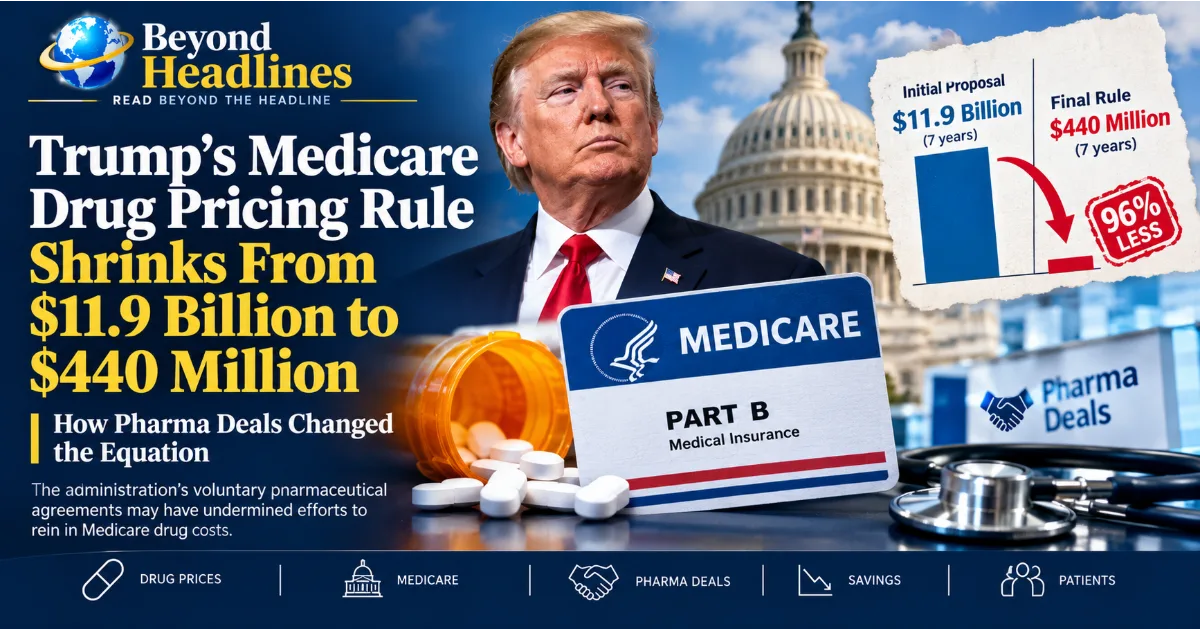
The Trump administration has finalized a major Medicare drug-pricing experiment that was originally presented as a potentially multibillion-dollar effort to bring the price of certain medicines in the United States closer to what patients pay in other wealthy countries. But by the time the policy reached its final form, the projected savings had fallen dramatically. Medicare actuaries now estimate that the program will save about $440 million over seven years, compared with approximately $11.9 billion projected when the proposal was first released. That represents a reduction of roughly 96.3% in projected savings. The final model will also apply to only four pharmaceutical manufacturers, a substantial contraction from the much broader program originally envisioned.
The policy is known as the Global Benchmark for Efficient Drug Pricing Model, or GLOBE. It is one of the Trump administration's efforts to use international drug prices as a reference point for reducing what Medicare pays for certain expensive medicines administered in clinical settings. These include drugs used to treat cancer, autoimmune conditions and arthritis, among other therapies covered under Medicare Part B. The model is scheduled to begin on January 1, 2027, and run through March 31, 2032, with some financial reconciliation continuing beyond the formal operating period. CMS says the model is intended to reduce costs for Medicare beneficiaries and the federal government while preserving or improving quality of care.
The striking change between the proposal and the final rule is at the center of the debate. The administration initially projected that GLOBE could generate nearly $12 billion in savings over seven years. The final estimate is just $440 million. Put another way, for every $100 of projected savings in the original proposal, the finalized program is expected to produce only about $3.70. The difference is not simply an accounting adjustment. It reflects significant changes to which drugs and pharmaceutical companies will actually be subject to the mandatory pricing model.
One of the most consequential changes involves pharmaceutical companies that have reached separate voluntary agreements with the Trump administration. Those agreements are part of the administration's broader Most-Favored-Nation, or MFN, drug-pricing strategy. Under the approach, participating drugmakers agree to provide certain medicines at prices linked to what other developed countries pay. The administration has promoted these agreements as a way of reducing U.S. drug prices without relying exclusively on mandatory government price controls. The White House said in August that 26 pharmaceutical manufacturers had reached MFN agreements, covering 89% of the branded-drug market.
The interaction between those voluntary agreements and GLOBE is what has created much of the controversy surrounding the final rule. According to STAT's reporting on the final regulation, companies that entered qualifying voluntary agreements with the administration can have their products excluded from the GLOBE pilot. The original GLOBE proposal did not contemplate excluding companies simply because they had separately reached voluntary agreements with the administration. As a result, the universe of medicines potentially exposed to GLOBE has become considerably smaller.
That change has produced sharply different interpretations of what the administration has accomplished. Supporters of the broader Trump strategy can point to the separate MFN agreements and argue that negotiated reductions can achieve lower prices without subjecting every manufacturer to the same mandatory formula. The White House says the agreements give Medicaid programs access to MFN prices and describes them as part of an effort to make medicines more affordable while encouraging pharmaceutical manufacturing and investment in the United States.
Critics take a different view. Their argument is that a voluntary agreement can become a substitute for a stronger mandatory pricing mechanism, particularly if companies can obtain exemptions from GLOBE by participating in another administration program. STAT reported that analysts and policy researchers saw the final exclusions as a major reason for the collapse in projected GLOBE savings. Public Citizen, a consumer advocacy organization that supports stronger government intervention on drug prices, similarly argued that the final model had become substantially weaker than the original proposal. These are criticisms from identified outside organizations and researchers, rather than findings established independently of the policy debate.
The distinction matters because the $440 million figure is sometimes easy to misinterpret. It does not mean that the entire Trump administration drug-pricing agenda is expected to save only $440 million. The figure refers specifically to the finalized GLOBE model and its seven-year projected savings. The administration has separate MFN agreements with pharmaceutical companies, and those agreements have their own claimed savings and coverage. GLOBE is also separate from another proposed Medicare experiment known as GUARD, which is aimed at a different segment of the prescription-drug market.
Understanding that distinction is essential because the administration is pursuing several drug-pricing strategies simultaneously. One approach relies on voluntary negotiations with pharmaceutical manufacturers. Another uses mandatory Medicare demonstrations. A third element involves international price comparisons, in which the United States attempts to use prices paid by economically comparable countries as a reference point. These approaches overlap in their objectives but differ substantially in how the government obtains lower prices and how much leverage it has over manufacturers.
GLOBE itself is based on a relatively straightforward concept. Americans have historically paid substantially more for many medicines than patients in other wealthy countries, although the reasons for those differences are complex and vary across drugs and health systems. The model attempts to incorporate those international differences into the way Medicare Part B pays for certain drugs. CMS describes the policy as a test of whether a new rebate formula can reduce Medicare spending when the U.S. price is higher than prices in economically comparable countries.
The model is focused on medicines that are administered in clinical settings rather than the traditional prescription pills that beneficiaries generally pick up at pharmacies. Medicare Part B covers many physician-administered drugs, including treatments delivered through infusion or injection. These medicines can be extremely expensive and can represent significant spending for both Medicare and patients. Because beneficiaries often pay coinsurance for Part B services, a reduction in the underlying payment amount can also affect what some patients pay out of pocket.
CMS says that under GLOBE, beneficiary coinsurance for eligible drugs will be linked to the international benchmark. The agency expects this to reduce out-of-pocket costs for beneficiaries receiving GLOBE drugs in the areas selected for the model. The program will not cover every Original Medicare beneficiary nationwide. Instead, it will operate in selected geographic areas representing approximately a quarter of Original Medicare beneficiaries.
That geographic design is another important feature of the experiment. GLOBE is not an immediate nationwide restructuring of Medicare drug prices. It is a mandatory demonstration model operated through the Center for Medicare and Medicaid Innovation. Its purpose is partly to test whether an international benchmarking approach can lower costs without creating unacceptable effects on treatment, access or quality. CMS says it will evaluate the model's effects during its operation.
The final rule also contains exclusions that further narrow the program. According to reporting on the regulation, drugs for rare diseases are excluded under the final model, although medicines used both for rare diseases and for other conditions are treated differently. Other categories of medicines and therapies are also outside the scope of GLOBE. The result is a program that addresses only a relatively small portion of Medicare's overall pharmaceutical spending.
This narrowing helps explain why the initial $11.9 billion projection and the final $440 million estimate are so far apart. The initial projection assumed a considerably larger universe of eligible drugs and manufacturers. Once exemptions and exclusions were incorporated into the final design, the amount of spending that could potentially be affected by the model fell substantially.
The question now is whether the smaller GLOBE program should be judged independently or as part of the administration's broader pharmaceutical strategy. From the administration's perspective, the answer may be that voluntary MFN agreements and mandatory GLOBE pricing serve different purposes. If a manufacturer agrees to provide lower prices through a separate agreement, the administration could argue that imposing another mandatory pricing mechanism on the same products is unnecessary. The White House has emphasized the breadth of its voluntary agreements, saying that 26 manufacturers were participating as of August and that those companies accounted for 89% of the branded-drug market.
The counterargument is that market coverage and actual savings are not the same thing. A company can participate in an agreement covering a large portion of the branded-drug market while the specific prices, products, populations and conditions covered by that agreement differ from those that would have been affected by GLOBE. The existence of an agreement therefore does not automatically establish that the same level of Medicare savings will be achieved.
That distinction has become particularly important because some of the pharmaceutical agreements are not fully transparent. The Washington Post recently reported that confidential agreements involving companies including Pfizer and Eli Lilly contained terms that were not fully disclosed publicly, including provisions relating to tariffs and other commitments. The administration has defended the confidentiality of portions of the agreements on commercial grounds. The existence of confidential terms makes independent assessment of the full economic effect of some agreements more difficult.
There is also a question about where the greatest pricing leverage exists. Medicare Part B serves a population that is disproportionately older and therefore includes many patients receiving expensive treatments for cancer, arthritis, autoimmune diseases and other chronic conditions. If a pharmaceutical company can negotiate a separate agreement that covers a different patient population or government program, the economic effect on its Medicare business may differ considerably from the effect of being subject to a mandatory Medicare pricing model.
Researchers have raised precisely this issue. STAT reported comments from Harvard researcher Thomas Hwang suggesting that pharmaceutical companies could give concessions in markets where those concessions are less costly to them in order to avoid larger reductions in markets where their exposure is greater. Washington University law professor Rachel Sachs similarly described the final exclusions as having dramatically reduced the potential impact of GLOBE. Those comments represent expert interpretations of the policy's incentives, not official findings by CMS.
The pharmaceutical industry's position is also important to understand. Drug manufacturers have historically argued that government efforts to impose international price controls can interfere with pharmaceutical research and development, distort the market and potentially affect access to new medicines. The Pharmaceutical Research and Manufacturers of America has opposed GLOBE and characterized the final policy as unlawful and harmful to patients. The organization argues that international pricing benchmarks can import foreign government price controls into the U.S. system.
Those arguments are part of a much larger dispute over how the United States should determine the value and price of medicines. American pharmaceutical prices are influenced by patents, competition, insurance structures, rebates, negotiations, pharmacy benefit managers, government programs, regulatory requirements and the timing of generic or biosimilar competition. International prices are also shaped by the purchasing power of national health systems and the bargaining power of governments. Consequently, simply comparing the sticker price of a medicine in the United States with the price in another country does not capture the entire economic system behind those prices.
Yet international price comparisons remain politically powerful because the basic disparity is difficult to ignore. The Trump administration has made the difference between U.S. prices and prices in other wealthy countries a central part of its argument for MFN pricing. CMS Administrator Mehmet Oz said when the GLOBE rule was finalized that Medicare patients and American taxpayers have paid significantly more for prescription medicines than people in comparable countries. CMS says GLOBE is intended to test whether that gap can be reduced while maintaining quality and access.
The experiment therefore represents a test not only of a pricing formula but also of the administration's broader theory of how pharmaceutical companies respond to government pressure. If voluntary agreements can produce substantial reductions without the need for broad mandatory price controls, the administration could point to them as evidence that negotiation and leverage can accomplish the same objective through a different route. If the voluntary agreements prove narrower than expected or fail to produce substantial Medicare savings, the case for stronger mandatory mechanisms could become more prominent.
At the same time, GLOBE faces a legal challenge before its practical impact can even be fully assessed. Pharmaceutical industry representatives have argued that CMS lacks sufficient authority to impose the model. The administration has proceeded despite those objections, but lawsuits could affect the timing, scope or survival of the program. The first Trump administration also attempted to introduce an international reference pricing model for Medicare drugs, but that effort was blocked by courts and did not become a lasting national pricing system.
The legal question is significant because GLOBE is not simply a new reimbursement formula created through ordinary Medicare administration. It is a mandatory demonstration model that attempts to change the economic incentives surrounding some of the most expensive drugs covered by Part B. The outcome of litigation could therefore have implications beyond the four manufacturers initially subject to the model.
There is also an important difference between reducing government spending and reducing what patients pay at the pharmacy counter. GLOBE primarily concerns drugs covered under Medicare Part B, many of which are administered by physicians or other healthcare providers. The way Medicare pays for those drugs is different from the system governing many retail prescription medicines covered by Part D. A reduction in Medicare's spending does not automatically translate into an identical reduction in every patient's total healthcare costs.
CMS nevertheless expects GLOBE to reduce beneficiary coinsurance for affected drugs. Under the model, the international benchmark becomes relevant to the amount beneficiaries owe, and CMS says reduced coinsurance amounts will take effect beginning April 1, 2027. The agency expects these changes to continue through March 31, 2032.
For patients, the eventual question will be much more practical than the headline numbers. They will want to know whether their particular medicine is included, whether their provider participates in a geographic area covered by the model, how the payment formula changes their coinsurance and whether treatment decisions are affected. Those questions cannot be answered simply by pointing to the $440 million national projection.
For taxpayers, the question is different. The relevant issue is whether the program produces enough savings to justify its administrative complexity and potential legal costs, while maintaining access to appropriate treatment. CMS expects savings, but outside analysts disagree about the scale and significance of the broader Trump drug-pricing experiments. Some analysts cited by the Wall Street Journal have argued that the earlier Medicare drug-price negotiation program created under federal legislation could ultimately generate larger discounts than the newer voluntary deals and demonstration models. That is an analytical comparison rather than a settled outcome, and the programs operate under different statutory frameworks.
The political debate over GLOBE is therefore likely to continue long after the September 30 announcement. The administration can point to a new mandatory model that explicitly attempts to use international prices to lower Medicare costs. Critics can point to the dramatic reduction in projected savings and the fact that only four manufacturers are expected to fall within the finalized program. Both facts can be true at the same time.
The most consequential development may ultimately be the relationship between the voluntary and mandatory approaches. The Trump administration has created a system in which pharmaceutical manufacturers can negotiate directly with the government over MFN pricing while potentially obtaining exemptions from a separate mandatory Medicare experiment. Whether that structure produces more effective price reductions than a broader mandatory model will depend on the actual prices negotiated, the medicines covered, the populations affected and the savings ultimately realized.
The administration's August announcement provides one measure of the scale of the voluntary strategy. The White House said that nine additional pharmaceutical manufacturers had joined the MFN framework, bringing the total to 26 companies and 89% of the branded-drug market. The administration also said the nine companies would collectively invest at least $19.6 billion in U.S. manufacturing in the near term. These are administration-reported figures and commitments, and their ultimate economic effects will need to be evaluated as the agreements are implemented.
The GLOBE numbers provide a different measure. They show how much of the potential mandatory pricing system survived the negotiation and rulemaking process. The answer is substantially less than originally proposed. The initial $11.9 billion projected savings have become $440 million, while the program has narrowed to four manufacturers. That does not prove that the administration's broader drug-pricing strategy will fail, nor does it prove that the voluntary agreements will produce equivalent savings. It does show that the final GLOBE model is far smaller than the one initially presented.
That distinction is especially important when evaluating the phrase "96% less." The reduction is calculated from the difference between the original projected seven-year savings of about $11.9 billion and the final projection of $440 million. It is therefore a reduction in projected GLOBE savings, not evidence that pharmaceutical prices themselves have fallen by 96%, nor evidence that the Trump administration's entire drug-pricing program has lost 96% of its value. The terminology matters because the three figures represent very different things.
The next several years will provide the evidence needed to determine what GLOBE actually accomplishes. CMS will have to monitor prices, rebates, beneficiary costs, utilization and access. Pharmaceutical manufacturers will decide how to respond to the incentives created by the model and the separate MFN agreements. Courts may determine whether CMS has the legal authority to implement the program. And patients will ultimately experience the policy through their treatment costs and access to medicines rather than through the administration's projected savings figures.
The story is therefore larger than a single Medicare rule. It reflects an ongoing struggle over who should have the greatest influence over the price of medicines in the United States: pharmaceutical companies negotiating privately with the government, federal agencies establishing mandatory payment rules, or broader market forces involving insurers, providers and international competition. GLOBE represents one attempt to shift that balance by using prices paid in other countries as a reference point. Its final form shows how difficult that shift can be when voluntary agreements, industry objections, legal constraints and competing policy objectives are brought into the same system.
For the Trump administration, the final rule preserves a mechanism for testing international drug-price benchmarks within Medicare. For pharmaceutical manufacturers, the rule creates a smaller mandatory exposure than originally proposed while leaving separate negotiated agreements as a central component of the administration's pricing strategy. For Medicare beneficiaries, the immediate question will be whether the medicines they receive are included and whether the promised reductions in coinsurance materialize. For taxpayers, the key measure will ultimately be actual savings rather than the projections made at the beginning of the process.
The $440 million figure should therefore be read in context. It is neither the total value of the administration's drug-pricing campaign nor proof that every pharmaceutical agreement will produce minimal savings. It is the latest official projection for one specific Medicare experiment after the administration substantially narrowed its scope. What makes the number significant is the distance between it and the $11.9 billion estimate that preceded it.
That gap is the central fact behind the current debate. The Trump administration began with a proposal that could have subjected a much larger group of drugs and manufacturers to international price benchmarking. It ended with a mandatory GLOBE model covering only four manufacturers and an estimated seven-year saving of $440 million. Meanwhile, pharmaceutical companies that have reached qualifying voluntary agreements with the administration can be exempt from the GLOBE model.
Whether that represents a strategic shift toward negotiated drug prices or a significant reduction in the government's leverage over Medicare prices will depend on what the voluntary agreements actually deliver. That is not yet fully measurable from the announcement of the agreements themselves. The meaningful comparison will eventually be between the prices that would otherwise have been paid, the prices negotiated under the voluntary arrangements, the prices produced by GLOBE and the actual costs borne by Medicare beneficiaries and taxpayers.
Until those figures are available, the clearest conclusion is narrower. The finalized GLOBE Medicare pricing model is substantially smaller than the administration originally proposed, and its projected savings have fallen by about 96% from the initial estimate. The administration's separate pharmaceutical agreements are a major reason the final model has fewer companies and drugs in scope. Whether those agreements compensate for the reduction in GLOBE's mandatory reach remains an empirical question that will have to be answered by the prices and savings generated as the policies take effect.
For a healthcare system that spends enormous sums on prescription medicines, that distinction is more than a technical matter. It goes to the heart of how the United States attempts to control drug costs. A government can seek lower prices through direct negotiation, international benchmarking, mandatory payment reforms or some combination of all three. The Trump administration is testing several of those approaches at once. The final GLOBE rule shows that the path from an ambitious pricing proposal to an operating federal program can produce a very different result from the one initially projected.
And that is why the $11.9 billion versus $440 million comparison matters. It captures, in a single set of numbers, how dramatically the scope of one of the administration's central Medicare drug-pricing experiments changed before implementation. The next stage will be watching what happens to actual prices, actual Medicare spending and actual patient costs once the model begins in 2027.
#BeyondHeadlines #Trump #Medicare #DrugPricing #Healthcare #USHealthcare #Pharmaceuticals #MedicarePartB #GLOBEModel #DrugCosts #HealthcarePolicy #PrescriptionDrugs #Pharma #MFN #MostFavoredNation #CMS #MedicareCosts #HealthcareNews #USPolitics #HealthPolicy