
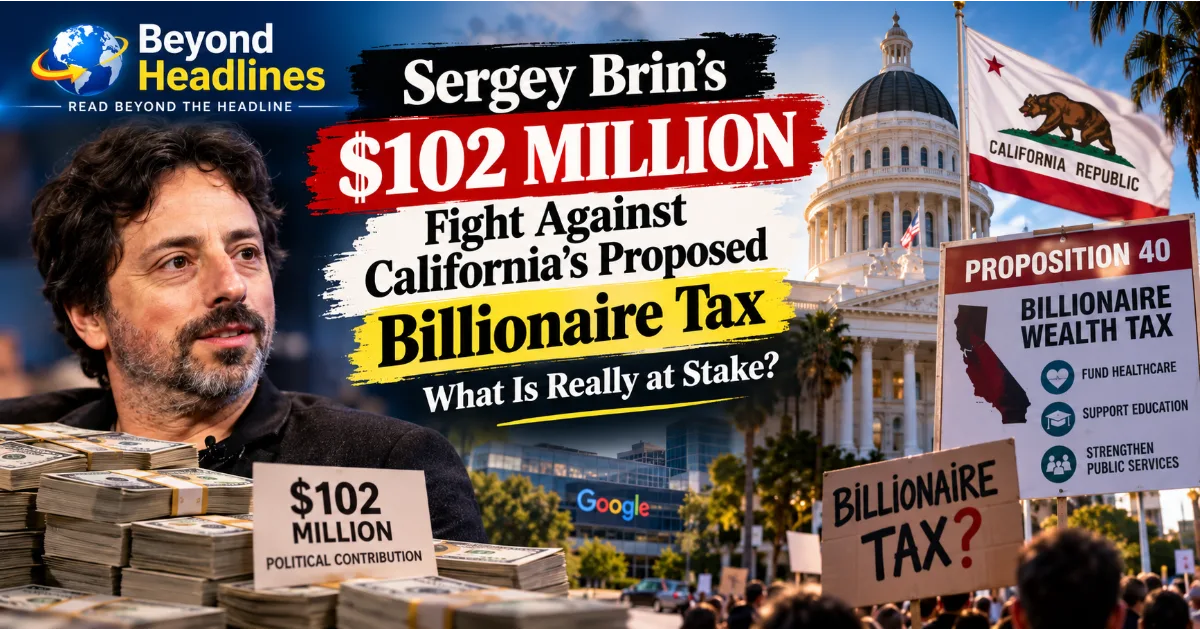
A political battle unfolding in California has placed one of the world's richest technology entrepreneurs at the center of a much larger debate about wealth, taxation, political influence and the future of the state's economy. Sergey Brin, the Google co-founder whose fortune is estimated in the hundreds of billions of dollars, has contributed approximately $102 million to an organization campaigning against California's proposed billionaire wealth tax. The figure is extraordinary on its own, but it becomes even more striking when compared with the potential tax liability Brin could face if the proposal becomes law.
Reports have estimated that Brin could potentially owe around $13 billion under the proposed tax, based on his reported wealth and the structure of the measure. That figure has generated headlines around the world because it creates a dramatic comparison: roughly $102 million spent on political opposition versus a potential tax exposure measured in billions of dollars. However, the headline comparison can obscure the more complicated reality behind the story. Brin has not simply paid $102 million to eliminate a $13 billion tax bill. His money has gone toward a political campaign designed to defeat a proposed measure before it becomes law.
That distinction matters because California's proposed billionaire tax is not an existing annual tax that Brin is currently required to pay. Proposition 40 is a ballot measure scheduled for California voters in November 2026. If approved and ultimately implemented, it would impose a one-time tax on qualifying billionaire wealth, with the proceeds directed primarily toward healthcare and other public programs. The measure has become one of the most closely watched tax battles in the United States because of the amount of money involved and the broader questions it raises about whether governments should tax accumulated wealth in addition to income.
Brin's involvement has transformed what might otherwise have been a complicated state tax proposal into a national conversation about the influence of billionaires in American politics. His contribution is reportedly the largest individual contribution to the opposition campaign, making him not only a financial participant but also a symbolic figure in the debate. His position raises questions that extend far beyond California. How should governments tax extreme wealth? What happens when billionaires can spend enormous sums to influence legislation that could affect their own fortunes? Can states impose wealth taxes without encouraging wealthy residents to leave? And perhaps most importantly, where should the line be drawn between legitimate political participation and the extraordinary influence that comes with enormous financial resources?
These questions make the Sergey Brin story much bigger than a single billionaire and a single tax proposal.
The $102 Million Contribution
According to reports, Sergey Brin has contributed approximately $102 million to Building a Better California, a political advocacy organization campaigning against California's proposed billionaire wealth tax. The organization has attracted significant financial support from wealthy individuals who oppose the measure, turning the fight over Proposition 40 into one of the most expensive political campaigns surrounding taxation in California.
The scale of Brin's contribution is difficult to put into ordinary political terms. A contribution of $102 million is larger than the annual budgets of many organizations and public institutions. It is also an amount that most individuals could never realistically accumulate, let alone spend on a political campaign. For Brin, however, the contribution represents a fraction of his estimated fortune.
That difference is important. Brin's wealth is largely connected to ownership of financial assets, particularly his holdings and investments connected to the technology sector. His net worth changes with the value of those assets, meaning that estimates of his fortune can fluctuate significantly from one period to another. Depending on the source and the date of measurement, his reported wealth has been estimated at well above $200 billion.
The $102 million contribution therefore has to be understood within the context of the enormous scale of his personal wealth. It is still an extraordinary amount of money, but for someone with a fortune measured in hundreds of billions of dollars, it represents a much smaller percentage of total wealth than the same contribution would represent for an ordinary individual.
That is one reason the story has attracted so much attention. It illustrates the unusual financial circumstances of the world's wealthiest people, where sums that would be life-changing for almost everyone else can become instruments of political strategy.
What Is California Proposition 40?
At the center of the controversy is Proposition 40, a measure that California voters are scheduled to consider in the November 3, 2026 general election.
The proposal would create a one-time tax on qualifying billionaire wealth. The California Legislative Analyst's Office has described the proposal as a tax of up to 5% on qualifying billionaires who meet the residency requirements, with the measure applying to individuals who were California residents on January 1, 2026. The tax would be based on wealth and covered assets rather than simply on annual salary or ordinary income.
This is an important distinction because the United States tax system has historically relied heavily on taxing income, capital gains, property and transactions rather than imposing a broad annual tax on a person's total net worth.
Under the proposal, the tax would be collected in 2027, with an option for qualifying taxpayers to spread payments over several years at an additional cost. Certain assets and categories of wealth would receive different treatment, meaning that the simple calculation of taking 5% of someone's publicly reported net worth does not necessarily represent their final legal tax liability.
The revenue generated by the proposal would primarily be directed toward healthcare. According to the state's analysis, 90% of the revenue would go toward healthcare programs, while the remaining 10% would support food assistance, education-related programs and administrative costs.
Supporters view the proposal as a way to capture additional revenue from people who have accumulated extraordinary fortunes while directing that money toward public services. Opponents argue that the measure could damage California's economy, encourage wealthy residents to relocate and create uncertainty around investment and entrepreneurship.
The disagreement is therefore not simply about whether billionaires should pay more taxes. It is also about how wealth should be measured, how quickly wealthy taxpayers can respond, and whether California can successfully tax wealth without undermining part of the economic base on which the state depends.
The $13 Billion Figure Needs Context
The $13 billion figure associated with Sergey Brin has become one of the most widely repeated elements of the story. It is easy to understand why. A potential tax bill of $13 billion sounds almost unimaginable, even when discussing someone whose wealth is itself measured in hundreds of billions of dollars.
However, the figure should be treated as an estimate rather than as a confirmed tax bill.
Brin's publicly reported net worth changes with the market value of his assets. The exact calculation under Proposition 40 would also depend on the definition of covered wealth, applicable exclusions and the taxpayer's legal circumstances. Consequently, saying that Brin "owes $13 billion" would be inaccurate because the measure has not yet become law and because the precise tax liability would depend on the actual rules and valuation of covered assets.
A more accurate interpretation is that analysts and reports have estimated that Brin could face a tax liability of roughly $13 billion if the proposal applies to him and if his qualifying wealth is sufficiently high to produce such an amount.
This distinction may seem technical, but it is central to understanding the story. The proposal is still a political question. Brin's contribution is therefore an attempt to influence whether the tax comes into existence rather than a payment against an existing liability.
Why Would Someone Spend $102 Million to Fight a Potential $13 Billion Tax?
The simplest explanation is financial.
If a person believes that a political campaign could prevent a tax liability worth billions of dollars, spending tens or even hundreds of millions of dollars to influence the outcome can be viewed as a rational financial decision. From that perspective, Brin's contribution is not merely a political donation. It can also be interpreted as an attempt to protect a much larger pool of wealth.
However, reducing the entire issue to a financial calculation would also be incomplete.
Brin has previously been involved in political and public policy issues, and his opposition to California's wealth tax reflects broader concerns expressed by wealthy technology entrepreneurs about taxation, government policy and the future of California. Reports have also linked his relocation away from California with the state's changing tax environment.
For supporters of the tax, this creates a difficult ethical question. If the wealthiest residents can spend enormous sums opposing taxes that affect them personally, does the political system give them disproportionate influence over public policy?
Opponents would frame the same situation differently. They could argue that wealthy individuals are citizens and taxpayers who have the same right to participate in political debate as anyone else. From this perspective, contributing to a political campaign is part of the democratic process, regardless of how wealthy the contributor happens to be.
The disagreement therefore extends beyond taxation. It touches on the role money should play in democratic politics.
Building a Better California and the Growing Opposition
Building a Better California has become the central political vehicle for opposition to Proposition 40. Brin is reportedly its largest individual contributor, but he is not the only wealthy person opposing the measure.
Other billionaires and prominent business figures have also contributed significant amounts. Reports indicate that the opposition campaign has accumulated hundreds of millions of dollars, demonstrating how seriously wealthy Californians and their allies are treating the proposed tax.
This level of spending is itself an important part of the story. Political campaigns generally operate within the boundaries of available financial resources, and a tax that could potentially affect billions or tens of billions of dollars of private wealth creates a particularly strong incentive for wealthy opponents to invest heavily in defeating it.
The resulting campaign is therefore not simply a traditional election contest. It is also a contest over the future of California's tax system.
If Proposition 40 passes, it could establish a precedent for taxing billionaire wealth in a state with one of the largest concentrations of wealthy technology entrepreneurs in the world. If it fails, opponents may view that outcome as evidence that voters are unwilling to adopt a wealth tax even when the money is intended for healthcare and other public services.
Why Supporters Want a Billionaire Wealth Tax
Supporters of Proposition 40 argue that California's economic success has produced enormous private fortunes while many residents continue to struggle with healthcare costs, housing expenses, food insecurity and other financial pressures.
Their argument is based partly on the idea that traditional income taxation does not fully capture how billionaire wealth grows.
A billionaire may receive a relatively modest salary compared with the value of their overall holdings. Much of their wealth can exist in shares of companies, investment portfolios and other assets that increase in value over time. If those assets are not sold, the owner may not recognize the increase as taxable income under traditional systems.
This creates a structural difference between how ordinary workers and extremely wealthy asset owners experience taxation.
An employee may receive a salary every month and pay taxes on that income. A billionaire can potentially see their wealth increase by billions of dollars because the value of their assets rises, while their taxable income does not increase by the same amount.
Supporters of wealth taxes argue that this difference allows extreme fortunes to grow faster than the tax system captures them.
From this perspective, Proposition 40 represents an attempt to tax a form of economic power that conventional income taxation may not fully reach.
The argument becomes especially compelling to supporters when the revenue is connected to public services. If billions of dollars could be directed toward healthcare, supporters argue that wealthy Californians who have benefited enormously from the state's economy can reasonably be asked to contribute more toward the public systems that support millions of residents.
Why Opponents Say the Tax Could Hurt California
Opponents of Proposition 40 argue that the measure could create consequences that go beyond the immediate amount collected from billionaires.
Their central concern is behavioral response.
Wealthy individuals have more flexibility than ordinary taxpayers when deciding where to live, where to establish businesses and where to hold certain assets. If California becomes significantly more expensive for billionaires, some may choose to establish residency elsewhere.
This is particularly important because California already has a complicated relationship with wealthy taxpayers. The state collects substantial revenue from high-income individuals, especially those whose fortunes are connected to technology, finance, entertainment and entrepreneurship.
If wealthy residents leave, the state could lose more than the wealth tax itself. It could potentially lose future income-tax revenue, investment activity, charitable contributions and other economic benefits associated with wealthy residents.
This creates a fundamental policy challenge. A government can increase the tax burden on a group and raise significant revenue in the short term, but if that group changes its behavior, the long-term results can be very different.
Opponents therefore argue that Proposition 40 could encourage tax migration and reduce California's attractiveness to entrepreneurs and investors.
Supporters, meanwhile, argue that predictions of mass billionaire migration are often exaggerated and that California's economic advantages are strong enough to retain substantial wealth and talent.
The truth may depend on how individuals respond to the policy and how other states structure their own tax systems.
California's Unique Relationship With Wealth
California is not an ordinary state when it comes to wealth creation.
It is home to Silicon Valley, Hollywood, major financial institutions, biotechnology companies, entertainment businesses and some of the world's most valuable technology companies. Over several decades, California has created an environment where entrepreneurs can build companies worth hundreds of billions of dollars.
That success has produced a significant concentration of extreme wealth.
The same environment that created these fortunes also creates a policy dilemma. California benefits from taxing wealthy residents, but it must also consider whether aggressive taxation could make the state less attractive to future entrepreneurs.
This is particularly relevant in technology, where successful founders can choose among different locations for their residences and businesses.
California's challenge is therefore different from that of a state with relatively few billionaires. It has a large potential tax base, but it also has a population of wealthy residents who possess extraordinary economic mobility.
That tension sits at the heart of Proposition 40.
The Silicon Valley Question
Sergey Brin's involvement makes the technology industry particularly relevant to the debate.
Silicon Valley's wealth was built on a combination of entrepreneurship, venture capital, research institutions, engineering talent and access to large markets. Many of the region's wealthiest people became billionaires because they owned significant stakes in companies that grew enormously in value.
Their wealth is therefore fundamentally different from a traditional high salary.
A person earning $10 million a year is primarily generating taxable income. A technology founder whose company shares increase in value by $10 billion may experience a huge increase in wealth without receiving $10 billion in annual income.
This is one of the central challenges facing governments that want to tax extreme wealth.
Traditional income taxes can capture salary and realized investment gains, but they do not necessarily capture every increase in the value of assets.
A wealth tax attempts to address that gap.
The question is whether such a tax can be designed and administered without creating excessive economic distortion.
The Problem of Valuing Billionaire Wealth
Taxing wealth sounds simple until governments have to calculate it.
A billionaire's fortune is rarely held entirely in cash. It may include publicly traded shares, private company holdings, real estate, investment funds and other assets.
Publicly traded shares can be valued relatively easily because markets provide observable prices. Private businesses are much harder to value because there may be no daily market price.
This creates administrative challenges.
If the government says someone owns $20 billion worth of private assets, how should that number be calculated? What happens if the value changes dramatically before the tax is collected? What happens if an asset is difficult to sell? How should liabilities and ownership structures be treated?
These questions matter because a wealth tax can create tax obligations even when the taxpayer has not sold the underlying assets.
A billionaire may be extremely wealthy on paper but may not have billions of dollars in cash available to pay a tax. They could be forced to sell assets or borrow against them.
That is one reason opponents argue that wealth taxation is fundamentally different from traditional income taxation.
The Question of Moving Away
One of the most important parts of the California debate is whether wealthy residents will leave.
Brin's own reported relocation from California has become a major part of the public discussion. Reports have connected his move to Nevada with concerns surrounding California's tax environment, although individual motivations for relocation can be complicated and should not automatically be attributed to a single policy.
For policymakers, however, the possibility matters regardless of any one person's motivations.
If California creates a large wealth tax and billionaires respond by establishing residency elsewhere, the state may find itself in a difficult position.
The state could collect significant revenue from those who remain while losing revenue from those who leave.
The question becomes one of elasticity. How sensitive is billionaire behavior to taxation?
There is no universally accepted answer.
Some wealthy people may remain because their businesses, families, social networks and professional opportunities are deeply connected to California. Others may have the resources and flexibility to relocate quickly.
California's technology economy makes the issue particularly interesting because digital businesses can sometimes operate across geographic boundaries more easily than traditional industries.
The Debate Is Bigger Than Sergey Brin
It would be easy to portray this as a story about one billionaire fighting one tax.
That would miss the larger significance.
Sergey Brin is simply one of the most visible participants in a much broader debate about how modern economies should tax extreme wealth.
Across the world, governments are wrestling with the same challenge. Wealth concentration has increased dramatically in recent decades, particularly in technology and finance. At the same time, governments face growing demands for healthcare, infrastructure, education and social programs.
The traditional tax system was largely designed around income and transactions. The modern billionaire economy is increasingly built around ownership of appreciating assets.
That creates a gap between economic wealth and taxable income.
Governments are now asking whether that gap is sustainable.
Proposition 40 is one attempt to answer that question.
The Political Spending Is Part of the Story
The enormous amount of money being spent against the tax proposal deserves attention in its own right.
Political spending is often discussed as a secondary issue, but in this case it is directly connected to the economic stakes.
If a billionaire believes a political campaign can protect billions of dollars in wealth, the incentive to spend heavily becomes obvious.
This creates an unusual dynamic in democratic politics.
The average voter may participate in the same election with one vote, while a billionaire can spend millions of dollars influencing the information environment around that vote.
Supporters of campaign finance rights would argue that political spending is an extension of free expression. Critics would argue that enormous financial contributions can distort democratic debate by allowing wealthy individuals to amplify their preferences far beyond what ordinary citizens can achieve.
Neither argument can be ignored.
The debate over Proposition 40 therefore involves not only taxation but also political equality.
Is This About Money or Power?
At its deepest level, the Sergey Brin story is about the relationship between wealth and power.
Money provides economic freedom, but extreme wealth can also provide political influence.
A billionaire who can contribute $100 million to a political campaign possesses an ability to shape public debate that is unavailable to almost everyone else.
That does not automatically make the political position wrong. Wealth does not eliminate a person's right to participate in democracy.
But it does raise a legitimate question about whether economic inequality eventually creates political inequality.
That question becomes particularly important when the political issue directly affects the wealth of the people funding the campaign.
In the case of Proposition 40, some of the most financially powerful people in California are spending extraordinary sums to oppose a policy that would directly affect people in their economic position.
That is not necessarily evidence of wrongdoing. It is evidence of how closely money and public policy can become connected when the financial stakes are large enough.
What Happens If Proposition 40 Passes?
If voters approve Proposition 40 and it survives legal and administrative challenges, California would move into a new phase of implementing a wealth tax on qualifying billionaires.
The state would have to determine exactly how qualifying wealth is calculated, identify taxpayers covered by the measure, establish valuation procedures and collect the tax.
The revenue could be substantial. State estimates indicate that the measure could generate tens of billions of dollars in temporary revenue over several years.
The immediate benefit would be additional funding for healthcare and other designated programs.
But the longer-term effects would be more difficult to measure.
California would need to determine how many wealthy residents remain in the state, how many relocate, whether future entrepreneurs alter their residency decisions and whether investment patterns change.
If the tax raises substantial revenue without significantly reducing the state's broader tax base, supporters would have a strong argument that the policy works.
If the state experiences significant tax migration and reduced revenue from other sources, opponents would argue that their warnings were justified.
The ultimate verdict would therefore depend on more than the initial amount collected.
What Happens If Proposition 40 Fails?
If voters reject the proposal, the billionaire wealth tax would not take effect under Proposition 40.
Opponents would likely present the result as evidence that voters rejected a potentially disruptive tax policy.
Supporters, however, could argue that the defeat reflects the enormous political spending used to oppose the measure rather than a rejection of the underlying idea of taxing billionaire wealth.
The issue would probably not disappear.
If California continues to face pressure over healthcare costs, housing, inequality and public spending, lawmakers and activists may return to the question of whether extreme wealth should contribute more to the state's finances.
The failure of one proposal does not necessarily mean the end of wealth tax debates.
There Is Also a Broader Ballot Battle
The political situation is more complicated because Proposition 40 is not the only measure connected to the issue on the 2026 California ballot.
Propositions 41 and 42 could also affect the legal and political landscape. According to the Legislative Analyst's Office, conflicts between certain ballot measures could create legal complications depending on which measures receive more votes.
This means the final outcome may depend on more than a simple yes-or-no vote on Proposition 40.
For voters, this makes understanding the actual ballot language particularly important. Political advertisements often simplify complicated policy proposals into emotionally powerful messages, while the legal consequences can be considerably more complex.
That is another reason the Sergey Brin headline needs to be examined carefully.
The National Implications
California is often a laboratory for policies that later become part of national debates.
If Proposition 40 succeeds and generates substantial revenue without causing the economic damage predicted by opponents, supporters of wealth taxes in other states could use California as evidence that such policies can work.
If wealthy residents leave in significant numbers or if the tax proves difficult to administer, opponents could point to California as a warning.
Either result could influence future discussions in other states and potentially at the federal level.
The United States has never implemented a broad federal wealth tax of the type being debated in some European countries and U.S. political circles. California's experiment, if approved, would therefore be closely watched.
The outcome could influence how policymakers think about the relationship between capital ownership and taxation.
The Human Side of the Argument
It is easy to lose sight of ordinary people when discussing billions of dollars.
For most Californians, the debate is not about whether Sergey Brin should have $260 billion or $280 billion. It is about whether government has enough resources to provide healthcare, food assistance, education and other public services.
For billionaires, however, the issue is also personal. Their wealth represents businesses they helped create, investments they own and financial interests they may have spent decades building.
Both sides therefore see the issue through very different lenses.
A taxpayer facing a potentially multibillion-dollar tax sees an enormous reduction in accumulated wealth. A family struggling with healthcare expenses may see the same amount of money as an opportunity to improve access to essential services.
Neither perspective should be dismissed.
The challenge for public policy is to find a system that raises necessary revenue without creating economic consequences that ultimately harm the broader population.
Beyond the Headline
The most important lesson from the Sergey Brin story is that the headline does not tell the whole story.
"$102 million to avoid a $13 billion tax" is attention-grabbing, but it oversimplifies what is happening.
Brin has reportedly contributed $102 million to a political organization opposing a proposed tax. The potential $13 billion figure is an estimate of what he could owe if the proposal becomes law and applies to his qualifying wealth. The two numbers therefore represent different things.
One is political spending.
The other is a potential future tax liability.
The relationship between them is nevertheless significant because it demonstrates how valuable political influence can become when a policy could affect enormous fortunes.
The story also demonstrates the limitations of thinking about billionaire wealth in the same way as ordinary household finances. For most people, taxes are primarily calculated from income. For billionaires, the biggest part of their financial position may consist of assets whose value changes dramatically over time.
That difference is at the heart of the modern wealth tax debate.
What California Is Really Testing
California is effectively testing a difficult proposition: whether a state can capture a portion of extreme wealth without undermining the economic environment that helped create that wealth.
There is no simple answer.
Supporters are right to point out that California has an extraordinary concentration of wealth and that traditional income taxes do not necessarily capture every increase in billionaire fortunes. They are also right that healthcare and other public services require substantial funding.
Opponents are right to question whether wealthy residents will respond by moving and whether a one-time tax can produce the expected revenue once behavioral changes are considered. They are also right that designing a tax on complex assets creates administrative and legal challenges.
The strongest analysis therefore cannot simply declare one side correct.
The real test will be what happens after the political debate ends.
If the tax produces significant revenue, remains enforceable and does not substantially reduce California's broader economic base, it could become an influential model.
If it produces less revenue than expected, encourages substantial relocation or creates prolonged legal and administrative problems, policymakers may reconsider the approach.
The Bigger Question About Billionaire Taxation
The debate surrounding Sergey Brin ultimately asks a much larger question: should extreme wealth be taxed differently from ordinary income?
There is no universally accepted answer.
Supporters of wealth taxation argue that billionaires can accumulate enormous fortunes without realizing equivalent taxable income, allowing their wealth to grow faster than the tax system captures it. They see wealth taxes as a way to ensure that those who benefit most from an economy contribute proportionally more to maintaining public institutions.
Opponents argue that wealth taxation can punish investment, encourage capital flight and create valuation problems. They believe governments should focus on income and realized gains rather than taxing assets simply because they have increased in value.
Both positions have legitimate economic arguments.
The debate becomes particularly complicated when the policy is introduced at the state level rather than nationally. Wealthy people can move between states, creating competition among jurisdictions.
That makes California's experiment especially significant.
Why Sergey Brin's $102 Million Matters
Sergey Brin's $102 million contribution matters not simply because it is a large number.
It matters because it reveals the extraordinary scale of the incentives involved.
If a person believes a political outcome could affect billions of dollars of their wealth, spending $100 million to influence that outcome becomes financially understandable. At the same time, the ability to spend that amount illustrates the enormous political influence that accompanies extreme wealth.
That contradiction is at the heart of the story.
The billionaire tax debate is about money, but it is also about democracy. It is about public services, but it is also about economic incentives. It is about California, but it could eventually influence tax policy across the United States.
Most importantly, it is about how governments should respond to a new economic reality in which individual fortunes can reach levels once associated with entire corporations.
Conclusion
Sergey Brin's reported $102 million contribution to the campaign against California's proposed billionaire wealth tax is one of the clearest examples of how economic wealth and political influence can intersect.
The proposed Proposition 40 tax could potentially generate tens of billions of dollars for healthcare and other public programs, but it could also create significant behavioral and economic consequences if wealthy residents respond by changing their residency or investment decisions. Brin's potential exposure has been estimated at roughly $13 billion, although that figure should be understood as an estimate rather than an existing tax bill.
The real significance of the story lies beyond those two numbers.
California is confronting a question that many governments may eventually face: how should a modern tax system treat fortunes built primarily through appreciating assets rather than traditional income?
At the same time, voters are being asked to decide whether the potential public benefits of taxing billionaire wealth outweigh the economic risks identified by opponents.
For Sergey Brin, the stakes are exceptionally high. For California, the stakes may be even higher because the result could influence the state's future tax base, healthcare funding and relationship with its wealthiest residents.
And for the United States, California's experiment could become a preview of a much larger national debate over wealth, taxation and economic power.
That is what lies beyond the headline. The story is not simply about a billionaire spending $102 million to fight a possible $13 billion tax. It is about whether governments can tax extreme wealth without weakening the economic systems that create it, whether enormous fortunes should carry greater public responsibilities, and how much influence individuals should be able to exercise when their financial interests are measured in billions of dollars.
The outcome of California's battle will not settle those questions permanently. But it could change the direction of the debate for years to come.
#BeyondHeadlines #SergeyBrin #Google #California #BillionaireTax #WealthTax #Proposition40 #CaliforniaPolitics #SiliconValley #Technology #BigTech #TaxPolicy #EconomicPolicy #WealthInequality #Billionaires #PoliticalSpending #USPolitics #CaliforniaEconomy #Healthcare #PublicPolicy #BusinessAndPolitics #TechEntrepreneurs #EconomicGrowth #Taxation #PoliticalInfluence #WealthAndPower #BusinessNews #TechnologyNews #CurrentAffairs #BeyondTheHeadline