
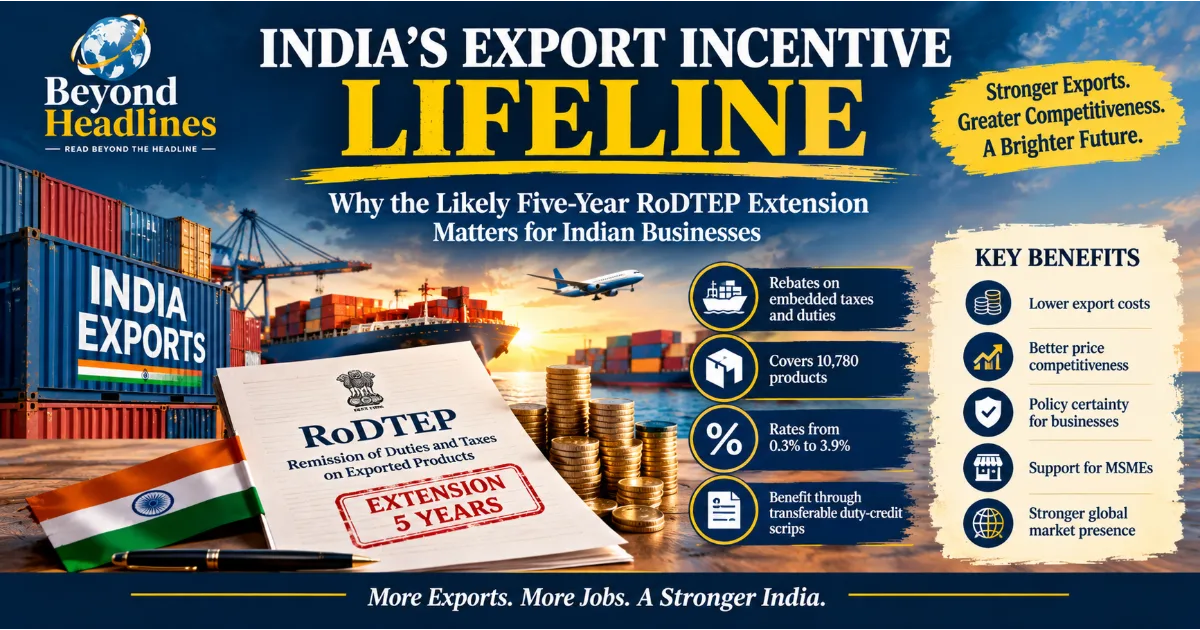
India is preparing to make an important decision about one of its most widely used export-support mechanisms. The government is expected to extend the Remission of Duties and Taxes on Exported Products, or RoDTEP, scheme for another five years after its current extension expires on September 30, 2026. According to a government trade source cited by Reuters on September 16, the Commerce Ministry has sought ₹23,000 crore for the scheme during the 2026-27 financial year as part of the proposed continuation. The proposal comes at a time when Indian exporters are dealing with geopolitical disruption, high logistics costs, changing tariff structures, currency volatility and intense competition in international markets. (Reuters)
The development matters because RoDTEP is not simply another subsidy programme that puts money into the hands of exporters. Its stated purpose is to reimburse certain embedded taxes and duties that are not otherwise refunded through existing mechanisms. In other words, the policy is designed around the principle that taxes and duties embedded in the production and distribution of an exported product should not remain embedded in the final export price when they cannot otherwise be recovered. The distinction is important because export competitiveness depends not only on the wages, productivity and technology of Indian companies, but also on the tax and logistics costs that accumulate before a product reaches an overseas customer.
For Indian businesses, the potential five-year extension could therefore provide something that exporters often value almost as much as the incentive itself: policy visibility. Exporters sign contracts, negotiate prices, purchase raw materials, arrange shipping, hire workers and make investment decisions months or even years in advance. When the availability of a government export-remission mechanism is uncertain, companies have to incorporate that uncertainty into their calculations. A longer policy horizon can make it easier to estimate costs and negotiate international contracts, although the actual benefit will continue to depend on the rates, product categories, caps and eligibility conditions notified by the government.
The timing is also significant. India's merchandise exports have recently shown strong growth despite difficult global conditions. Goods exports rose 26% year on year to $43.81 billion in August 2026, according to data reported by the Indian Express. Exports to the United States rose 21% to $8.3 billion during the month, while overall imports increased 14% to $70.67 billion. The merchandise trade deficit therefore remained substantial at $26.86 billion. (The Indian Express)
That combination captures the broader challenge facing India. The country wants to increase exports, diversify markets and move more manufacturing into globally integrated supply chains. At the same time, Indian companies must compete with producers from countries that may have lower costs, deeper supply chains, stronger logistics infrastructure or different forms of state support. The debate around RoDTEP is therefore ultimately a debate about how India can make its exports more competitive without creating inefficient or legally problematic incentives.
What exactly is RoDTEP?
The Remission of Duties and Taxes on Exported Products scheme was introduced in 2021. It replaced an earlier export incentive mechanism that had faced challenges under World Trade Organization rules. The basic principle behind RoDTEP is that certain taxes and duties incurred during the production and distribution of goods should be remitted when they are not otherwise refunded.
This matters because the normal GST framework does not necessarily eliminate every cost that can become embedded in an export product. Certain local taxes, electricity duties, fuel-related costs, mandi taxes, transport-related levies and other components can enter the production chain depending on the product and location. RoDTEP is intended to address eligible unrefunded elements rather than simply reward a company for exporting.
The government has used a rate-and-cap system under which eligible products receive a specified remission rate subject to value limits. According to the Financial Express, RoDTEP currently covers 10,780 products, with refund rates generally ranging from about 0.3% to 3.9% of export value depending on the product. The benefits are issued through transferable duty-credit scrips. The same report said the scheme had distributed ₹77,262.60 crore in benefits through December 2025. (The Financial Express)
The distinction between a remission and a conventional export subsidy is central to understanding why the scheme exists. The government's argument is that exporters should not carry taxes and duties that have already been incurred but cannot otherwise be refunded when the goods are sold abroad.
For an exporter operating in a highly competitive international market, even a relatively small percentage can matter. If a company is selling a product at a narrow margin, recovering eligible embedded costs can affect the difference between a profitable and unprofitable order.
Consider a simplified example. Suppose an Indian manufacturer exports goods worth ₹1 crore and receives an eligible RoDTEP benefit equivalent to 1% of the export value, subject to the applicable rules and caps. The potential remission would be ₹1 lakh. That amount might appear small relative to the total shipment value. But if the company exports ₹100 crore worth of eligible products, the corresponding amount would be ₹1 crore. For a business operating with tight margins, such amounts can influence pricing decisions and working capital.
The actual calculation is more complicated because product-specific rates, value caps and eligibility rules apply. The example therefore illustrates the principle rather than representing a universal RoDTEP entitlement.
Why is the government considering another five years?
The current RoDTEP extension runs only until September 30, 2026. The Directorate General of Foreign Trade had extended the scheme for six months from April 1 to September 30, with the rates and value caps applicable as of March 31 continuing during that period. (TaxGuru)
The government now appears to be considering a much longer horizon. Reuters reported on September 16 that the Commerce Ministry has requested ₹230 billion, or approximately $2.4 billion, from the Finance Ministry for the scheme during 2026-27 and is seeking a five-year extension. (Reuters)
A five-year policy period would represent a significant change in certainty compared with repeated short-term extensions.
For exporters, uncertainty about the continuation of an incentive can affect pricing. An overseas buyer may negotiate a contract lasting six months, one year or several years. The exporter must estimate production costs, shipping costs, exchange rates, financing costs and tax-related expenses over the duration of that contract. If an important remission mechanism is due to expire within weeks, the company has to consider whether the cost structure could change.
Longer policy visibility can make those calculations easier.
This is particularly relevant for sectors where international competition is based on relatively small differences in cost. Textiles, engineering products, chemicals, processed food, leather, handicrafts and a range of manufacturing categories can face intense competition from producers across Asia and elsewhere.
However, a longer extension does not automatically mean a larger benefit for every exporter. The actual financial impact will depend on the rates and product coverage ultimately notified by the government.
That distinction is important because headlines about a ₹23,000 crore allocation can otherwise create the impression that every exporter will receive a direct cash payment. RoDTEP operates through product-specific remission mechanisms, and eligibility depends on the applicable rules.
Why exporters need support right now
The global environment facing Indian exporters has become more complicated.
International trade is increasingly being shaped by tariffs, geopolitical tensions, shipping disruptions, sanctions, industrial policies and strategic competition among major economies. The traditional assumption that companies can simply manufacture in the lowest-cost location and sell freely around the world has become less reliable.
The West Asia crisis has provided a recent example. Disruptions to maritime routes increased shipping times and costs for companies moving goods through the region. In March 2026, the government restored RoDTEP rates and value caps that had previously been restricted, citing the impact of West Asia-related maritime disruptions on freight costs and export shipments. The restored rates were those in force before the February 2026 restriction. (Press Information Bureau)
That decision showed how export policy can be used to respond to an external shock.
The government also launched the Resilience & Logistics Intervention for Export Facilitation, or RELIEF, under the broader Export Promotion Mission. The initiative was designed to help exporters deal with logistics challenges arising from the geopolitical situation in West Asia. Eligibility under one component was extended through September 30, 2026. (India Briefing)
These measures point to a larger policy challenge. It is no longer enough for India to focus solely on production costs. The cost of moving a product from a factory in India to a customer overseas has become increasingly important.
A product can be manufactured competitively but lose that advantage if shipping costs rise sharply. A company can secure an international order but face difficulties if insurance premiums increase. A manufacturer can have sufficient capacity but struggle to quote a long-term price when exchange rates and freight costs are unusually volatile.
Export incentives therefore form only one part of a broader competitiveness strategy.
The rupee connection
The current discussion also comes at a time when the Indian rupee has been under pressure against the US dollar.
On September 16, the rupee closed at ₹95.9550 per dollar after touching ₹95.9750 during the session. Reuters reported that strong dollar demand from Indian companies, expectations of a Federal Reserve rate increase and elevated crude oil prices were contributing to the pressure. The Reserve Bank of India has been intervening in the foreign-exchange market to limit excessive volatility. (Reuters)
A weaker rupee can create both advantages and disadvantages for exporters.
When an Indian exporter earns dollars and converts those dollars into rupees, a weaker rupee can increase the rupee value of the company's foreign-currency revenue, assuming other variables remain unchanged.
For example, $1 million in export revenue is equivalent to ₹90 million at ₹90 per dollar and ₹96 million at ₹96 per dollar. That is a difference of ₹6 million.
But the picture changes when the exporter also imports raw materials, machinery or components. If a company earns dollars from exports but spends dollars on imported inputs, currency depreciation can increase its costs as well.
The final effect therefore depends on the company's import content.
This is particularly important for India's manufacturing ambitions. The country wants to increase its participation in global value chains, but many manufacturing industries use imported components or raw materials. A weaker currency can improve the rupee value of exports while simultaneously increasing the rupee cost of imported inputs.
RoDTEP operates through a different channel. It addresses eligible embedded taxes and duties rather than directly compensating exporters for currency movements.
Together, however, the exchange rate and export-remission system influence the cost structure faced by exporters.
Why India's export numbers matter
India's August export performance provides some context for the policy discussion.
Goods exports reached $43.81 billion in August 2026, representing a 26% increase from a year earlier, according to the Indian Express. Exports to the United States rose 21% to $8.3 billion. Imports also increased, reaching $70.67 billion, but grew more slowly than exports. The merchandise trade deficit was $26.86 billion. (The Indian Express)
The composition of export growth is also important.
The Indian Express reported that high-margin and high-technology products such as electronics, engineering goods and pharmaceuticals benefited from the weaker rupee, while some traditional sectors including textiles, leather and agricultural products experienced declines. (The Indian Express)
That suggests that India's export story is becoming more diversified, but not every sector is moving in the same direction.
This distinction matters for export policy. An incentive that is useful for an electronics manufacturer may have a different economic impact on a labour-intensive textile producer. Different industries face different input costs, capital requirements, tariff structures and levels of global competition.
Therefore, evaluating the RoDTEP extension requires looking beyond the headline allocation and examining which sectors receive support, how rates are calculated and whether the incentives address genuine cost disadvantages.
The textile sector illustrates the complexity
Textiles and apparel are particularly sensitive to export competitiveness because India competes with several major low-cost manufacturing countries.
The government has maintained separate support mechanisms for parts of the textile industry. The RoSCTL scheme, or Rebate of State and Central Taxes and Levies, covers apparel and made-ups. The government extended that scheme through September 30, 2026. RoDTEP continues to apply to eligible textile products outside the categories covered by RoSCTL. (Press Information Bureau)
The government has also taken other steps affecting textile exporters, including temporary customs-duty exemptions for cotton and selected inputs used in the man-made-fibre value chain. These measures illustrate how export competitiveness can depend on both the tax treatment of exports and the cost of imported inputs. (Press Information Bureau)
For a textile exporter, the question is not simply whether the government provides an export incentive. The company also needs access to competitively priced cotton and synthetic fibres, efficient ports, reliable electricity, affordable finance, predictable customs procedures and access to international buyers.
An export incentive can reduce one component of cost, but it cannot solve every competitiveness problem.
The Export Promotion Mission adds another layer
RoDTEP is also being considered alongside India's broader Export Promotion Mission.
The government launched the Export Promotion Mission with a stated focus on improving access to finance, market access and export capacity. However, a September 7 Business Standard report said the government was reviewing the more than ₹25,000 crore mission because exporters had shown substantial interest in only two of its 11 schemes. The two schemes with greater demand were reported to be interest support for exporters' working-capital requirements and market-access support. (Business Standard)
This provides an important lesson about government export programmes.
Creating a large financial allocation does not necessarily mean that businesses will use every component. Companies respond to actual commercial needs. If an exporter already has access to a particular service through private markets, a government programme may attract limited interest. If another constraint, such as expensive working capital or difficulty finding overseas buyers, is more severe, businesses may naturally gravitate toward programmes addressing those problems.
The government's review of the Export Promotion Mission therefore suggests that export policy is being evaluated not only by the amount of money allocated but also by how businesses actually use the support.
What does RoDTEP mean for MSMEs?
Small and medium-sized enterprises are an especially important part of India's export ecosystem.
An established multinational company may have dedicated teams managing customs, foreign exchange, shipping, tax compliance, insurance and international contracting. A smaller exporter may have a much thinner administrative structure.
For an MSME, a relatively small improvement in the cost of an export transaction can matter more because the company may operate with limited working capital.
At the same time, compliance requirements can also become a burden. A benefit is useful only if an eligible exporter can understand the rules, submit the required documentation and receive the benefit within a reasonable period.
This is why policy predictability and administrative simplicity are important alongside the headline value of an incentive.
A five-year RoDTEP extension could give smaller businesses greater visibility when preparing business plans and negotiating contracts. But its practical value will depend on the final rules and the ease with which eligible exporters can access the remission.
Does RoDTEP make Indian products cheaper abroad?
Potentially, but the mechanism needs to be understood correctly.
An exporter does not necessarily reduce the international price by exactly the value of its RoDTEP benefit. A company may instead use the benefit to improve its margin, offset higher input costs, absorb freight increases or maintain a competitive quotation.
Suppose two companies sell similar products internationally. If the Indian company faces higher embedded domestic costs, a remission mechanism can help narrow the cost difference. The exporter can then choose how to use that improved economics.
It could reduce its export price and compete more aggressively. It could maintain its price and earn a higher margin. It could use the additional room to absorb rising logistics costs.
The actual outcome depends on market conditions.
If overseas buyers have substantial bargaining power and multiple alternative suppliers are available, some of the benefit may ultimately be reflected in lower export prices. If demand is strong and supply is constrained, the exporter may retain more of the benefit.
Therefore, the economic impact cannot be determined simply by looking at the size of the government allocation.
The WTO dimension
Another reason RoDTEP matters is India's experience with international trade rules.
The scheme was introduced after India's previous Merchandise Exports from India Scheme, or MEIS, faced challenges under World Trade Organization rules. RoDTEP was structured around the principle of remitting taxes and duties that are not otherwise refunded rather than providing a direct export-linked subsidy.
This distinction is important because India's export strategy must operate within its international trade commitments.
The objective is to prevent taxes from being exported along with the product, while avoiding a structure that could be interpreted as an impermissible export subsidy.
That is also why the scheme is built around defined rates, eligible products, value caps and specific categories of embedded taxes and duties.
The precise design of any five-year extension will therefore matter as much as the decision to extend it.
Why a five-year period could change business planning
Short-term extensions can keep a scheme alive, but they can also create uncertainty.
A company considering a new factory may calculate expected export revenue over five or ten years. If the economics of that investment depend partly on an export-remission mechanism that is renewed every few months, the company faces additional policy risk.
A five-year framework could make planning easier.
For example, an exporter may be able to negotiate longer contracts, expand capacity or invest in production technology with greater confidence about the policy environment. It may also help financial institutions assess export-oriented businesses because projected cash flows become easier to model.
That does not mean the scheme will determine investment decisions by itself. Labour costs, electricity, infrastructure, access to ports, technology, domestic demand, financing and global market conditions remain important.
But policy stability can reduce one source of uncertainty.
The bigger question: Can incentives create lasting competitiveness?
This is perhaps the most important question surrounding the proposed extension.
Export incentives can help companies overcome specific cost disadvantages, but they cannot substitute indefinitely for productivity improvements.
If an industry depends on incentives simply to remain competitive, policymakers eventually have to consider whether the underlying production system is efficient enough.
India's long-term export ambitions depend on increasing productivity, improving logistics, developing skilled labour, reducing transaction costs, expanding manufacturing capacity and gaining access to more international markets.
Government incentives can support that process, particularly during periods of external disruption. But they work alongside structural reforms rather than replacing them.
The strongest export ecosystems typically combine competitive production costs with efficient ports, reliable infrastructure, skilled workers, strong supplier networks, predictable regulations and access to large markets.
RoDTEP addresses only part of that equation.
Why market diversification is becoming more important
Another major theme in India's export strategy is diversification.
India's traditional export markets include the United States and Europe, but Indian companies are increasingly looking toward other regions as global trade becomes more fragmented.
Recent analysis has highlighted the growth of South-South trade, with developing economies accounting for a growing share of global merchandise commerce. India is also pursuing market-access agreements and trade arrangements intended to open additional destinations for Indian products. (The Economic Times)
Market diversification matters because dependence on one or two major destinations can increase vulnerability to tariff changes, recessions or political disputes.
The same principle applies to supply chains. If an exporter depends heavily on one shipping route, one imported component or one overseas buyer, an external disruption can have an outsized effect.
Export policy therefore increasingly has two dimensions. The first is helping companies remain competitive in markets they already serve. The second is helping them enter new markets.
What the proposed extension does not solve
Even if the government approves the proposed five-year RoDTEP extension, several challenges will remain.
Indian exporters will continue to face global tariff uncertainty. Freight costs can change rapidly because of geopolitical developments. The rupee can fluctuate sharply against the dollar. Imported components can become more expensive. Foreign demand can weaken during economic downturns. Competitor countries can introduce their own incentives.
There is also the question of fiscal cost.
A programme seeking ₹23,000 crore for 2026-27 represents a substantial public expenditure commitment. The policy rationale is that supporting exports can generate wider economic benefits through production, employment, foreign-exchange earnings and investment. But the effectiveness of that spending ultimately depends on the additional economic activity it helps create.
This is why measuring outcomes is important.
The key questions are not simply how much money is distributed, but whether the support increases exports, helps firms enter new markets, encourages investment, creates jobs, improves productivity and strengthens India's position in global supply chains.
What exporters should watch after September 30
The immediate date to watch is September 30, 2026, when the current RoDTEP extension expires.
If the government approves the proposed longer extension, exporters will need to examine the notification carefully rather than relying only on the headline announcement. Product-specific rates, value caps, eligible categories and procedural requirements will determine the actual benefit available to individual businesses.
Companies should also pay attention to whether the five-year period is accompanied by changes in the rate structure.
A longer duration with lower rates would have a different economic effect from a longer duration with unchanged rates.
Similarly, expanding product coverage would affect different industries differently.
Exporters should also monitor the interaction between RoDTEP and other programmes, including the Export Promotion Mission, RELIEF and sector-specific schemes such as RoSCTL.
The broader policy environment matters because companies may qualify for several forms of support while facing different eligibility conditions.
The real story behind the ₹23,000 crore request
The proposed ₹23,000 crore allocation is therefore more than a budget number.
It signals that the government sees export competitiveness as an important policy priority at a time when international trade is becoming more difficult and unpredictable. Reuters reported that the Commerce Ministry is seeking the funding as part of a proposed five-year extension, while other reporting indicates that the government is simultaneously reviewing the effectiveness of its broader export-promotion programmes. (Reuters)
The timing is notable. India's merchandise exports are growing strongly, but the country still runs a large merchandise trade deficit. The rupee is under pressure, oil prices are elevated and global trade policy is changing rapidly. Meanwhile, Indian companies are trying to move into higher-value manufacturing and services while competing with established exporters across Asia and other regions.
In that environment, the question is not whether one incentive can transform India's export sector. It cannot.
The more important question is whether incentives such as RoDTEP can form part of a broader system that makes Indian companies more competitive while encouraging investment, productivity and diversification.
For exporters, a five-year extension could provide greater certainty. For policymakers, it creates an opportunity to examine which incentives produce measurable results and which need redesign. For taxpayers, the relevant issue is whether the public expenditure generates sufficient economic value through stronger exports, investment and employment.
For India's economy, the stakes are broader than the scheme itself.
Exports bring foreign currency into the country. They connect Indian manufacturers and service providers to international supply chains. They create opportunities for companies to grow beyond the domestic market. They can encourage investment in technology and productivity. And they can help diversify the sources of economic growth.
But becoming a major export economy requires more than incentives. It requires competitive infrastructure, reliable logistics, skilled workers, access to finance, efficient regulation, strong domestic supply chains and stable access to overseas markets.
RoDTEP can address one part of that equation by reducing the burden of eligible unrefunded taxes and duties embedded in exported goods. The proposed five-year extension could give exporters more policy certainty at a time when global trade conditions remain unsettled.
The next step will be the government's final decision and the details of the scheme that follows.
That is the part worth watching beyond the headline.
The headline is a ₹23,000 crore export incentive request. The bigger story is whether India can turn policy support into durable export competitiveness.
#BeyondHeadlines #RoDTEP #IndianExports #Exports #IndiaEconomy #IndianEconomy #ExportIncentives #Exporters #MakeInIndia #Manufacturing #MSME #GlobalTrade #InternationalTrade #TradePolicy #DGFT #CommerceMinistry #IndianBusiness #BusinessNews #EconomicNews #Rupee #GlobalEconomy #SupplyChains #ExportPromotion #BeyondTheHeadline