
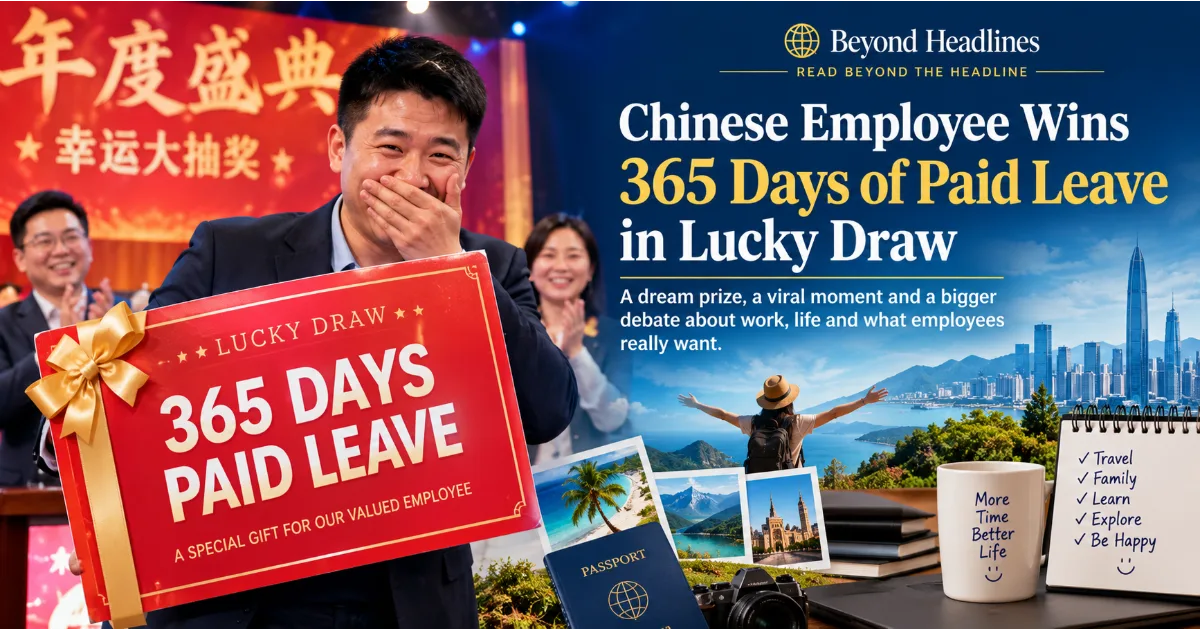
Imagine being called onto the stage at your company’s annual dinner and discovering that you have just won the workplace equivalent of a lottery jackpot. There is no luxury car waiting outside, no expensive smartphone, no holiday package and no giant cash cheque. Instead, the prize is something that many employees may value even more: 365 days of paid leave. You can stay away from the office for an entire year while continuing to receive pay. For one employee at an unnamed company in Shenzhen, China, this extraordinary prize became reality in April 2023, turning what had been an ordinary corporate celebration into a story that quickly spread across Chinese social media and international news outlets. (The Straits Times)
The story immediately captured attention because it touches a powerful idea in modern working life. People spend years competing for promotions, negotiating salaries, accumulating annual leave and trying to find enough time for family, travel and personal interests. A full year of paid leave appears to solve all of those problems at once. Yet the unusual prize also created a second question that is much more complicated: would an employee actually feel comfortable taking it? The answer is not necessarily obvious. Being paid not to work for 365 days sounds like the ultimate reward, but a year away from a company can also mean a year away from professional developments, workplace relationships, responsibilities and the everyday visibility that often comes with being present. The Shenzhen story therefore became more than a tale of extraordinary luck. It became an unexpected conversation about what employees really want from work and whether being indispensable is actually the same thing as having job security.
The prize was awarded during an annual company dinner held on April 9, 2023. According to reports, the company had not held its annual gathering for three years because of the COVID-19 pandemic. When employees finally gathered again, management decided to make the event more entertaining by introducing a lucky draw with unusual prizes. A member of the company's administrative department, identified in reports by the surname Chen, said the idea was partly intended to help employees relax after a difficult period and provide some relief from work-related pressure. Instead of limiting the event to conventional prizes, the company introduced a mixture of rewards and penalties, with the most extraordinary reward being the 365-day paid leave prize. (The Straits Times)
The person who eventually won the prize was reportedly not a junior employee sitting quietly at the edge of the organisation. He was described as a member of management and had been with the company for approximately 14 years, having joined after graduating. Reports said he frequently travelled as part of his work and was involved in business-related responsibilities. That detail became particularly important after the prize was drawn because the employee's absence was not as straightforward as allowing an ordinary member of staff to take a long holiday. His position carried responsibilities, and the company had to consider how those responsibilities would be handled if he actually stopped working for a full year. (The Straits Times)
What made the moment even more unusual was that the winner reportedly did not immediately believe that he had genuinely won. According to the company's administrative staff, he repeatedly questioned whether the prize was real and initially thought the draw might be a joke or some form of prank. Even the company's boss was reportedly surprised when the winning ticket was drawn. Another employee, identified as Song, said the odds of winning were about one in a thousand. The company had reportedly created hundreds of possible rewards and penalties, making the year-long paid leave prize something that management did not seriously expect to have to honour. Yet the unlikely event happened, and suddenly the company had to confront the practical consequences of its own generosity. (South China Morning Post)
The story quickly became a sensation online. Many people reacted exactly as one might expect when hearing that someone had won a full year away from work without giving up their salary. Social media users expressed envy, joked about applying for jobs at the company and wondered whether vacancies were suddenly available. The idea was especially attractive because it seemed to represent freedom from one of the defining pressures of adult life: having to exchange time and effort for income. A conventional cash prize provides financial value, but 365 days of paid leave provides something different. It gives a person time while protecting the income that normally requires that time to be spent working.
That distinction is important. Money can buy experiences, but money cannot directly create additional hours in a day. An employee who receives a large cash bonus may still have to continue working five days a week. Someone who receives 365 days of paid leave has effectively been given an entire year in which the normal relationship between work and income has been suspended. The employee can potentially travel, spend time with family, pursue education, work on personal projects or simply do nothing for a while. The psychological appeal of the prize is therefore much larger than its monetary value might initially suggest.
At the same time, the story exposed a contradiction at the heart of modern professional culture. Many employees say they want more time away from work, but many also fear what might happen if they actually take it. Workers can worry that colleagues will advance while they are away, that managers will forget their contributions or that somebody else will demonstrate an ability to perform their role. In highly competitive workplaces, being visible can feel almost as important as being productive. Employees may therefore accumulate leave without using it, respond to messages while on holiday and remain connected to work even when they are officially supposed to be resting.
The Shenzhen employee's situation made that tension unusually visible. If he took the entire 365 days, the company would have to operate without him for an exceptionally long period. During that time, other employees could learn his responsibilities, projects could change direction and business conditions could evolve. When he returned, the workplace might not look exactly as it had when he left. One social media commenter jokingly asked whether he would return after a year and discover that somebody else had taken his position. The joke resonated because it captured a genuine anxiety that exists in many workplaces: if a person is absent for long enough, what happens to the professional value that comes from being present? (The Straits Times)
This is where the story moves beyond an amusing lucky draw and becomes a useful examination of workplace culture. A healthy organisation should ideally be able to function when an individual employee takes leave. If a company cannot operate without one person for even a short period, that may indicate that too much knowledge, authority or responsibility is concentrated in a single role. From an organisational perspective, the ability of other employees to take over responsibilities temporarily can actually be a strength. It means the company has developed redundancy, cross-training and succession planning rather than relying entirely on one individual.
For the employee, however, the experience can feel different. Being needed can provide a sense of importance and job security. People naturally want to believe that their contribution matters. When a colleague takes over their work successfully, it can sometimes create an uncomfortable question: if someone else can perform my role, what makes me indispensable? Yet the opposite situation can also be problematic. If an employee becomes so indispensable that the company cannot function without them, that person may find it difficult to take leave, move into another position or even receive a promotion because nobody else can immediately perform the work they currently do.
A 2023 commentary by Channel NewsAsia examined precisely this tension after the Shenzhen story went viral. The commentary argued that employees can mistakenly associate being indispensable with job security, while extreme dependence on one individual can create organisational bottlenecks and contribute to stress or burnout. It also noted that employees who focus too heavily on remaining indispensable may miss opportunities to develop new skills or prepare for future roles. (CNA)
The idea raises an important question: what is the ideal employee relationship with a company? Being completely replaceable can feel insecure, but being impossible to replace can also become a burden. A healthier position may be to be valuable without becoming a bottleneck. That means having expertise and making meaningful contributions while also sharing knowledge, training colleagues and building systems that allow work to continue during an absence. In such an environment, taking leave does not threaten the employee's value because the organisation recognises the person for their judgement, adaptability and contribution rather than simply for being the only individual who knows how to perform a particular task.
For the Shenzhen winner, the company itself appeared to recognise this dilemma. Reports said management would discuss with him whether he wanted to take the paid leave or receive its value in cash. The precise final arrangement was not established in the widely circulated reports, but the fact that the company considered the question demonstrates how quickly an entertaining prize could become a serious business decision. (The Straits Times)
From the employee's perspective, taking the year off would offer an extraordinary opportunity. Fourteen years with the same company is a substantial portion of a working life. A year away could provide time to travel without having to calculate every holiday around limited annual leave. It could provide opportunities to spend more time with family members, pursue hobbies that have been postponed, study something unrelated to work or simply recover from years of professional routine. The employee could potentially return with a clearer understanding of what he wants from his career and personal life.
There is also a psychological dimension to taking extended leave. Most holidays end with the same familiar countdown: the return flight, the first morning back at the office, the unanswered emails and the knowledge that the normal routine is waiting. A year of paid leave would remove that immediate pressure. Instead of treating rest as a brief interruption between periods of productivity, the employee could potentially make rest itself the central activity for an extended period.
Yet a year without work can also have disadvantages. Work provides more than income. It can provide social relationships, structure, professional identity and a sense of purpose. Someone accustomed to a demanding managerial role may initially enjoy complete freedom but eventually find the absence of routine challenging. Friends and family members may continue working, creating different schedules and priorities. Professional knowledge can also become outdated in rapidly changing industries. Technologies, customer expectations, regulations and business strategies can change significantly over twelve months.
The employee's role reportedly involved business responsibilities and frequent travel, which makes the decision particularly complicated. If the position requires close relationships with clients or suppliers, a prolonged absence could alter those relationships. If the employee's responsibilities are strategic, the company might need to redistribute decision-making authority. The longer the absence continues, the greater the possibility that temporary arrangements could become permanent because organisations naturally adapt to changing circumstances. (The Straits Times)
That does not mean the employee should necessarily refuse the prize. It simply demonstrates that the value of paid leave cannot be measured by salary alone. The practical value depends on the terms. Would the employee retain his exact position? Would his benefits continue? Would the leave be taken consecutively or could it be divided into periods? Could he remain involved in major decisions if necessary? Would he be allowed to travel freely? Could he return to the same responsibilities? The public reports did not establish every one of these details, which means it would be inappropriate to assume how the arrangement ultimately worked.
The possibility of converting the prize into cash adds another fascinating dimension. Cash provides flexibility. The employee could save it, invest it, pay debts, support relatives or spend it gradually. If the amount offered were substantial, he might conclude that financial security is more valuable than a year away from work. A cash payment also avoids many of the professional uncertainties associated with a prolonged absence.
But choosing cash would mean giving up something that money cannot necessarily replace: time. The value of time becomes clearer as people become older. An employee may be able to earn additional money later, but particular moments with children, parents, partners or friends cannot always be recreated. A year of paid leave could therefore be valuable not because it allows a person to avoid work, but because it creates an unusual period in which personal priorities can take centre stage without the financial penalty normally associated with stepping away from employment.
The story also highlights the changing way people think about employee benefits. Traditionally, workplace rewards have been heavily focused on money and physical goods. Bonuses, salary increases, cars, electronics, gift cards and travel packages are common incentives. Time is different. A company that gives employees more control over their time is giving them something directly connected to autonomy. The 365-day prize became memorable precisely because it recognised a resource that many employees feel they lack.
That does not mean every organisation should start offering enormous amounts of paid leave. The Shenzhen case was an extraordinary lucky-draw prize, not a standard employment policy. In fact, most employees would benefit far more from predictable and realistic leave arrangements than from the tiny possibility of winning a once-in-a-lifetime workplace jackpot. A company with fair working hours, manageable workloads and a culture that genuinely encourages employees to use their leave may contribute more to employee wellbeing than a company that offers one spectacular prize while ordinary staff remain overworked.
This is one of the deeper lessons behind the viral story. Extraordinary rewards attract attention, but everyday working conditions determine whether most employees are satisfied. One person winning 365 days of paid leave may generate headlines, but hundreds or thousands of employees receiving reasonable workloads, adequate rest and respect for their personal lives would have a much broader effect.
The pandemic context also matters. The company reportedly had not held its annual dinner for three years because of COVID-19. When employees finally gathered again, management wanted to create a memorable celebration and relieve some of the pressure associated with work. The lucky draw was therefore part of a wider return to normal social interaction after a period in which workplaces around the world had been disrupted. (The Straits Times)
The unusual prize can be understood within that context. After years of uncertainty, restrictions and disrupted routines, giving an employee an entire year of paid leave symbolically turned the idea of relief into a tangible reward. It was almost an exaggerated expression of what many people had wanted during the pandemic: time away from pressure without losing financial security.
The story also became interesting because it was not entirely unprecedented. The Straits Times reported that another employee in Shenzhen had won a similar 365-day paid-leave prize in January 2022. That employee reportedly converted part of the prize into cash and donated another portion to local charities. (The Straits Times)
The existence of more than one such case suggests that the idea of using a year of paid leave as a corporate lucky-draw prize was not completely unique. It also demonstrates how companies can use unusual rewards to create excitement around annual events. A conventional cash prize may be appreciated, but a prize that people have never seen before is much more likely to become a story that employees remember and share.
For the company, the publicity was significant. A previously unknown firm suddenly appeared in international media because of a single lucky draw. People who had never heard of the business were discussing its workplace culture, asking whether it was hiring and debating whether they themselves would take such a prize. From a communications perspective, the event generated enormous attention without appearing to have been designed as a conventional advertising campaign.
But there is an important distinction between publicity and workplace policy. A company can become famous for giving one person an extraordinary reward while still needing to demonstrate that its ordinary employees are treated fairly. A memorable annual dinner does not automatically indicate a healthy workplace. The long-term measure of employee welfare remains the everyday experience of working there.
The debate over the prize also reflects a broader cultural question about work-life balance. In many societies, long working hours have historically been associated with ambition and dedication. Employees who stay late may be viewed as committed. Those who leave on time can sometimes feel pressure to remain available. Technology has made the boundary even less clear. Smartphones allow emails, messages and work documents to follow employees home, while remote work can make the workplace effectively present everywhere.
Against that background, the idea of 365 paid days away from work feels almost revolutionary. It represents the complete opposite of permanent availability. Instead of asking how employees can become more productive, the prize asks what happens when productivity is temporarily removed from the equation.
Perhaps that is why the story generated such strong reactions. People were not simply jealous of a lucky employee. They were responding to the idea of freedom. The prize represented an escape from schedules, deadlines and professional obligations while retaining the economic security of a salary. In an era when many workers struggle to disconnect even during ordinary holidays, the fantasy of a completely work-free year can be extraordinarily powerful.
Yet the story also reminds us that work is not the only source of identity or security. If an employee believes that taking leave will make him irrelevant, then the problem is not necessarily the employee's desire to rest. It may be the structure of the workplace. Organisations should ideally be designed so that people can take legitimate time off without fearing that their entire professional future will disappear.
That requires preparation. Companies can document processes, distribute knowledge, train multiple employees for important responsibilities and establish clear succession plans. Managers can encourage employees to take leave rather than rewarding those who never disconnect. Teams can learn to operate without relying on one person for every decision. Employees can also build broader skills instead of protecting information simply because being the only person who knows something makes them feel secure.
In that sense, the Shenzhen lucky draw created an accidental test of organisational resilience. Could a company allow a manager to disappear for an entire year and still operate effectively? If yes, the organisation may have strong systems and capable people. If no, the prize exposes a dependency that might already have existed before the lucky draw.
There is another lesson for employees. Career security should ideally come from adaptability rather than indispensability. An employee who continuously learns, develops relationships, understands the business and can work across different responsibilities may remain valuable even when absent temporarily. A person whose entire value depends on performing one narrow task may have more difficulty adapting when circumstances change.
The 365-day prize therefore creates an interesting paradox. The employee may have won a year in which he does not need to prove his value through daily work. Yet taking that year could also force him to confront the question of how much of his professional identity depends on being physically present. The decision is not simply between work and holiday. It is between two different ideas of security: financial security through continued employment and personal freedom through extended time away.
There is no universal answer. Some people would choose the year. Others would take the money. Some might want to negotiate a compromise, combining an extended break with a partial cash payment or dividing the leave across several periods. The right decision would depend on the employee's finances, career, family circumstances, personality and the precise terms offered by the company.
That uncertainty is part of what makes the story so compelling. The prize appears simple when written on a giant cheque: 365 days of paid leave. But behind those words is a complicated decision about time, money, career, identity and freedom.
The bigger lesson extends far beyond one employee in Shenzhen. Modern workplaces increasingly talk about flexibility, wellbeing and work-life balance, but those concepts become meaningful only when employees can actually use them without fear. A person should not have to win a lucky draw to discover what it feels like to have enough time for life outside work.
The extraordinary nature of the Shenzhen prize is precisely why it made headlines. For one employee, an annual company dinner unexpectedly transformed into the possibility of an entire year without the normal demands of employment. The boss reportedly did not expect anyone to win it. The winner himself reportedly struggled to believe it was real. Employees and social media users could hardly resist imagining what they would do with such an opportunity. (The Straits Times)
But the most interesting part of the story may not be the lucky draw itself. It is the question that came afterwards: what is a year of paid freedom actually worth?
For someone exhausted by work, it may be priceless. For someone building a career, it may create uncertainty. For someone with financial responsibilities, cash may be more attractive. For someone who has spent 14 years with the same company, however, the opportunity to step away and experience life outside the normal professional routine could be extraordinary.
The story also challenges the assumption that more work automatically means more security. Being constantly available can create the appearance of importance, but a healthy organisation should not depend on employees sacrificing their personal lives simply to remain relevant. The ability to take meaningful leave can actually be a sign of organisational maturity. Companies that can function while their employees rest are often better positioned to avoid burnout, distribute knowledge and build resilient teams.
Ultimately, the Chinese employee's unusual prize was not simply 365 days of paid leave. It was 365 days in which the normal bargain between time and money was temporarily changed. Most people work because they need income, and most people take leave knowing that their time away is limited. This employee was offered the possibility of having both: time and pay.
Whether that opportunity became a year-long holiday, a cash settlement or some negotiated arrangement is less important than the question the story leaves behind. If people dream of winning a year away from work, perhaps the conversation should not end with envy over one lucky employee. It should also ask what workplaces can do to make ordinary life less exhausting in the first place.
The real story beyond the headline is therefore not that one Chinese employee became extraordinarily lucky at an annual dinner. It is that a bizarre corporate prize exposed one of the most persistent tensions in modern employment: people want financial security, but they also want time; they want meaningful careers, but they also want lives beyond those careers; they want to be valuable to their employers, but they do not want their entire identity or security to depend on being permanently available.
A year of paid leave may remain an extraordinary exception. For most employees, it will never arrive through a lucky draw. But the reaction to the Shenzhen winner demonstrates just how powerful the idea of time has become. In a world where work can follow people through phones, laptops and constant notifications, perhaps the ultimate workplace luxury is not another device, another bonus or another title. Perhaps it is simply the freedom to step away, knowing that life and livelihood do not have to be competing priorities.
And that is why a simple piece of paper announcing “365 days of paid leave” became such a powerful symbol. It represented something almost every working person understands, regardless of country or profession: sometimes the thing we want most is not more work, more responsibility or more money. Sometimes we simply want enough time to live.
#BeyondHeadlines #China #ChinaNews #PaidLeave #WorkLifeBalance #WorkplaceCulture #EmployeeWellbeing #BusinessNews #HumanResources #WorkplaceTrends #LuckyDraw #CorporateCulture #FutureOfWork #Employment #WorkplaceWellbeing